Introduction
Cloud Policy as Code (PaC) has emerged as the definitive standard for managing governance, security, and compliance in high-velocity DevOps environments. As infrastructure scales across multiple clouds and thousands of ephemeral resources, manual audits and static spreadsheets are no longer viable. PaC treats security requirements and operational guardrails as version-controlled code, allowing organizations to automate the “gatekeeping” process. By shifting security left—integrating it directly into the CI/CD pipeline—teams can prevent misconfigured buckets, insecure network groups, and non-compliant resource types before they are even provisioned. This proactive approach turns “security by design” from a buzzword into a functional, repeatable reality.
The modern enterprise faces a complex web of regulatory mandates like GDPR, SOC 2, and HIPAA, alongside internal performance and cost standards. Policy as Code tools provide the mechanism to enforce these requirements consistently across AWS, Azure, and Google Cloud. Rather than relying on human review, these tools evaluate Infrastructure as Code (IaC) templates and runtime environments against a set of predefined logical rules. When a violation is detected, the system can automatically block the deployment or trigger a remediation workflow. This automation not only reduces the risk of data breaches but also accelerates development speed by providing engineers with instant, actionable feedback on their infrastructure’s compliance status.
Best for: Security engineers, Cloud Architects, and DevOps teams who need to enforce global guardrails across complex, multi-cloud, or Kubernetes-heavy environments.
Not ideal for: Very small organizations with manually managed, static infrastructure where the overhead of learning policy languages might exceed the immediate benefits of automation.
Key Trends in Cloud Policy as Code
The most significant trend in the sector is the move toward “Unified Policy Engines” that can handle everything from infrastructure provisioning and Kubernetes admission control to fine-grained application authorization. We are seeing a consolidation where tools that once only scanned Terraform files are now evolving to monitor live cloud state and even microservices traffic. Artificial Intelligence is also beginning to play a role, with “AI Policy Assistants” that can suggest Rego or HCL code based on natural language descriptions of a regulatory requirement, significantly lowering the barrier to entry for new teams.
Another major shift is the rise of “Developer-First Security,” where policy results are piped directly into the IDE or Pull Request comments rather than being siloed in a separate security dashboard. This creates a tighter feedback loop and reduces friction between security and engineering. Furthermore, the industry is moving toward standardized policy libraries—community-driven sets of rules for common frameworks like the CIS Benchmarks—allowing companies to bootstrap their compliance posture in minutes. Finally, there is an increased focus on “Drift Detection,” where platforms continuously compare the actual state of the cloud against the intended policy, ensuring that manual “hotfixes” in the console don’t lead to long-term security debt.
How We Selected These Tools
Our selection process focused on tools that provide high levels of automation and support modern “Shift-Left” workflows. We prioritized platforms that use declarative languages, as these allow for clearer auditing and easier versioning in Git repositories. A primary criterion was the breadth of integration—how well the tool fits into popular CI/CD pipelines and supports a variety of IaC providers like Terraform, Pulumi, and CloudFormation. We also looked for tools with strong community backing or robust corporate support to ensure long-term viability and frequent updates to policy libraries.
We evaluated the “time-to-value,” favoring tools that come with extensive pre-built policy sets for common compliance standards. Performance was another critical factor; the policy engine must be fast enough to run in a blocking CI gate without frustrating developers. Security and scalability were also scrutinized, ensuring the tools can handle the demands of global organizations with tens of thousands of resources. Finally, we looked for a balance between open-source flexibility for custom needs and enterprise-grade reporting for audit readiness, ensuring that the selected tools serve both the engineer at the terminal and the compliance officer in the boardroom.
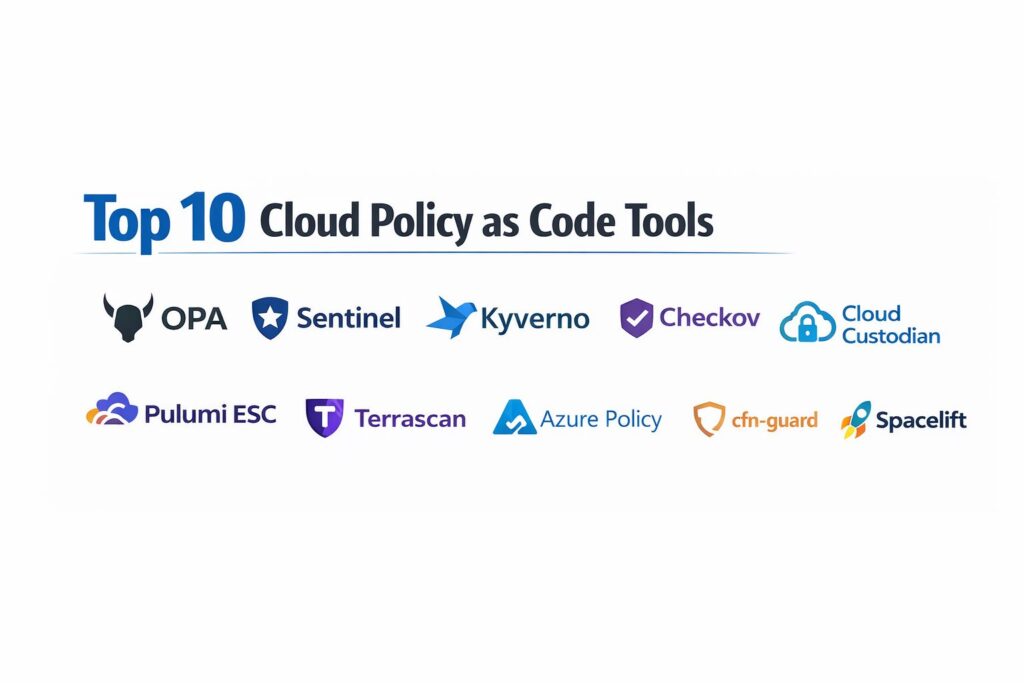
1. Open Policy Agent (OPA)
Open Policy Agent (OPA) is the industry’s most popular open-source, general-purpose policy engine. It uses a high-level declarative language called Rego to define policies across the entire cloud-native stack, from Kubernetes to CI/CD pipelines.
Key Features
The platform features a decoupled architecture where policy decision-making is separated from the data and the service itself. It includes a powerful “Policy Testing” framework that allows you to write unit tests for your governance rules. The system offers “OPA Gatekeeper,” a specialized version for Kubernetes that functions as an admission controller. It features “Styra Declarative Authorization Service” for enterprise-level management and visibility. It also provides a rich ecosystem of integrations, including support for Envoy, Terraform, and various API gateways.
Pros
Opa is incredibly versatile and can be used for almost any policy use case beyond just cloud infrastructure. It has the largest community and the most extensive library of community-contributed policies.
Cons
Rego, the policy language, has a steep learning curve and can be difficult for non-developers to master. Managing a large number of OPA instances across a global fleet can become complex without a control plane.
Platforms and Deployment
Available as a standalone binary, a sidecar container, or integrated via library.
Security and Compliance
Graduate project of the Cloud Native Computing Foundation (CNCF) with robust security auditing.
Integrations and Ecosystem
Integrates with nearly every major DevOps tool, including Kubernetes, Terraform, and Spinnaker.
Support and Community
Massive open-source community support and professional enterprise support provided by Styra.
2. HashiCorp Sentinel
Sentinel is a proprietary policy-as-code framework embedded directly into the HashiCorp ecosystem. It provides fine-grained, logic-based policy enforcement for Terraform, Vault, Consul, and Nomad.
Key Features
The platform features “Policy Sets,” which allow organizations to group and apply policies to specific environments or workspaces. It includes “Enforcement Levels” (Advisory, Soft Mandatory, Hard Mandatory) to control how strictly a policy is applied. The system offers a specialized, human-readable language that is easier to learn than general-purpose languages. It features deep “Terraform Integration” that allows for pre-plan, post-plan, and pre-apply checks. It also provides a “Simulator” for testing policies locally before deploying them to the cloud.
Pros
The integration with the HashiCorp stack is seamless and offers the best developer experience for Terraform users. The enforcement levels provide a flexible way to roll out new policies without breaking builds.
Cons
It is a proprietary tool, meaning it is only available in the paid tiers of HashiCorp products (Terraform Cloud/Enterprise). It cannot be used as a standalone engine for non-HashiCorp tools.
Platforms and Deployment
Integrated into HashiCorp Cloud Platform (HCP) and self-hosted Enterprise versions.
Security and Compliance
Adheres to strict enterprise security standards and provides immutable audit logs of all policy decisions.
Integrations and Ecosystem
Exclusively integrated with the HashiCorp suite, though it can govern any cloud provider managed by Terraform.
Support and Community
Offers premium enterprise support and extensive documentation from HashiCorp.
3. Kyverno
Kyverno is a Kubernetes-native policy engine that allows users to manage policies as standard Kubernetes resources. Unlike OPA, it does not require learning a new language like Rego, using YAML instead.
Key Features
The platform features “Policy Generation,” which can automatically create new resources based on existing ones. It includes “Mutating and Validating” webhooks that can change or block resource requests in real-time. The system offers “Policy Reporting” which provides a detailed view of compliance across the entire cluster. It features a simple YAML-based syntax that is familiar to any Kubernetes administrator. It also provides “CLI Support” for testing policies in CI/CD pipelines before they are applied to the cluster.
Pros
Because it uses YAML, the barrier to entry is extremely low for Kubernetes teams. It offers unique “mutate” and “generate” capabilities that most other policy engines lack.
Cons
It is strictly limited to Kubernetes, meaning you cannot use it for broader cloud infrastructure like AWS account settings. The logic can become verbose in YAML for very complex policy scenarios.
Platforms and Deployment
Deployed directly into Kubernetes clusters as a set of controllers.
Security and Compliance
CNCF incubating project with a focus on supply chain security and pod security standards.
Integrations and Ecosystem
Deeply integrated with the Kubernetes ecosystem and GitOps tools like ArgoCD and Flux.
Support and Community
Rapidly growing community and commercial support available via Nirmata.
4. Checkov (by Prisma Cloud)
Checkov is a static code analysis tool for infrastructure-as-code (IaC). It scans files like Terraform, CloudFormation, and Kubernetes manifests to detect misconfigurations and security issues.
Key Features
The platform features over 1,000 “Built-in Policies” that cover common security best practices and compliance frameworks. It includes a “Graph-Based Engine” that understands the relationships between resources, allowing for more complex checks. The system offers “Automated Remediation,” providing code snippets to fix the issues it finds. It features a “VS Code Extension” that gives developers real-time feedback while they write code. It also provides a “Policy-as-Code” framework using Python for creating custom, organization-specific rules.
Pros
It is incredibly fast and easy to integrate into any CI/CD pipeline as a simple CLI step. The visual graph view makes it easier to understand how a misconfiguration impacts the broader architecture.
Cons
It is primarily a “static” tool, meaning it doesn’t see the “live” state of the cloud or runtime changes. Some advanced features are reserved for the Prisma Cloud enterprise platform.
Platforms and Deployment
Python-based CLI tool; runs on Windows, macOS, and Linux.
Security and Compliance
Maintained by Palo Alto Networks; provides mapping to frameworks like PCI, HIPAA, and GDPR.
Integrations and Ecosystem
Supports Terraform, CloudFormation, Helm, Kubernetes, and Serverless framework.
Support and Community
Strong open-source community on GitHub and enterprise support through Palo Alto Networks.
5. Cloud Custodian
Cloud Custodian is a rules engine for managing public cloud accounts and resources. It allows users to define policies in YAML that describe a set of resources, a set of filters, and a set of actions.
Key Features
The platform features “Real-time Remediation,” using serverless functions (like AWS Lambda) to fix violations as soon as they occur. It includes “Multi-Cloud Support” for AWS, Azure, and Google Cloud within a single engine. The system offers a “Cost Management” module that can automatically turn off unused resources to save money. It features “Off-hours” policies to schedule resource availability. It also provides an “Output and Reporting” suite that integrates with specialized logging and monitoring tools.
Pros
The “Action” part of the engine is extremely powerful, allowing for automated fixes rather than just alerts. It is highly efficient and costs very little to run due to its serverless architecture.
Cons
The YAML-based logic can become difficult to debug for very intricate, multi-step policies. It is more of a “runtime” governance tool than a “pre-deployment” scanner.
Platforms and Deployment
Python-based CLI that typically deploys policies to serverless runtimes in the cloud.
Security and Compliance
Used by major financial institutions; provides deep auditing and compliance tracking.
Integrations and Ecosystem
Integrates with AWS CloudWatch, Azure Monitor, and various notification services like Slack.
Support and Community
Large community of contributors and commercial support available from Stacklet.
6. Pulumi ESC (Environments, Secrets, and Configuration)
Pulumi ESC is a modern take on policy and configuration management, extending the “Infrastructure as Code” philosophy into centralized governance and secret handling.
Key Features
The platform features “Centralized Policy Enforcement” using Pulumi’s CrossGuard, which allows you to write policies in TypeScript, Python, or Go. It includes “Static and Dynamic” checks that run during the preview and update phases of infrastructure changes. The system offers “Secret Masking” and management, ensuring sensitive data is never exposed in logs. It features “Environment Hierarchies,” allowing policies to be inherited from a global level down to specific projects. It also provides an “OIDC Integration” for secure, temporary access to cloud providers without static keys.
Pros
Using real programming languages for policy allows for maximum flexibility and the use of standard software engineering practices like IDE autocomplete and linting. It unifies secrets and policy management in one place.
Cons
It requires the use of the Pulumi platform, which may not be ideal for teams heavily invested in Terraform. Writing policies in code requires a higher level of programming proficiency.
Platforms and Deployment
SaaS-based control plane with local CLI execution.
Security and Compliance
SOC 2 Type II compliant with a strong focus on secure-by-default configuration.
Integrations and Ecosystem
Native to the Pulumi ecosystem but governs resources across all major cloud providers.
Support and Community
Strong corporate support from Pulumi Corp and a dedicated Slack community for developers.
7. Terrascan (by Tenable)
Terrascan is an open-source static code analyzer that uses OPA under the hood to provide security and compliance checks for infrastructure-as-code.
Key Features
The platform features over 500 “Out-of-the-Box” policies based on the CIS Benchmarks and other security standards. It includes a “Server Mode” where it can run as an admission controller for Kubernetes clusters. The system offers “Multi-IaC Support,” scanning Terraform, Kubernetes, Helm, and Kustomize files. It features “Git Integration,” allowing it to scan entire repositories or just the changes in a specific branch. It also provides a “Compliance Dashboard” in its enterprise version for executive-level visibility.
Pros
It leverages the power of OPA and Rego while providing a much simpler interface for common IaC scanning tasks. It is exceptionally lightweight and easy to run in containerized pipelines.
Cons
The community is smaller compared to OPA or Checkov, resulting in fewer third-party guides and integrations. The reporting on the free version is relatively basic.
Platforms and Deployment
Standalone binary available for Linux, macOS, and Windows.
Security and Compliance
Supported by Tenable, a leader in vulnerability management; aligns with major security frameworks.
Integrations and Ecosystem
Integrates with GitHub Actions, Jenkins, and various other CI/CD platforms.
Support and Community
Maintained by Tenable with a focus on open-source contributions and enterprise reliability.
8. Azure Policy
Azure Policy is a native governance service within Microsoft Azure that helps organizations maintain compliance and consistency at scale across their entire Azure environment.
Key Features
The platform features “Policy Definitions” that use a structured JSON format to describe compliance rules. It includes “Initiatives,” which group multiple policies together for comprehensive framework coverage (e.g., ISO 27001). The system offers “Real-time Enforcement,” blocking non-compliant resource creation or modification in the Azure Portal or via API. It features “Remediation Tasks” that can automatically fix existing non-compliant resources. It also provides “Guest Configuration” to enforce policies inside virtual machines.
Pros
It is built directly into the Azure control plane, so there is nothing to install or manage. It provides the most authoritative and comprehensive coverage for Azure-specific services and features.
Cons
It is a single-cloud tool; it cannot govern resources in AWS or Google Cloud. The JSON-based policy language can be wordy and difficult to read for complex logic.
Platforms and Deployment
Fully managed Azure service accessible via the Azure Portal, CLI, or PowerShell.
Security and Compliance
Highly compliant with global standards; used by governments and large financial institutions worldwide.
Integrations and Ecosystem
Seamlessly integrates with Azure Blueprints, Azure DevOps, and Microsoft Defender for Cloud.
Support and Community
Backed by Microsoft’s global support network and extensive documentation.
9. AWS CloudFormation Guard (cfn-guard)
CloudFormation Guard is an open-source general-purpose policy-as-code tool from AWS that provides a simple, domain-specific language (DSL) for defining rules.
Key Features
The platform features a “Policy DSL” that is designed specifically for checking hierarchical data like JSON or YAML. It includes “Guard Clauses” that define exactly what a resource property should look like. The system offers a “Validate” command for checking local files before they are uploaded to the cloud. It features “JSON/YAML Support” making it useful for more than just CloudFormation, including Kubernetes and Terraform JSON. It also provides “Rule Sets” that can be shared across an entire organization.
Pros
The language is much simpler and more concise than Rego or JSON, making it easier for non-programmers to write policies. It is exceptionally fast and has zero external dependencies.
Cons
It is primarily focused on AWS-centric workflows, though it is technically general-purpose. It lacks the advanced “action” capabilities of tools like Cloud Custodian.
Platforms and Deployment
Rust-based CLI tool; runs on Windows, macOS, and Linux.
Security and Compliance
Official AWS tool; used internally by AWS to validate their own service templates.
Integrations and Ecosystem
Native to the AWS developer workflow and easily integrated into AWS CodePipeline.
Support and Community
Supported by the AWS Open Source team with a focus on developer simplicity.
10. Spacelift
Spacelift is a specialized “Infrastructure-as-Code” management platform that places policy-as-code at the center of the deployment workflow.
Key Features
The platform features “Trigger Policies” that control which code changes can initiate a deployment. It includes “Plan Policies” using OPA/Rego to approve or reject infrastructure changes based on the proposed plan. The system offers “Approval Policies” that can automate or delegate the human review process. It features “Drift Detection” that alerts you when the live cloud state doesn’t match your code. It also provides “Stack Dependencies,” allowing you to govern complex, multi-layered infrastructure projects.
Pros
It acts as a complete control plane for all your other IaC tools, providing a unified way to apply OPA policies to Terraform, Pulumi, and Ansible. The UI is exceptionally polished and insightful.
Cons
It is a commercial SaaS platform, which may be a hurdle for organizations that prefer purely open-source or self-hosted tools. It requires shifting your entire deployment workflow to their platform.
Platforms and Deployment
Cloud-based SaaS platform with support for private workers.
Security and Compliance
SOC 2 compliant with features like SSO, audit logs, and granular RBAC.
Integrations and Ecosystem
Integrates with all major VCS providers (GitHub, GitLab, Bitbucket) and cloud providers.
Support and Community
Offers excellent professional support and a very active community of DevOps practitioners.
Comparison Table
| Tool Name | Best For | Platform(s) Supported | Deployment | Standout Feature | Public Rating |
| 1. OPA | General Purpose | Multi-Platform | Cloud/Self/Sidecar | Decoupled Rego Logic | 4.9/5 |
| 2. Sentinel | HashiCorp Stack | Web/CLI | Cloud/Enterprise | Enforcement Levels | 4.7/5 |
| 3. Kyverno | Kubernetes Only | Linux (K8s) | In-Cluster Controller | YAML-native Policies | 4.8/5 |
| 4. Checkov | IaC Security Scan | Win/Mac/Linux | CLI / CI Gate | Graph-based Scanning | 4.7/5 |
| 5. Cloud Custodian | Multi-Cloud Remediation | Win/Mac/Linux | Serverless / CLI | Real-time Actions | 4.6/5 |
| 6. Pulumi ESC | Modern Dev Teams | Web/CLI | SaaS Control Plane | Policy as TS/Go Code | 4.7/5 |
| 7. Terrascan | Lightweight OPA | Win/Mac/Linux | CLI / Server Mode | Pre-built CIS Rules | 4.5/5 |
| 8. Azure Policy | Azure Native | Web/Portal | Native Cloud Service | Built-in Remediation | 4.8/5 |
| 9. cfn-guard | AWS Simplicity | Win/Mac/Linux | CLI | Simple Policy DSL | 4.4/5 |
| 10. Spacelift | IaC Orchestration | Web/SaaS | Cloud SaaS | Trigger & Plan Policy | 4.8/5 |
Evaluation & Scoring of Cloud Policy as Code Tools
The scoring below is a comparative model intended to help shortlisting. Each criterion is scored from 1–10, then a weighted total from 0–10 is calculated using the weights listed. These are analyst estimates based on typical fit and common workflow requirements, not public ratings.
Weights:
- Core features – 25%
- Ease of use – 15%
- Integrations & ecosystem – 15%
- Security & compliance – 10%
- Performance & reliability – 10%
- Support & community – 10%
- Price / value – 15%
| Tool Name | Core (25%) | Ease (15%) | Integrations (15%) | Security (10%) | Performance (10%) | Support (10%) | Value (15%) | Weighted Total |
| 1. OPA | 10 | 4 | 10 | 10 | 10 | 9 | 9 | 8.80 |
| 2. Sentinel | 8 | 8 | 6 | 10 | 9 | 9 | 7 | 8.05 |
| 3. Kyverno | 9 | 10 | 8 | 9 | 9 | 8 | 9 | 8.90 |
| 4. Checkov | 8 | 9 | 10 | 9 | 10 | 8 | 9 | 8.85 |
| 5. Cloud Custodian | 9 | 6 | 9 | 9 | 9 | 8 | 10 | 8.55 |
| 6. Pulumi ESC | 8 | 7 | 8 | 9 | 9 | 9 | 8 | 8.20 |
| 7. Terrascan | 8 | 8 | 8 | 8 | 9 | 7 | 9 | 8.05 |
| 8. Azure Policy | 9 | 9 | 5 | 10 | 9 | 10 | 8 | 8.40 |
| 9. cfn-guard | 7 | 9 | 6 | 9 | 10 | 7 | 9 | 7.90 |
| 10. Spacelift | 9 | 8 | 9 | 10 | 9 | 10 | 7 | 8.80 |
How to interpret the scores:
- Use the weighted total to shortlist candidates, then validate with a pilot.
- A lower score can mean specialization, not weakness.
- Security and compliance scores reflect controllability and governance fit, because certifications are often not publicly stated.
- Actual outcomes vary with assembly size, team skills, templates, and process maturity.
Which Cloud Policy as Code Tool Is Right for You?
Solo / Freelancer
For early-stage startups with small cloud footprints, the goal is “maximum protection with minimum effort.” You likely don’t have time to learn complex languages like Rego. Start with Checkov or cfn-guard; they are fast, free, and provide immediate security value by scanning your templates before they reach the cloud. These tools allow you to follow best practices from day one without needing a dedicated security hire.
SMB
Nonprofits often operate on limited budgets and need to ensure they aren’t wasting money on unused cloud resources. Cloud Custodian is an excellent choice here. Beyond security, its ability to automatically turn off dev environments on weekends or delete unattached storage volumes can save significant portions of your monthly cloud bill, essentially paying for itself through cost optimization.
Mid-Market
As organizations scale, they often find themselves heavily invested in a specific ecosystem. If you are a Microsoft shop, Azure Policy is a no-brainer for native governance. If your team is primarily using Kubernetes, Kyverno provides a familiar, YAML-driven way to manage cluster security. Mid-market teams should focus on tools that integrate deeply with their existing CI/CD pipelines to ensure a frictionless developer experience.
Enterprise
Enterprises require a “Global Control Plane” that spans multiple accounts, regions, and cloud providers. OPA is the gold standard for this level of scale due to its extreme flexibility and “write once, run anywhere” policy logic. Large organizations should also consider Spacelift or Pulumi ESC for the added benefits of centralized management, audit-ready reporting, and granular access controls that satisfy regulatory requirements.
Budget vs Premium
Open-source tools like OPA and Cloud Custodian offer incredible power for zero licensing cost, but they require significant internal engineering time to set up and maintain. Premium platforms like Spacelift or HashiCorp Sentinel trade a licensing fee for a significantly better user interface, managed infrastructure, and professional support, which is often a worthwhile trade-off for teams that want to focus on their product rather than their tooling.
Feature Depth vs Ease of Use
If your primary concern is highly complex, multi-stage logic—such as “if it is a production environment and it’s after hours, only the CTO can approve a change to the firewall”—then OPA or Pulumi ESC are your best bets. However, if you just want to ensure that “all S3 buckets must be encrypted,” simpler tools with pre-built rule sets like Checkov or Azure Policy will be much easier to implement and maintain.
Integrations & Scalability
A policy tool is only useful if it’s integrated into the places where developers work. Look for tools that have high-quality plugins for your VCS (like GitHub/GitLab) and your CI system (like Jenkins or Actions). Scalability is also key; the tool must be able to handle hundreds of policy checks per minute without slowing down your deployment pipeline, making performance-optimized engines like OPA or cfn-guard highly attractive.
Security & Compliance Needs
For companies in highly regulated sectors, the ability to generate “Immutable Evidence” for auditors is the most important feature. Native cloud tools like Azure Policy and enterprise platforms like Spacelift excel here, providing detailed logs of every policy evaluation and decision. Ensure the tool you choose can map its technical checks directly to regulatory frameworks like NIST, HIPAA, or SOC 2 to simplify your next audit.
Frequently Asked Questions (FAQs)
1. What is the difference between static and dynamic policy enforcement?
Static enforcement (like Checkov) scans your code files before they are deployed to find potential issues. Dynamic enforcement (like Cloud Custodian or Azure Policy) monitors your live cloud environment and can even take action to fix issues that occur during runtime or were created manually via the console.
2. Do I need to learn a new language to use Policy as Code?
It depends on the tool. Some tools like Kyverno and Cloud Custodian use YAML, which is familiar to most DevOps engineers. Others, like OPA, use Rego, which is a specialized logic language. Pulumi allows you to use standard programming languages like TypeScript, Python, or Go.
3. Can Policy as Code replace traditional security audits?
It doesn’t replace them, but it makes them much faster and more accurate. Instead of an auditor checking a sample of resources once a year, Policy as Code provides continuous, automated auditing of 100% of your resources, every time they change, providing a far more defensible compliance posture.
4. What is “Shift-Left” in the context of policy?
“Shift-Left” means moving policy checks earlier in the development process. Instead of finding a security flaw after a resource is running in production, you find it on the developer’s laptop or in the CI pipeline, where it is much cheaper and easier to fix.
5. How does Policy as Code help with cost management?
Many tools allow you to write rules that limit the size or type of cloud resources that can be created. For example, you can create a policy that prevents expensive “GPU” instances from being launched in a development environment, preventing accidental overspending.
6. Can I use OPA for things other than cloud infrastructure?
Yes, OPA is a general-purpose engine. You can use it for application authorization (who can click what button in your app), database access control, and even checking configuration files for local software. This makes it a great “one tool to learn” for enterprise-wide policy.
7. What is “Drift Detection”?
Drift detection is the process of comparing your intended infrastructure state (the code) with the actual live state in the cloud. Policy as code tools can alert you if someone manually changes a setting in the cloud console that violates your security or compliance rules.
8. Is Policy as Code only for Kubernetes?
No. While Kubernetes is a popular use case, Policy as Code is used across all layers of the cloud, including virtual machines, databases, serverless functions, and global network settings. Most tools in this list are multi-cloud and general-purpose.
9. How do I start with Policy as Code if I have zero rules today?
Most tools like Checkov, OPA, and Terrascan come with “Community Libraries” that include hundreds of pre-written rules for common standards like the CIS Benchmarks. You can simply turn these on to get an immediate security baseline without writing a single line of policy code.
10. What is an “Admission Controller”?
In Kubernetes, an admission controller is a piece of code that intercepts requests to the Kubernetes API server before an object is stored. Policy tools like OPA Gatekeeper or Kyverno act as admission controllers to ensure that no “bad” pods or services are ever allowed into the cluster.
Conclusion
Policy as Code is no longer a luxury for highly technical organizations; it is a fundamental requirement for any business operating in the modern cloud. By transforming abstract security guidelines into executable, version-controlled code, companies can finally achieve the “Agile Governance” needed to balance rapid innovation with strict compliance. These tools eliminate the human error inherent in manual reviews and provide developers with the clear, instant boundaries they need to work with confidence. As the cloud continues to grow in complexity, the organizations that thrive will be those that embrace automation not just for deployment, but for the very rules that keep their digital estates secure and efficient.
I find this comparison of Cloud Policy as Code (CPaC) tools to be a critical resource for my current work as a DevSecOps Lead focused on scaling security across multi-cloud environments. I learned from this blog that the real shift is moving away from “detective” controls—where we find out something is wrong after it’s built—to “preventative” controls that stop non-compliant infrastructure from ever being provisioned.
In my real-world experience, using tools like Open Policy Agent (OPA) or Checkov has transformed our security team from a bottleneck into a facilitator. By providing developers with the code to check their own work, we reduce friction and ensure that encryption, tagging, and network rules are consistent every time. For other organizations, this means moving toward a “self-healing” governance model where the human element of error is minimized by automated guardrails.