Introduction
Crypto custody platforms represent the critical infrastructure required for the institutional adoption of digital assets. Unlike traditional banking, where “custody” often refers to the bookkeeping of assets held in central depositories, crypto custody involves the secure management of private keys—the cryptographic strings that prove ownership and authorize transactions on a blockchain. As the market cap of digital assets expands, the technical challenge shifts from simple storage to creating a balance between high-level security and operational liquidity. Modern custody solutions utilize sophisticated architectures like Multi-Party Computation (MPC) and Hardware Security Modules (HSM) to ensure that no single individual can authorize a transfer, effectively neutralizing the “insider threat” and external hacking attempts.
For fiduciaries, fund managers, and corporate treasuries, a regulated custodian is not just a luxury but a compliance necessity. These platforms provide the governance frameworks, insurance coverage, and audited reporting (such as SOC 1 and SOC 2) required to meet global regulatory standards like MiCA in Europe or the GENIUS Act in the United States. In an environment where “losing your keys” means losing your capital permanently, these providers offer a safety net that includes disaster recovery protocols and multi-signature authorization workflows. Choosing the right partner involves assessing the trade-off between “cold storage” (maximum security, slower access) and “warm/hot wallets” (lower security, immediate liquidity for trading and staking).
Best for: Institutional investors, hedge funds, family offices, and enterprises that require high-value asset protection, regulatory compliance, and complex multi-user governance.
Not ideal for: Individual retail investors with small holdings who can manage their own security with hardware wallets, or high-frequency day traders who prioritize sub-millisecond execution over long-term custodial safety.
Key Trends in Crypto Custody Platforms
The most significant trend currently is the integration of “Staking-as-a-Service” directly within custodial environments. Institutions are no longer content with idle assets; they demand yield. Leading custodians now allow clients to stake assets like Ethereum or Solana directly from cold storage, ensuring that security is never compromised for the sake of earning rewards. Additionally, the industry is moving toward “unified settlement” networks, where custody and execution are no longer siloed. This allows for off-exchange settlement, reducing the need to keep large balances on trading venues and thereby mitigating exchange counterparty risk.
Regulatory harmonization is also driving the rise of “Qualified Custodians” who hold federal banking charters. In 2026, the distinction between “crypto-native” and “bank-grade” is blurring, as traditional giants enter the space and native firms obtain the same licenses as global banks. Furthermore, there is an increasing focus on “tokenization of real-world assets” (RWA). Custodians are expanding their technical support beyond cryptocurrencies to include tokenized treasury bills, real estate, and private equity, requiring a more versatile infrastructure capable of handling diverse smart contract standards.
How We Selected These Tools
The selection of these ten platforms was based on a rigorous evaluation of their technical security models and regulatory standing. We prioritized “Qualified Custodians”—those who operate as fiduciaries under a banking license—as this provides the highest level of legal protection for client funds. The maturity of the security stack was a primary factor; we looked for providers using advanced MPC or multi-signature technology that has been battle-tested against high-profile breach attempts.
Operational flexibility was also considered. A top-tier custodian must offer more than just a “digital vault”; it needs to provide APIs for automated reporting, support for a wide range of protocols, and integrated prime brokerage services. We also analyzed the insurance policies backing these platforms, ensuring that they offer meaningful coverage for both electronic theft and physical loss. Finally, we looked for platforms with a proven track record of transparency, specifically those that undergo regular, independent third-party audits of their security controls and financial solvency.
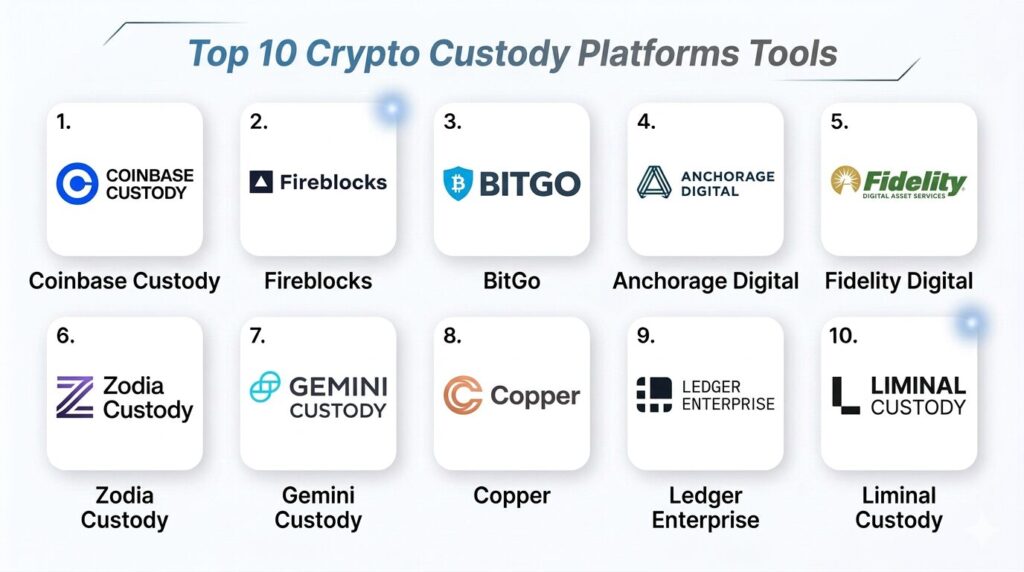
1. Coinbase Custody
Coinbase Custody is a fiduciary and qualified custodian under New York Banking Law, offering a high-trust environment for institutional capital. It is part of the broader Coinbase Prime ecosystem, which allows for seamless transitions between long-term storage and active trading. The platform is known for its “cold storage first” philosophy, keeping the vast majority of client assets offline.
Key Features
The platform utilizes a proprietary cold storage architecture that includes geographically distributed secrets and redundant hardware security modules. It supports over 450 digital assets and offers native staking for major Proof-of-Stake protocols. Institutional users benefit from sophisticated governance tools, allowing for custom withdrawal limits and multi-level approval chains. The system also provides detailed reporting tools that are SOC 1 Type 2 and SOC 2 Type 2 compliant. Furthermore, it offers a robust insurance policy that covers assets against theft and cyber-attacks.
Pros
Direct integration with one of the world’s largest liquidity pools makes it ideal for institutions that trade frequently. The regulatory standing as a NYDFS-chartered trust company provides significant legal peace of mind.
Cons
The platform’s high-security focus can lead to slower withdrawal times compared to MPC-only providers. It may have higher minimum balance requirements than some competitors.
Platforms and Deployment
Web-based institutional dashboard and API-driven access for automated workflows.
Security and Compliance
Regulated by the NYDFS; SOC 1 and SOC 2 certified with a $320M+ commercial crime insurance policy.
Integrations and Ecosystem
Deeply integrated with Coinbase Prime, supporting trading, financing, and staking in a unified interface.
Support and Community
Offers dedicated institutional coverage teams and 24/7 technical support for high-AUM clients.
2. Fireblocks
Fireblocks is a technical powerhouse that utilizes Multi-Party Computation (MPC) to secure assets while they are in motion. Unlike traditional cold storage, Fireblocks focuses on “velocity,” allowing institutions to move assets across exchanges and wallets at high speed without sacrificing the security of the private keys.
Key Features
The core of the platform is the Fireblocks Network, a private ecosystem that connects thousands of institutional participants for instant, secure transfers. It uses MPC-CMP technology to ensure that private keys are never assembled in one place, even during a transaction. The platform includes a “Policy Engine” that allows administrators to set granular rules for every transaction, such as whitelisting addresses and requiring biometric approvals. It also provides a “Non-Custodial” infrastructure option for businesses that want to build their own wallets using Fireblocks technology.
Pros
Unrivaled speed for asset transfers, making it the top choice for market makers and hedge funds. The MPC architecture eliminates the single point of failure inherent in traditional key management.
Cons
As a technology provider, it does not always act as the “qualified custodian” itself unless paired with a third-party trust partner. The complexity of the policy engine can require significant technical expertise to manage.
Platforms and Deployment
Cloud-native platform with extensive SDKs and APIs for custom enterprise integration.
Security and Compliance
SOC 2 Type II certified; utilizes Intel SGX and MPC to protect key shards.
Integrations and Ecosystem
Connects to over 30 exchanges and supports hundreds of DeFi protocols and dApps.
Support and Community
Provides extensive developer documentation and 24/7 global support for enterprise clients.
3. BitGo
BitGo is a pioneer in multi-signature security and one of the few platforms that offers both technology and regulated custody. With its federal bank charter, BitGo serves as a “one-stop-shop” for institutions that need a qualified custodian with a heavy emphasis on programmable governance.
Key Features
The platform offers a unique “Multi-Sig” approach where the client, BitGo, and a third-party backup each hold a key. It supports “Self-Managed” wallets where clients hold their own keys using BitGo’s software, or “Regulated Custody” where BitGo acts as the fiduciary. BitGo provides an institutional-grade staking platform and a “Wealth Management” suite for managing multi-asset portfolios. It also features a “Private Ledger” that allows for internal transfers between sub-accounts without hitting the public blockchain.
Pros
The federal bank charter makes it one of the most compliant-ready platforms globally. The multi-sig model provides a clear, auditable trail of who authorized every transaction.
Cons
The multi-sig architecture can be more expensive in terms of on-chain gas fees compared to MPC-based solutions. The user interface is highly functional but can feel “developer-centric” for non-technical users.
Platforms and Deployment
Web dashboard, mobile application, and a robust REST API for enterprise developers.
Security and Compliance
OCC-chartered national trust bank; SOC 2 Type 2 certified with up to $250M in insurance coverage.
Integrations and Ecosystem
Integrates with major clearinghouses and provides the backend for several large crypto exchanges.
Support and Community
Offers 24/7 white-glove support and a dedicated account management team for institutional partners.
4. Anchorage Digital
Anchorage Digital is notable for being the first crypto-native firm to receive a federal bank charter from the OCC. It is designed for institutions that require a “bank-grade” experience for complex operations like staking, voting, and financing directly from a custodial account.
Key Features
The platform uses a “Hardware-Security-Module-first” approach, where all keys are generated and stored in FIPS 140-2 Level 3 HSMs. It offers sub-15-minute settlement from cold storage, a feat that traditionally took hours or days. Anchorage provides a full suite of “Prime” services, including collateralized lending and institutional-grade trading. It also features a unique “Participation” module that allows clients to engage in on-chain governance and voting without moving their assets out of the bank.
Pros
The most regulated environment for crypto in the US, providing the highest level of fiduciary protection. Exceptional speed for a “cold-first” custody model.
Cons
Strict onboarding requirements make it inaccessible for smaller funds or individual HNIs. The asset support list, while growing, is more curated than marketplace-style platforms.
Platforms and Deployment
Managed service with a secure web interface and dedicated API access.
Security and Compliance
OCC National Bank Charter; audited by major accounting firms for SOC compliance.
Integrations and Ecosystem
Integrated with major institutional platforms like BlackRock’s Aladdin for seamless asset management.
Support and Community
Provides high-touch service with dedicated relationship managers for every institutional client.
5. Fidelity Digital Assets
Fidelity Digital Assets brings the weight of a traditional finance giant to the crypto world. It provides a secure, institutional-grade platform for the custody and execution of digital assets, leveraging the same security standards that Fidelity uses for trillions of dollars in traditional assets.
Key Features
The platform offers a 100% offline cold storage model, with keys stored in physical vaults with 24/7 monitoring. It is strictly focused on institutional clients, providing a highly regulated environment that is separate from Fidelity’s retail operations. The service includes an integrated execution platform that allows for large-block trading of Bitcoin and Ethereum. It provides comprehensive reporting that fits seamlessly into traditional institutional accounting and audit workflows.
Pros
Unrivaled reputation and financial stability, being backed by one of the largest asset managers in the world. Deep expertise in institutional compliance and fiduciary duties.
Cons
Limited asset support, primarily focusing on Bitcoin and Ethereum. Lacks the “DeFi-native” features found in more agile, crypto-native custodians.
Platforms and Deployment
Managed institutional platform with specialized access for investment committees.
Security and Compliance
Regulated as a New York limited-purpose trust company; SOC 1 and SOC 2 Type II certified.
Integrations and Ecosystem
Strongest ties to the traditional finance (TradFi) ecosystem and institutional clearing networks.
Support and Community
Offers the same level of white-glove service expected from a major global investment firm.
6. Zodia Custody
Zodia Custody is a bank-backed digital asset custodian developed by Standard Chartered in association with Northern Trust. It is specifically designed to meet the needs of traditional financial institutions and corporations who require a custodian that speaks the “language of banks.”
Key Features
The platform utilizes a multi-layered security model that combines hardware security with bank-grade operational controls. It offers “Zodia Interchange,” a service that protects client assets by keeping them off-exchange even while they are being used for trading on major venues. It features a robust staking infrastructure and comprehensive compliance tools that align with MiCA and other global frameworks. The system is designed for “multi-entity” management, allowing large corporations to manage assets across different subsidiaries.
Pros
Backing by global banks ensures a level of regulatory and operational rigor that is difficult to match. The “Interchange” feature significantly reduces exchange counterparty risk.
Cons
Onboarding and compliance checks can be more extensive and time-consuming than with crypto-native firms. Focus is primarily on Tier 1 and Tier 2 financial institutions.
Platforms and Deployment
Web-based institutional portal with API integration for core banking systems.
Security and Compliance
FCA-registered and MiCA-aligned; adheres to the highest global banking security standards.
Integrations and Ecosystem
Strongest integrations are with institutional trading venues and traditional settlement banks.
Support and Community
Offers global 24/7 support with a focus on institutional relationship management.
7. Gemini Custody
Gemini Custody, operated by Gemini Trust Company, is a regulated custodian that provides high-security storage with a focus on simplicity and transparency. It is a popular choice for funds that want a highly regulated US partner with a broad range of supported assets.
Key Features
The platform offers segregated cold storage where each client’s assets are held in unique addresses on the blockchain. It provides “Instant Liquidity,” allowing users to trade their custodial assets on the Gemini exchange without waiting for a cold storage withdrawal. It features a $200M insurance policy for its cold storage system, one of the largest in the industry. The interface is exceptionally user-friendly for an institutional platform, offering clear dashboards and easy-to-use governance tools.
Pros
Excellent balance between top-tier security and ease of use. The ability to trade instantly from custody is a major operational advantage for active managers.
Cons
Has faced some regulatory scrutiny in the past, though it remains a chartered trust company. Fees for smaller institutional accounts can be higher than competitors.
Platforms and Deployment
Web interface and mobile app with a comprehensive set of institutional APIs.
Security and Compliance
NYDFS-regulated trust company; SOC 1 Type 2 and SOC 2 Type 2 certified.
Integrations and Ecosystem
Deeply integrated with the Gemini Exchange and its staking and lending products.
Support and Community
Provides dedicated account support and an extensive library of institutional resources.
8. Copper
Copper is a UK-based platform that has gained significant traction for its “ClearLoop” technology, which allows for the instantaneous settlement of trades across multiple exchanges while assets remain in secure custody.
Key Features
The “ClearLoop” network is the standout feature, connecting over 45 exchanges and allowing for collateral management and trading without moving funds into exchange wallets. Copper uses an MPC-based security model that provides high speed and operational flexibility. The platform also offers a “Walled Garden” feature that restricts asset movement to a predefined set of trusted addresses. It provides a dedicated portal for staking and DeFi access, allowing institutions to participate in on-chain yield safely.
Pros
The most advanced solution for mitigating exchange risk through off-exchange settlement. Highly innovative and responsive to the needs of the fast-moving crypto-native market.
Cons
The platform’s focus on velocity and trading might not appeal to “buy-and-hold” institutions looking for simple cold storage. Regulatory status in certain jurisdictions has been a point of transition.
Platforms and Deployment
Cloud-based web platform with a focus on API connectivity for trading desks.
Security and Compliance
ISO 27001 certified; utilizes MPC technology for key management and security.
Integrations and Ecosystem
Integrated with a vast network of exchanges including Binance, OKX, and Bybit.
Support and Community
Offers 24/7 support and is very active in the institutional trading and settlement space.
9. Ledger Enterprise
Ledger Enterprise (formerly Ledger Vault) is the corporate-grade version of the famous hardware wallet technology. It allows businesses to build their own internal custody solutions using Ledger’s industry-leading hardware security and a flexible governance framework.
Key Features
The platform is built around the “Personal Security Device” (PSD), a hardware-based authentication tool that ensures only authorized users can sign transactions. It features a sophisticated “Rule Engine” that allows for conditional transaction approvals based on amount, currency, or destination. Unlike many other providers, Ledger Enterprise allows for a hybrid model where the client can maintain ultimate control over their keys. It supports a massive array of assets and provides a professional staking interface.
Pros
Leverages the most trusted name in hardware security. Provides a high degree of “self-sovereignty” for institutions that do not want to fully outsource their keys.
Cons
Requires more internal management and hardware handling than “managed” custody services. The setup and governance design can be complex for smaller teams.
Platforms and Deployment
Hybrid model involving dedicated hardware devices and a cloud-based management platform.
Security and Compliance
FIPS 140-2 Level 3 security modules; SOC 2 Type 2 certified.
Integrations and Ecosystem
Provides a robust API for building custom wallet applications and integrating with DeFi.
Support and Community
Offers professional services for setup and 24/7 technical support for enterprise customers.
10. Liminal Custody
Liminal is an emerging leader in the automated wallet infrastructure space, specializing in “plug-and-play” custody for exchanges, OTC desks, and Web3 companies. It focuses on reducing the operational overhead of managing thousands of individual wallets.
Key Features
The platform uses an MPC-based architecture to provide “zero-key-exposure” management. It features a “Smart Policy Engine” that can automate complex workflows, such as refueling gas for thousands of sub-wallets or consolidating funds. Liminal provides an “Express” integration for developers, allowing companies to launch secure wallet infrastructure in days rather than months. It also includes built-in AML (Anti-Money Laundering) screening that automatically flags suspicious incoming transactions.
Pros
The best choice for businesses that need to manage a high volume of wallets and transactions automatically. Very competitive pricing for infrastructure-level services.
Cons
Newer brand compared to giants like Coinbase or Fidelity, which may affect “brand-name” trust for some conservative institutions. The interface is optimized for developers more than non-technical users.
Platforms and Deployment
Cloud-based dashboard with a heavy emphasis on RESTful APIs and SDKs.
Security and Compliance
ISO 27001 and ISO 27701 certified; utilizes multi-layered MPC and HSM security.
Integrations and Ecosystem
Strong support for over 50 blockchain networks and seamless integration with treasury management systems.
Support and Community
Provides high-speed technical support and is active in the developer-led Web3 ecosystem.
Comparison Table
| Tool Name | Best For | Platform(s) Supported | Deployment | Standout Feature | Public Rating |
| 1. Coinbase Custody | US Institutions | Web, API | Cloud | NYDFS Qualified Status | 4.8/5 |
| 2. Fireblocks | High Velocity | Web, API, SDK | Cloud | MPC-CMP Network | 4.9/5 |
| 3. BitGo | Multi-Sig Governance | Web, API | Hybrid | Federal Bank Charter | 4.7/5 |
| 4. Anchorage Digital | Bank-Grade Staking | Web, API | Managed | Sub-15m Cold Withdrawal | 4.8/5 |
| 5. Fidelity Digital | Traditional Funds | Managed Portal | Managed | 100% Offline Vaults | 4.6/5 |
| 6. Zodia Custody | Bank-Aligned Firms | Web, API | Cloud | Interchange Technology | 4.5/5 |
| 7. Gemini Custody | Active Trading | Web, API | Cloud | Instant Liquidity | 4.4/5 |
| 8. Copper | Off-Exchange Trade | Web, API | Cloud | ClearLoop Settlement | 4.5/5 |
| 9. Ledger Enterprise | Key Control | Hardware + Web | Hybrid | PSD Hardware Governance | 4.7/5 |
| 10. Liminal Custody | Ops Automation | API-First | Cloud | Smart Refueling Engine | 4.3/5 |
Evaluation & Scoring of Crypto Custody Platforms
The scoring below is a comparative model intended to help shortlisting. Each criterion is scored from 1–10, then a weighted total from 0–10 is calculated using the weights listed. These are analyst estimates based on typical fit and common workflow requirements, not public ratings.
Weights:
- Core features – 25%
- Ease of use – 15%
- Integrations & ecosystem – 15%
- Security & compliance – 10%
- Performance & reliability – 10%
- Support & community – 10%
- Price / value – 15%
| Tool Name | Core (25%) | Ease (15%) | Integrations (15%) | Security (10%) | Performance (10%) | Support (10%) | Value (15%) | Weighted Total |
| 1. Coinbase Custody | 10 | 8 | 10 | 10 | 8 | 9 | 7 | 8.95 |
| 2. Fireblocks | 9 | 7 | 10 | 10 | 10 | 9 | 8 | 8.95 |
| 3. BitGo | 9 | 8 | 9 | 9 | 9 | 10 | 9 | 8.95 |
| 4. Anchorage Digital | 10 | 7 | 8 | 10 | 9 | 10 | 7 | 8.85 |
| 5. Fidelity Digital | 8 | 9 | 6 | 10 | 8 | 10 | 7 | 8.40 |
| 6. Zodia Custody | 9 | 7 | 8 | 9 | 9 | 9 | 7 | 8.35 |
| 7. Gemini Custody | 8 | 10 | 9 | 9 | 8 | 8 | 8 | 8.55 |
| 8. Copper | 9 | 7 | 9 | 9 | 10 | 8 | 8 | 8.65 |
| 9. Ledger Enterprise | 8 | 6 | 8 | 10 | 9 | 8 | 9 | 8.15 |
| 10. Liminal Custody | 8 | 8 | 9 | 9 | 9 | 8 | 10 | 8.60 |
How to interpret the scores:
- Use the weighted total to shortlist candidates, then validate with a pilot.
- A lower score can mean specialization, not weakness.
- Security and compliance scores reflect controllability and governance fit, because certifications are often not publicly stated.
- Actual outcomes vary with assembly size, team skills, templates, and process maturity.
Which Crypto Custody Platform Tool Is Right for You?
Solo / Freelancer
While high-end institutional platforms like Anchorage are generally out of reach, a freelancer with significant digital wealth should look at Ledger Enterprise or the retail version of Gemini. These offer a significant security upgrade over basic software wallets without requiring a full corporate legal team for onboarding.
SMB
Small funds and startups should prioritize Liminal Custody or BitGo. These platforms offer flexible pricing and “pay-as-you-grow” models that provide institutional-grade security without the massive minimum annual fees often associated with major banks.
Mid-Market
For hedge funds and family offices, Coinbase Custody and Fireblocks are the gold standard. They provide the perfect mix of regulatory compliance for audit purposes and the technical speed needed to manage a portfolio across different protocols and exchanges.
Enterprise
Large-scale financial institutions and multinational corporations should gravitate toward Zodia Custody or Fidelity Digital Assets. These providers are built on traditional banking principles and offer the most rigorous legal and compliance frameworks available in the industry.
Budget vs Premium
If cost is the primary driver, API-first infrastructure providers like Liminal offer the best value. However, if the risk of loss is the primary concern, paying the premium for the insurance and fiduciary status of a platform like Anchorage or Coinbase is a non-negotiable expense.
Feature Depth vs Ease of Use
Gemini is the clear winner for teams that want a “clean” user experience and simple setup. Conversely, Fireblocks and Ledger Enterprise offer the most feature depth for technical teams that want to customize every aspect of their security and transaction workflow.
Integrations & Scalability
Fireblocks and Copper lead the market in terms of exchange connectivity and DeFi access. These are the best tools for organizations that plan to be “on-chain” daily. For those who simply need to “buy and hold,” the scalability of Fidelity or Coinbase’s vault systems is more than sufficient.
Security & Compliance Needs
For organizations operating in strictly regulated jurisdictions, the OCC-chartered status of Anchorage and BitGo, or the NYDFS status of Coinbase and Gemini, provides a legal shield that “technology-only” providers cannot match.
Frequently Asked Questions (FAQs)
1. What is the difference between a hot and cold wallet?
A hot wallet is connected to the internet for fast transactions, while a cold wallet is kept offline to prevent hacking. Institutional custodians often use a hybrid approach to balance security with liquidity.
2. Is my crypto insured on these platforms?
Most institutional custodians carry insurance for their cold storage and certain types of cyber-theft. However, this rarely covers losses due to market volatility or the failure of a specific blockchain protocol.
3. What is a “Qualified Custodian”?
In the US, this is a financial institution that is authorized to hold client assets under strict fiduciary standards, often holding a state or federal banking charter. It is the gold standard for institutional compliance.
4. How does Multi-Party Computation (MPC) work?
MPC breaks a private key into “shards” that are distributed among different parties. To sign a transaction, the shards interact mathematically without ever combining into a single, complete key.
5. Can I earn interest or yield on my custodial assets?
Yes, most modern custodians like Zodia and Anchorage offer “Staking-as-a-Service,” allowing you to earn rewards on Proof-of-Stake assets directly from your secure account.
6. Do these platforms support NFTs?
Major custodians like Coinbase and Fireblocks have expanded their infrastructure to support high-value NFT collections, treating them with the same level of security as fungible tokens.
7. How long does a withdrawal from cold storage take?
Historically, this took 24–48 hours, but modern “fast-cold” solutions from providers like Anchorage have reduced this to less than 15 minutes through automated hardware security.
8. What is “off-exchange settlement”?
This allows you to trade on an exchange while keeping your funds with your custodian. The custodian and exchange settle the net difference later, reducing the risk of an exchange going bankrupt with your funds.
9. Are my assets commingled with the custodian’s funds?
No. Regulated custodians are legally required to keep client assets in segregated accounts, ensuring that your funds are not used for the company’s operational expenses or other investments.
10. Do I need to be a corporation to use these services?
Most of these platforms are strictly B2B (Business-to-Business) and require a formal entity. However, some have “Family Office” tiers that allow high-net-worth individuals to onboard under specific conditions.
Conclusion
The evolution of crypto custody from experimental hardware to bank-grade fiduciary services has fundamentally changed the risk profile of digital asset ownership. The maturity of these platforms means that security is no longer the primary hurdle for institutional entry; rather, the focus has shifted to capital efficiency and regulatory harmonization. A successful custody strategy requires a multi-faceted approach that considers not just the “vault” but the entire operational lifecycle of an asset—from secure acquisition and yield generation to compliant reporting and ultimate settlement. As the industry continues to integrate with traditional financial rails, the custodians featured here will serve as the trusted bridges, providing the necessary layer of professionalism and safety that allows global finance to operate with confidence on public blockchains. Choosing a custodian is a long-term partnership, and the decision should be guided by a deep alignment between the platform’s technical capabilities and your organization’s specific fiduciary obligations.