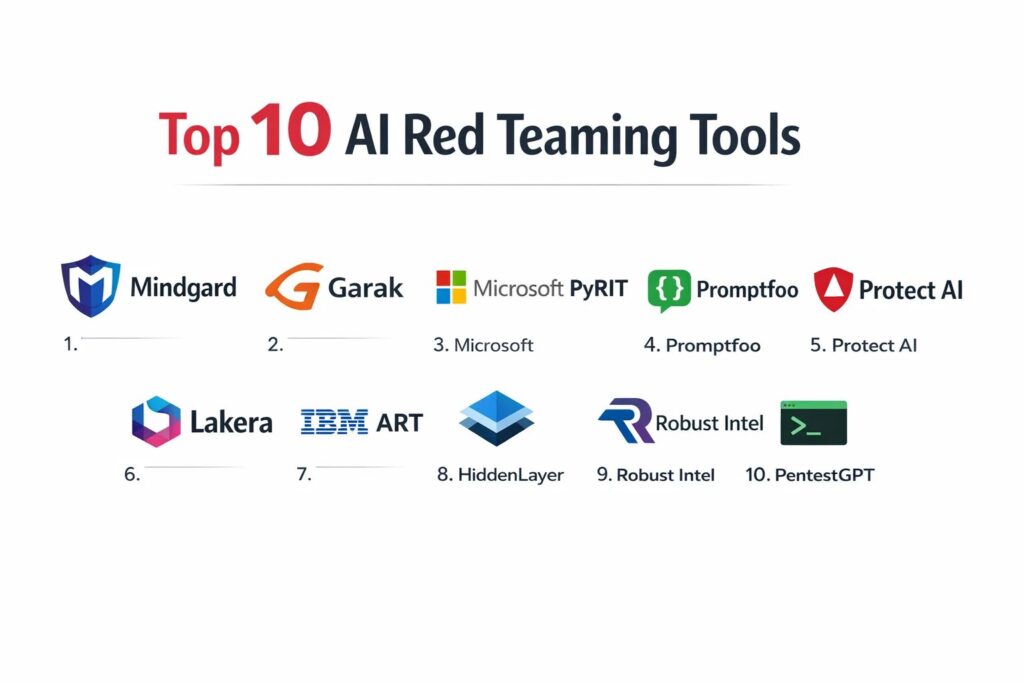
Introduction
AI red teaming has emerged as a specialized discipline within the cybersecurity ecosystem, specifically designed to stress-test the robustness, safety, and security of large language models (LLMs) and agentic workflows. Unlike traditional penetration testing, which targets network vulnerabilities and software bugs, AI red teaming focuses on the unique failure modes of generative systems, such as prompt injection, data poisoning, model extraction, and the bypass of ethical guardrails. These tools simulate adversarial intent by generating complex, mutated inputs that attempt to force an AI into non-deterministic or harmful behaviors. As organizations move from experimental pilots to production-grade AI agents, the ability to programmatically audit these systems for vulnerabilities is no longer optional; it is a fundamental requirement for risk management and regulatory compliance.
The technical complexity of modern AI stacks—incorporating retrieval-augmented generation (RAG), external tool-calling, and multi-cloud deployments—requires a new generation of offensive security tools. These platforms combine classical fuzzing techniques with generative adversarial networks (GANs) and LLM-as-a-judge scoring to provide a continuous feedback loop for security engineers. By automating the discovery of edge cases that human testers might overlook, these tools enable a “shift-left” approach to AI security, identifying risks during the development phase rather than post-deployment. The following assessment highlights the most reliable tools in 2026 for securing the AI-enabled enterprise.
Best for: Security researchers, DevSecOps engineers, and AI red teamers who need to automate the discovery of prompt injection, jailbreaking, and output safety violations in production-grade LLM applications.
Not ideal for: General IT teams looking for standard network vulnerability scanners or organizations that do not yet have a functional AI or machine learning pipeline to audit.
Key Trends in AI Red Teaming Tools
The most significant trend is the rise of “Agentic Red Teaming,” where the testing tool itself is an autonomous AI agent capable of multi-step reasoning. Instead of sending single static prompts, these tools engage in a dialogue with the target model, attempting to build trust or manipulate context over several turns to achieve a jailbreak. Another major shift is the move toward “White-Box” testing, where tools analyze the internal weights and activations of a model to predict adversarial susceptibility, rather than relying solely on black-box API interactions.
Furthermore, we are seeing the deep integration of AI red teaming into the CI/CD pipeline, often referred to as “Continuous Red Teaming.” In this model, every change to a system prompt or a RAG database triggers an automated suite of adversarial tests to ensure no regressions in safety policies. Regulatory pressure, particularly from the EU AI Act and updated NIST frameworks, has also forced tools to provide more granular compliance mapping, translating technical failure states into documentable legal and ethical risks.
How We Selected These Tools
The selection process for this list involved a rigorous evaluation of each tool’s ability to handle the specific “non-deterministic” nature of AI threats. We prioritized frameworks that offer a broad library of pre-built “probes” or attack recipes, covering everything from PII leakage to toxic content generation. A key criterion was the quality of the “Scorer” or “Judge” mechanism—the component that determines whether an attack was successful—as inaccurate scoring leads to high false-positive rates that can paralyze a development team.
We also looked for architectural flexibility, favoring tools that can be deployed locally (for testing private models) or integrated via API with major providers like OpenAI, Anthropic, and Google. Security and data privacy of the testing tool itself were also considered; we sought out tools that do not require sending sensitive training data to third-party servers. Finally, we emphasized tools with active community support or strong enterprise backing, ensuring that the attack libraries are frequently updated to reflect the latest jailbreaking techniques discovered in the wild.
1. Mindgard
Mindgard is an enterprise-grade platform designed for automated AI security testing and red teaming. It stands out for its ability to simulate real-world exploitation paths that traditional application security tools miss. The platform is built to handle the entire AI lifecycle, providing both pre-deployment assessments and runtime protection for models, agents, and complex enterprise workflows.
Key Features
The tool provides an automated reconnaissance engine that maps the attack surface of an AI application. It features a comprehensive library of adversarial attacks, including prompt injection, model inversion, and evasion tactics. Mindgard uses a “Red-Team-as-a-Service” approach that can be integrated into CI/CD pipelines for continuous monitoring. It provides a centralized risk dashboard that correlates technical vulnerabilities with business impact. Additionally, it offers automated remediation suggestions to help developers harden their models against discovered threats.
Pros
High degree of automation allows for testing at scale without a massive team of human researchers. Excellent enterprise support and reporting tailored for compliance audits.
Cons
The platform is a commercial solution and may be cost-prohibitive for very small startups or individual researchers.
Platforms and Deployment
Cloud-based SaaS with hybrid deployment options for on-premises data requirements.
Security and Compliance
Full alignment with NIST AI RMF and ISO/IEC 42001; provides secure, encrypted handling of test results.
Integrations and Ecosystem
Native integrations with major MLOps platforms, GitHub, and enterprise SOC tools.
Support and Community
Offers 24/7 technical support and a dedicated research wing that publishes frequent AI threat intelligence.
2. Garak
Garak is an open-source LLM vulnerability scanner that functions much like Nmap but for language models. It probes models for a wide range of failure modes, from security vulnerabilities like prompt injection to safety issues like hallucination and toxic output.
Key Features
The framework is highly modular, allowing users to select specific “probes” (attack types) and “detectors” (success criteria). It supports a vast array of interfaces, including local models via Hugging Face and cloud models via API. Garak is capable of “fuzzing” inputs by generating thousands of variations of a prompt to find weak points in a model’s filters. It produces detailed reports in multiple formats, making it easy to share findings with development teams. Its active open-source community ensures that it is one of the first tools to include new jailbreak patterns.
Pros
Completely free and open-source, offering high transparency into how tests are conducted. Extremely fast to set up and run against a new model endpoint.
Cons
Requires a degree of technical proficiency to interpret results and customize probes. Lacks a native enterprise-grade GUI for long-term trend tracking.
Platforms and Deployment
Python-based CLI tool compatible with Linux, macOS, and Windows.
Security and Compliance
As an open-source tool, users have full control over data residency; no data leaves the local environment unless configured.
Integrations and Ecosystem
Integrates well with other open-source security tools and can be scripted into custom Python workflows.
Support and Community
Strong GitHub community and Discord presence for troubleshooting and shared attack recipes.
3. Microsoft PyRIT
The Python Risk Identification Tool (PyRIT) is Microsoft’s flagship open-source framework for red teaming generative AI systems. It is designed to help security professionals move beyond manual “one-off” prompt testing toward a more structured, repeatable, and automated strategy.
Key Features
PyRIT uses an “orchestrator” model that can manage complex, multi-turn conversations between an adversarial agent and the target model. It allows for the automation of “prompt engineering” attacks where the tool mutates a single malicious intent into hundreds of different linguistic styles. The framework includes a scoring engine that can use other LLMs to evaluate the safety of the responses. It is built to handle massive scale, capable of testing large-scale enterprise AI deployments across multiple regions.
Pros
Strong backing from Microsoft ensures high-quality engineering and alignment with modern security standards. Excellent for building “defensive” red teaming datasets to train better guardrails.
Cons
The learning curve is steeper than simpler scanners, as it requires writing Python code to define custom orchestrators.
Platforms and Deployment
Python library and CLI; cloud-neutral but heavily optimized for Azure AI environments.
Security and Compliance
Designed to help organizations meet the requirements of the White House Executive Order on AI and the EU AI Act.
Integrations and Ecosystem
Deeply integrated with the Microsoft security stack, but supports any model with a Python-accessible API.
Support and Community
Well-documented on GitHub with regular updates from Microsoft’s AI Red Team.
4. Promptfoo
Recently acquired by OpenAI, Promptfoo is an essential tool for developers who want to test and evaluate prompts, agents, and RAG systems. It focuses on finding the “best” version of a prompt while simultaneously scanning for security vulnerabilities.
Key Features
The platform allows for side-by-side comparison of different models and prompts based on custom test cases. It includes built-in security scanners for prompt injection, PII leaks, and jailbreaking. Users can define assertions in plain English or JavaScript to validate the output of an AI. It features a “matrix testing” capability where thousands of variables can be tested against multiple models at once. It produces a highly visual web report that makes it easy for non-technical stakeholders to understand the risks.
Pros
Extremely developer-friendly with a focus on improving the “inner loop” of AI development. Now backed by OpenAI, ensuring it remains at the cutting edge of model capabilities.
Cons
While it has security features, its primary focus is on “evaluation” rather than deep offensive research.
Platforms and Deployment
Node.js based CLI and web-based viewer.
Security and Compliance
Offers a self-hosted option for teams that cannot upload their prompts to a third-party service.
Integrations and Ecosystem
Integrates with GitHub Actions, GitLab, and most modern CI/CD stacks.
Support and Community
Massive user base and extensive documentation; a vibrant community of over 100,000 developers.
5. Protect AI (Guardian)
Protect AI offers a suite of tools, including the “Guardian” platform, which acts as a secure gateway for AI interactions. It focuses on the “MLSecOps” lifecycle, providing deep visibility into the security of models and the data pipelines that feed them.
Key Features
Guardian provides a “scanning” layer that intercepts requests to LLMs to block malicious prompts in real-time. It features a “Model Scanner” that can detect hidden malware or “backdoors” inside of model weights. The platform provides a comprehensive inventory of all AI models and datasets used across an organization. It includes a specialized red teaming module that simulates attacks against RAG databases to find data leakage points. It also offers a “bug bounty” platform specifically for AI, connecting companies with external security researchers.
Pros
Provides a holistic view of the entire AI supply chain, not just the model output. Strong focus on enterprise governance and risk posture management.
Cons
Can be complex to deploy across a large, fragmented organization with many different AI initiatives.
Platforms and Deployment
Enterprise SaaS with agents for local and cloud environments.
Security and Compliance
Industry leader in AI supply chain security (AI-SCA) and SBOM (Software Bill of Materials) for AI.
Integrations and Ecosystem
Integrates with Amazon SageMaker, Google Vertex AI, and Azure AI Studio.
Support and Community
Professional enterprise support and a leading voice in the “MLSecOps” community.
6. Lakera (Lakera Guard)
Lakera is a top-tier choice for teams focused on “Prompt Security.” Their platform, Lakera Guard, provides a lightweight but powerful defensive and offensive testing layer for LLM applications, famous for its work on the “Gandalf” jailbreaking game.
Key Features
The platform uses a proprietary, high-speed engine to detect prompt injection and data exfiltration attempts in milliseconds. It includes an extensive database of “known-bad” prompts and attack patterns that is updated daily. Lakera provides a “Red Teaming API” that allows developers to automatically send adversarial traffic to their models during the build process. It offers specialized protection for “Agentic” workflows where an AI might be manipulated into taking unauthorized actions in external systems.
Pros
One of the fastest and most lightweight solutions on the market, adding minimal latency to AI interactions. Very high accuracy in detecting “indirect” prompt injection.
Cons
Focus is primarily on prompt-based attacks rather than the broader ML infrastructure (like data poisoning or model theft).
Platforms and Deployment
API-first cloud service with private cloud deployment options.
Security and Compliance
SOC 2 Type II compliant; focuses on ensuring data privacy for end-users.
Integrations and Ecosystem
Plug-and-play integrations for LangChain, LlamaIndex, and major LLM providers.
Support and Community
Excellent developer documentation and a strong presence in the AI security education space.
7. IBM Adversarial Robustness Toolbox (ART)
IBM’s ART is a highly technical, research-oriented library for developers and researchers to defend and evaluate machine learning models against adversarial threats. It is one of the most comprehensive libraries for non-LLM based machine learning security.
Key Features
ART supports all major machine learning frameworks (TensorFlow, Keras, PyTorch, Scikit-learn). It covers a wide range of attack types, including evasion, poisoning, extraction, and inference. The library includes state-of-the-art “defensive” algorithms that can be used to harden models against the very attacks it simulates. It is particularly strong in the area of “Image” and “Audio” AI red teaming, which many LLM-focused tools ignore. It provides quantitative metrics for model robustness, allowing for scientific benchmarking of security improvements.
Pros
Unrivaled depth in classical machine learning security and non-text modalities. Completely free and backed by IBM’s world-class research division.
Cons
Requires deep knowledge of machine learning theory to use effectively; not a “turn-key” solution for app developers.
Platforms and Deployment
Python library (pip installable) for use in research and development environments.
Security and Compliance
Highly transparent and auditable; widely used in academic and government security research.
Integrations and Ecosystem
Integrates with almost any Python-based machine learning pipeline.
Support and Community
Extensive documentation and a large academic community contributing new research-based attacks.
8. HiddenLayer
HiddenLayer is a security platform that protects the machine learning models that power the modern enterprise. They are known for their “Model Detection and Response” (MDR) approach, treating models as critical assets that need 24/7 monitoring.
Key Features
The platform features a “Model Scanner” that looks for adversarial vulnerabilities and embedded malicious code in model files. It provides a real-time detection layer that identifies “model extraction” attacks where an adversary tries to steal the intellectual property of a model. HiddenLayer offers a red teaming service that combines automated tools with human expertise to find deep architectural flaws. It provides a “Security Console” that allows SOC teams to monitor AI threats alongside traditional cyber threats.
Pros
Strongest focus on protecting the “Intellectual Property” and weights of the model itself. Built for the SOC, making it familiar to traditional security analysts.
Cons
The offensive testing features are more service-oriented and less “self-service” than tools like Garak or Promptfoo.
Platforms and Deployment
Cloud-native platform with support for hybrid and air-gapped environments.
Security and Compliance
Specifically designed to help regulated industries (Finance, Healthcare) secure their AI investments.
Integrations and Ecosystem
Strong partnerships with Databricks, Intel, and major cloud providers.
Support and Community
Full enterprise support with dedicated account managers and threat hunters.
9. Robust Intelligence (AI Risk Management)
Robust Intelligence provides an end-to-end “AI Firewall” and risk management platform. Their focus is on ensuring that AI models are not only secure but also fair, unbiased, and compliant with global regulations.
Key Features
The platform offers “Continuous AI Testing” that automatically identifies and mitigates risks across the entire model lifecycle. It features a “Pre-deployment Stress Test” that evaluates models for security, ethical, and operational risks. Robust Intelligence provides an “AI Firewall” that wraps around production models to block adversarial attacks and data drift in real-time. It includes automated compliance reporting for the EU AI Act and other emerging frameworks. The tool uses “Generative Red Teaming” to create novel attack scenarios that haven’t been seen before.
Pros
The most holistic approach to “Risk,” covering security, fairness, and performance in a single pane of glass. Very strong automated reporting for executive leadership.
Cons
The platform is an enterprise-scale solution with a corresponding price point and deployment complexity.
Platforms and Deployment
Enterprise SaaS and on-premises deployment options.
Security and Compliance
Deep alignment with global regulatory standards; emphasizes “Trustworthy AI.”
Integrations and Ecosystem
Integrates with Snowflake, Amazon SageMaker, and Azure Machine Learning.
Support and Community
Professional support and a high level of industry thought leadership on AI safety.
10. PentestGPT
PentestGPT is an innovative tool that uses the power of LLMs to automate the penetration testing process itself. While not exclusively for AI, it is a primary tool for “AI-Assisted Red Teaming” of any digital infrastructure, including AI applications.
Key Features
The tool uses a “Reasoning Module” to maintain a task tree of an ongoing penetration test, deciding the next best move based on scan results. It can automatically generate complex terminal commands and exploit scripts. It features a “Parsing Module” that cleans up the output of traditional security tools (like Nmap or Burp Suite) to provide clear insights. PentestGPT can be used to red team the “Web Interface” or “API” of an AI application, finding the traditional vulnerabilities that often serve as the entry point for AI-specific attacks.
Pros
Revolutionizes the “speed” of a red team engagement by automating the tedious parts of the attack chain. Great for learning the “logic” of an expert hacker.
Cons
Still in an early, evolving stage; can sometimes “hallucinate” exploit paths that do not exist.
Platforms and Deployment
Python-based open-source tool; requires an API key for a powerful underlying LLM (like GPT-4 or Claude 3.5).
Security and Compliance
Users must be cautious about sending target infrastructure data to the LLM provider used by the tool.
Integrations and Ecosystem
Designed to work alongside traditional pentesting tools like Metasploit and Nmap.
Support and Community
Active GitHub repository with a growing community of “AI-enhanced” security researchers.
Comparison Table
| Tool Name | Best For | Platform(s) Supported | Deployment | Standout Feature | Public Rating |
| 1. Mindgard | Enterprise Red Teaming | Web, Hybrid | Cloud/Hybrid | Attacker-aligned Workflows | 4.8/5 |
| 2. Garak | Quick Vulnerability Scan | Linux, macOS, Win | Self-hosted | Massive Probe Library | 4.6/5 |
| 3. Microsoft PyRIT | Automated Adversarial | Python, CLI | Self-hosted | Multi-turn Orchestrator | 4.5/5 |
| 4. Promptfoo | Dev-centric Eval | Node.js, CLI | Hybrid | Matrix Variable Testing | 4.9/5 |
| 5. Protect AI | ML Supply Chain | Web, Agents | Cloud | Model Weight Scanning | 4.7/5 |
| 6. Lakera | Real-time Defense | API, Web | Cloud | Injection-focused Guard | 4.8/5 |
| 7. IBM ART | Research/Classical ML | Python Library | Self-hosted | Non-text Modality Support | 4.4/5 |
| 8. HiddenLayer | Model IP Protection | Web, Agents | Hybrid | Model Extraction Defense | 4.6/5 |
| 9. Robust Intel | Compliance & Governance | Web, API | Cloud | Holistic “AI Firewall” | 4.7/5 |
| 10. PentestGPT | AI-Assisted Pentesting | Python, CLI | Self-hosted | Automated Attack Reasoning | 4.3/5 |
Evaluation & Scoring of AI Red Teaming Tools
The scoring below is a comparative model intended to help shortlisting. Each criterion is scored from 1–10, then a weighted total from 0–10 is calculated using the weights listed. These are analyst estimates based on typical fit and common workflow requirements, not public ratings.
Weights:
- Core features – 25%
- Ease of use – 15%
- Integrations & ecosystem – 15%
- Security & compliance – 10%
- Performance & reliability – 10%
- Support & community – 10%
- Price / value – 15%
| Tool Name | Core (25%) | Ease (15%) | Integrations (15%) | Security (10%) | Performance (10%) | Support (10%) | Value (15%) | Weighted Total |
| 1. Mindgard | 10 | 8 | 9 | 10 | 9 | 10 | 8 | 9.15 |
| 2. Garak | 9 | 8 | 7 | 8 | 10 | 7 | 10 | 8.55 |
| 3. Microsoft PyRIT | 9 | 6 | 8 | 9 | 8 | 8 | 9 | 8.15 |
| 4. Promptfoo | 8 | 10 | 10 | 8 | 9 | 9 | 9 | 8.90 |
| 5. Protect AI | 9 | 7 | 9 | 10 | 8 | 9 | 8 | 8.65 |
| 6. Lakera | 8 | 9 | 10 | 9 | 10 | 8 | 8 | 8.75 |
| 7. IBM ART | 10 | 4 | 7 | 9 | 8 | 7 | 10 | 7.95 |
| 8. HiddenLayer | 9 | 7 | 8 | 10 | 8 | 9 | 7 | 8.35 |
| 9. Robust Intel | 9 | 8 | 9 | 9 | 8 | 9 | 7 | 8.50 |
| 10. PentestGPT | 7 | 8 | 6 | 7 | 8 | 7 | 9 | 7.40 |
How to interpret the scores:
- Use the weighted total to shortlist candidates, then validate with a pilot.
- A lower score can mean specialization, not weakness.
- Security and compliance scores reflect controllability and governance fit, because certifications are often not publicly stated.
- Actual outcomes vary with assembly size, team skills, templates, and process maturity.
Which AI Red Teaming Tool Is Right for You?
Solo / Freelancer
For independent researchers or those just beginning their journey in AI security, Garak is the gold standard. Its open-source nature and vast library of probes allow for immediate experimentation without the need for a corporate budget. If you are more interested in the “logic” of an attack, PentestGPT provides a fascinating look at how AI can assist in the offensive process.
SMB
Small to medium businesses deploying their first AI applications should look toward Promptfoo or Lakera. Promptfoo is exceptionally easy for developers to integrate into their existing test suites, while Lakera provides an immediate “protective” layer that can also be used for basic red teaming.
Mid-Market
For companies with established MLOps pipelines that need to prove security to their customers, Mindgard or Protect AI are the best choices. These tools offer the professional reporting and supply chain visibility that B2B clients and insurance providers are increasingly demanding.
Enterprise
Large-scale enterprises with high-risk profiles (such as those in finance or infrastructure) should opt for the comprehensive “AI Governance” approach of Robust Intelligence or the specialized model protection of HiddenLayer. These platforms provide the scale and SOC integration necessary for managing hundreds of models across a global organization.
Budget vs Premium
If budget is the primary concern, a combination of Garak (for scanning) and PyRIT (for custom orchestration) provides an enterprise-level capability for zero licensing cost. For teams where “Time-to-Value” is more important than budget, Mindgard provides a “turn-key” experience that replaces the need for hiring a specialized AI red team.
Feature Depth vs Ease of Use
IBM ART offers the most technical depth but is the hardest to use. Conversely, Promptfoo offers a very high “Ease of Use” with a slightly narrower focus on LLM evaluations. Choosing between them depends on whether you are doing deep academic research or rapid product development.
Integrations & Scalability
Microsoft PyRIT is the clear winner for teams already built on the Azure/Microsoft stack, while Promptfoo and Lakera offer the best “neutral” integrations for a multi-cloud or startup-focused ecosystem.
Security & Compliance Needs
For organizations that must strictly adhere to the EU AI Act or NIST frameworks, Robust Intelligence and Mindgard provide the most “ready-to-use” compliance mapping features, saving hundreds of hours of manual audit preparation.
Frequently Asked Questions (FAQs)
1. What is the difference between AI Red Teaming and traditional Red Teaming?
Traditional red teaming targets the “perimeter” (servers, networks, identities), while AI red teaming targets the “logic” and “stochastic” nature of the model itself. AI red teaming deals with inputs that can “confuse” or “trick” a model into violating its programming without ever “breaking into” the server.
2. Can automated tools replace human AI red teamers?
No. Automated tools are excellent for catching “known” vulnerabilities and regression testing at scale. However, human red teamers are still required for “creative” attacks, complex multi-step reasoning, and discovering “zero-day” jailbreak techniques that haven’t been programmed into tools yet.
3. Do I need to be a data scientist to use these tools?
Not necessarily. Tools like Promptfoo and Lakera are designed for software developers and security generalists. However, for more research-heavy tools like IBM ART or PyRIT, a basic understanding of Python and machine learning concepts is highly beneficial.
4. Is prompt injection a real threat?
Yes. Prompt injection can allow an attacker to bypass safety filters, access private data within a RAG system, or even force an AI agent to perform unauthorized actions (like deleting a user account) if the agent has the necessary tool-calling permissions.
5. How often should I run AI red teaming tests?
Ideally, you should run automated red teaming tests every time you change the model version, the system prompt, or the data source (RAG). A full human-led red teaming engagement should be conducted at least annually or before any major product launch.
6. Can these tools test “Image” or “Audio” AI?
Most current tools (like Garak and Promptfoo) are text-focused. However, specialized tools like IBM ART and certain modules within Microsoft PyRIT are designed specifically for “multimodal” red teaming, including vision and audio models.
7. Does red teaming help with AI “Hallucinations”?
Yes. While hallucinations are often a performance issue, they can become a security issue if a model hallucinates a malicious URL or sensitive PII. Red teaming tools can be configured to detect and score the “groundedness” of a response.
8. Is it legal to red team a public model like GPT-4?
You should always check the Terms of Service. Most providers allow “Safety Research” but strictly prohibit “Adversarial Stress Testing” that attempts to degrade their service. It is always safest to test against your own API deployment or a local instance of an open-source model.
9. What is “LLM-as-a-Judge”?
Many red teaming tools use a more powerful model (like GPT-4o) to “score” the output of a smaller model. The “Judge” model looks at the response to see if the jailbreak was successful or if the safety filters held up.
10. How do these tools help with the EU AI Act?
The EU AI Act requires “High-Risk” AI systems to undergo rigorous risk assessment and stress testing. These tools provide the documented evidence and “Adversarial Testing” results required to prove that a system is safe for public use.
Conclusion
Navigating the transition from static software security to the dynamic, unpredictable world of AI risk requires a fundamental shift in technical strategy. As the complexity of agentic systems increases, the surface area for adversarial manipulation expands exponentially, making automated red teaming an indispensable component of the modern security stack. The tools highlighted in this assessment represent the current state-of-the-art in adversarial simulation, providing the rigor necessary to protect both organizational data and brand reputation. Successful implementation, however, depends on more than just selecting a high-performing tool; it requires a culture of continuous audit where security is treated as an iterative process rather than a final checkbox. By integrating these offensive capabilities into the core development lifecycle, enterprises can confidently deploy AI systems that are not only powerful but resilient against the evolving tactics of modern adversaries.
I find that this breakdown of the Top 10 AI Red Teaming Tools is a critical manual for anyone responsible for the security of modern generative AI systems. From my perspective as a Red Team Lead, I learned that the traditional methods of penetration testing simply aren’t enough when dealing with the non-deterministic nature of LLMs. We now need specialized tools like Garak or Microsoft PyRIT that can automate “adversarial stress testing” to uncover vulnerabilities like prompt injection and data leakage before they can be exploited in the wild.
In my professional experience, the real-world value of these tools lies in their ability to perform Continuous Red Teaming within our CI/CD pipelines. This ensures that every update to a model or a RAG database is automatically vetted against the latest jailbreaking techniques. For other organizations, adopting these frameworks will provide the documented evidence required by new regulations like the EU AI Act, proving that their AI systems are safe for public use. My advice for anyone exploring this list is to prioritize the quality of the Scorer or Judge mechanism—having a high-performing tool is useless if it produces false positives that drown your development team in noise.