Introduction
Responsible AI (RAI) tooling has transitioned from a theoretical ethical framework into a technical necessity for modern engineering teams. As artificial intelligence models move from experimental sandboxes to mission-critical production environments, the risks associated with bias, lack of transparency, and regulatory non-compliance have become existential for many organizations. Responsible AI tooling refers to a specialized category of software and libraries designed to monitor, evaluate, and mitigate these risks throughout the machine learning lifecycle. These tools provide the technical “guardrails” required to ensure that automated systems are fair, secure, and explainable, transforming abstract principles into measurable, auditable technical metrics.
The strategic deployment of RAI tools allows organizations to build “Trust by Design.” Rather than treating ethics as a final compliance check, these tools integrate directly into the CI/CD pipeline, allowing developers and SREs to catch “model drift” or “fairness degradation” in real-time. In a landscape increasingly defined by global regulations like the EU AI Act and NIST frameworks, having a robust RAI stack is no longer optional. It is the operational foundation that enables innovation to scale without compromising corporate integrity or safety. By utilizing these specialized toolsets, technical leaders can provide stakeholders with the data-driven assurance that their AI systems are operating within defined ethical and legal boundaries.
Best for: Machine Learning Engineers, Data Scientists, Compliance Officers, and DevOps teams who need to operationalize ethical guidelines and ensure long-term model reliability and safety.
Not ideal for: Purely creative or non-critical AI use cases where the impact of an incorrect output carries negligible risk and does not involve sensitive demographic data or regulated decision-making.
Key Trends in Responsible AI Tooling
The most significant shift in the market is the move toward “Governance-as-Code.” Organizations are increasingly seeking tools that don’t just generate reports but actually enforce policies in real-time, such as blocking a model deployment if its bias metrics exceed a certain threshold. There is also a rising focus on “Agentic Governance,” specifically designed to monitor autonomous AI agents that make sequential decisions without direct human oversight. This requires a new generation of observability tools that can track the reasoning chains of large language models (LLMs) to ensure they haven’t bypassed safety protocols.
Another dominant trend is the rise of “Privacy-Enhancing Technologies” (PETs) integrated directly into the RAI workflow. Tools are now incorporating differential privacy and synthetic data generation to allow models to be trained and audited without exposing sensitive user information. Furthermore, “Cross-Modal Fairness” is becoming a priority; as AI systems handle text, audio, and video simultaneously, RAI tools must now detect bias and toxicity across all these formats concurrently. Finally, the industry is seeing a convergence of MLOps and RAI, where “Responsible MLOps” ensures that every version of a model is automatically tagged with a “Model Card” detailing its ethical performance history.
How We Selected These Tools
The selection of these tools was based on their ability to address the four pillars of Responsible AI: Fairness, Explainability, Privacy, and Robustness. We prioritized toolkits that offer “production-grade” reliability, moving beyond academic research projects into solutions that can handle the scale of enterprise data. Market adoption and community support were critical factors, as the most effective RAI tools are those with active ecosystems that contribute to the evolving standards of AI safety. We also looked for a balance between open-source libraries that provide deep technical transparency and managed platforms that offer comprehensive governance dashboards for non-technical stakeholders.
Technical interoperability was another primary criterion. We selected tools that integrate seamlessly with major cloud providers (AWS, Azure, Google Cloud) and common machine learning frameworks like PyTorch and TensorFlow. Security and compliance were non-negotiable; every tool on this list was evaluated for its ability to generate the audit trails and documentation required by modern regulatory standards. Finally, we looked for “innovative edge”—tools that are specifically addressing the new challenges of generative AI, such as prompt injection protection and hallucination detection.
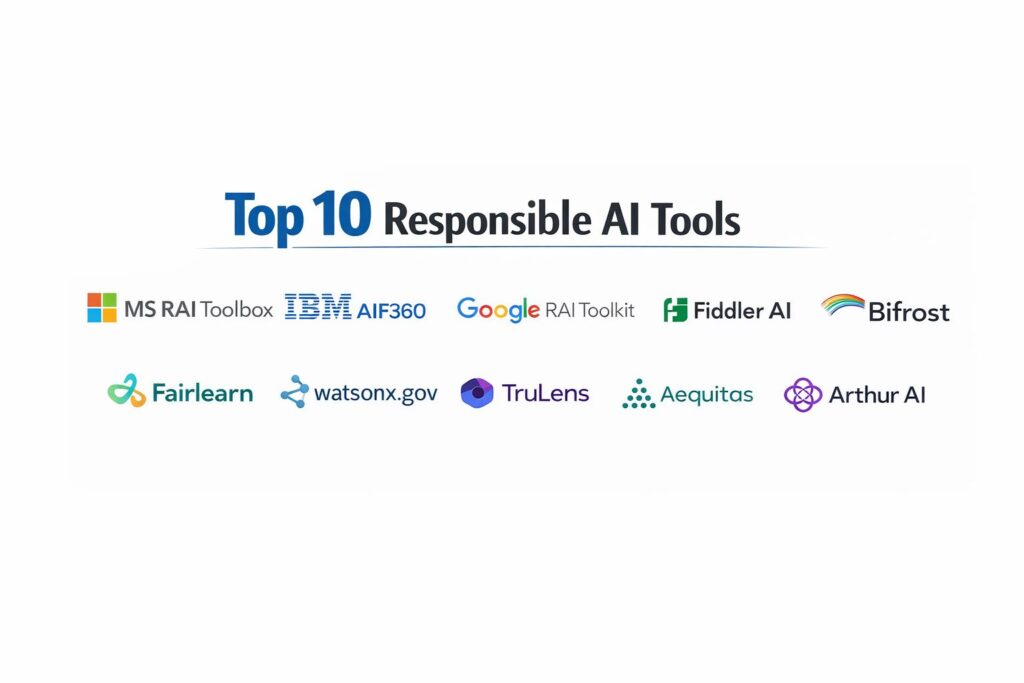
1. Microsoft Responsible AI Toolbox
The Microsoft Responsible AI Toolbox is an expansive open-source suite that unifies several critical RAI capabilities into a single dashboard. It is designed to help developers and data scientists evaluate model fairness, interpretability, and error analysis across the entire lifecycle. By integrating multiple tools—such as Fairlearn and Error Analysis—it provides a holistic view of where a model might be failing specific demographic groups or edge cases.
Key Features
The toolbox features a unified dashboard that visualizes the “causal relationship” between data features and model predictions. It includes a dedicated “Error Analysis” component that uses decision trees to identify cohorts of data where the model has a higher error rate. It provides deep interpretability through SHAP and LIME integration, allowing users to see which features most influenced a specific outcome. The suite also offers “Counterfactual Analysis,” which shows what minimal changes to an input would change the model’s decision. Additionally, it provides built-in fairness metrics to detect and mitigate demographic disparities in model outputs.
Pros
Offers one of the most comprehensive and well-integrated open-source dashboards available. It simplifies complex ethical audits into actionable visual reports that are easy for diverse stakeholders to understand.
Cons
The learning curve can be steep due to the sheer volume of features and the depth of statistical knowledge required to interpret some of the causal insights.
Platforms and Deployment
Available as a Python package; integrates natively with Azure Machine Learning and works with local Jupyter Notebooks.
Security and Compliance
Designed to assist with regulatory compliance by providing automated “Model Cards” and detailed audit trails.
Integrations and Ecosystem
Extensive support for scikit-learn, PyTorch, and TensorFlow; deeply embedded in the Microsoft Azure AI ecosystem.
Support and Community
Strongly supported by Microsoft Research and a large open-source community on GitHub.
2. IBM AI Fairness 360 (AIF360)
IBM AI Fairness 360 is a comprehensive open-source library that provides data scientists with a massive array of metrics and algorithms to detect and mitigate bias in machine learning models. It is built on the philosophy that bias can occur at any stage of the pipeline—from the initial training data to the final model predictions—and offers specialized “de-biasing” interventions for each.
Key Features
AIF360 includes over 70 fairness metrics and 10 state-of-the-art bias mitigation algorithms. It offers “Pre-processing” algorithms to balance training data before a model is ever built. “In-processing” tools allow developers to add fairness constraints directly into the model’s training objective. It also features “Post-processing” techniques to adjust the final predictions of an existing model to meet fairness targets. The library includes a web-based experience for non-coders to learn about bias concepts. It also supports “Fairness Industry Standards” by providing templates for documented fairness audits.
Pros
The most scientifically robust library for bias mitigation, offering algorithms that are not found in other general-purpose toolkits. It covers the widest range of bias types across many different industries.
Cons
It is primarily a technical library; it lacks a unified “push-button” enterprise governance dashboard for non-technical executives.
Platforms and Deployment
Python and R versions available; can be deployed in any containerized environment or as part of a CI/CD pipeline.
Security and Compliance
Enables deep technical auditing that satisfies high-level regulatory requirements for fairness and non-discrimination.
Integrations and Ecosystem
Integrates with IBM Watson OpenScale and is compatible with major ML frameworks like Spark ML and Keras.
Support and Community
Maintained by IBM Research with an active Slack community and extensive documentation for developers.
3. Google Responsible Generative AI Toolkit
Google’s toolkit is specifically engineered for the era of Large Language Models (LLMs). It provides a set of technical resources and guidance for safely developing and evaluating generative AI applications. It focuses heavily on “safety alignment” and “transparency,” helping developers understand and control the behavior of complex foundational models.
Key Features
The toolkit features the “Learning Interpretability Tool” (LIT) for visually debugging and inspecting the behavior of NLP models. It includes “ShieldGemma,” a set of content safety classifiers that can be deployed to filter harmful inputs and outputs. It provides the “LLM Comparator,” which allows for side-by-side qualitative evaluation of different model versions or prompts. The suite includes tools for “SynthID” text watermarking, which helps in identifying AI-generated content. It also offers guidance on “Safety Tuning” via Reinforcement Learning from Human Feedback (RLHF) and fine-tuning.
Pros
Specifically optimized for the unique challenges of generative AI and LLMs, such as hallucinations and toxicity. The visualization tools (LIT) are best-in-class for understanding complex language model reasoning.
Cons
Many features are tightly coupled with Google’s ecosystem (Gemma and Vertex AI), which might limit its utility for teams using entirely different stacks.
Platforms and Deployment
Cloud-based via Vertex AI and open-source libraries available for Python environments.
Security and Compliance
Includes tools specifically for “Secure AI Framework” (SAIF) alignment to protect against prompt injection and data poisoning.
Integrations and Ecosystem
Deeply integrated with Google Cloud Platform, Firebase, and the Gemma model family.
Support and Community
Excellent documentation and support through Google AI for Developers and the broader Google Cloud community.
4. Fiddler AI
Fiddler AI is an enterprise-grade Model Performance Management (MPM) platform that places a heavy emphasis on “Explainable AI” and “Model Monitoring.” It is designed for organizations that need to monitor models in production at scale, ensuring they remain fair, accurate, and transparent over time.
Key Features
The platform features a “Pluggable Explainability” engine that provides both global and local explanations for any model type. It offers real-time monitoring for “Bias Drift,” alerting teams if a model’s fairness starts to degrade as it encounters new real-world data. A dedicated “Safety Guardrail” system allows for real-time interception of problematic LLM responses. It provides “Model Integrity” checks to detect data quality issues or adversarial attacks. The system also generates comprehensive compliance reports that map directly to internal and external governance frameworks.
Pros
Exceptional at monitoring models after they have been deployed, filling the critical “SRE” gap in the AI lifecycle. It provides high-level dashboards that connect technical metrics to business outcomes.
Cons
As a commercial enterprise platform, it carries a significant cost that may be prohibitive for smaller startups or individual researchers.
Platforms and Deployment
SaaS, VPC, or On-premise deployment options for high-security environments.
Security and Compliance
SOC 2 Type II compliant; specifically built to meet the “Model Risk Management” (MRM) standards of the financial services industry.
Integrations and Ecosystem
Native integrations with AWS SageMaker, Databricks, and Snowflake, plus support for custom model deployments.
Support and Community
Offers dedicated enterprise support, white-glove onboarding, and regular “AI Ethics” webinars for clients.
5. Bifrost (by Maxim AI)
Bifrost is an infrastructure-level “AI Governance Gateway” that sits between your application and your AI providers. Unlike documentation-focused tools, Bifrost enforces governance in real-time on every single request. It is designed to solve the “Shadow AI” problem in large enterprises by providing a single, controlled point of entry for all AI activity.
Key Features
The tool provides “Unified Access Control” through a single API that works across OpenAI, Anthropic, and AWS Bedrock. It features “Real-time Policy Enforcement,” allowing admins to block requests that contain PII (Personally Identifiable Information) or toxic content. It includes a “Hierarchical Budget Management” system to set hard spending limits by team or project. The platform offers “Semantic Caching” to reduce costs and latency while ensuring responses stay within safety guidelines. It also provides “Automatic Failover,” switching between providers if a specific model starts producing unsafe or low-quality results.
Pros
Operating at the network layer allows for the enforcement of responsible AI policies without requiring changes to the model’s code. It is extremely fast (microsecond overhead) and addresses cost and safety simultaneously.
Cons
Focused primarily on the “Generative AI” and “LLM” space; it is not designed for traditional tabular machine learning governance.
Platforms and Deployment
Cloud SaaS or a self-hosted “On-Premise Agent” for maximum data privacy.
Security and Compliance
Integrates with HashiCorp Vault for key management and provides a complete audit trail of every prompt and response for compliance.
Integrations and Ecosystem
Supports over 12 major AI providers and integrates with existing observability tools like Prometheus and Grafana.
Support and Community
Rapidly growing community; offers dedicated support for enterprise infrastructure teams.
6. Fairlearn
Fairlearn is one of the most widely used open-source Python libraries for assessing and improving the fairness of machine learning systems. It focuses on “Group Fairness,” helping developers ensure that their models do not perform worse for one group (e.g., based on gender or race) than they do for another.
Key Features
The library provides two main components: a “Fairness Assessment” dashboard and “Mitigation Algorithms.” The assessment tool calculates a variety of metrics, such as demographic parity and equalized odds. The mitigation suite includes “Grid Search” and “Exponentiated Gradient” algorithms that re-train models to satisfy specific fairness constraints. It supports “Binary Classification,” “Regression,” and “Recommendation” tasks. It also features a “Fairness Comparison” tool that allows developers to visualize the trade-off between model accuracy and fairness.
Pros
Extremely lightweight and easy to integrate into existing scikit-learn or PyTorch workflows. It is the “gold standard” for open-source fairness research and is very well-documented.
Cons
It is a “point solution” library; it does not handle broader RAI concerns like security, privacy, or enterprise-wide policy governance.
Platforms and Deployment
Pure Python library; can be run anywhere Python is supported.
Security and Compliance
Provides the raw metrics and visual proof required to document fairness efforts in regulatory filings.
Integrations and Ecosystem
Part of the broader “Responsible AI Toolbox” and maintains seamless compatibility with the Scikit-Learn ecosystem.
Support and Community
Governed by a neutral community of academic and industry contributors; highly active GitHub repository.
7. IBM watsonx.governance
IBM watsonx.governance is an enterprise platform specifically built to provide the “guardrails” for generative AI. It automates the documentation and monitoring of models, ensuring they are factual, unbiased, and compliant with emerging global regulations. It acts as the “command center” for an organization’s entire AI inventory.
Key Features
The platform features an “Automated Documentation” engine that captures all metadata throughout the AI lifecycle to create an immutable audit trail. It provides “Model Lifecycle Management” (MLM) to track versions and approval workflows. It includes “Bias and Drift Detection” for both traditional ML and LLMs. The system features “Guardrails for GenAI” that monitor for hallucinations and improper data leakage. It also provides a “Policy Orchestration” layer that allows organizations to map their technical AI metrics directly to specific regulatory requirements like the EU AI Act.
Pros
The most comprehensive solution for large, highly regulated enterprises (banks, healthcare) that need a “single source of truth” for all AI risk and compliance data.
Cons
Can be complex and expensive to implement, as it is designed for enterprise-wide scale rather than individual project use.
Platforms and Deployment
Available on IBM Cloud, on-premise, or via any public cloud through Red Hat OpenShift.
Security and Compliance
Specifically designed to satisfy the world’s strictest regulatory standards (ISO 42001, NIST, EU AI Act).
Integrations and Ecosystem
Integrates with the full watsonx platform and connects to third-party model providers through a unified governance API.
Support and Community
Offers 24/7 global enterprise support and access to IBM’s elite team of AI ethics consultants.
8. TruLens
TruLens is an open-source library designed specifically for the “Evaluation and Observability” of Large Language Model applications. It introduces the “RAG Triad” concept—a specialized framework for evaluating the truthfulness and relevance of Retrieval-Augmented Generation (RAG) systems.
Key Features
The library features “Feedback Functions” that use smaller AI models to automatically score the performance of your main LLM. It focuses on the “RAG Triad”: Context Relevance, Groundedness (factuality), and Answer Relevance. It provides a “Leaderboard” to compare different model configurations, prompts, and retrieval strategies. The system includes “Interpretability Tools” for neural networks to see which parts of an input led to a specific response. It also offers a “Traceability” feature that allows developers to drill down into a specific conversation to find exactly where a hallucination occurred.
Pros
The most practical tool for developers building RAG-based applications who need to prove their system doesn’t “hallucinate.” The feedback function approach allows for automated, scalable evaluation.
Cons
Primarily focused on LLMs and RAG; it is not a general-purpose tool for traditional machine learning or non-language data types.
Platforms and Deployment
Python-based library; works locally and integrates with cloud-based observability platforms.
Security and Compliance
Provides the technical metrics needed to validate that an AI application is grounded in factual data and safe for public use.
Integrations and Ecosystem
Native support for LlamaIndex, LangChain, and all major LLM providers.
Support and Community
Maintained by the TruEra team (now part of Snowflake) with a very active community of LLM developers.
9. Aequitas
Aequitas is an open-source bias audit toolkit developed specifically for “data-informed” decision-making in the public sector and social good spaces. It is designed to help policymakers and researchers understand the impact of their models on vulnerable populations, focusing on “Equal Opportunity” and “Predictive Parity.”
Key Features
The toolkit features the “Aequitas Audit Tool,” which generates a “Fairness Report Card” for any dataset or model. It focuses on “Subgroup Analysis,” allowing users to see how metrics like False Positive Rates vary across dozens of demographic intersections. It provides a “Fairness Tree” to help users select the most appropriate fairness metric for their specific social context. It includes a web-based interface where users can upload a CSV and get an instant bias report. The library also supports “Temporal Fairness,” checking if a model’s bias is getting worse over time.
Pros
Extremely user-friendly for non-data scientists, making it the best choice for legal teams or government agencies to conduct initial bias audits. Its “Report Card” format is easy to share and understand.
Cons
It is primarily an auditing tool; it does not provide the “in-training” mitigation algorithms found in more technical libraries like AIF360.
Platforms and Deployment
Available as a Python library and a web-based GUI.
Security and Compliance
Highly effective for creating the transparency reports required for social services and public-sector AI applications.
Integrations and Ecosystem
Works with any CSV-based model output; widely used in academic and governmental research projects.
Support and Community
Developed by the Center for Data Science and Public Policy at the University of Chicago; active among the “AI for Social Good” community.
10. Arthur AI
Arthur AI is a leading enterprise “AI Monitoring and Guardrail” platform. It provides a centralized hub for tracking model performance, bias, and data integrity. It is particularly known for its “Arthur Bench” tool, which is an open-source framework for comparing LLMs based on real-world business criteria.
Key Features
The platform features “Arthur Scope,” which provides real-time detection of data drift and anomalies. It includes “Arthur Shield,” a proactive guardrail system that catches hallucinations and PII leaks before they reach the user. “Arthur Bench” allows teams to evaluate different LLMs side-by-side using custom scoring metrics. The system offers “Inherent Explainability” tools that work with black-box models. It also provides “Financial Impact Tracking,” which connects model performance drops directly to lost revenue or increased risk costs.
Pros
Offers a very polished, enterprise-ready interface that bridges the gap between high-level governance and granular technical monitoring. The “Shield” feature is one of the most robust real-time protection layers in the market.
Cons
The full platform is a significant investment; while “Arthur Bench” is open-source, the core monitoring capabilities are licensed.
Platforms and Deployment
SaaS, VPC, or Air-gapped deployment for maximum security.
Security and Compliance
Offers robust SOC 2 compliance and is built to handle the rigorous security requirements of healthcare and finance.
Integrations and Ecosystem
Integrates with all major cloud ML platforms (SageMaker, Vertex) and supports a wide variety of LLM providers.
Support and Community
Provides dedicated account management and a “Solution Engineering” team to help clients set up their governance frameworks.
Comparison Table
| Tool Name | Best For | Platform(s) Supported | Deployment | Standout Feature | Public Rating |
| 1. MS RAI Toolbox | Unified Analysis | Python, Azure | Cloud/Local | Causal Error Analysis | 4.8/5 |
| 2. IBM AIF360 | Deep Bias Mitigation | Python, R | Any | 70+ Fairness Metrics | 4.7/5 |
| 3. Google RAI Toolkit | Generative AI Safety | Vertex AI, Python | Cloud | ShieldGemma Classifiers | 4.6/5 |
| 4. Fiddler AI | Production Monitoring | SaaS, VPC | Hybrid | Real-time Bias Drift | 4.5/5 |
| 5. Bifrost | Infrastructure Gate | API-based | Gateway | Real-time Policy Guard | 4.7/5 |
| 6. Fairlearn | Data Scientists | Python | Local/CI-CD | Group Fairness Metrics | 4.6/5 |
| 7. watsonx.gov | Enterprise Governance | IBM Cloud, OpenShift | Hybrid | Regulatory Mapping | 4.4/5 |
| 8. TruLens | RAG / Hallucination | Python, LangChain | Cloud/Local | The RAG Triad Scoring | 4.5/5 |
| 9. Aequitas | Public Sector Audit | Python, Web GUI | Local/Web | Fairness Report Cards | 4.3/5 |
| 10. Arthur AI | Proactive Protection | SaaS, VPC | Enterprise | Arthur Shield Guardrail | 4.6/5 |
Evaluation & Scoring of Responsible AI Tooling
The scoring below is a comparative model intended to help shortlisting. Each criterion is scored from 1–10, then a weighted total from 0–10 is calculated using the weights listed. These are analyst estimates based on typical fit and common workflow requirements, not public ratings.
Weights:
- Core features – 25%
- Ease of use – 15%
- Integrations & ecosystem – 15%
- Security & compliance – 10%
- Performance & reliability – 10%
- Support & community – 10%
- Price / value – 15%
| Tool Name | Core (25%) | Ease (15%) | Integrations (15%) | Security (10%) | Performance (10%) | Support (10%) | Value (15%) | Weighted Total |
| 1. MS RAI Toolbox | 10 | 7 | 10 | 9 | 9 | 9 | 10 | 9.15 |
| 2. IBM AIF360 | 10 | 6 | 9 | 8 | 9 | 8 | 10 | 8.75 |
| 3. Google RAI Toolkit | 9 | 8 | 9 | 10 | 9 | 9 | 8 | 8.85 |
| 4. Fiddler AI | 9 | 8 | 8 | 9 | 8 | 10 | 7 | 8.35 |
| 5. Bifrost | 8 | 10 | 10 | 10 | 10 | 8 | 9 | 9.10 |
| 6. Fairlearn | 9 | 9 | 10 | 7 | 9 | 8 | 10 | 8.95 |
| 7. watsonx.gov | 10 | 5 | 8 | 10 | 8 | 10 | 6 | 8.15 |
| 8. TruLens | 9 | 8 | 10 | 8 | 9 | 8 | 9 | 8.80 |
| 9. Aequitas | 7 | 10 | 6 | 8 | 8 | 7 | 10 | 7.90 |
| 10. Arthur AI | 9 | 8 | 9 | 10 | 9 | 9 | 7 | 8.70 |
How to interpret the scores:
- Use the weighted total to shortlist candidates, then validate with a pilot.
- A lower score can mean specialization, not weakness.
- Security and compliance scores reflect controllability and governance fit, because certifications are often not publicly stated.
- Actual outcomes vary with assembly size, team skills, templates, and process maturity.
Which Responsible AI Tool Is Right for You?
Solo / Freelancer
If you are an individual developer or researcher, Fairlearn and the Microsoft Responsible AI Toolbox are your best bets. They are free, open-source, and provide more than enough power to conduct thorough fairness and explainability audits on small-to-medium datasets without any recurring costs.
SMB
For smaller companies starting to use LLMs, TruLens and Bifrost provide the most “bang for your buck.” TruLens helps you ensure your RAG applications are factual, while Bifrost gives you the immediate security and cost controls you need to prevent a single “rogue agent” from ballooning your API bills.
Mid-Market
Growing businesses that need to prove compliance to their board or customers should look at Arthur AI or Fiddler AI. These platforms offer the “observability” layer that shows your models are being monitored 24/7, providing the professional assurance needed to build trust with high-value clients.
Enterprise
Large organizations with thousands of models across multiple departments require the heavy-duty governance of IBM watsonx.governance. It is designed to handle the “administrative” side of RAI—inventorying models, managing approval workflows, and mapping technical metrics to global laws.
Budget vs Premium
The open-source tools (AIF360, Aequitas, Fairlearn) offer the best value for teams with strong engineering skills. However, for organizations where the cost of a “regulatory failure” or a “public bias scandal” is measured in millions of dollars, the premium price of enterprise platforms like Arthur or IBM is a necessary insurance policy.
Feature Depth vs Ease of Use
If you need ease of use for non-technical auditors, Aequitas is unbeatable. If you need the deepest possible technical mitigation algorithms to actually fix a biased model, IBM’s AIF360 is the industry leader, though it requires significant expertise to use effectively.
Integrations & Scalability
Bifrost and the MS RAI Toolbox lead in terms of ecosystem integration. Bifrost’s “gateway” approach means it scales automatically with your API traffic, while the Microsoft suite is so deeply embedded in Azure that it becomes a natural extension of any Microsoft-centric shop.
Security & Compliance Needs
For organizations where “Prompt Injection” and “Data Privacy” are the primary concerns, the Google Responsible Generative AI Toolkit and Bifrost offer the most specialized real-time security features, acting as active shields rather than just passive reporting tools.
Frequently Asked Questions (FAQs)
1. What is the difference between AI Ethics and Responsible AI?
AI Ethics refers to the philosophical principles and values that guide how AI should behave. Responsible AI is the operationalization of those ethics—using technical tools and governance processes to ensure those values are actually met in real-world systems.
2. Can these tools fix my model automatically?
Some tools, like IBM AIF360 and Fairlearn, have algorithms that can “de-bias” a model during or after training. However, these often involve a trade-off with accuracy. A human expert must always decide if the fairness improvement is worth the potential dip in performance.
3. Do I need a specialized “AI Ethicist” to use these tools?
While an ethicist helps define the policy, modern RAI tools are designed for engineers and data scientists. They translate ethical goals into technical metrics (like False Positive Rates) that any developer can monitor and optimize.
4. How does the EU AI Act affect tool selection?
The EU AI Act requires “high-risk” AI systems to have robust documentation, transparency, and human oversight. Tools like watsonx.governance and Arthur AI are specifically built to generate the compliance artifacts required by this regulation.
5. What is “Explainable AI” (XAI)?
XAI refers to techniques that make the “black box” of machine learning understandable to humans. Tools use methods like SHAP or LIME to show exactly which data features (e.g., age, income) were the most important factors in a model’s specific decision.
6. Can RAI tools prevent LLM hallucinations?
They cannot prevent them 100%, but tools like TruLens and Arthur Shield can detect them in real-time. By checking if an LLM’s answer is “grounded” in the provided context, these tools can flag or block factual errors before they reach the user.
7. Is bias detection only for demographic data?
No. While race and gender are common focuses, RAI tools can detect bias against any group (e.g., geographic location, device type, or even time of day). If your model performs significantly worse for one subgroup, these tools will find it.
8. Do I need to be on the cloud to use these tools?
Many of the best tools (Fairlearn, AIF360, Aequitas) are open-source Python libraries that run on any local machine. However, enterprise-wide governance and real-time monitoring are often easier to manage via cloud-based SaaS platforms.
9. What is “Model Drift”?
Model drift occurs when a model’s performance degrades over time because the real world has changed since the model was trained. RAI monitoring tools like Fiddler and Arthur detect this early so you can retrain the model before it becomes a liability.
10. How much do RAI tools cost?
The open-source libraries are free. Managed enterprise platforms typically use “custom pricing” based on the number of models monitored or the volume of API calls, often ranging from $1,000 to $10,000+ per month for large-scale deployments.
Conclusion
The era of “building fast and breaking things” in AI is effectively over, replaced by a mandate for technical accountability and systemic trust. Implementing Responsible AI tooling is the most effective way for a technical organization to safeguard its reputation, its data, and its legal standing. The complexity of multi-modal models and autonomous agents will only increase the demand for more sophisticated, real-time governance. By choosing a mix of deep-dive open-source audit libraries and high-level enterprise monitoring gateways, organizations can create a “defense-in-depth” strategy for their AI initiatives. This approach doesn’t just prevent failure; it provides the radical transparency and consistency required to turn AI from a risky experiment into a sustainable competitive advantage. The ultimate goal of RAI tooling is to bridge the gap between human values and machine logic, ensuring that as our systems become more powerful, they also become more reliable, fair, and human-centric.