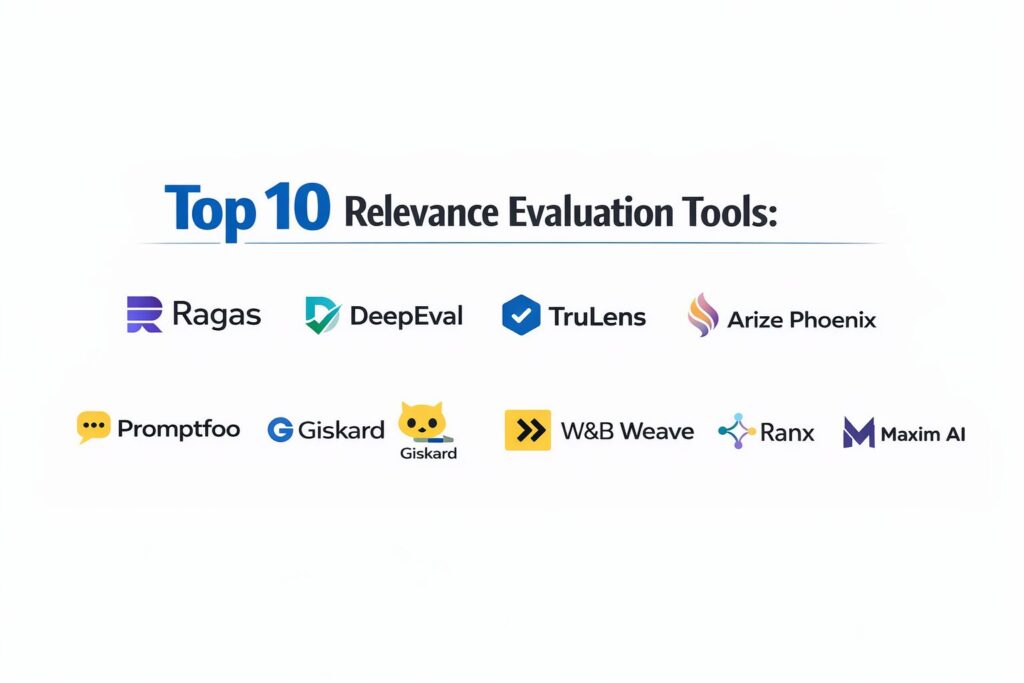
Introduction
Relevance evaluation has emerged as the critical frontier in the deployment of generative artificial intelligence and search systems. In the current era of Retrieval-Augmented Generation, the ability to programmatically determine whether an AI’s response is grounded in provided context—and whether that context was relevant to the user’s intent—is the difference between a production-ready application and a liability. Relevance evaluation toolkits provide the mathematical and algorithmic frameworks necessary to quantify “vibes” into verifiable data. These toolkits allow engineers to measure specific dimensions of performance, such as context precision, faithfulness, and answer relevance, ensuring that the information retrieved from vast vector databases is actually useful for the generation phase.
The transition from traditional keyword search to semantic, agentic workflows has complicated the evaluation landscape. We no longer just measure if a word matches; we measure if a concept aligns. This requires a sophisticated blend of statistical metrics and modern techniques where a stronger model acts as a judge for a smaller one. For those in the engineering and operations space, these toolkits are not just testing utilities—they are the guardrails of the entire lifecycle. By integrating these tools into the delivery pipeline, organizations can automate quality gates, preventing hallucinations from reaching the end user and maintaining a high standard of data integrity across complex, multi-modal systems.
Best for: Machine learning engineers, data scientists, and operations professionals who are building RAG-based applications, search engines, or autonomous agents that require rigorous, automated quality assurance and performance benchmarking.
Not ideal for: Teams building simple, deterministic applications where the output is always the same for a given input, or for projects where manual human review of every single output is feasible and cost-effective.
Key Trends in Relevance Evaluation Toolkits
A dominant trend is the move toward “LLM-as-a-judge,” where high-parameter models are used to evaluate the outputs of smaller, more efficient models. This approach allows for a level of semantic understanding that traditional metrics like word overlap could never achieve. Furthermore, there is a significant push toward “reference-free” metrics. In the past, evaluation required a “gold standard” or a human-written correct answer to compare against. Modern toolkits are now capable of assessing the quality of a response based purely on its internal consistency and its relationship to the retrieved documents, significantly reducing the labor required to build a test suite.
Another major shift involves the integration of evaluation directly into the observability stack. Instead of evaluation being a separate, “offline” phase, it is increasingly happening in “online” production environments. Engineers are now sampling live traffic and running relevance scores in near real-time to detect performance drift. This is accompanied by the rise of synthetic data generation for testing. Toolkits are now smart enough to look at your raw documentation and automatically generate thousands of question-and-answer pairs to test your system’s relevance before you even have your first real user.
How We Selected These Tools
Our selection process focused on toolkits that offer a balance between academic rigor and production-grade reliability. We prioritized frameworks that support the “RAG Triad”—the relationship between the query, the retrieved context, and the generated response. Tools were evaluated based on their ability to provide “explainable” scores; a simple number is not enough for an engineer to debug a system, so we favored toolkits that provide the reasoning behind why a particular relevance score was given.
We also considered the “developer experience” as a primary factor. In a fast-moving environment, the speed at which a toolkit can be integrated into a continuous integration pipeline is paramount. We looked for libraries with clear documentation, minimal boilerplate code, and the ability to work across various model providers. Security was the final pillar of our methodology. We selected tools that respect data privacy, offering options for local execution or secure, encrypted telemetry, ensuring that sensitive enterprise data used during the evaluation process remains protected.
1. Ragas
Ragas stands as one of the most widely adopted frameworks specifically designed for the evaluation of retrieval-augmented generation pipelines. It focuses on the internal components of a system, allowing developers to isolate whether a failure occurred because the search engine found the wrong information or because the generator misinterpreted the correct information. It has pioneered the use of specific metrics that have become industry standards for measuring the “hallucination” rate of language models.
Key Features
The toolkit provides a suite of metrics including faithfulness, which measures how much the answer is derived from the context, and answer relevance, which measures how well the response addresses the prompt. It includes context precision and context recall to evaluate the retrieval engine’s efficiency. Ragas also offers a powerful synthetic test data generation feature that can transform a set of documents into a comprehensive evaluation dataset. It is built to be framework-agnostic, meaning it can be used regardless of whether the underlying application is built with a specific orchestration library or a custom-coded solution.
Pros
It provides highly specialized metrics that are grounded in the latest research on language model behavior. The ability to generate test cases automatically from raw text significantly speeds up the development of a robust testing suite.
Cons
It relies heavily on calls to external models to calculate its scores, which can introduce additional costs and latency during the evaluation phase. Some of the metrics can be sensitive to the specific prompt used for the “judge” model.
Platforms and Deployment
Primarily a Python-based library that can be run in any local or cloud environment.
Security and Compliance
Does not store data internally; it acts as a processing layer. Users must ensure that the model providers they connect to for evaluation meet their internal security standards.
Integrations and Ecosystem
Integrates seamlessly with LangChain, LlamaIndex, and major vector databases, making it a staple in the modern AI engineering stack.
Support and Community
Maintains an active open-source community with frequent updates and a dedicated channel for technical troubleshooting and contribution.
2. DeepEval
DeepEval is an open-source framework that brings the philosophy of “unit testing” to the world of large language models. It is designed for developers who want to apply the same rigor to their AI outputs that they apply to their traditional software code. It allows for the creation of “test cases” that can be run automatically as part of a build process, ensuring that new updates to a model or prompt do not cause a regression in performance.
Key Features
The platform offers over fourteen different metrics, covering everything from hallucination and bias to toxicity and relevance. It includes a unique feature for “G-Eval,” which uses a specialized algorithm to allow models to score outputs based on custom-defined criteria in natural language. DeepEval provides a dashboard for visualizing test results over time, allowing teams to see if their model’s relevance is improving or degrading as the system evolves. It also supports “conversational” evaluation, which is critical for testing multi-turn agents where the context changes as the dialogue progresses.
Pros
The “pytest-like” syntax makes it extremely intuitive for software engineers to adopt. The visual dashboard provided for free in the open-source version is a significant advantage for tracking experiment history.
Cons
Setting up complex conversational test cases can require a more significant amount of initial configuration compared to simpler metrics.
Platforms and Deployment
Available as a Python library with a web-based dashboard for result visualization.
Security and Compliance
Offers an on-premise version of its dashboard for enterprise users who need to keep their evaluation data entirely within a private cloud environment.
Integrations and Ecosystem
Features built-in integrations for popular testing frameworks and continuous delivery tools.
Support and Community
Excellent documentation and a very responsive core team that provides support via digital communities and GitHub.
3. TruLens
TruLens provides a robust set of tools for evaluating and tracking the performance of applications built on top of large language models. It is built around the concept of “feedback functions,” which are programmatic ways to score the inputs, outputs, and intermediate steps of an AI application. This toolkit is particularly strong at identifying where in a “chain of thought” a particular error was introduced.
Key Features
The core of the toolkit is the “TruLens-Eval” library, which tracks and evaluates applications with a focus on the “RAG Triad.” It offers detailed tracing of every step in a model’s reasoning process, allowing for granular debugging of relevance issues. It includes pre-built feedback functions for groundedness, context relevance, and answer relevance. The toolkit also provides a “leaderboard” feature, where different versions of a prompt or model can be compared head-to-head on the same dataset to determine which configuration is most effective.
Pros
The visual tracing of the execution path is invaluable for debugging complex, multi-step agentic workflows. It offers a high degree of flexibility in defining custom feedback functions using any model or script.
Cons
The learning curve can be steeper for those who are not familiar with the concepts of instrumentation and tracing in software performance.
Platforms and Deployment
Runs as a local dashboard or can be integrated into cloud-based observability workflows.
Security and Compliance
Designed to be used with OpenTelemetry, allowing organizations to maintain control over their data flow and integrate with existing enterprise security monitors.
Integrations and Ecosystem
Highly compatible with LangChain and LlamaIndex, as well as several popular data science environments.
Support and Community
Backed by an established company in the AI quality space, offering both open-source and professional tiers of support.
4. Arize Phoenix
Arize Phoenix is an open-source observability library designed for the era of large language models. It focuses on providing “zero-config” insights into relevance, allowing developers to visualize their embeddings and identify “clusters” of failures. It is uniquely positioned as a bridge between traditional monitoring and modern evaluation, making it ideal for teams that want to troubleshoot production issues quickly.
Key Features
The toolkit features a powerful embedding visualizer that helps engineers see where their retrieval system is failing to find relevant documents. It provides automated “evaluators” for RAG systems that run on top of traces, allowing for the continuous measurement of relevance in production. It supports the OpenTelemetry standard, making it easy to export data to other enterprise tools. Phoenix also includes a “data exploration” mode where users can query their traces and evaluations using a SQL-like interface to find specific edge cases.
Pros
The visual representation of high-dimensional data makes it much easier to understand why certain queries are returning irrelevant results. Being entirely open-source and self-hostable makes it highly attractive for cost-conscious or privacy-focused teams.
Cons
The focus is more on “post-hoc” observability than on “pre-deployment” synthetic data generation, which may necessitate using it in conjunction with other tools.
Platforms and Deployment
A lightweight Python library that launches a local or hosted web server for data visualization.
Security and Compliance
Since it is self-hosted, all data remains within the user’s infrastructure, ensuring full compliance with internal data sovereignty policies.
Integrations and Ecosystem
Works with any framework that supports OpenTelemetry and has native support for common model providers.
Support and Community
Offers a vibrant community and a wealth of educational resources on the concepts of AI observability and relevance.
5. LangSmith
LangSmith is a production-grade platform for the entire lifecycle of an AI application, focusing heavily on the debugging and evaluation phases. Developed by the team behind the most popular orchestration framework, it provides a highly integrated experience for teams that want to move from an initial prototype to a reliable production system.
Key Features
The platform offers a comprehensive tracing engine that captures every interaction with a model, including the specific prompts, retrieved documents, and token usage. It includes an “Evaluation” module where users can create datasets from production logs and run them against various evaluators. It features a collaborative interface where human experts can review and “grade” model responses, which can then be used to “fine-tune” automated evaluators. It also provides a playground for testing prompt variations side-by-side with immediate relevance scoring.
Pros
The level of integration with the LangChain ecosystem is unparalleled, providing a “one-click” path from development to evaluation. The collaborative features make it the best choice for teams where developers and domain experts must work together on quality.
Cons
While it can be used independently, its full value is most easily realized when using the associated orchestration library. The managed service nature may not fit all enterprise budget models.
Platforms and Deployment
Available as a managed cloud service with options for private deployments.
Security and Compliance
Provides enterprise features like single sign-on, role-based access control, and is built to handle the rigorous security requirements of large-scale organizations.
Integrations and Ecosystem
Native integration with the entire LangChain suite and a broad range of model APIs and vector stores.
Support and Community
Extensive documentation, professional support options, and a massive community of users and contributors.
6. Promptfoo
Promptfoo is a command-line utility and library designed for systematic testing of model prompts and outputs. It is built for speed and efficiency, allowing developers to run hundreds of test cases in seconds to evaluate how changes in a prompt or model version affect the relevance and accuracy of the results.
Key Features
The tool uses a declarative configuration format where users define their test cases, prompts, and evaluation metrics in a single file. It supports a wide variety of metrics, including semantic similarity, model-graded relevance, and traditional regex-based checks. It provides a “matrix” testing feature that can compare multiple prompts against multiple models simultaneously. The toolkit also includes a local web viewer that generates a side-by-side comparison table of all test results, making it easy to spot regressions.
Pros
It is extremely lightweight and fast, making it the perfect tool for local development and CI/CD pipelines. The declarative approach makes it easy to version-control your evaluation logic along with your code.
Cons
The command-line focus may be less appealing to users who prefer a more GUI-driven experience for all aspects of their workflow.
Platforms and Deployment
A cross-platform CLI tool that runs on any environment where the associated runtime is supported.
Security and Compliance
Operates locally by default, ensuring that prompts and test data are not uploaded to a third-party server unless configured to do so.
Integrations and Ecosystem
Supports dozens of model providers and integrates easily with GitHub Actions and other automation tools.
Support and Community
A fast-growing open-source community with a focus on developer productivity and rapid iteration.
7. Giskard
Giskard is a specialized framework for the evaluation of AI models with a heavy emphasis on safety, security, and quality control. It goes beyond simple relevance to look for “vulnerabilities” in how a model handles information, making it an essential tool for high-stakes industries like finance or healthcare.
Key Features
The toolkit features a “RAGET” (RAG Evaluation Toolkit) that automatically scans a system for specific failure modes like hallucinations, PII leakage, and misinformation. It includes a collaborative “Hub” where non-technical stakeholders can interact with models and “flag” incorrect or irrelevant responses. Giskard provides automated “quality scans” that can detect biases or performance drops in specific subsets of your data. It also generates detailed compliance reports that are helpful for internal audits and regulatory requirements.
Pros
Its focus on “safety-first” evaluation makes it unique in the market. The ability to involve non-technical team members in the evaluation process through the Hub is a major organizational benefit.
Cons
The interface and feature set are more specialized for “risk and compliance,” which might be more than what is needed for simple creative applications.
Platforms and Deployment
Available as an open-source Python library with a collaborative web-based Hub that can be self-hosted.
Security and Compliance
Specifically designed to help organizations meet the requirements of emerging AI regulations, with strong features for data privacy and auditability.
Integrations and Ecosystem
Works well with common data science libraries and has dedicated modules for testing RAG pipelines and tabular models.
Support and Community
Provides professional-grade support and a community focused on ethical and reliable AI development.
8. Weights & Biases Weave
Weights & Biases has long been the gold standard for experiment tracking in traditional machine learning, and Weave is their dedicated toolkit for the generative AI era. It is designed to track every detail of an LLM application’s development, from initial prompt engineering to final production evaluation.
Key Features
Weave provides a “one-line” integration that captures all inputs and outputs from a model, along with their associated metadata. It features a highly flexible evaluation system where users can define custom “scorers” to measure relevance, tone, or accuracy. The platform offers a powerful visualization suite for comparing different “traces” of an application’s execution. It also includes “leaderboards” that allow teams to track the progress of their relevance metrics over time and across different experimental branches.
Pros
It leverages the familiar and powerful Weights & Biases interface, making it an easy transition for existing ML teams. The ability to handle multimodal data (text, images, audio) in the same evaluation framework is a significant plus.
Cons
As part of a larger ecosystem, it may feel “heavyweight” if your only requirement is a simple relevance score for a single project.
Platforms and Deployment
Available as a managed cloud platform with enterprise-grade on-premise options.
Security and Compliance
Highly mature security model with SOC 2 compliance, SSO integration, and robust data encryption at rest and in transit.
Integrations and Ecosystem
Deeply integrated with the broader Weights & Biases suite and compatible with all major AI frameworks and libraries.
Support and Community
Large, professional support team and a global community of machine learning and AI practitioners.
9. Ranx
Ranx is a specialized library for the evaluation of ranking and retrieval systems. While many modern toolkits focus on the “generation” side of AI, Ranx is the definitive tool for engineers who need to optimize the “retrieval” side—ensuring that the information fetched from a database is mathematically the most relevant.
Key Features
The toolkit provides a comprehensive implementation of almost every ranking metric used in information retrieval, including nDCG, Mean Average Precision (MAP), and Mean Reciprocal Rank (MRR). It is highly optimized for performance, allowing it to evaluate millions of queries against large-scale datasets in seconds. It includes tools for “statistical significance” testing, which helps engineers determine if an improvement in a relevance score is a real trend or just random noise. Ranx also supports “fusion” methods, allowing users to combine the results of different search algorithms and evaluate the hybrid outcome.
Pros
It is the most scientifically rigorous tool for measuring search and retrieval performance. The speed of the library is exceptional, making it suitable for extremely large benchmarking tasks.
Cons
It does not handle the “generative” side of AI evaluation; it is purely focused on the relevance of ranked lists of data.
Platforms and Deployment
A high-performance Python library designed for local or server-side execution.
Security and Compliance
As a standalone library with no cloud dependencies, it offers the highest level of data privacy as no data ever leaves the local environment.
Integrations and Ecosystem
Can be easily integrated into any data pipeline and used as the evaluation engine for search-heavy applications.
Support and Community
A niche but dedicated community of search and information retrieval experts.
10. Maxim AI
Maxim AI is an end-to-end platform for the evaluation and observability of AI agents and complex RAG systems. It is designed to unify the “offline” development environment with “online” production monitoring, creating a continuous feedback loop that drives relevance improvements.
Key Features
The platform features a “simulation” engine where teams can test their AI agents across hundreds of diverse scenarios and user personas. It provides a “Store” of pre-built evaluators for common tasks, along with the ability to build custom “LLM-as-a-judge” metrics. Maxim includes a powerful data curation engine that helps teams convert production failures into new test cases automatically. It also features detailed tracing and alerting, notifying teams immediately when relevance scores in production fall below a specific threshold.
Pros
It offers one of the most comprehensive “lifecycle” views, connecting the dots between initial testing and real-world performance. The agent simulation feature is uniquely powerful for testing complex, multi-step systems.
Cons
The breadth of the platform may involve a higher setup time compared to single-purpose libraries.
Platforms and Deployment
Available as a managed cloud platform with flexible deployment options for enterprise needs.
Security and Compliance
Built with enterprise-grade security, offering fine-grained role-based access control and comprehensive audit logging.
Integrations and Ecosystem
Supports a wide range of model providers, frameworks, and continuous integration tools.
Support and Community
Provides dedicated support for enterprise clients and an active community for open-source users.
Comparison Table
| Tool Name | Best For | Platform(s) Supported | Deployment | Standout Feature | Public Rating |
| 1. Ragas | RAG-specific Metrics | Python | Local/Cloud | Synthetic Test Generation | 4.8/5 |
| 2. DeepEval | Developer Unit Testing | Python | Local/Web | Pytest Integration | 4.7/5 |
| 3. TruLens | Chain-of-Thought Eval | Python | Local/Web | RAG Triad Tracing | 4.6/5 |
| 4. Arize Phoenix | Open Observability | Python | Self-Hosted | Embedding Visualization | 4.5/5 |
| 5. LangSmith | Production-grade Eval | Cloud | Managed/VPC | LangChain Ecosystem | 4.7/5 |
| 6. Promptfoo | Fast CLI Testing | Node/Python | Local/CLI | Matrix Prompt Testing | 4.6/5 |
| 7. Giskard | Safety & Compliance | Python | Self-Hosted | Vulnerability Scanning | 4.4/5 |
| 8. W&B Weave | Experiment Tracking | Cloud | Managed/VPC | Multimodal Support | 4.8/5 |
| 9. Ranx | Search Optimization | Python | Local | Statistical Significance | 4.5/5 |
| 10. Maxim AI | Agent Simulation | Cloud | Managed | End-to-End Lifecycle | 4.6/5 |
Evaluation & Scoring of Relevance Evaluation Toolkits
The scoring below is a comparative model intended to help shortlisting. Each criterion is scored from 1–10, then a weighted total from 0–10 is calculated using the weights listed. These are analyst estimates based on typical fit and common workflow requirements, not public ratings.
Weights:
- Core features – 25%
- Ease of use – 15%
- Integrations & ecosystem – 15%
- Security & compliance – 10%
- Performance & reliability – 10%
- Support & community – 10%
- Price / value – 15%
| Tool Name | Core (25%) | Ease (15%) | Integrations (15%) | Security (10%) | Performance (10%) | Support (10%) | Value (15%) | Weighted Total |
| 1. Ragas | 10 | 8 | 9 | 8 | 8 | 9 | 10 | 9.05 |
| 2. DeepEval | 9 | 10 | 9 | 9 | 9 | 9 | 10 | 9.25 |
| 3. TruLens | 9 | 7 | 9 | 9 | 8 | 9 | 8 | 8.45 |
| 4. Arize Phoenix | 8 | 8 | 9 | 10 | 9 | 8 | 9 | 8.60 |
| 5. LangSmith | 9 | 9 | 10 | 9 | 9 | 10 | 7 | 8.95 |
| 6. Promptfoo | 8 | 9 | 8 | 10 | 10 | 8 | 9 | 8.75 |
| 7. Giskard | 8 | 7 | 8 | 10 | 8 | 9 | 8 | 8.20 |
| 8. W&B Weave | 9 | 8 | 9 | 10 | 9 | 9 | 8 | 8.85 |
| 9. Ranx | 10 | 6 | 7 | 10 | 10 | 7 | 10 | 8.65 |
| 10. Maxim AI | 9 | 7 | 9 | 9 | 8 | 9 | 8 | 8.45 |
How to interpret the scores:
- Use the weighted total to shortlist candidates, then validate with a pilot.
- A lower score can mean specialization, not weakness.
- Security and compliance scores reflect controllability and governance fit, because certifications are often not publicly stated.
- Actual outcomes vary with assembly size, team skills, templates, and process maturity.
Which Relevance Evaluation Toolkit Is Right for You?
Solo / Freelancer
For individuals working on small-scale projects, Promptfoo or Ragas are the optimal choices. These tools provide the highest “value for time,” allowing for quick setup and immediate insights into model relevance without the need for complex infrastructure or expensive subscriptions.
SMB
Small to medium businesses benefit most from DeepEval. Its ease of use and the built-in visual dashboard allow a small team of engineers to maintain high quality across multiple projects without a dedicated QA department, while the pytest-style syntax keeps development overhead low.
Mid-Market
Organizations with a growing suite of AI applications should look at Arize Phoenix or TruLens. These tools provide the necessary observability and tracing to manage more complex systems where the relationship between data retrieval and generation is harder to untangle.
Enterprise
Large enterprises with strict security and compliance requirements are best served by LangSmith or Weights & Biases Weave. These platforms offer the robust security features, role-based access, and centralized audit trails required to manage AI performance across hundreds of users and dozens of departments.
Budget vs Premium
If budget is the primary constraint, Ranx and Arize Phoenix offer industry-leading capabilities entirely for free. If the priority is a polished, end-to-end experience with professional support, LangSmith and Maxim AI provide a premium ecosystem that justifies their cost through increased developer velocity.
Feature Depth vs Ease of Use
Ragas offers the most specialized depth in RAG-specific metrics but requires more understanding of AI concepts. Conversely, Promptfoo is much easier to pick up but provides a more “general-purpose” testing interface that may not capture the nuances of retrieval failures as deeply.
Integrations & Scalability
Teams heavily invested in the LangChain framework will find LangSmith to be the most scalable option due to its native integration. For those using a wide variety of different tools and frameworks, the OpenTelemetry support in Arize Phoenix ensures long-term scalability without vendor lock-in.
Security & Compliance Needs
Giskard is the definitive choice for organizations where compliance is a primary concern. Its focus on scanning for vulnerabilities and generating audit-ready reports provides a level of legal and operational protection that more generalist evaluation tools do not prioritize.
Frequently Asked Questions (FAQs)
1. What is the difference between relevance and accuracy?
Relevance measures how well a response addresses the intent and context of a query, while accuracy measures whether the information provided is factually correct. An answer can be relevant but inaccurate, or accurate but irrelevant to the user’s specific question.
2. Why should I use a specialized toolkit instead of manual review?
Manual review does not scale and is prone to human fatigue. These toolkits provide consistent, repeatable, and automated benchmarks that can handle thousands of test cases in the time a human can review one, ensuring a much higher overall quality standard.
3. What are “reference-free” metrics in evaluation?
Reference-free metrics are scores that do not require a “correct” human-written answer to compare against. They use the internal relationship between the prompt, the retrieved data, and the response to determine quality, which is essential for scaling evaluation.
4. Can these tools help reduce hallucinations in my model?
Yes, by using metrics like “faithfulness” or “groundedness,” these tools detect when a model is making things up rather than using provided information. Identifying these failures during testing allows you to adjust your prompts or retrieval logic to fix them.
5. How much does it cost to run these automated evaluations?
While many of the libraries are open-source and free, running “LLM-as-a-judge” metrics incurs token costs from your model provider. However, this is typically much cheaper and faster than hiring human annotators for the same task.
6. Do I need to be a data scientist to use these toolkits?
Most modern toolkits, like DeepEval and Promptfoo, are designed for software engineers and DevOps professionals. While a basic understanding of AI concepts is helpful, you do not need an advanced degree in data science to implement them.
7. Can I integrate these tools into my existing CI/CD pipeline?
Absolutely. Most of these tools offer command-line interfaces or Python APIs that are designed to be run as automated steps in systems like GitHub Actions or Jenkins, allowing you to “fail the build” if quality drops.
8. What is the “RAG Triad” in evaluation?
The RAG Triad refers to the three core relationships in a retrieval-augmented system: the relevance of the context to the query, the faithfulness of the answer to the context, and the relevance of the answer to the original query.
9. Is it safe to use my sensitive data with these evaluation tools?
Many of these tools, like Arize Phoenix and Giskard, offer local or self-hosted versions that ensure your data never leaves your environment. Always check the deployment model of a tool to ensure it meets your privacy requirements.
10. How often should I run these evaluations?
Evaluation should happen at three stages: during development when changing prompts or models, during the build process as a quality gate, and continuously in production to monitor for performance drift and new edge cases.
Conclusion
The implementation of a dedicated relevance evaluation toolkit is no longer an optional luxury but a fundamental requirement for the professional delivery of AI-powered systems. As the complexity of our retrieval and generation pipelines increases, the reliance on subjective “vibes” must be replaced by the rigor of quantifiable metrics. By adopting one of these top-tier frameworks, engineering teams can ensure their applications are not only relevant and accurate but also secure and compliant. The right toolkit bridges the gap between experimentation and production, providing the clarity needed to iterate with confidence and the safety needed to deploy at scale. Investing in these tools today is an investment in the reliability and reputation of your future AI infrastructure