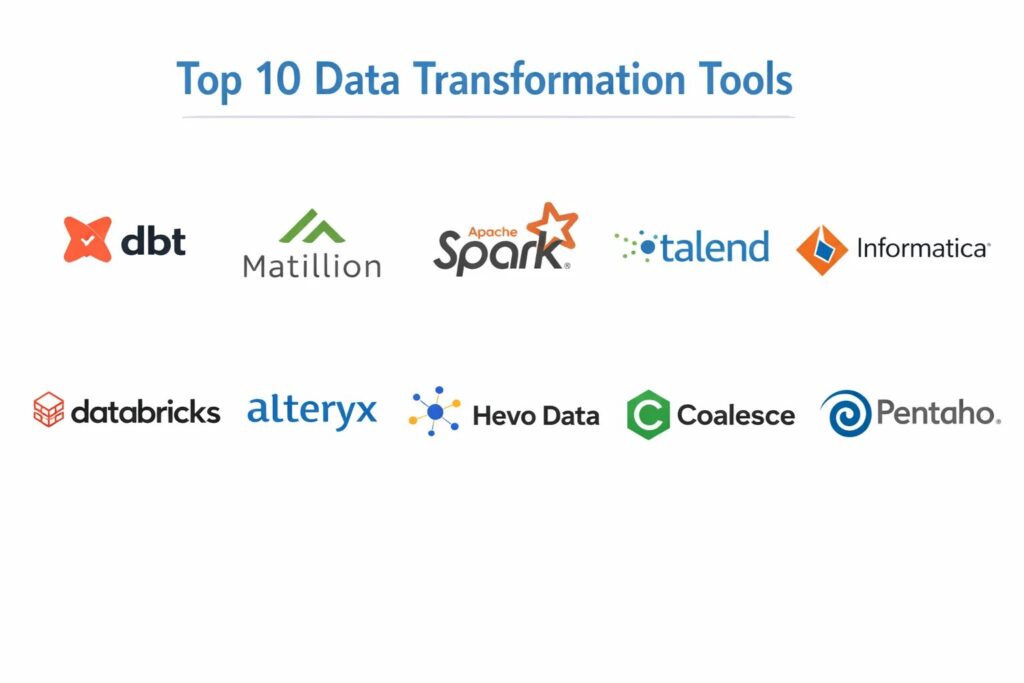
Introduction
Data transformation is the critical process of converting data from one format, structure, or state into another to make it usable for analysis, reporting, and operational intelligence. In the modern data stack, this process acts as the bridge between raw data ingestion and meaningful insight. It involves complex operations such as filtering, joining, aggregating, and normalizing data to ensure consistency across disparate systems. Whether through traditional Batch processing or modern Real-time streams, transformation is what turns “noise” into “signal.” As organizations move toward decentralized architectures, the ability to govern and automate these transformations has become a primary competitive advantage.
In the current data landscape, the shift from ETL (Extract, Transform, Load) to ELT (Extract, Load, Transform) has fundamentally changed how engineering teams operate. By leveraging the immense compute power of cloud data warehouses, transformation tools now allow for more agile, version-controlled, and scalable data modeling. When evaluating these platforms, technical leaders must look beyond basic functionality. Key criteria include support for “Data-as-Code” principles, the robustness of the scheduling engine, the granularity of data lineage tracking, and the security of the transformation pipeline. A high-performing transformation layer doesn’t just move data; it ensures that the data is trustworthy, documented, and ready for high-stakes decision-making.
Best for: Data engineers, analytics engineers, data scientists, and enterprise IT departments tasked with building scalable data pipelines and maintaining high-quality data models for business intelligence.
Not ideal for: Small teams with static, low-volume spreadsheets or organizations that lack a centralized data warehouse or lakehouse architecture. If your data processing needs are purely transactional and local, full-scale transformation platforms may introduce unnecessary complexity.
Key Trends in Data Transformation Tools
The industry is moving rapidly toward the “Data Mesh” concept, where transformation logic is decentralized across domain teams rather than being siloed in a single engineering department. This shift is supported by the rise of Low-code and No-code transformation interfaces that allow business analysts to participate in data modeling without writing complex SQL or Python. We are also seeing the integration of Artificial Intelligence to automate the mapping of source-to-target schemas and to suggest optimizations for expensive query patterns.
Version control and CI/CD for data—often referred to as DataOps—have become mandatory features for enterprise transformation tools. This ensures that every change to a data model is tested and documented before hitting production. Furthermore, there is a growing focus on “FinOps” within transformation, where tools provide real-time visibility into the compute costs associated with specific models. Finally, the convergence of Batch and Stream processing allows organizations to apply the same transformation logic to both historical data and live event streams, ensuring consistency across the entire data lifecycle.
How We Selected These Tools
Our selection process focused on identifying tools that excel in modern cloud-native environments and support high-scale enterprise requirements. We prioritized platforms that embrace the ELT paradigm, as this represents the dominant architectural shift in the industry. Market adoption and community strength were significant factors, as tools with large ecosystems offer better documentation and a wider range of pre-built connectors. We also evaluated each tool’s ability to handle “Data Lineage,” which is the visibility into how data changes as it moves through the pipeline.
Technical performance was assessed based on how well the tools utilize the underlying compute power of modern data warehouses. Security was a top priority, with a focus on role-based access control and secure credential management. We also considered the “Developer Experience,” looking for tools that support modular code, automated testing, and seamless integration with Git providers. Finally, we ensured a balance between code-heavy tools for engineering teams and visual-first platforms for broader organizational use.
1. dbt (Data Build Tool)
dbt has redefined the transformation layer by allowing data analysts and engineers to build data models using simple SQL select statements. It treats data transformation as a software engineering discipline, bringing version control, testing, and documentation to the world of analytics.
Key Features
The platform allows for modular SQL development using Jinja templates to create reusable code blocks. It features a built-in testing framework that validates data quality during the transformation process. The tool automatically generates documentation and visual lineage graphs that show exactly how data moves between tables. It supports version control via Git, enabling teams to collaborate through pull requests and code reviews. Its “adapter” system allows it to work natively with all major cloud data warehouses, pushing the compute load directly to the warehouse.
Pros
It bridges the gap between data engineering and business intelligence, allowing anyone who knows SQL to build production-grade models. The community ecosystem is vast, providing thousands of pre-built packages.
Cons
It does not handle the “Extract” or “Load” phases, requiring separate tools for data ingestion. The learning curve for Jinja and command-line operations can be a barrier for non-technical users.
Platforms and Deployment
Cloud-based (dbt Cloud) or self-hosted via command-line interface (dbt Core).
Security and Compliance
Offers single sign-on, role-based access control, and audit logging in its enterprise version. It is compliant with major data privacy standards.
Integrations and Ecosystem
Native support for Snowflake, BigQuery, Redshift, and Databricks, with deep integrations into orchestration tools like Airflow and Dagster.
Support and Community
Features one of the most active communities in the data space, with extensive documentation and a dedicated professional support tier.
2. Matillion
Matillion is an enterprise-grade ETL/ELT platform specifically built for cloud data warehouses. It combines a powerful visual interface with deep technical capabilities, making it suitable for both complex engineering tasks and high-speed data delivery.
Key Features
It provides a browser-based environment where users can build transformation logic through a drag-and-drop interface. The platform includes hundreds of pre-built connectors for popular SaaS applications and databases. It offers a “high-code” option where users can inject custom Python or SQL scripts for specialized logic. The tool features sophisticated job scheduling and error-handling capabilities. It is designed to scale dynamically with cloud environments, ensuring that large-scale data migrations are handled efficiently without manual infrastructure tuning.
Pros
The visual nature of the tool significantly speeds up the development of complex pipelines. It is highly optimized for performance on specific cloud platforms, leading to faster execution times.
Cons
The licensing model can be expensive for smaller organizations. It requires a dedicated instance to be deployed within the user’s cloud environment, adding to the infrastructure management overhead.
Platforms and Deployment
Cloud-native; deployed as an instance within AWS, Azure, or Google Cloud.
Security and Compliance
Supports multi-factor authentication, enterprise SSO, and fine-grained permissions. It is designed for SOC 2 and GDPR compliance.
Integrations and Ecosystem
Deeply integrated with Snowflake, Amazon Redshift, Google BigQuery, and Azure Synapse.
Support and Community
Provides dedicated account management and technical support, along with a robust training academy.
3. Apache Spark
Apache Spark is a unified analytics engine for large-scale data processing. While it is often used for machine learning and data science, its ability to transform massive datasets in a distributed fashion makes it the gold standard for big data engineering.
Key Features
It utilizes in-memory processing to perform transformations significantly faster than traditional disk-based systems. The platform supports multiple languages, including Python, Scala, and Java, allowing teams to use their preferred coding environment. Its “Spark SQL” module allows for the processing of structured data using familiar query patterns. It handles both batch and streaming data through a single programming model. The engine is highly extensible, with a rich library of modules for graph processing and advanced analytics.
Pros
It can handle petabyte-scale data transformation that would crash most other systems. Its versatility makes it suitable for everything from simple ETL to complex real-time data pipelines.
Cons
The operational complexity of managing Spark clusters is very high. It requires a high degree of technical expertise in distributed computing to optimize performance and costs.
Platforms and Deployment
Self-hosted on-premises or cloud-managed (via Databricks, Amazon EMR, or Google Cloud Dataproc).
Security and Compliance
Supports Kerberos authentication and fine-grained access control through integration with platforms like Apache Ranger.
Integrations and Ecosystem
Integrates with almost every major data source and storage format, including HDFS, S3, and various NoSQL databases.
Support and Community
As one of the most popular open-source projects, it has a global community of contributors and professional support available through multiple vendors.
4. Talend (Qlik)
Talend provides a comprehensive suite of data integration and transformation tools that cater to the entire data lifecycle. It is known for its “Open Studio” origins and its ability to manage data quality and governance alongside transformation.
Key Features
The platform features a visual designer with thousands of pre-configured components for data mapping and transformation. It includes built-in data profiling and cleansing tools to ensure data accuracy before it reaches the warehouse. The tool supports “Zero-code” and “Low-code” development, making it accessible to a wide range of users. It offers robust metadata management and data lineage capabilities for compliance. The system can generate standalone Java or Spark code that can be deployed independently of the Talend environment.
Pros
It offers a unified platform for data integration, quality, and governance, reducing the need for multiple siloed tools. The open-source version provides a powerful entry point for smaller projects.
Cons
The enterprise version is a high-cost investment. The user interface can feel heavy and complex compared to modern, lightweight ELT tools.
Platforms and Deployment
On-premises, cloud, or hybrid deployment models.
Security and Compliance
Features comprehensive security controls, including data masking and encryption at rest and in transit.
Integrations and Ecosystem
Broad support for legacy on-premises systems and all major cloud service providers.
Support and Community
Offers professional services, global support tiers, and a large community of certified developers.
5. Informatica Cloud Data Integration
Informatica is a long-standing leader in the data management space, and its cloud-native integration service is designed for enterprise-scale digital transformation and complex hybrid-cloud environments.
Key Features
It uses an AI-powered engine called CLAIRE to automate data discovery and transformation mapping. The platform provides a high-productivity visual interface for building complex logic. It supports “Advanced Serverless” execution, allowing transformations to run without the need to manage underlying servers. The system includes integrated data quality and master data management features. It is built on a microservices architecture, ensuring high availability and scalability for mission-critical enterprise data flows.
Pros
Unrivaled for managing complex, multi-cloud, and hybrid data environments in large global organizations. The AI-driven suggestions significantly reduce manual development time.
Cons
Often considered the most expensive option on the market, making it less accessible for startups. Its enterprise-first focus can make simple tasks feel overly engineered.
Platforms and Deployment
Cloud-native platform (IDMC) with support for hybrid deployments.
Security and Compliance
Exceeds most industry standards for security, with deep compliance support for HIPAA, SOC 2, and GDPR.
Integrations and Ecosystem
Deeply integrated with SAP, Oracle, Salesforce, and all major cloud data warehouses.
Support and Community
Provides premium enterprise support, dedicated success managers, and extensive certification programs.
6. Databricks (Delta Live Tables)
Databricks has pioneered the “Lakehouse” architecture, and its Delta Live Tables (DLT) service simplifies the transformation of data by providing a declarative framework for building reliable and scalable data pipelines.
Key Features
DLT manages the underlying infrastructure automatically, ensuring that pipelines scale based on the volume of data. It provides built-in quality monitoring and “expectations” that prevent bad data from moving downstream. The platform allows for the use of SQL or Python within the same pipeline. It handles both batch and streaming data seamlessly, ensuring consistency across all data models. The tool includes advanced lineage tracking and an integrated development environment for collaborative coding.
Pros
Perfect for organizations already using Databricks, as it deeply integrates with the Delta Lake storage format. It simplifies the operational burden of managing complex Spark-based pipelines.
Cons
The platform is primarily optimized for the Databricks ecosystem, which may lead to vendor lock-in. Costs can escalate quickly if compute resources are not carefully managed.
Platforms and Deployment
Cloud-managed service available on AWS, Azure, and Google Cloud.
Security and Compliance
Utilizes Unity Catalog for unified governance and fine-grained access control across the entire lakehouse.
Integrations and Ecosystem
Strongest within the Spark and Delta Lake ecosystem, with growing support for various BI tools and data sources.
Support and Community
Excellent professional support and a rapidly growing community centered around the Lakehouse architecture.
7. Alteryx
Alteryx focuses on “Analytic Process Automation,” providing a platform where business users can perform complex data transformation and spatial analytics without writing code.
Key Features
The platform features an intuitive drag-and-drop interface with hundreds of pre-built “tools” for joining, parsing, and cleaning data. it includes specialized modules for predictive and spatial analytics. The tool allows users to build “Analytic Apps” that can be shared across the organization. It supports “In-Database” processing, pushing transformation logic directly to the warehouse for improved performance. The system also includes a robust library of connectors for popular business applications like Salesforce and Tableau.
Pros
Empowers business analysts to perform advanced data work that would otherwise require a data engineer. The time-to-value is very fast for non-technical teams.
Cons
The desktop-first heritage can make collaboration and version control more challenging than code-based tools. It is a high-cost platform tailored for enterprise budgets.
Platforms and Deployment
Windows Desktop (Designer) with cloud-based sharing and scheduling (Alteryx Server/Cloud).
Security and Compliance
Supports enterprise-standard security, including SSO and role-based permissions at the server level.
Integrations and Ecosystem
Excellent integration with BI visualization tools like Tableau and Power BI.
Support and Community
A very passionate community of “Alteryx Aces” and a high level of professional training support.
8. Hevo Data
Hevo Data is a “No-code” data pipeline platform that simplifies the process of moving and transforming data from diverse sources into a destination of choice.
Key Features
It provides an automated data mapping engine that handles schema changes without manual intervention. The platform includes a “Python-based” transformation layer for users who need custom logic beyond basic mapping. It features real-time data streaming capabilities for immediate insight. The system is designed to be completely “Zero-maintenance,” with the platform handling all infrastructure scaling and error recovery. It offers a very transparent, consumption-based pricing model that is attractive to mid-market companies.
Pros
Extremely easy to set up; a production-ready pipeline can be built in minutes. It offers a very high degree of automation for schema and metadata management.
Cons
The transformation layer is less powerful than dedicated tools like dbt for complex data modeling. It is primarily focused on ingestion rather than deep, multi-stage transformations.
Platforms and Deployment
Cloud-native platform.
Security and Compliance
SOC 2 compliant with support for two-factor authentication and data encryption at rest.
Integrations and Ecosystem
Supports over 150 connectors for SaaS apps, databases, and cloud warehouses.
Support and Community
Offers 24/7 live chat support and a growing library of technical documentation.
9. Coalesce
Coalesce is a specialized transformation platform built exclusively for Snowflake. It aims to combine the ease of a visual tool with the flexibility and scalability of code.
Key Features
The platform uses a “column-aware” architecture that makes managing thousands of tables and columns much faster. It generates native Snowflake SQL, ensuring that transformations are optimized for the warehouse. The tool provides a visual interface for building models but allows users to edit the underlying code at any time. It features advanced metadata management and automated documentation. It is designed specifically for “Data-as-Code” workflows, supporting Git integration and automated deployment patterns.
Pros
Offers the most efficient developer experience for teams committed to the Snowflake platform. It significantly reduces the time required to build and maintain complex data architectures.
Cons
It is currently limited to the Snowflake ecosystem, which may not suit organizations with a multi-warehouse strategy. It is a specialized tool that requires a specific architectural choice.
Platforms and Deployment
Cloud-native; built on Snowflake.
Security and Compliance
Deeply integrated with Snowflake’s security model, supporting SSO and RBAC.
Integrations and Ecosystem
Optimized specifically for the Snowflake Data Cloud and its associated toolset.
Support and Community
Provides high-touch professional support and is building a focused community of Snowflake power users.
10. Pentaho (Hitachi Vantara)
Pentaho is a veteran in the data integration space, providing a comprehensive open-source and enterprise platform for data transformation and business analytics.
Key Features
It features a powerful visual designer for building ETL jobs and transformation steps. The platform includes a “Metadata Injection” feature that allows for dynamic pipeline creation. It supports integration with big data ecosystems like Hadoop and Spark. The system includes built-in reporting and dashboarding tools, providing a full-stack data solution. It offers a robust scheduling and orchestration engine for managing complex enterprise workflows across on-premises and cloud environments.
Pros
The open-source version provides significant power without a licensing fee. It is highly versatile, capable of handling legacy data tasks alongside modern integration needs.
Cons
The interface can feel dated compared to modern cloud-first tools. The enterprise version requires significant resources for maintenance and configuration.
Platforms and Deployment
On-premises, cloud, or hybrid.
Security and Compliance
Standard enterprise security protocols, including LDAP integration and role-based access.
Integrations and Ecosystem
Wide range of connectors for both traditional databases and modern cloud storage.
Support and Community
Strong open-source community support and professional enterprise services from Hitachi Vantara.
Comparison Table
| Tool Name | Best For | Platform(s) Supported | Deployment | Standout Feature | Public Rating |
| 1. dbt | Analytics Engineering | Cloud Warehouses | Hybrid | SQL-as-Code | 4.8/5 |
| 2. Matillion | Cloud-native ETL | AWS, Azure, GCP | Cloud | Visual Low-code | 4.5/5 |
| 3. Apache Spark | Big Data Processing | Distributed Clusters | Hybrid | In-memory Speed | 4.7/5 |
| 4. Talend | Data Governance | Multi-cloud | Hybrid | Unified Lifecycle | 4.2/5 |
| 5. Informatica | Global Enterprise | Multi-cloud | Cloud | AI-Powered Mapping | 4.4/5 |
| 6. Databricks | Lakehouse Pipelines | AWS, Azure, GCP | Cloud | Delta Live Tables | 4.6/5 |
| 7. Alteryx | Business Analytics | Windows | Hybrid | No-code Spatial/Predictive | 4.6/5 |
| 8. Hevo Data | Rapid Ingestion | Cloud | Cloud | Zero-maintenance Automation | 4.5/5 |
| 9. Coalesce | Snowflake Architects | Snowflake | Cloud | Column-aware Modeling | N/A |
| 10. Pentaho | Legacy & Big Data | Multi-platform | Hybrid | Open-source Versatility | 4.1/5 |
Evaluation & Scoring of Data Transformation Tools
The scoring below is a comparative model intended to help shortlisting. Each criterion is scored from 1–10, then a weighted total from 0–10 is calculated using the weights listed. These are analyst estimates based on typical fit and common workflow requirements, not public ratings.
Weights:
- Core features – 25%
- Ease of use – 15%
- Integrations & ecosystem – 15%
- Security & compliance – 10%
- Performance & reliability – 10%
- Support & community – 10%
- Price / value – 15%
| Tool Name | Core (25%) | Ease (15%) | Integrations (15%) | Security (10%) | Performance (10%) | Support (10%) | Value (15%) | Weighted Total |
| 1. dbt | 10 | 7 | 8 | 9 | 10 | 10 | 10 | 9.15 |
| 2. Matillion | 9 | 8 | 9 | 9 | 9 | 9 | 7 | 8.60 |
| 3. Apache Spark | 10 | 3 | 10 | 8 | 10 | 9 | 8 | 8.35 |
| 4. Talend | 8 | 7 | 10 | 9 | 8 | 9 | 6 | 8.10 |
| 5. Informatica | 10 | 6 | 10 | 10 | 9 | 10 | 5 | 8.55 |
| 6. Databricks | 10 | 6 | 9 | 10 | 10 | 9 | 8 | 8.85 |
| 7. Alteryx | 7 | 10 | 8 | 8 | 8 | 9 | 6 | 7.90 |
| 8. Hevo Data | 7 | 10 | 9 | 8 | 8 | 9 | 9 | 8.35 |
| 9. Coalesce | 8 | 9 | 6 | 9 | 10 | 8 | 8 | 8.25 |
| 10. Pentaho | 8 | 6 | 9 | 8 | 8 | 7 | 9 | 7.90 |
How to interpret the scores:
- Use the weighted total to shortlist candidates, then validate with a pilot.
- A lower score can mean specialization, not weakness.
- Security and compliance scores reflect controllability and governance fit, because certifications are often not publicly stated.
- Actual outcomes vary with assembly size, team skills, templates, and process maturity.
Which Data Transformation Tool Is Right for You?
Solo / Freelancer
For individuals, dbt Core (open source) or Hevo Data’s free tier offers the best balance of power and cost. These tools allow you to build professional pipelines without upfront investment, scaling as your data needs grow.
SMB
Small businesses should prioritize ease of use and low maintenance. Hevo Data and Matillion provide high levels of automation, allowing a small team to manage complex data flows without needing a dedicated team of data engineers.
Mid-Market
Organizations in this tier often benefit from the “Analytics Engineering” approach. Combining dbt Cloud with a modern warehouse like Snowflake or BigQuery provides a scalable, version-controlled environment that can be managed by SQL-savvy analysts.
Enterprise
For global organizations with legacy systems and high security requirements, Informatica or Talend are the strongest contenders. They provide the centralized governance and high-touch support necessary for mission-critical data operations.
Budget vs Premium
Budget: Apache Spark (open source) and dbt Core offer the most power for zero licensing cost, though they require high technical expertise.
Premium: Informatica and Alteryx offer high-end features and AI automation but come with premium enterprise pricing.
Feature Depth vs Ease of Use
Depth: Apache Spark and Houdini-level technical platforms like Databricks offer unlimited technical freedom.
Ease: Alteryx and Hevo Data allow users to see results in minutes through visual interfaces.
Integrations & Scalability
If your data lives in hundreds of different SaaS applications, Talend or Hevo Data offer the most comprehensive connector libraries. For pure scalability of data volume, Spark and Databricks remain unrivaled.
Security & Compliance Needs
Organizations in highly regulated industries like finance or healthcare should lean toward Informatica or dbt Cloud Enterprise, which offer the most robust audit trails and compliance certifications.
Frequently Asked Questions (FAQs)
1. What is the difference between ETL and ELT?
ETL transforms data before loading it into a warehouse, which was necessary when storage was expensive. ELT loads raw data first and uses the warehouse’s compute power to transform it, allowing for more flexibility and faster processing.
2. Is SQL still relevant for data transformation?
Absolutely. SQL remains the primary language for most transformation tools because it is declarative and widely understood. Even advanced platforms like dbt and Databricks rely heavily on SQL for their core modeling logic.
3. Do I need a data engineer to use these tools?
It depends on the tool. “No-code” platforms like Alteryx or Hevo can be managed by analysts. However, “Code-heavy” tools like Spark or dbt require a technical understanding of data structures and version control.
4. How do these tools handle data quality?
Modern tools include testing frameworks that check for null values, unique constraints, and accepted values during the transformation. Some, like Databricks, can even stop a pipeline if data quality drops below a certain threshold.
5. Can these tools handle real-time data?
Yes, several tools like Spark, Databricks, and Hevo are designed to process streaming data in real-time. This allows organizations to update their dashboards and operational systems as events happen.
6. What is data lineage and why does it matter?
Data lineage is a visual map showing the journey of data from its source to its final destination. It is critical for troubleshooting errors, understanding the impact of changes, and meeting regulatory compliance requirements.
7. Can I switch transformation tools easily?
It can be difficult, especially with visual tools where logic is stored in proprietary formats. Tools that use “SQL-as-Code” (like dbt) are generally easier to migrate because the core logic is stored in standard SQL files.
8. How do these tools impact cloud warehouse costs?
Since ELT tools push the work to the warehouse, inefficient transformation logic can lead to high compute costs. Many modern tools now include “FinOps” features to help you track and optimize these expenses.
9. Are open-source tools as secure as paid ones?
The core code of open-source tools is often highly secure due to community scrutiny. However, paid versions usually add the “Enterprise” security features like SSO, audit logs, and professional support that large organizations require.
10. What role does AI play in data transformation?
AI is increasingly used to suggest optimal table joins, automatically document code, and even generate transformation logic from natural language prompts, significantly reducing the manual workload for data teams.
Conclusion
The selection of a data transformation tool is a foundational architectural decision that determines the agility and reliability of an organization’s entire data ecosystem. As we move further into a cloud-first era, the choice is no longer just about moving data from point A to point B; it is about establishing a sustainable, governed, and scalable framework for data intelligence. Whether you opt for the developer-centric precision of dbt, the massive processing power of Spark, or the AI-driven automation of Informatica, the goal remains the same: ensuring that data is transformed into a strategic asset. By prioritizing lineage, quality, and version control, technical leaders can build pipelines that not only provide insights for today but are also resilient enough to handle the data challenges of tomorrow.
I find that this comprehensive guide to Data Transformation Tools is a vital resource for my role as a Data Architect. I learned from this blog that the industry has decisively shifted from traditional ETL to the ELT (Extract, Load, Transform) paradigm, where tools like dbt and Matillion leverage the raw compute power of cloud warehouses to handle massive datasets. In my real-world projects, I use these insights to choose between “code-first” tools like Apache Spark for petabyte-scale processing and “no-code” platforms like Alteryx to empower business analysts. For others, understanding this list means you can better align your toolset with your team’s technical maturity and your organization’s specific cloud strategy. My advice for learning from this blog is to pay close attention to the pros and cons of each tool, especially regarding cost and complexity; it’s easy to over-engineer a solution with Informatica when a lightweight tool like Hevo Data might solve your immediate needs more efficiently. How do you see the rise of AI-powered mapping changing the day-to-day responsibilities of data engineers over the next few years?