Introduction
Edge AI inference platforms represent the technical frontier where artificial intelligence moves from massive, centralized data centers to the localized devices where data is actually generated. In this architectural paradigm, “inference” refers to the process of a trained machine learning model making real-time predictions or decisions on new data—such as identifying a defect on a high-speed assembly line or detecting an obstacle for an autonomous drone—directly on the “edge” device. This shift is driven by the critical need to eliminate the latency associated with round-trip cloud communication, reduce expensive bandwidth consumption, and ensure data privacy by keeping sensitive information on-premises.
The strategic deployment of edge inference requires a deep understanding of the trade-off between computational power and energy efficiency. While cloud-based AI can utilize virtually unlimited resources, edge platforms operate within strict “SWaP” (Space, Weight, and Power) constraints. Modern platforms solve this through specialized silicon, such as Neural Processing Units (NPUs) and Application-Specific Integrated Circuits (ASICs), which are architected specifically for the mathematical operations required by deep learning. For an organization, choosing the right platform is no longer just about raw TFLOPS; it is about the maturity of the software stack, the reliability of the hardware in industrial environments, and the ability to manage a fleet of thousands of distributed intelligence nodes.
Best for: DevOps engineers, IoT architects, and AI researchers building real-time applications in robotics, autonomous vehicles, smart cities, and industrial automation where sub-millisecond latency is non-negotiable.
Not ideal for: Applications that require massive, multi-petabyte model training or “cold” data analytics where real-time response is unnecessary and centralized cloud processing offers better economies of scale.
Key Trends in Edge AI Inference Platforms
The most significant trend is the rise of “TinyML,” which enables complex inference on ultra-low-power microcontrollers, allowing AI to run on devices powered by coin-cell batteries for years. Simultaneously, we are seeing the emergence of “Generative AI at the Edge,” where optimized versions of Large Language Models (LLMs) and Vision Transformers are being deployed locally on high-end edge modules. This allows for natural language interfaces and advanced image synthesis without an internet connection, a feat previously thought impossible for edge hardware.
Sustainability and “Green AI” have also become central to platform development. Manufacturers are now competing on “Performance per Watt,” focusing on reducing the thermal footprint of edge nodes in fanless industrial environments. Additionally, the industry is moving toward “Federated Learning,” where models are refined locally on edge devices and only the updated weights—not the raw customer data—are sent back to the cloud. This trend, coupled with the “EU AI Act” and other global regulations, is making local inference a requirement for legal compliance in many jurisdictions.
How We Selected These Tools
The selection of these ten platforms was based on a rigorous evaluation of their hardware-software synergy and ecosystem maturity. We prioritized platforms that provide a comprehensive SDK (Software Development Kit) and robust model-optimization tools, such as quantization and pruning, which are essential for shrinking cloud-trained models to fit edge constraints. Reliability in “disconnected” or “air-gapped” scenarios was a primary criterion, as true edge AI must function without constant cloud tethers.
Technical performance was measured using industry-standard benchmarks for latency and throughput across various neural network architectures. We also considered the diversity of the form factors available—ranging from tiny M.2 modules to ruggedized industrial servers—to ensure the tools could meet the needs of different physical environments. Finally, we looked at the security features provided, specifically focusing on hardware “Root of Trust” and secure boot capabilities, which are vital for protecting AI models from physical tampering in the field.
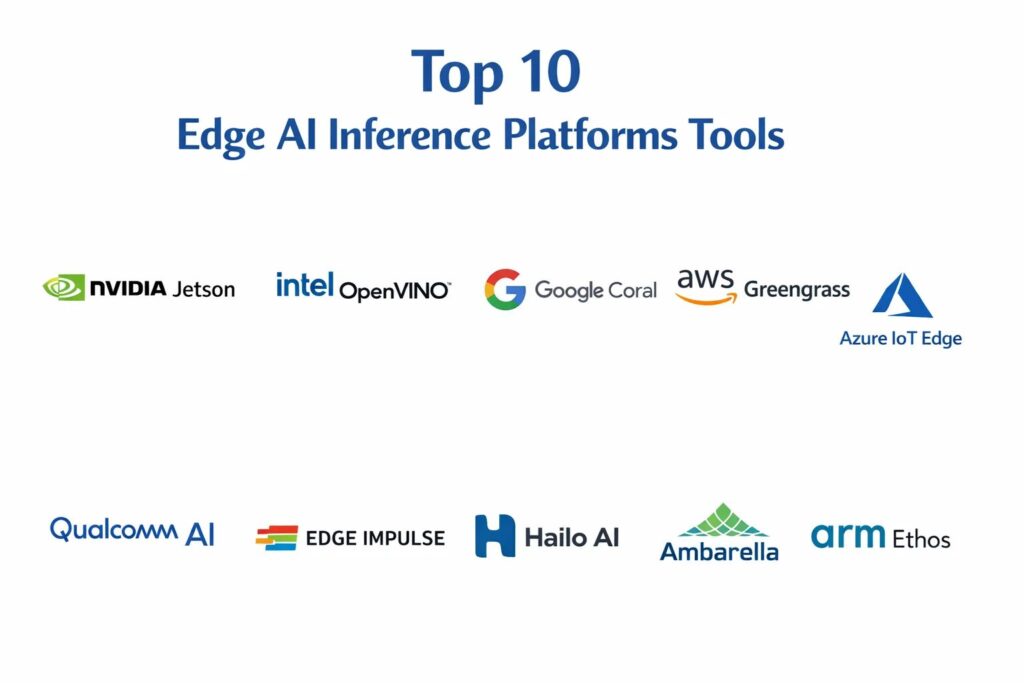
1. NVIDIA Jetson
The NVIDIA Jetson platform is the gold standard for high-performance edge AI. It utilizes the same CUDA-X software stack as NVIDIA’s data center GPUs, allowing developers to seamlessly port models from the cloud to small, energy-efficient modules. It is the premier choice for complex computer vision and robotics applications that require significant parallel processing power.
Key Features
The platform is powered by the JetPack SDK, which includes the TensorRT inference optimizer and DeepStream for multi-stream video analytics. It supports a wide range of hardware, from the entry-level Orin Nano to the industrial-grade AGX Orin, which delivers up to 275 TOPS of AI performance. It features native support for ROS 2 (Robot Operating System), making it a favorite for autonomous machine development. The modules are designed with unified memory architectures, reducing the overhead of data transfer between the CPU and GPU. It also includes hardware-accelerated video encoders and decoders for high-resolution 4K streams.
Pros
Unmatched computational performance for generative AI and high-resolution vision tasks. The largest and most mature developer community provides extensive libraries and pre-trained models.
Cons
High power consumption and hardware costs compared to specialized ASIC-based competitors. The complexity of the CUDA environment can lead to a steeper learning curve for beginners.
Platforms and Deployment
Linux-based (Ubuntu) with a focus on embedded modules and ruggedized edge gateways.
Security and Compliance
Features secure boot, hardware-accelerated disk encryption, and support for Trusted Execution Environments (TEE).
Integrations and Ecosystem
Deeply integrated with the NVIDIA NGC catalog and major MLOps platforms for edge device management.
Support and Community
Extensive documentation, active developer forums, and global enterprise support programs.
2. Intel OpenVINO
OpenVINO (Open Visual Inference and Neural network Optimization) is a cross-platform toolkit designed to optimize and deploy AI inference across Intel hardware. It is unique in its ability to extract high performance from standard CPUs, integrated GPUs, and specialized NPUs without requiring expensive dedicated AI hardware.
Key Features
The toolkit includes a Model Optimizer that converts models from frameworks like PyTorch and TensorFlow into an Intermediate Representation (IR). It features a “Plugin” architecture that allows the same code to run on a low-power Atom processor or a high-end Xeon server. It provides a library of highly optimized kernels for computer vision and speech processing. The platform includes a “Post-training Optimization Tool” (POT) for 8-bit quantization, significantly speeding up inference with minimal accuracy loss. It also supports “Auto-Device” selection, which dynamically allocates workloads to the best available hardware on the system.
Pros
Allows for high-performance AI on existing Intel-based industrial PCs, reducing the need for new hardware investment. It is open-source and highly portable across different operating systems.
Cons
Performance is primarily limited to Intel ecosystems, making it less ideal for ARM-based embedded systems. GPU acceleration is limited to integrated Intel graphics rather than discrete high-end GPUs.
Platforms and Deployment
Supports Windows, Linux, and macOS across a wide range of Intel silicon.
Security and Compliance
Supports Intel Software Guard Extensions (SGX) for secure, isolated workload execution.
Integrations and Ecosystem
Strong support for Kubernetes and Docker for containerized edge deployments.
Support and Community
Professional enterprise support via Intel and a massive library of pre-trained models in the Open Model Zoo.
3. Google Coral (Edge TPU)
Google Coral is built around the Edge TPU (Tensor Processing Unit), a specialized ASIC designed to run 8-bit quantized TensorFlow Lite models with extreme efficiency. It is the go-to platform for low-power embedded vision and sensor fusion in high-volume IoT products.
Key Features
The Edge TPU is capable of performing 4 trillion operations per second (TOPS) while consuming only 2 watts of power. It comes in various form factors, including USB accelerators, M.2 modules, and standalone Dev Boards. The platform is optimized exclusively for TensorFlow Lite, ensuring the most efficient execution of Google’s ML ecosystem. It features a “web-based” compiler that allows for quick model conversion without complex local environments. Coral also supports “on-device” backpropagation for limited retraining of the final layers of a model, allowing for localized adaptation to new environments.
Pros
Incredible performance-per-watt makes it ideal for fanless, battery-powered, or heat-sensitive devices. The hardware is highly affordable for prototyping and mass-market scaling.
Cons
Strictly limited to the TensorFlow Lite ecosystem, requiring significant model conversion work for users of other frameworks. Limited to 8-bit integer quantization, which can impact the accuracy of complex models.
Platforms and Deployment
Compatible with Linux, Windows, and macOS, with a strong focus on Debian-based systems.
Security and Compliance
Includes a built-in cryptographic coprocessor for secure device identification and data handling.
Integrations and Ecosystem
Seamless integration with Google Cloud IoT Core and Vertex AI for end-to-end MLOps.
Support and Community
Well-documented with a clean API, supported by Google’s vast developer relations network.
4. AWS IoT Greengrass
AWS IoT Greengrass is a software-centric platform that extends AWS cloud capabilities to edge devices. It allows for local inference using models trained in Amazon SageMaker while providing the robust management infrastructure needed for massive device fleets.
Key Features
The platform enables devices to act locally on the data they generate while still using the cloud for management, analytics, and durable storage. It supports a “Component” based architecture where AI models, Lambda functions, and Docker containers can be deployed as modular pieces. It features a local “Pub/Sub” message broker that allows devices to communicate with each other without an internet connection. Greengrass includes a pre-built “ML Feedback” component that can automatically send low-confidence predictions back to the cloud for human review and retraining. It also handles the complexities of OTA (Over-the-Air) updates and secret management at the edge.
Pros
The best choice for organizations already invested in the AWS ecosystem. It provides the most robust fleet management and orchestration tools for thousands of distributed nodes.
Cons
Heavy reliance on the AWS cloud for management and initial deployment. Can become expensive as the number of devices and the volume of synced data increases.
Platforms and Deployment
Supports any Linux-based OS and Windows, running on hardware from ARM microcontrollers to x86 servers.
Security and Compliance
Utilizes AWS IoT Core security protocols, including X.509 certificates and TLS encryption for all communications.
Integrations and Ecosystem
Directly integrated with the entire AWS suite, including SageMaker, Lambda, and S3.
Support and Community
Enterprise-grade support and a wide network of hardware partners in the AWS Partner Network.
5. Azure IoT Edge
Azure IoT Edge is Microsoft’s answer to distributed intelligence, focusing on “Containerized AI.” It treats AI models as Docker containers that can be deployed, managed, and monitored from the Azure Portal, offering a familiar environment for DevOps teams.
Key Features
The platform revolves around the “IoT Edge Runtime,” which manages the lifecycle of custom modules and communicates with the Azure IoT Hub. It supports “Offline Operation,” allowing edge devices to store data and execute inference during extended periods of connectivity loss. It integrates with Azure Machine Learning to automate the pipeline from cloud training to edge deployment. The system supports “Azure SQL Edge,” a lightweight database engine with built-in AI for streaming data. It also features a “Module Marketplace” where users can find pre-built AI modules for tasks like anomaly detection and facial recognition.
Pros
Excellent for enterprises that need to bridge the gap between IT and OT (Operational Technology). The container-based approach makes it highly flexible for deploying various AI frameworks.
Cons
The runtime has a higher memory footprint than more specialized edge-native agents. Setting up the full Azure IoT infrastructure can be complex for smaller projects.
Platforms and Deployment
Supports Linux and Windows, with a strong focus on “Azure Sphere” for highly secure IoT.
Security and Compliance
Features a “Security Manager” that acts as a hardware-independent interface for secure silicon (HSM/TPM).
Integrations and Ecosystem
Native integration with the Microsoft Azure cloud, including Stream Analytics and Cognitive Services.
Support and Community
Comprehensive documentation and strong support for industrial protocols like OPC-UA.
6. Qualcomm AI Stack
The Qualcomm AI Stack is a unified software framework that targets the NPUs and DSPs (Digital Signal Processors) within Snapdragon and Cloud AI 100 hardware. It is the premier platform for mobile-edge and 5G-connected AI, powering billions of smartphones and automotive cockpits.
Key Features
The stack includes the Qualcomm AI Engine Direct, which provides a low-level API for direct hardware acceleration. It features an “AI Model Efficiency Toolkit” (AIMET) for advanced compression and quantization. The platform is optimized for heterogeneous computing, allowing a single model to be split across the CPU, GPU, and NPU for maximum efficiency. It includes specific optimizations for 5G connectivity, enabling low-latency “Split-AI” where tasks are shared between the device and the network edge. It also supports the latest generative AI architectures, including on-device LLMs.
Pros
Industry-leading power efficiency and performance for mobile and automotive applications. Excellent support for high-bandwidth 5G environments.
Cons
Developer tools have traditionally been more closed-off compared to NVIDIA’s open ecosystem. Hardware is often tied to specific OEM devices rather than general-purpose modules.
Platforms and Deployment
Focused on Android, Linux, and Windows on ARM.
Security and Compliance
Utilizes Qualcomm’s Secure Processing Unit (SPU) for hardware-level isolation and biometric security.
Integrations and Ecosystem
Dominant in the mobile and automotive sectors with a growing footprint in industrial IoT via the “Snapdragon X Elite” series.
Support and Community
Professional support for hardware partners and a growing developer portal for AI researchers.
7. Edge Impulse
Edge Impulse is a leading “No-Code/Low-Code” platform that simplifies the end-to-end workflow of creating and deploying AI for the edge. It acts as a bridge between data scientists and embedded engineers, automating the complex process of signal processing and model optimization.
Key Features
The platform features an “EON Compiler” that optimizes neural networks to use up to 55% less RAM than standard runtimes. It provides a visual “Impulse” builder for creating data pipelines that include filtering, feature extraction, and inference. It supports a massive range of hardware, from tiny Arduino boards to high-end NVIDIA GPUs. The platform includes a “Data Acquisition” tool that can pull data directly from mobile phones or connected dev kits for rapid prototyping. It also features “Tuner,” an AutoML tool that automatically finds the best model architecture for a specific set of hardware constraints.
Pros
The fastest way to move from a raw sensor dataset to a working edge model. It is hardware-agnostic and provides excellent visibility into memory and latency metrics during the design phase.
Cons
The free tier is limited for professional use, and enterprise pricing can be high. It is less suited for “heavy” vision tasks compared to hardware-specific toolkits like JetPack.
Platforms and Deployment
Web-based development environment with deployment to any C++ compatible device.
Security and Compliance
Maintains high data privacy standards and allows for local, private data storage for enterprise accounts.
Integrations and Ecosystem
Strong partnerships with almost every major semiconductor manufacturer, including Nordic, Silicon Labs, and Sony.
Support and Community
Excellent tutorials, a very active community forum, and regular “TinyML” workshops.
8. Hailo AI
Hailo is a specialized AI chip company that provides high-throughput inference for vision-heavy applications. Their architecture is designed specifically for deep learning, offering the computational density of a high-end GPU in a tiny, fanless form factor.
Key Features
The Hailo-8 processor delivers up to 26 TOPS at a typical power consumption of only 2.5 watts. It utilizes a unique “Dataflow” architecture that minimizes the need for external memory access, which is the primary cause of latency and heat in traditional chips. The platform includes the Hailo “Dataflow Compiler,” which converts models from standard frameworks into a highly efficient hardware map. It supports high-frame-rate processing for multiple 4K cameras simultaneously. The modules are available in M.2 and Mini-PCIe form factors, making them easy to add to existing industrial PCs.
Pros
Best-in-class performance-per-watt for high-speed industrial vision and smart city cameras. It enables high-end AI in completely sealed, fanless enclosures.
Cons
The software ecosystem is smaller than the “Big Three” (NVIDIA, Intel, Google). The proprietary compiler can be restrictive for non-standard or custom neural network layers.
Platforms and Deployment
Focused on Linux and Windows-based edge gateways and smart cameras.
Security and Compliance
Provides secure boot and encrypted bitstream loading to protect the proprietary AI model.
Integrations and Ecosystem
Growing network of industrial PC partners like Advantech and Lanner.
Support and Community
Offers a dedicated “Developer Zone” with specialized support for high-volume industrial clients.
9. Ambarella
Ambarella specializes in “AI Vision” SoCs that combine high-end image signal processing (ISP) with dedicated AI acceleration. They are the market leader for safety-critical applications like autonomous driving and advanced security cameras.
Key Features
The CVflow architecture provides dedicated hardware acceleration for a variety of computer vision algorithms, including stereo vision and optical flow. It features an integrated ISP that can handle “Low-Light” and “High Dynamic Range” (HDR) video, ensuring the AI model receives high-quality data even in poor conditions. The “CV3-AD” family is designed specifically for autonomous driving, supporting multi-sensor fusion of cameras, radar, and lidar. The platform also includes tools for “Privacy Masking” and on-chip encryption to meet strict video surveillance regulations.
Pros
The most advanced integration of professional-grade camera technology and AI inference. Extremely low latency for safety-critical obstacle detection and path planning.
Cons
High entry cost and limited availability for individual hobbyists or small startups. The development environment is highly specialized for vision and video.
Platforms and Deployment
Embedded RTOS and Linux-based SoCs for automotive and security hardware.
Security and Compliance
Compliance with ASIL-D (Automotive Safety Integrity Level) and high-level cybersecurity standards for video data.
Integrations and Ecosystem
Deeply integrated with the global automotive Tier-1 supplier network.
Support and Community
Focused on enterprise-level engineering support for long-lifecycle industrial products.
10. ARM Ethos
ARM Ethos NPUs provide the foundational AI acceleration for billions of mobile and IoT devices. Rather than selling a standalone product, ARM licenses this technology to chip manufacturers, making it the “invisible” engine behind much of the world’s edge AI.
Key Features
The Ethos-U series is designed for microcontrollers (Cortex-M), while the Ethos-N series targets high-performance applications (Cortex-A). It features a “weight compression” technology that reduces the memory bandwidth required for inference by up to 3x. The platform is supported by the “Arm NN” software framework, which bridges the gap between ML frameworks and the underlying hardware. It supports a wide range of neural network operators, including CNNs and RNNs. It is architected for “Deterministic” performance, meaning the inference time is consistent, which is vital for real-time control systems.
Pros
The most ubiquitous and energy-efficient architecture for embedded AI. It benefits from the massive, standardized ARM software ecosystem.
Cons
As an IP provider, ARM does not sell the hardware directly; you must find a semiconductor partner that has implemented the Ethos NPU.
Platforms and Deployment
Deployment to any SoC or MCU that utilizes ARM’s licensed AI IP.
Security and Compliance
Integrates with ARM TrustZone for system-wide security and hardware-level isolation.
Integrations and Ecosystem
Part of the “Project Cassini” initiative to standardize the edge ecosystem for seamless software portability.
Support and Community
Extensive technical documentation and a massive global network of silicon and software partners.
Comparison Table
| Tool Name | Best For | Platform(s) Supported | Deployment | Standout Feature | Public Rating |
| 1. NVIDIA Jetson | High-end Robotics | Linux (Ubuntu) | Embedded | 275 TOPS Orin Module | 4.8/5 |
| 2. Intel OpenVINO | Standard x86 Hardware | Win, Linux, Mac | Cross-platform | CPU/iGPU Optimization | 4.6/5 |
| 3. Google Coral | Low-power Vision | Linux, Win, Mac | ASIC/USB | 2W Performance/Watt | 4.5/5 |
| 4. AWS Greengrass | AWS-centric Fleets | Linux, Windows | Cloud-Edge | SageMaker Integration | 4.4/5 |
| 5. Azure IoT Edge | Enterprise DevOps | Linux, Windows | Container | Containerized Modules | 4.4/5 |
| 6. Qualcomm AI | Mobile & 5G Edge | Android, Linux | SoC-native | 5G Split-AI Support | 4.7/5 |
| 7. Edge Impulse | Rapid Prototyping | Agnostic | SaaS/C++ | EON Compiler (TinyML) | 4.9/5 |
| 8. Hailo AI | Fanless Industrial | Linux, Windows | M.2/PCIe | Dataflow Architecture | 4.5/5 |
| 9. Ambarella | Automotive Vision | Embedded Linux | SoC-native | Integrated Pro-ISP | 4.3/5 |
| 10. ARM Ethos | Ultra-low Power | ARM Ecosystem | IP-based | Deterministic NPU | 4.2/5 |
Evaluation & Scoring of Edge AI Inference Platforms
The scoring below is a comparative model intended to help shortlisting. Each criterion is scored from 1–10, then a weighted total from 0–10 is calculated using the weights listed. These are analyst estimates based on typical fit and common workflow requirements, not public ratings.
Weights:
- Core features – 25%
- Ease of use – 15%
- Integrations & ecosystem – 15%
- Security & compliance – 10%
- Performance & reliability – 10%
- Support & community – 10%
- Price / value – 15%
| Tool Name | Core (25%) | Ease (15%) | Integrations (15%) | Security (10%) | Performance (10%) | Support (10%) | Value (15%) | Weighted Total |
| 1. NVIDIA Jetson | 10 | 7 | 10 | 9 | 10 | 10 | 7 | 9.05 |
| 2. Intel OpenVINO | 9 | 8 | 9 | 9 | 8 | 9 | 10 | 8.80 |
| 3. Google Coral | 8 | 9 | 8 | 8 | 9 | 8 | 10 | 8.55 |
| 4. AWS Greengrass | 9 | 7 | 10 | 10 | 8 | 9 | 7 | 8.55 |
| 5. Azure IoT Edge | 9 | 7 | 10 | 10 | 8 | 9 | 7 | 8.55 |
| 6. Qualcomm AI | 10 | 6 | 8 | 9 | 10 | 8 | 8 | 8.45 |
| 7. Edge Impulse | 7 | 10 | 10 | 8 | 7 | 9 | 9 | 8.35 |
| 8. Hailo AI | 9 | 7 | 7 | 9 | 10 | 8 | 8 | 8.35 |
| 9. Ambarella | 10 | 5 | 7 | 10 | 10 | 7 | 6 | 8.00 |
| 10. ARM Ethos | 8 | 6 | 9 | 9 | 9 | 8 | 9 | 8.15 |
How to interpret the scores:
- Use the weighted total to shortlist candidates, then validate with a pilot.
- A lower score can mean specialization, not weakness.
- Security and compliance scores reflect controllability and governance fit, because certifications are often not publicly stated.
- Actual outcomes vary with assembly size, team skills, templates, and process maturity.
Which Edge AI Inference Platforms Tool Is Right for You?
Solo / Freelancer
For individuals prototyping smart gadgets or hobbyist projects, Edge Impulse and Google Coral are the gold standards. They offer the lowest barrier to entry with high-quality documentation and affordable hardware, allowing you to go from an idea to a working model in a single afternoon.
SMB
Small businesses focusing on industrial vision or retail analytics should look at Intel OpenVINO or NVIDIA Jetson Orin Nano. These tools allow you to utilize mid-range hardware that balances cost with enough computational power to handle multi-camera feeds or complex object detection.
Mid-Market
For companies scaling their IoT footprint across multiple locations, AWS IoT Greengrass or Azure IoT Edge are essential. They provide the management “glue” that allows a small DevOps team to manage hundreds of devices without needing to manually SSH into every node for updates.
Enterprise
Large-scale manufacturers and smart city operators benefit most from Hailo AI or the Qualcomm AI Stack. These platforms offer the “performance-per-watt” and ruggedized reliability needed for permanent, 24/7 installations where energy costs and heat dissipation are critical business factors.
Budget vs Premium
If budget is the primary constraint, OpenVINO is the clear winner as it can turn almost any existing PC into an AI powerhouse for free. For premium, safety-critical performance in automotive or high-speed automation, the dedicated silicon from NVIDIA or Ambarella is a necessary investment.
Feature Depth vs Ease of Use
NVIDIA Jetson offers the deepest feature set but requires significant technical expertise. Conversely, Edge Impulse offers a streamlined, visual experience that abstracts away the complexity of embedded C++ at the cost of some fine-grained hardware control.
Integrations & Scalability
Scale is often limited by how well you can update your fleet. If your strategy involves deep cloud integration for long-term data analytics, the AWS and Azure platforms are unmatched. If you require a “closed-loop” system for extreme privacy, hardware-centric tools like Coral or Hailo are better.
Security & Compliance Needs
In highly regulated sectors like healthcare or defense, Azure IoT Edge (via Azure Sphere) and ARM Ethos (via TrustZone) provide the most robust, hardware-level security frameworks to ensure that your AI models and data remain tamper-proof.
Frequently Asked Questions (FAQs)
1. What is the difference between AI training and AI inference?
Training is the resource-heavy process of teaching a model using massive datasets, usually done in the cloud. Inference is the process of using that trained model to make predictions on new, real-world data, which can be done efficiently at the edge.
2. Can I run multiple AI models on a single edge device?
Yes, high-end platforms like NVIDIA Jetson or Hailo-8 are specifically designed to run multiple neural networks in parallel, such as running object detection and speech recognition simultaneously on a single module.
3. Do edge AI platforms require a constant internet connection?
No, one of the primary benefits of edge AI is the ability to perform inference completely offline. While you may need a connection for initial deployment or updates, the actual “decision-making” happens locally.
4. What is model quantization?
Quantization is the process of reducing the precision of a model’s weights (e.g., from 32-bit floats to 8-bit integers). This significantly reduces the memory footprint and speeds up inference with very little loss in accuracy.
5. Which programming languages are used for edge AI?
Python is the most common language for development and prototyping, while C++ is typically used for the final deployment to ensure maximum performance and minimum memory usage on the edge device.
6. Is edge AI more secure than cloud AI?
In many ways, yes. Since the data is processed locally and never leaves the device, it is not vulnerable to interception during transmission and is not stored on third-party servers, greatly reducing the “attack surface.”
7. How much power do these edge devices consume?
It ranges significantly: from a few milliwatts for TinyML microcontrollers to 5-15 watts for mid-range accelerators like Google Coral, and up to 60+ watts for high-end NVIDIA Jetson AGX modules.
8. Can I use my existing PyTorch or TensorFlow models at the edge?
Yes, but they usually require “conversion.” Tools like OpenVINO or the EON compiler will take your standard model and optimize it for the specific hardware architecture of your edge device.
9. What is “Latency” in the context of edge AI?
Latency is the time it takes for a device to receive data (like a video frame) and produce a result. At the edge, latency is often measured in milliseconds, which is critical for safety-sensitive tasks like braking an autonomous car.
10. What is “Performance per Watt”?
This is a metric used to measure how much AI work a device can do for every watt of electricity it consumes. It is the most important metric for mobile, battery-powered, or fanless edge applications.
Conclusion
The transition from cloud-centric AI to distributed edge inference is not merely a hardware upgrade; it is a fundamental shift in how we architect intelligent systems for the real world. As we look toward the remainder of 2026, the platforms that will dominate are those that can bridge the “gap of complexity” between high-level data science and low-level embedded engineering. The value of these tools lies in their ability to provide a consistent, secure, and high-performance environment that allows developers to treat the “Edge” as a first-class citizen in their software lifecycle. By choosing a platform that aligns with your specific constraints of power, latency, and scale, you are not just deploying a model; you are building a resilient, private, and hyper-responsive infrastructure that can perceive and act upon the world in real-time.