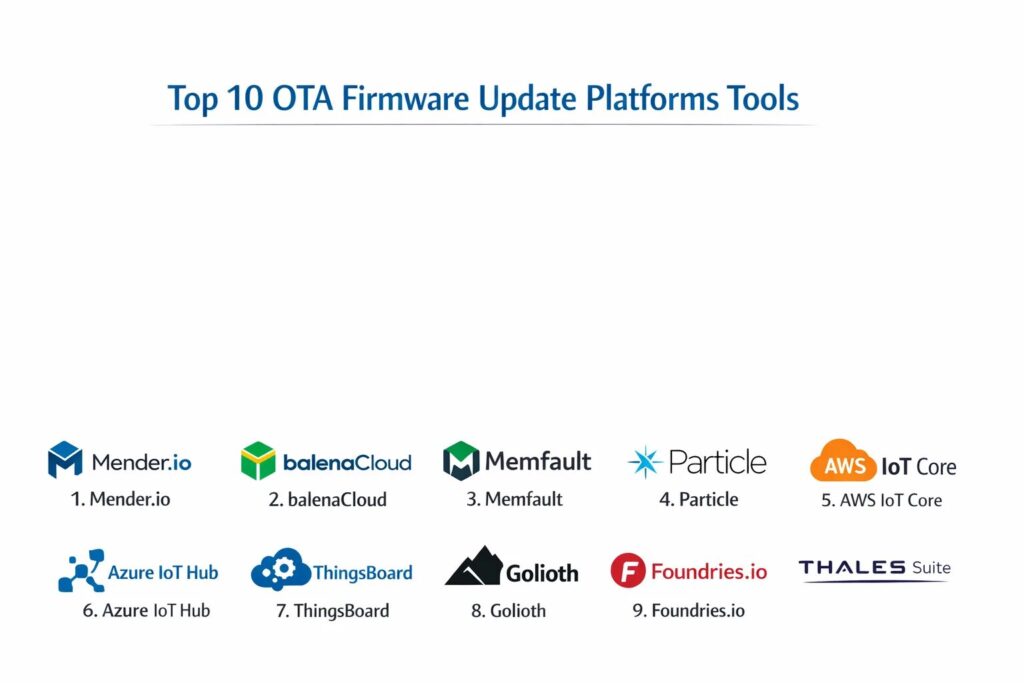
Introduction
Over-the-Air (OTA) firmware update platforms have become the backbone of the modern Internet of Things (IoT) and embedded systems ecosystem. As the number of connected devices scales into the billions, the ability to remotely patch security vulnerabilities, fix bugs, and deploy new features without physical access is no longer a luxury—it is a critical operational requirement. These platforms provide a secure, reliable bridge between a developer’s local build environment and a globally distributed fleet of hardware. For industries ranging from automotive and medical devices to industrial automation, an effective OTA strategy is the difference between a resilient product lifecycle and a catastrophic fleet-wide failure.
The complexity of managing firmware updates at scale involves more than just moving binary files from point A to point B. It requires sophisticated orchestration, including staged rollouts to minimize risk, automatic rollbacks if an update fails, and robust cryptographic signing to ensure code integrity. As cyber threats against edge devices grow more sophisticated, these platforms have integrated advanced security features like mutual Transport Layer Security (mTLS), secure boot integration, and anti-rollback protection. Choosing the right platform involves balancing the technical constraints of the device—such as memory, power, and bandwidth—with the enterprise’s need for compliance, observability, and fleet management efficiency.
Best for: IoT developers, embedded systems engineers, and fleet managers who need to maintain device security and functionality throughout the product lifecycle.
Not ideal for: Simple, non-connected hardware projects or legacy systems that lack the bootloader support necessary for remote firmware execution.
Key Trends in OTA Firmware Update Platforms
The most significant trend in the OTA space is the shift toward “Delta Updates,” where only the changed portions of the firmware are transmitted to the device. This drastically reduces data consumption and power usage, making it possible to update battery-powered devices over low-bandwidth cellular or satellite links. We are also seeing the integration of “Observability-First” updates, where platforms collect detailed health metrics and crash logs before and after a rollout. This allows teams to detect subtle performance regressions or memory leaks that might not trigger a total system failure but could impact long-term reliability.
Security compliance has also moved to the forefront, driven by new regulations like the EU Cyber Resilience Act and U.S. FDA requirements for medical devices. Modern OTA platforms now offer “out-of-the-box” compliance features, such as automated audit logs and multi-signature approval workflows. Furthermore, the rise of containerized edge computing is blurring the lines between traditional firmware updates and application-level deployments. Platforms are increasingly supporting Docker-based updates for powerful edge gateways while maintaining lightweight, partition-based updates for resource-constrained microcontrollers (MCUs).
How We Selected These Tools
Our selection process focused on identifying platforms that provide a reliable “end-to-end” update lifecycle, from the initial build to the final confirmation on the device. We prioritized tools that offer high “Update Success Rates” and robust failure recovery mechanisms, such as A/B partitioning and watchdog timers. Security was a non-negotiable criterion; we only selected platforms that support industry-standard encryption, secure key storage, and code signing. We also evaluated the developer experience, looking for well-documented SDKs and APIs that allow for seamless integration into existing CI/CD pipelines.
Scalability was another key factor, as a platform must be as effective at managing ten prototypes as it is at managing ten million production units. We looked for diversity in hardware support, ensuring the list includes options for everything from high-end Linux-based gateways to ultra-low-power RTOS-based sensors. Finally, we assessed the operational features of each platform, such as the ability to group devices by geography or hardware version, and the quality of the real-time monitoring dashboards that provide visibility into the progress of a global rollout.
1. Mender.io
Mender is a leading open-source OTA update manager designed for robustness and security in embedded Linux and microcontroller environments. It is widely recognized for its “A/B Partitioning” strategy, which ensures that a device always has a working version of firmware to fall back on in case of an update failure.
Key Features
The platform features a robust “dual-partition” update mechanism that provides a 100% guarantee against bricking devices during a power loss. It includes a “Mender Gateway” for managing updates across local networks or air-gapped environments. The system offers “Delta Updates” to minimize bandwidth usage by only sending changes between firmware versions. It features an “Artifact” management system that allows developers to package and sign firmware with cryptographic keys. It also provides “Phased Rollouts,” enabling teams to deploy updates to small groups before a full-scale release.
Pros
The open-source core allows for deep customization and local hosting for high-security environments. It provides excellent support for both Yocto and Debian-based Linux distributions.
Cons
The enterprise features can be expensive for smaller fleets. Setting up the A/B partition layout on existing hardware can be technically challenging.
Platforms and Deployment
Web-based SaaS and self-hosted Docker-based instances.
Security and Compliance
SOC 2 Type II, GDPR, and ISO 27001 compliant with built-in support for signed updates.
Integrations and Ecosystem
Seamlessly integrates with CI/CD tools like GitLab and Jenkins, and hardware platforms like Raspberry Pi and NVIDIA Jetson.
Support and Community
Maintains an active community forum “Mender Hub” and offers professional support for enterprise clients.
2. balenaCloud
Balena (formerly Resin.io) is an all-in-one IoT platform that brings modern containerization to the edge. It allows developers to manage OTA updates by pushing Docker containers to their devices, making software management as simple as it is in the cloud.
Key Features
The platform features “balenaOS,” a lightweight Linux distribution optimized for running containers on embedded hardware. It includes “balenaEngine,” a Docker-compatible container engine designed specifically for the resource constraints of IoT. The system offers a “Multi-container” architecture, allowing different parts of an application to be updated independently. It features “Public Device URLs” for remote troubleshooting and diagnostics. It also provides a “Local Mode” that allows developers to push code directly to a device over a local network for rapid prototyping.
Pros
Simplifies the update process by treating edge devices like cloud servers. The platform provides incredible ease of use for developers familiar with Docker and modern web technologies.
Cons
The reliance on containers can be too resource-intensive for very small, low-power microcontrollers. Users are often locked into the Balena ecosystem for the best experience.
Platforms and Deployment
Cloud-based SaaS with a specialized operating system for the hardware.
Security and Compliance
Implements rigorous security including encrypted storage and VPN-based device communication.
Integrations and Ecosystem
Integrates with GitHub and Bitbucket for automated “git push” deployments.
Support and Community
Offers a rich technical blog and an active developer community alongside enterprise-grade 24/7 support.
3. Memfault
Memfault is an “observability-first” platform that focuses on the health and performance of the device fleet as much as the update process itself. It is designed to help teams identify bugs in the field and deploy patches before users even notice an issue.
Key Features
The platform features “Automated Error Tracking,” which captures core dumps and stack traces from devices in the field. It includes “Fleet Observability” dashboards that monitor battery health, memory usage, and connectivity patterns. The system offers “Cohort-based Updates,” allowing for targeted rollouts based on hardware revision or user group. It features “Release Monitoring” that automatically pauses a rollout if it detects an increase in crash rates. It also provides “Diagnostic Snapshots” to help engineers reproduce difficult-to-find bugs.
Pros
Provides the best “post-update” visibility in the industry, ensuring that updates don’t introduce new problems. It is exceptionally lightweight and works well on even the smallest MCUs.
Cons
It is primarily a monitoring and OTA management tool and does not provide its own cloud storage for large binary files. The data-heavy nature of logs can increase cellular costs.
Platforms and Deployment
Web-based SaaS platform.
Security and Compliance
SOC 2 compliant with advanced data anonymization and secure transmission protocols.
Integrations and Ecosystem
Strong partnerships with Nordic Semiconductor, NXP, and AWS IoT.
Support and Community
Known for its “Interrupt” technical community and high-touch engineering support.
4. Particle
Particle provides an integrated “full-stack” IoT platform that covers everything from hardware and cellular connectivity to the OTA update cloud. It is the choice for companies that want a turnkey solution to move from prototype to production rapidly.
Key Features
The platform features “Zero-Configuration OTA,” where updates are managed through a simple web console or API with no custom bootloader code required. It includes “Particle Device OS,” a reliable firmware framework that handles connectivity and updates in the background. The system offers “Intelligent Firmware Releases” that automatically target devices by product type. It features “Vital Health Monitoring” to track the status of devices during the update process. It also provides “Cellular Data Management” to optimize the cost of updates over mobile networks.
Pros
Offers the most seamless experience for developers by providing a tightly coupled hardware and software stack. It significantly reduces the time to market for new connected products.
Cons
The platform is proprietary, meaning you are largely restricted to using Particle’s own hardware and connectivity services. It can be less flexible for highly custom Linux builds.
Platforms and Deployment
Full-stack cloud platform with integrated hardware.
Security and Compliance
Features multi-factor authentication, team permissions, and end-to-end encryption for all updates.
Integrations and Ecosystem
Integrates with Google Cloud, Azure, and various webhooks for data orchestration.
Support and Community
Maintains one of the largest and most helpful developer communities in the IoT space.
5. AWS IoT Core (Jobs & OTA)
For organizations already embedded in the Amazon ecosystem, AWS IoT Core provides a highly scalable framework for managing OTA updates through its “Jobs” and “OTA Update” services. It is built for massive fleets requiring enterprise-grade infrastructure.
Key Features
The platform features “AWS IoT Jobs,” which orchestrates the deployment of remote actions across millions of devices. It includes the “FreeRTOS OTA Library,” a specialized set of tools for securely updating microcontrollers. The system offers “Continuous Jobs” that automatically update new devices as they onboard to the fleet. It features “Code Signing for AWS IoT,” ensuring that only authorized firmware can run on your devices. It also provides “Amazon CloudWatch” integration for detailed logging and alerting on update progress.
Pros
Provides virtually unlimited scalability and integrates perfectly with the broader AWS suite for data and analytics. It offers very granular control over the update lifecycle.
Cons
The platform has a very steep learning curve and requires significant cloud architecture knowledge. The pricing model can be complex to forecast for large-scale deployments.
Platforms and Deployment
AWS Cloud infrastructure.
Security and Compliance
Inherits AWS’s massive list of certifications including FedRAMP, HIPAA, and SOC 2.
Integrations and Ecosystem
Native integration with AWS Lambda, S3, and IAM for a unified security and data model.
Support and Community
Supported by the extensive AWS partner network and professional consulting services.
6. Azure IoT Hub (Device Update)
Microsoft’s Azure IoT Hub offers “Device Update for IoT Hub,” a service designed to publish, distribute, and monitor updates across a diverse range of hardware from sensors to complex gateways.
Key Features
The platform features “Update Manifests” that describe the update content and installation instructions for the device. It includes “Importing Tools” that allow developers to easily move firmware images from local builds to the Azure cloud. The system offers “Deployment Grouping” based on “Device Twins” for precise targeting. It features “Update Compliance” reporting that shows exactly which devices are up-to-date. It also provides specialized support for “Multi-tier Updates,” where a gateway can update itself and its connected leaf nodes.
Pros
Ideal for enterprise environments that have standardized on the Microsoft stack and Azure Active Directory. It provides a very structured and governed approach to fleet management.
Cons
Like AWS, it can be overwhelming for smaller teams due to its complexity. It requires multiple Azure services to be configured correctly to work effectively.
Platforms and Deployment
Microsoft Azure Cloud.
Security and Compliance
Top-tier enterprise security with integration into Azure Defender for IoT.
Integrations and Ecosystem
Strong links to Azure DevOps for automated firmware build and release pipelines.
Support and Community
Backed by Microsoft’s global support infrastructure and extensive documentation.
7. ThingsBoard
ThingsBoard is primarily an open-source IoT dashboard and visualization tool, but its “OTA Updates” and “Rule Engine” make it a powerful platform for orchestrating custom firmware lifecycles.
Key Features
The platform features a “Firmware Management” dashboard where users can upload and track different firmware versions. It includes a “Rule Engine” that allows for complex automation, such as triggering an update based on a specific telemetry value. The system offers “Multi-tenancy,” allowing service providers to manage updates for multiple different customers from one instance. It features “Audit Logs” to track every action taken by users within the platform. It also provides a “Mobile App” for monitoring fleet status on the go.
Pros
The open-source nature provides unparalleled flexibility for teams that want to host their own update infrastructure. The visual rule engine makes it easy to automate update logic without code.
Cons
The burden of scaling and securing the server falls on the user’s team. The OTA features are more “build-your-own” compared to turnkey solutions like Particle.
Platforms and Deployment
Self-hosted (on-premise or cloud) and ThingsBoard Cloud SaaS.
Security and Compliance
Supports SSL/TLS for device communication and offers granular user permissions.
Integrations and Ecosystem
Offers a wide range of “Data Converters” to integrate with various hardware protocols and external databases.
Support and Community
Provides a robust community edition and professional “PE” support tiers for businesses.
8. Golioth
Golioth is a modern, “developer-first” IoT platform that focuses on making the cloud side of hardware as easy as writing firmware. It is particularly strong for teams using the Zephyr RTOS or Nordic Semiconductor hardware.
Key Features
The platform features “Native Zephyr Support,” making OTA updates as simple as adding a few lines of configuration. It includes “LightDB Stream,” a high-performance data system that can be used to track device state during updates. The system offers “Remote Procedure Calls” (RPC) to trigger specific actions on a device remotely. It features “Blue/Green Deployments” for safely testing updates on a subset of the fleet. It also provides a “Command Line Interface” (CLI) for managing updates directly from a terminal.
Pros
Extremely fast to set up for modern embedded developers. The platform is hardware and connectivity agnostic, giving teams total freedom in their design.
Cons
The ecosystem is newer than giants like AWS or Mender, meaning fewer community-driven guides. Some advanced enterprise governance features are still maturing.
Platforms and Deployment
Cloud-based SaaS.
Security and Compliance
Focuses on security-by-design with encrypted device communication and secure identity management.
Integrations and Ecosystem
Deeply integrated with the Zephyr project and popular hardware ecosystems like ESP32 and Nordic nRF91.
Support and Community
Offers a dedicated developer portal and very responsive technical support for early-stage and enterprise teams.
9. Foundries.io (FoundriesFactory)
Foundries.io provides a “DevSecOps” platform for the IoT, focusing on the long-term maintenance and security of Linux-based devices. Its “FoundriesFactory” service automates the entire process of building and updating secure operating systems.
Key Features
The platform features a “Continuous Integration” (CI) pipeline that automatically builds a new OS image whenever code is committed. It includes “Uptane Compliance,” the gold standard for automotive-grade security in OTA updates. The system offers “LMP” (Linux Micro Platform), a secure, minimal Linux distribution that is easy to update. It features “Fleet Monitoring” for tracking the health and security posture of every device. It also provides “Secure Key Management” to protect the root of trust for the entire fleet.
Pros
The best choice for teams that need to maintain a secure, custom Linux distribution for 10+ years. It significantly reduces the cost of ongoing security maintenance.
Cons
It is highly specialized for Linux and is not suitable for small microcontrollers. The subscription-based “Factory” model can be a significant investment.
Platforms and Deployment
Cloud-based orchestration with specialized hardware-side software.
Security and Compliance
Designed specifically for high-security industries, adhering to Uptane and PSA Certified standards.
Integrations and Ecosystem
Works closely with silicon vendors like NXP and ARM to ensure hardware-level security integration.
Support and Community
Provides deep technical collaboration and expert-led engineering support for long-term projects.
10. Thales Cinterion OTA Suite
Thales is a global leader in digital identity and security, and their Cinterion OTA Suite is a specialized enterprise solution focused on cellular IoT devices and global connectivity management.
Key Features
The platform features “Campaign Management” for orchestrating large-scale updates across different global mobile networks. It includes “Zero-Touch Provisioning” to securely onboard and update devices at the point of manufacture. The system offers “Subscription Management” for updating the cellular credentials (eSIM) alongside the firmware. It features “Security Analytics” to detect and respond to anomalies in device behavior. It also provides “Regulatory Reporting” to help companies prove compliance with international standards.
Pros
Provides unmatched expertise in cellular security and global carrier compatibility. It is the ideal choice for mission-critical industrial and infrastructure projects.
Cons
The platform is very “enterprise-heavy” and can be difficult for small startups to access or navigate. It is highly focused on cellular connectivity rather than Wi-Fi or local networks.
Platforms and Deployment
Managed enterprise cloud service.
Security and Compliance
Leading security posture with specialized certifications for telecommunications and critical infrastructure.
Integrations and Ecosystem
Deeply integrated with Thales’ own line of cellular modules and secure elements.
Support and Community
Offers professional services and high-touch support for large-scale industrial deployments.
Comparison Table
| Tool Name | Best For | Platform(s) Supported | Deployment | Standout Feature | Public Rating |
| 1. Mender.io | Secure Linux / MCU | Linux, RTOS, MCU | SaaS / On-Prem | A/B Fallback Protection | 4.8/5 |
| 2. balenaCloud | Containerized Edge | Linux-based SBCs | Cloud SaaS | Docker-based Updates | 4.7/5 |
| 3. Memfault | Observability / MCU | RTOS, MCU, Android | Cloud SaaS | AI Release Monitoring | 4.9/5 |
| 4. Particle | Turnkey Projects | Particle Hardware | Full Stack | Zero-Config Setup | 4.8/5 |
| 5. AWS IoT Core | Massive AWS Fleets | RTOS, Linux, MCU | AWS Cloud | AWS IoT Jobs Scalability | 4.6/5 |
| 6. Azure IoT Hub | Microsoft Ecosystem | Windows, Linux, MCU | Azure Cloud | Multi-tier Update Support | 4.5/5 |
| 7. ThingsBoard | Open-Source Control | Linux, MCU, HTTP | Self-Hosted | Visual Rule Engine | 4.6/5 |
| 8. Golioth | Zephyr / Developer | Zephyr, RTOS, MCU | Cloud SaaS | Native Zephyr Integration | 4.7/5 |
| 9. Foundries.io | Long-term Linux | Linux / Embedded | Cloud SaaS | Uptane Security Standard | 4.8/5 |
| 10. Thales Suite | Cellular / Industrial | Cellular Modules | Managed Cloud | eSIM & Firmware Sync | 4.4/5 |
Evaluation & Scoring of OTA Firmware Update Platforms
The scoring below is a comparative model intended to help shortlisting. Each criterion is scored from 1–10, then a weighted total from 0–10 is calculated using the weights listed. These are analyst estimates based on typical fit and common workflow requirements, not public ratings.
Weights:
- Core features – 25%
- Ease of use – 15%
- Integrations & ecosystem – 15%
- Security & compliance – 10%
- Performance & reliability – 10%
- Support & community – 10%
- Price / value – 15%
| Tool Name | Core (25%) | Ease (15%) | Integrations (15%) | Security (10%) | Performance (10%) | Support (10%) | Value (15%) | Weighted Total |
| 1. Mender.io | 10 | 7 | 9 | 10 | 9 | 9 | 8 | 9.00 |
| 2. balenaCloud | 9 | 10 | 9 | 9 | 8 | 9 | 8 | 8.85 |
| 3. Memfault | 8 | 9 | 10 | 9 | 10 | 10 | 8 | 9.05 |
| 4. Particle | 10 | 10 | 7 | 9 | 9 | 9 | 7 | 8.80 |
| 5. AWS IoT Core | 10 | 4 | 10 | 10 | 10 | 8 | 6 | 8.20 |
| 6. Azure IoT Hub | 9 | 5 | 10 | 10 | 9 | 8 | 6 | 7.95 |
| 7. ThingsBoard | 8 | 8 | 8 | 8 | 8 | 8 | 10 | 8.20 |
| 8. Golioth | 8 | 9 | 9 | 9 | 9 | 9 | 9 | 8.75 |
| 9. Foundries.io | 9 | 6 | 8 | 10 | 9 | 9 | 7 | 8.25 |
| 10. Thales Suite | 8 | 5 | 7 | 10 | 8 | 8 | 6 | 7.45 |
How to interpret the scores:
- Use the weighted total to shortlist candidates, then validate with a pilot.
- A lower score can mean specialization, not weakness.
- Security and compliance scores reflect controllability and governance fit, because certifications are often not publicly stated.
- Actual outcomes vary with assembly size, team skills, templates, and process maturity.
Which OTA Firmware Update Tool Is Right for You?
Solo / Freelancer
For independent developers or early-stage founders, the goal is to prove the product concept without getting bogged down in infrastructure management. You should prioritize platforms that offer a “ready-to-go” experience, such as those that provide both the hardware and the update cloud. Look for a tool that has a generous free tier for the first 50-100 devices, allowing you to scale your pilot project without immediate financial overhead.
SMB
When working on specialized research or academic projects, flexibility and “openness” are paramount. You likely need a platform that allows you to inspect the source code of the update client and potentially host the backend on your own servers. Choosing an open-source tool ensures that your research isn’t tied to a single vendor’s roadmap and that you can implement custom experimental features as needed.
Mid-Market
Growing companies should focus on operational efficiency and risk reduction. At this stage, you need a platform that provides “staged rollouts” and “automated rollbacks” to ensure that a single bad update doesn’t take down your entire customer base. Look for tools that integrate directly with your existing developer workflows, so that your engineering team can spend more time on features and less time on update scripts.
Enterprise
For large-scale industrial or consumer operations, security and compliance are the primary drivers. You must select a platform that offers multi-region availability, deep audit logs, and the ability to integrate with complex identity management systems. The capacity to handle millions of simultaneous updates while maintaining strict data residency and security protocols is essential for protecting both your reputation and your legal liability.
Budget vs Premium
Budget-oriented teams should look toward open-source self-hosted models or “pay-as-you-go” cloud services that only charge for the data moved. While these require more internal technical expertise to manage, they offer the lowest long-term cost. Premium services, however, provide invaluable “peace of mind” through dedicated support engineers and enterprise-grade security certifications that can significantly accelerate your own product’s certification process.
Feature Depth vs Ease of Use
If your team is composed of expert embedded Linux engineers, you will value the depth and granularity of a platform that allows you to control every aspect of the bootloader and kernel update process. Conversely, if your team’s expertise lies in web or mobile development, a platform that uses familiar concepts like Docker containers will drastically reduce your “Time-to-Insight” and prevent common configuration errors.
Integrations & Scalability
Your OTA platform should not be an island. It needs to talk to your CI/CD pipelines, your crash reporting tools, and your customer support dashboards. Ensure that the platform you choose has a robust REST API and pre-built webhooks. Scalability isn’t just about handling more devices; it’s about handling more “complexity” as your product evolves into multiple hardware versions and geographical regions.
Security & Compliance Needs
In sectors like automotive, medical, or national infrastructure, the security of the OTA process is a matter of safety. You must choose a platform that adheres to specialized standards like Uptane or IEC 62443. The ability to perform “End-to-End Signing” where the firmware is never unencrypted or unsigned from the developer’s desk to the device’s secure enclave is a baseline requirement for high-stakes environments.
Frequently Asked Questions (FAQs)
1. What is an A/B partition update?
An A/B partition update uses two separate memory areas for firmware. The system runs from partition A while the update is downloaded to partition B. If the update is successful, the system switches to B; if not, it remains on A, preventing the device from becoming unusable (bricked).
2. How do delta updates save money?
Instead of sending a full 50MB firmware image, a delta update identifies and sends only the 500KB of code that has actually changed. This reduces data transmission costs by up to 99%, which is critical for devices on metered cellular or satellite plans.
3. What is code signing in the context of OTA?
Code signing is a security process where a developer uses a private key to “sign” a firmware file. The device then uses a public key to verify that the file was created by an authorized source and has not been tampered with during transmission.
4. Can I update devices that are currently offline?
Yes, modern OTA platforms use a “Job” or “Deployment” system where the update is queued in the cloud. As soon as the device reconnects to the internet, it checks for pending updates and begins the download process.
5. What happens if a device loses power during an update?
Professional OTA platforms use “atomic updates” and watchdog timers. If power is lost, the device will either resume the update upon restart or automatically fall back to the last known working version of the firmware, ensuring the device remains functional.
6. Do these platforms support microcontrollers (MCUs)?
Yes, while some platforms are Linux-only, many listed here provide lightweight SDKs for RTOS (Real-Time Operating Systems) and “bare metal” microcontrollers like the ESP32, STM32, and Nordic nRF series.
7. Is it possible to update just the application without changing the OS?
Yes, platforms that support containerization (like Docker) or modular firmware allow you to update specific application layers or data files without having to replace the entire underlying operating system or kernel.
8. How do I target a specific group of devices for a beta test?
OTA platforms use “Tags” or “Device Attributes” to create groups. You can target updates based on any criteria, such as “Geography: North America,” “Hardware Version: v2.1,” or “User Type: Beta-Tester.”
9. What is a “Rollback” and why is it important?
A rollback occurs when a device detects that a newly installed update is failing to run correctly. The system automatically reverts to the previous version of the firmware to ensure that service is not interrupted while engineers fix the issue.
10. Do I need a specialized bootloader for OTA?
Yes, the bootloader is the first piece of code that runs on a device and is responsible for managing the update process. Most OTA platforms provide a specialized bootloader or an SDK that integrates with common bootloaders like U-Boot or MCUBoot.
Conclusion
In an era where hardware is increasingly software-defined, the selection of an OTA firmware update platform is a foundational decision that dictates a product’s long-term security and viability. These platforms have evolved far beyond simple file delivery systems, now providing the sophisticated governance, observability, and safety mechanisms required for global-scale operations. By implementing a professional OTA strategy, organizations can transform their hardware from a static asset into a dynamic service that improves over time. Whether managing a niche medical device or a massive industrial fleet, the right platform provides the ultimate insurance policy against the inherent risks of the connected world.