Introduction
Edge device management has emerged as a cornerstone of modern distributed computing, shifting the operational focus from centralized data centers to the periphery of the network. Unlike traditional cloud management, edge orchestration involves overseeing a heterogeneous fleet of hardware—ranging from micro-controllers to ruggedized industrial servers—located in physically inaccessible or network-constrained environments. These tools provide the necessary framework for secure provisioning, remote configuration, and continuous monitoring, ensuring that devices remain functional even when disconnected from the primary cloud backbone. By automating the lifecycle of these assets, organizations can achieve real-time data processing and localized intelligence without the latency penalties of backhauling data to a central region.
The technical complexity of managing the “edge” requires a specialized set of capabilities, including atomic Over-the-Air (OTA) updates, container orchestration, and hardware-rooted security. As the number of connected devices scales into the millions, manual intervention becomes impossible, making automated “zero-touch” provisioning a non-negotiable requirement. These platforms act as a unified control plane, bridging the gap between Operational Technology (OT) and Information Technology (IT). For a technical leader, selecting the right edge management tool is not merely an IT decision but a strategic move to ensure infrastructure resilience, data sovereignty, and the ability to deploy complex machine learning models at the point of data generation.
Best for: DevOps engineers, SREs, and IoT architects who need to manage large-scale, distributed hardware fleets across retail, manufacturing, logistics, or smart city environments.
Not ideal for: Organizations with purely centralized cloud workloads or those with a very small number of stationary devices that do not require frequent software updates or remote health monitoring.
Key Trends in Edge Device Management Tools
The most significant trend is the convergence of Kubernetes and the edge. We are seeing a move away from proprietary, monolithic agents toward lightweight, edge-optimized Kubernetes distributions that allow developers to use the same CI/CD pipelines for both cloud and edge. This “GitOps for hardware” approach ensures that the state of the edge device is always synchronized with a central repository, simplifying rollbacks and configuration management across thousands of nodes.
Another dominant trend is the rise of Edge AI orchestration. Management tools are increasingly integrating with MLOps pipelines to handle the specialized task of deploying and upscaling heavy AI models to low-power hardware. Furthermore, security has shifted toward a Zero Trust architecture, where every device must continuously prove its identity and health before accessing the network. This includes the use of hardware “Secure Elements” and automated certificate rotation to mitigate the risks associated with physically exposed devices in the field.
How We Selected These Tools
The tools selected for this analysis represent the state-of-the-art in 2026, focusing on their ability to handle high-concurrency fleet operations and heterogeneous hardware support. We prioritized platforms that offer a “single pane of glass” view, allowing administrators to monitor hardware vitals, network stability, and application health in one interface. Our evaluation also factored in the maturity of the OTA update mechanism, as the ability to patch vulnerabilities without bricking remote hardware is the single most critical function of an edge management tool.
Beyond core functionality, we assessed each tool’s integration ecosystem and its ability to operate in “offline-first” scenarios. We sought out tools that provide robust security features, such as remote wipe and encrypted file systems, which are essential for devices deployed in public or unsecured locations. Finally, we looked for a balance between “developer-friendly” open-source foundations and “enterprise-ready” managed services to ensure that the list covers a wide spectrum of organizational needs.
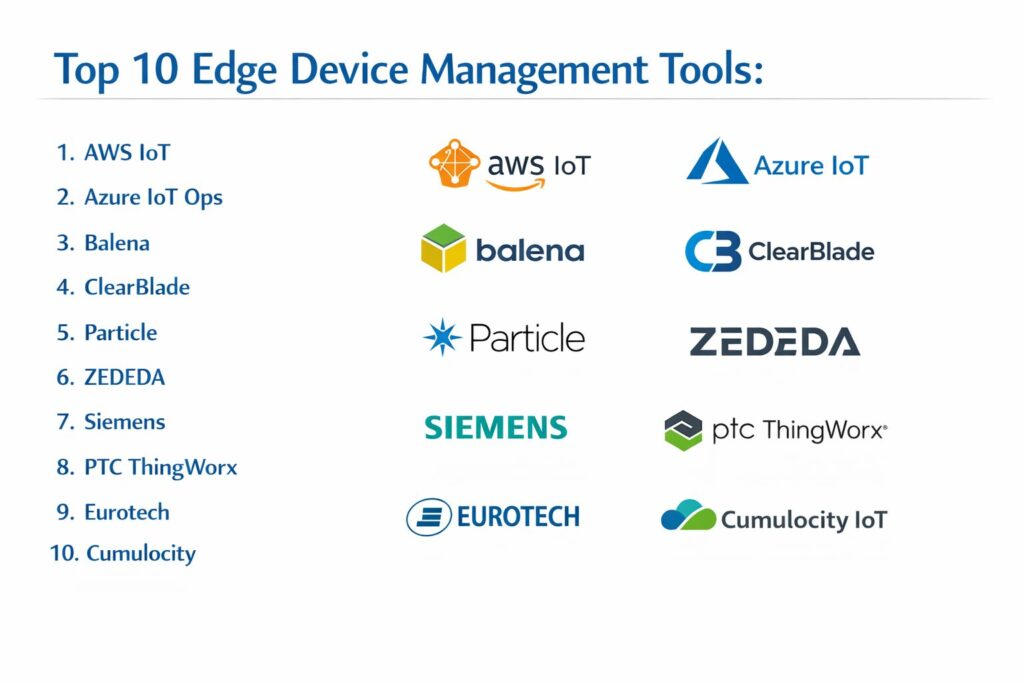
1. AWS IoT Device Management
AWS IoT Device Management is a high-scale service designed to track, monitor, and manage massive fleets of connected devices throughout their entire lifecycle. It is deeply integrated with the broader AWS ecosystem, making it the natural choice for organizations already utilizing AWS IoT Core for connectivity.
Key Features
The platform provides a “Fleet Indexing” service that allows for real-time searching and grouping of devices based on state or metadata. It supports “Jobs” for scheduled OTA updates, allowing for staggered rollouts to minimize network congestion. Secure tunneling is built-in, providing a secure shell (SSH) to devices behind firewalls for remote troubleshooting. The service also includes a “Device Advisor” to test device software against AWS best practices before deployment. It manages “Device Shadows,” which store the last known state of a device to ensure synchronization once it regains connectivity.
Pros
Unrivaled scalability capable of managing millions of devices simultaneously. Deep integration with AWS Lambda and SageMaker enables complex edge-to-cloud workflows.
Cons
The pricing structure can become complex and expensive as message volume and the number of remote actions grow. The learning curve for IAM and policy configuration is steep.
Platforms and Deployment
Cloud-based management console with SDKs for FreeRTOS, Linux, and custom embedded OS.
Security and Compliance
Utilizes X.509 certificates for mutual authentication and AWS IoT Device Defender for continuous security monitoring and anomaly detection.
Integrations and Ecosystem
Native integration with the entire AWS suite, including S3 for logs, Kinesis for data streaming, and CloudWatch for monitoring.
Support and Community
Enterprise-grade support plans are available, backed by an extensive library of whitepapers and a global network of AWS partners.
2. Azure IoT Operations
Azure IoT Operations is Microsoft’s unified platform that leverages Azure Arc to treat edge devices as standard Kubernetes-governed resources. It is specifically built for industrial environments where consistency between the factory floor and the cloud is paramount.
Key Features
The tool utilizes Azure Arc to project edge devices into the Azure Resource Manager, enabling unified policy enforcement. It includes native support for industrial protocols like OPC UA through specialized connectors. The “Device Twin” feature allows for bi-directional state synchronization and configuration. It provides a localized web-based dashboard for on-site technicians to monitor health without cloud access. The platform also integrates “Defender for IoT,” offering specialized threat detection for operational technology (OT) assets.
Pros
Provides a consistent management experience for teams already familiar with Kubernetes and Azure DevOps. Excellent for “hybrid” scenarios where data must be processed locally for compliance.
Cons
Requires a significant amount of underlying infrastructure (Kubernetes) which may be overkill for simple, low-power IoT sensors.
Platforms and Deployment
Cloud-managed via Azure Portal, deployed on Kubernetes-compatible edge hardware.
Security and Compliance
Strong focus on Zero Trust and industry-specific certifications like IEC 62443 for industrial control systems.
Integrations and Ecosystem
Seamlessly connects with Azure Data Explorer, Microsoft Fabric, and Power BI for real-time industrial analytics.
Support and Community
Microsoft offers robust enterprise support and a large community of certified systems integrators.
3. Balena
Balena is a developer-centric platform that treats edge devices like modern web applications. It uses a container-based approach to simplify the deployment of code across diverse hardware fleets, making it a favorite for rapid prototyping and agile hardware development.
Key Features
The platform is built around “balenaOS,” a lightweight Linux distribution optimized for flash memory and container performance. It features “balenaCloud” for centralized management and “balenaEngine,” a Docker-compatible container engine. The “Preload” feature allows for the shipment of devices with pre-installed containers to reduce first-boot download times. It provides a unique “Public Device URL” for remote web access to a device’s local services. The system also supports delta updates, which only transmit the changes in a container image to save bandwidth.
Pros
Exceptional developer experience with a “git push” workflow for hardware updates. The container-centric model makes application management extremely flexible and reliable.
Cons
The platform is somewhat of a “walled garden,” performing best when using their specific OS and engine. Pricing transitions quickly from a free tier to a per-device model.
Platforms and Deployment
SaaS-based management dashboard with support for over 100 hardware types (SBCs, NUCs, etc.).
Security and Compliance
Features include secure boot support, encrypted storage, and automated VPN tunneling for all device communication.
Integrations and Ecosystem
Supports standard webhooks and has a growing library of “Blocks” for common tasks like Wi-Fi management or browser displays.
Support and Community
Very active developer forums and high-quality technical documentation geared toward engineers.
4. ClearBlade
ClearBlade focuses on “edge-native” management, providing a platform that can run entirely in a private cloud or on-premises without requiring a constant connection to the public internet. This makes it ideal for high-security or remote infrastructure projects.
Key Features
The platform features an “Edge Orchestrator” that can manage local clusters of devices independently of the central cloud. It provides a built-in NoSQL database and message broker at the edge for low-latency data handling. Its “Auto-sync” capability ensures that logic and data are eventually consistent when connectivity returns. It uses a “low-code” approach for building operational dashboards. The system is designed to run on a wide variety of architectures, from ARM micro-controllers to massive x86 server clusters.
Pros
Strongest performance in completely offline or “air-gapped” environments. The platform is highly efficient and requires minimal resources to run at the edge.
Cons
The user interface is more technical and less “polished” than the major cloud providers. Finding specialized talent for ClearBlade-specific logic can be difficult.
Platforms and Deployment
Available as a SaaS, on-premises installation, or private cloud deployment.
Security and Compliance
Built with a “security-first” mindset, featuring end-to-end encryption and fine-grained access control for every data point.
Integrations and Ecosystem
Offers a wide range of “Adapters” for legacy industrial protocols and modern cloud services.
Support and Community
Provides high-touch enterprise support and specialized consulting for complex industrial deployments.
5. Particle
Particle is an integrated “edge-to-cloud” platform that provides the hardware, the connectivity, and the management software in a single bundle. It is the best choice for companies building new connected products from the ground up.
Key Features
The “Particle Console” provides a unified view of device health, cellular data usage, and firmware versions. It features a “Logic” engine that allows for running serverless functions directly on the device or in the cloud. Its OTA update system is highly optimized for cellular networks, ensuring reliability even in low-signal areas. The platform includes “Device Vitals,” a diagnostic suite that monitors battery levels, signal strength, and memory usage. It also offers “Ethernet” and “Wi-Fi” modules alongside its core cellular hardware.
Pros
Eliminates the complexity of sourcing separate hardware, SIM cards, and management software. Very fast time-to-market for new hardware products.
Cons
Creates significant vendor lock-in, as the management software is tied specifically to Particle hardware. Not suitable for managing existing third-party devices.
Platforms and Deployment
Fully managed cloud platform with integrated hardware modules.
Security and Compliance
Hardware-rooted identity and encrypted communication are standard across all devices.
Integrations and Ecosystem
Native integrations with Google Cloud, Azure, and AWS for data offloading and advanced analytics.
Support and Community
Excellent documentation and a very large community of hardware developers and makers.
6. ZEDEDA
ZEDEDA is a cloud-native orchestration platform that uses an open-source virtualization layer (EVE-OS) to manage edge infrastructure. It treats the edge as a distributed data center, making it ideal for managing high-power edge compute nodes.
Key Features
The platform utilizes “EVE-OS,” a project from the Linux Foundation that provides a secure, hardware-agnostic runtime. It supports running both virtual machines (VMs) and containers side-by-side on the same edge device. It features “Zero-Touch Provisioning,” where a device securely onboards itself as soon as it is powered on and connected. The system provides a centralized “App Marketplace” for deploying common edge applications like firewalls or AI models. It also includes comprehensive remote hardware monitoring, including CPU temperature and disk health.
Pros
The ability to run legacy VM-based applications alongside modern containers is a major advantage for brownfield industrial projects. The open-source foundation prevents total vendor lock-in.
Cons
Targeted primarily at “thick edge” (gateways and servers) and is not designed for tiny, low-power sensors.
Platforms and Deployment
SaaS management console with hardware-agnostic EVE-OS.
Security and Compliance
Includes a distributed firewall, automated disk encryption, and support for hardware-based TPM (Trusted Platform Module).
Integrations and Ecosystem
Strong partnerships with hardware vendors like Dell, Advantech, and Lanner.
Support and Community
Enterprise support is available through ZEDEDA, with community contributions through the LF Edge Project EVE.
7. Siemens Insights Hub (formerly MindSphere)
Insights Hub is Siemens’ flagship industrial IoT platform, specifically tailored for the manufacturing and energy sectors. It focuses on the “Industrial Edge,” providing deep connectivity to programmable logic controllers (PLCs) and factory automation systems.
Key Features
The platform features an “Edge Management” portal that allows for deploying industrial apps to factory-floor gateways. It includes pre-built “MindConnect” tools for extracting data from Siemens, Rockwell, and Mitsubishi controllers. It provides “Visual Flow Creator” for building logic without writing code. The system includes specialized tools for predictive maintenance and energy management. It also supports “closed-loop” integration with Siemens’ Product Lifecycle Management (PLM) software.
Pros
The gold standard for factory automation and large-scale industrial infrastructure. Its understanding of industrial protocols and hardware is second to none.
Cons
High entry cost and complex licensing make it inaccessible for small businesses. The ecosystem is heavily centered around industrial use cases.
Platforms and Deployment
Cloud-based management (Azure/AWS/Private) with dedicated Siemens industrial edge hardware.
Security and Compliance
Meets the highest industrial security standards, including ISO 27001 and specialized OT security protocols.
Integrations and Ecosystem
Deep integration with the Siemens Xcelerator portfolio and other enterprise ERP systems.
Support and Community
Extensive global support network and specialized training for industrial engineers.
8. PTC ThingWorx
PTC ThingWorx is an enterprise-grade IIoT platform known for its “Mashup Builder,” which allows for the rapid creation of complex AR and 2D interfaces for edge device monitoring. It is a leader in the digital twin space.
Key Features
The tool features a powerful “Software Content Management” module for handling complex multi-step updates across global fleets. It provides a “Digital Twin” framework that maps physical assets to their digital representations in real-time. The platform includes specialized “Kepware” connectivity for accessing legacy industrial data. It features an integrated “Analytics” engine that can run both in the cloud and at the edge. The system also supports “Augmented Reality” (AR) views of device data through PTC’s Vuforia integration.
Pros
Best-in-class tools for visualizing complex industrial assets and their data. Highly scalable and reliable for critical infrastructure.
Cons
The platform is very complex and usually requires professional services or specialized consultants for implementation.
Platforms and Deployment
Available as a SaaS, on-premises, or in a hybrid configuration.
Security and Compliance
Enterprise-grade security with support for LDAP/SAML and comprehensive audit logging.
Integrations and Ecosystem
Strong ties to CAD and PLM software, making it a favorite for “Smart Manufacturing” initiatives.
Support and Community
Provides extensive corporate support, a university program, and a large partner network.
9. Eurotech Everyware Cloud
Eurotech Everyware Cloud is an IoT integration platform that provides a “plug-and-play” experience for managing edge gateways and sensors. It is built on open standards and is particularly strong in the transportation and energy sectors.
Key Features
The platform utilizes “ESF” (Everyware Software Framework), an open-source-based edge runtime that provides a visual programming environment. It features a robust “Device Management” console for remote configuration and health checks. It includes a “Data Management” service for real-time telemetry ingestion and storage. The system supports “Remote Access” through a secure VPN for direct device interaction. It also features a “Rule Engine” for triggering alerts based on edge data.
Pros
High degree of flexibility and avoids vendor lock-in by using open-source foundations (Eclipse Kura). Excellent for ruggedized and mobile edge applications.
Cons
The community is smaller than the major cloud providers, which can lead to fewer third-party resources and plugins.
Platforms and Deployment
Cloud-based management console with support for Eurotech and third-party gateways.
Security and Compliance
ISO 27001 certified and GDPR compliant, with a focus on secure lifecycle management.
Integrations and Ecosystem
Strong integration with enterprise IT systems and various cloud providers via MQTT and REST APIs.
Support and Community
Offers high-touch technical support and specialized engineering services for custom hardware integration.
10. Cumulocity IoT (Software AG)
Cumulocity IoT is an independent, device-agnostic platform that emphasizes simplicity and rapid “self-service” onboarding. It is designed to be usable by operational teams without deep coding knowledge.
Key Features
The platform features a “Device Management” module that supports over 100 pre-integrated device protocols. It provides “Smart Rules” for building logic through a simple drag-and-drop interface. It includes a “Digital Twin” service for modeling complex asset hierarchies. The system provides a highly customizable “Cockpit” for building user-specific dashboards. It also supports “Multi-tenancy,” allowing service providers to manage multiple customers from a single instance.
Pros
One of the easiest enterprise platforms to set up and use. Its “plug-and-play” approach to device connectivity significantly reduces implementation time.
Cons
While very flexible, it may lack some of the deepest “developer-first” customization found in tools like Balena or AWS.
Platforms and Deployment
Cloud-based SaaS with options for on-premises or “Edge” (local) deployment.
Security and Compliance
Strong multi-tenant security architecture with ISO 27001 and SOC 2 compliance.
Integrations and Ecosystem
Seamlessly integrates with other Software AG products and major enterprise platforms like Salesforce and SAP.
Support and Community
Provides solid documentation and a growing user community with dedicated enterprise support tiers.
Comparison Table
| Tool Name | Best For | Platform(s) Supported | Deployment | Standout Feature | Public Rating |
| 1. AWS IoT | Global Multi-million Fleets | Linux, RTOS, ARM/x86 | Cloud | Fleet Indexing | 4.7/5 |
| 2. Azure IoT Ops | Microsoft-Centric Apps | Kubernetes, Win/Linux | Hybrid | Azure Arc Integration | 4.6/5 |
| 3. Balena | Developer-Led Teams | Any Docker-ready HW | Cloud | Container Delta Updates | 4.8/5 |
| 4. ClearBlade | High-Security / Offline | Linux, Windows, Bare | On-Prem | Edge-Native Runtime | 4.5/5 |
| 5. Particle | Integrated Hardware | Particle HW Only | SaaS | End-to-End Bundle | 4.7/5 |
| 6. ZEDEDA | Virtualized Edge Compute | Hardware Agnostic | Cloud | EVE-OS (VM+Container) | 4.4/5 |
| 7. Siemens | Industrial Automation | Siemens/Third-party | Hybrid | MindConnect PLC Tools | 4.3/5 |
| 8. PTC ThingWorx | Digital Twin/AR | Windows, Linux, Unix | Hybrid | Mashup Builder | 4.2/5 |
| 9. Eurotech | Rugged/Mobile Edge | Eurotech/Third-party | Cloud | ESF (Open Standards) | 4.4/5 |
| 10. Cumulocity | Self-Service Onboarding | Multi-vendor HW | SaaS | Multi-tenancy | 4.5/5 |
Evaluation & Scoring of Edge Device Management Tools
The scoring below is a comparative model intended to help shortlisting. Each criterion is scored from 1–10, then a weighted total from 0–10 is calculated using the weights listed. These are analyst estimates based on typical fit and common workflow requirements, not public ratings.
Weights:
- Core features – 25%
- Ease of use – 15%
- Integrations & ecosystem – 15%
- Security & compliance – 10%
- Performance & reliability – 10%
- Support & community – 10%
- Price / value – 15%
| Tool Name | Core (25%) | Ease (15%) | Integrations (15%) | Security (10%) | Performance (10%) | Support (10%) | Value (15%) | Weighted Total |
| 1. AWS IoT | 10 | 7 | 10 | 10 | 9 | 9 | 8 | 9.00 |
| 2. Azure IoT Ops | 9 | 7 | 10 | 9 | 10 | 9 | 8 | 8.85 |
| 3. Balena | 8 | 10 | 8 | 9 | 9 | 8 | 9 | 8.60 |
| 4. ClearBlade | 9 | 6 | 7 | 10 | 10 | 8 | 8 | 8.15 |
| 5. Particle | 7 | 10 | 7 | 9 | 8 | 10 | 9 | 8.35 |
| 6. ZEDEDA | 9 | 7 | 8 | 9 | 9 | 8 | 7 | 8.15 |
| 7. Siemens | 10 | 5 | 8 | 10 | 8 | 9 | 6 | 8.05 |
| 8. PTC ThingWorx | 10 | 5 | 9 | 9 | 8 | 9 | 6 | 8.10 |
| 9. Eurotech | 8 | 8 | 7 | 9 | 8 | 8 | 8 | 8.00 |
| 10. Cumulocity | 8 | 9 | 9 | 8 | 8 | 8 | 8 | 8.30 |
How to interpret the scores:
- Use the weighted total to shortlist candidates, then validate with a pilot.
- A lower score can mean specialization, not weakness.
- Security and compliance scores reflect controllability and governance fit, because certifications are often not publicly stated.
- Actual outcomes vary with assembly size, team skills, templates, and process maturity.
Which Edge Device Management Tool Is Right for You?
Solo / Freelancer
For individuals or small-scale developers, Balena offers the most seamless “cloud-like” experience for managing physical hardware. The ability to use Docker containers and a simple CLI makes it the fastest way to get a single device or a small lab environment up and running with professional-grade remote access.
SMB
Small to medium businesses building specific connected products should look at Particle. By providing the hardware and the software as a single integrated stack, it significantly reduces the overhead of managing multiple vendors and ensures that the connectivity layer is always compatible with the management tools.
Mid-Market
For companies with diverse industrial needs that aren’t yet ready for a massive hyperscaler commitment, Cumulocity IoT provides a balanced “low-code” approach. It allows for rapid scaling across different types of hardware without requiring a massive team of specialized embedded engineers.
Enterprise
Large organizations with massive cloud footprints should stick to their respective primary providers. AWS IoT Device Management is the go-to for scale, while Azure IoT Operations is the logical choice for those moving toward a Kubernetes-first infrastructure strategy.
Budget vs Premium
If cost is the primary driver, open-source-based solutions like Eurotech (via Eclipse Kura) or self-hosted ThingsBoard (though not on this specific top 10 list) offer the best long-term value. However, the premium cost of Siemens or PTC is often justified in heavy industry by the reduction in downtime and the depth of specialized analytics.
Feature Depth vs Ease of Use
Tools like AWS and PTC ThingWorx provide immense depth but require significant training. Conversely, Particle and Cumulocity emphasize ease of use, allowing operational staff to manage fleets without becoming experts in device protocols or cloud architecture.
Integrations & Scalability
When scalability is the priority, the “Big Three” cloud providers are unmatched. However, if your business requires deep integration with legacy factory hardware, the specialized industrial platforms like Siemens Insights Hub or ZEDEDA provide better out-of-the-box connectivity for the edge.
Security & Compliance Needs
For mission-critical or air-gapped deployments, ClearBlade is the clear winner. Its ability to run a fully functional management environment without any external dependencies ensures that security and data sovereignty are maintained even in the most sensitive environments.
Frequently Asked Questions (FAQs)
1. What is the difference between IoT management and Edge management?
IoT management often focuses on simple telemetry and connectivity for low-power sensors. Edge management goes further, orchestrating complex applications, virtual machines, and AI models on more powerful gateways or local servers.
2. Can I manage devices with different operating systems from one tool?
Yes, tools like ZEDEDA and Azure IoT Operations are designed to be hardware and OS agnostic, allowing you to manage a mix of Linux, Windows, and even RTOS devices from a single dashboard.
3. What happens to my edge devices if the management platform goes down?
Most modern edge tools are designed to be “autonomous.” The devices will continue to run their local logic and collect data. Once the management platform is back online, the devices will sync their state and report any events that occurred during the outage.
4. How do Over-the-Air (OTA) updates work?
The management tool pushes a new software package (often a container image or binary) to the device. The device downloads it in the background, verifies its integrity, and then reboots into the new version, often keeping the old version as a fallback in case of failure.
5. Is 5G necessary for edge device management?
While 5G provides lower latency and higher bandwidth, it is not a requirement. Most management tools are optimized for low-bandwidth environments and can function over 4G, Satellite, or even intermittent Wi-Fi connections.
6. What is “Zero-Touch Provisioning”?
It is a process where a device is shipped directly to its destination and, upon being plugged in, automatically connects to the management cloud, identifies itself, and downloads its designated configuration without any manual setup by a technician.
7. Can I run AI models on these managed devices?
Yes, platforms like AWS, Azure, and ZEDEDA have specific features for deploying and managing “Edge AI” workloads, ensuring that models are optimized for the specific hardware they are running on.
8. How do these tools handle data privacy?
Edge management allows data to be filtered and processed locally. Only summarized or “anonymized” data needs to be sent to the cloud, which helps organizations comply with strict data residency and privacy laws like GDPR.
9. Are these tools compatible with legacy equipment?
Industrial-focused tools like Siemens and PTC ThingWorx include specialized protocols (like Modbus or OPC UA) specifically designed to “bridge” legacy machines into modern management platforms.
10. Do I need a specialized team to run these platforms?
For enterprise tools like AWS or PTC, yes, you generally need engineers with specific cloud or IIoT certifications. However, “self-service” tools like Particle or Cumulocity are designed to be managed by IT generalists or operational staff.
Conclusion
The evolution of edge device management tools represents a fundamental shift in how we approach the reliability and scalability of distributed systems. As the physical and digital worlds continue to merge, the ability to remotely orchestrate complex software at the network’s edge has become a competitive necessity rather than a luxury. The tools analyzed here demonstrate that there is no one-size-fits-all solution; the choice depends heavily on your existing cloud strategy, the nature of your hardware, and the specific security requirements of your industry. By selecting a platform that offers robust OTA updates, autonomous operation, and seamless integration, technical leaders can build a resilient infrastructure that thrives in the decentralized. The future of the edge is not just about connectivity, but about the intelligent, secure, and automated management of every node in the global network.