Introduction
Healthcare interoperability APIs represent the critical infrastructure required to move clinical data across fragmented healthcare ecosystems securely and efficiently. For decades, patient information remained trapped in siloed Electronic Health Record (EHR) systems, but the advent of modern standards like HL7 (Health Level Seven) and FHIR (Fast Healthcare Interoperability Resources) has transformed how data is exchanged. These APIs act as universal translators, allowing diverse applications—from hospital management systems to patient-facing mobile apps—to speak the same language. In a modern clinical environment, this connectivity is the primary driver for improving patient outcomes, reducing medical errors, and streamlining the complex workflows of healthcare providers.
The shift toward value-based care and strict regulatory mandates has made interoperability a non-negotiable requirement for any health-tech organization. Unlike traditional data exchange, FHIR-based APIs utilize RESTful web services, making it significantly easier for developers to build modular, scalable applications that can query specific data points like medications, allergies, or lab results. This granular access is replacing the old model of exchanging massive, unformatted documents. When selecting an interoperability partner, organizations must evaluate the depth of their FHIR resource support, the robustness of their identity and access management (IAM), the reliability of their data normalization engines, and their ability to maintain strict compliance with global healthcare privacy standards.
Best for: Hospital IT directors, health-tech developers, health information exchanges (HIEs), and medical device manufacturers who need to synchronize patient data across disparate clinical and administrative systems.
Not ideal for: General-purpose data integration that does not involve protected health information (PHI) or simple web applications that do not require clinical data standards or regulatory compliance.
Key Trends in Healthcare Interoperability APIs
The industry is seeing a massive acceleration in the adoption of FHIR R4 and R5, which offer more stabilized resource definitions and better support for complex clinical scenarios. Artificial Intelligence is being integrated directly into the interoperability layer to perform real-time data “cleansing” and mapping, ensuring that unstructured data from legacy HL7 v2 messages is accurately converted into structured FHIR resources. We are also witnessing the rise of “SMART on FHIR” applications, which allow third-party developers to create plug-and-play tools that run natively within larger EHR interfaces, creating a more cohesive experience for clinicians.
Another dominant trend is the move toward “Bulk FHIR” for population health management, enabling organizations to export large datasets for analytics and research with a single API call. Privacy and security have reached a new level of sophistication with the implementation of verifiable credentials and decentralized identifiers, giving patients more control over who accesses their medical history. Furthermore, there is an increased focus on Social Determinants of Health (SDOH) data, with APIs now incorporating non-clinical factors like housing and transportation into the patient record to provide a more holistic view of community health.
How We Selected These Tools
Our selection process focused on identifying platforms that demonstrate extreme technical reliability and widespread adoption within the healthcare industry. We prioritized APIs that offer full support for the latest FHIR standards while maintaining robust backward compatibility with legacy HL7 v2 and v3 systems. A critical criterion was the “normalization capability,” assessing how effectively the tool can ingest messy, non-standard data and output clean, compliant FHIR resources. We looked for platforms that provide a developer-friendly experience, including comprehensive sandboxes and high-quality documentation.
Security and regulatory compliance were the most heavily weighted factors in our assessment. We selected tools that have established a reputation for maintaining high standards in data encryption, audit logging, and consent management. Scalability was also scrutinized, ensuring that these APIs can handle the massive throughput required by large-scale hospital networks and national health exchanges. Finally, we assessed the strength of each platform’s ecosystem, looking at the breadth of their pre-built connectors to major EHR vendors and their ability to facilitate seamless multi-party data exchange.
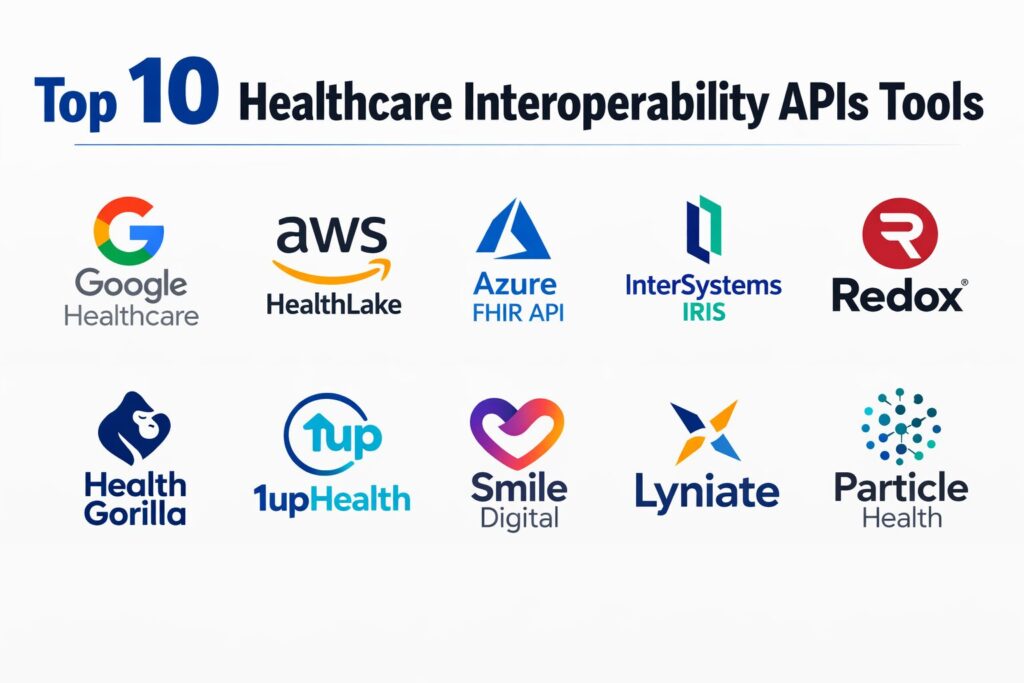
1. Google Cloud Healthcare API
The Google Cloud Healthcare API is an enterprise-grade solution designed to bridge the gap between clinical systems and the power of cloud-based analytics. It provides a highly scalable managed service for storing and exchanging healthcare data using HL7 v2, FHIR, and DICOM standards.
Key Features
The platform features automated data de-identification, which is essential for using clinical data in research and machine learning without compromising patient privacy. It includes a robust FHIR store that supports the full spectrum of FHIR resources and complex search queries. The system offers seamless integration with BigQuery, allowing organizations to perform real-time analytics on vast amounts of clinical data. It features a high-performance ingestion engine for HL7 v2 messages and imaging data. It also provides advanced IAM controls to manage granular access to sensitive health information.
Pros
It offers unparalleled scalability and performance, backed by the global infrastructure of Google Cloud. The integration with advanced AI and machine learning tools is a major advantage for research-focused organizations.
Cons
The complexity of the Google Cloud ecosystem can be overwhelming for smaller organizations with limited technical staff. Pricing is consumption-based, which can become expensive for very high-volume data operations.
Platforms and Deployment
Cloud-native (SaaS) on Google Cloud Platform.
Security and Compliance
HIPAA, GDPR, and SOC 2 compliant, featuring industry-leading encryption and audit capabilities.
Integrations and Ecosystem
Integrates deeply with BigQuery, Looker, and Google Cloud AI, while supporting standard healthcare protocols for external connectivity.
Support and Community
Offers professional enterprise support and extensive technical documentation through the Google Cloud portal.
2. AWS HealthLake
AWS HealthLake is a purpose-built, HIPAA-eligible service that enables healthcare and life sciences companies to aggregate, store, and analyze health data at a massive scale. It uses specialized machine learning models to structure and normalize data into a consistent FHIR format.
Key Features
The platform features integrated Natural Language Processing (NLP) that automatically extracts medical information from unstructured notes and reports. It includes a high-performance FHIR R4 data store that maintains a complete history of every patient record. The system offers automated data transformation, converting disparate records into a unified chronological view. It features deep integration with Amazon SageMaker for building and deploying predictive health models. It also provides a robust console for managing data ingestion and monitoring pipeline health.
Pros
The automated extraction of data from unstructured clinical text is a standout feature for organizations dealing with legacy paper records. It provides a highly resilient environment for large-scale data lakes.
Cons
Setting up complex data pipelines requires significant expertise in the AWS ecosystem. It is primarily a cloud-native solution, which may not suit organizations requiring on-premises data handling.
Platforms and Deployment
Cloud-native (SaaS) on Amazon Web Services.
Security and Compliance
HIPAA-eligible and compliant with ISO and SOC standards, offering robust encryption at rest and in transit.
Integrations and Ecosystem
Seamlessly connects with the broader AWS ecosystem, including QuickSight for visualization and Athena for querying.
Support and Community
Provides tiered support through AWS Enterprise Support and a vast network of certified healthcare technology partners.
3. Microsoft Azure API for FHIR
The Microsoft Azure API for FHIR is a managed, standards-based service that enables the rapid exchange of data through FHIR APIs. It is designed to help healthcare organizations simplify data management and enable the development of modern health applications.
Key Features
The platform features “SMART on FHIR” support, allowing third-party apps to integrate securely with the data store. It includes a robust mapping engine that transforms legacy data formats into FHIR resources. The system offers deep integration with Azure Active Directory for secure, identity-based access control. It features an “IoT Connector” that can ingest and normalize data from wearable medical devices in real-time. It also provides a managed environment that handles all patching and scaling automatically.
Pros
It is an ideal choice for organizations already invested in the Microsoft ecosystem, offering seamless integration with Office 365 and Teams. The security and identity management features are exceptionally strong.
Cons
The platform can be complex to configure for specific non-standard clinical workflows. Some users find the pricing model for the IoT connector to be high for large-scale deployments.
Platforms and Deployment
Cloud-native (SaaS) on Microsoft Azure.
Security and Compliance
Compliant with HIPAA, HITRUST, GDPR, and ISO standards, leveraging Azure’s extensive security infrastructure.
Integrations and Ecosystem
Integrates with Power BI for analytics and Azure Synapse for large-scale data warehousing.
Support and Community
Offers professional support through Microsoft Azure and a dedicated healthcare-focused developer community.
4. InterSystems IRIS for Health
InterSystems IRIS for Health is a high-performance data platform specifically engineered to extract value from healthcare data. It combines a powerful database with advanced interoperability and analytics capabilities.
Key Features
The platform features an exceptionally fast multi-model database that can handle structured and unstructured data simultaneously. It includes extensive support for all major healthcare standards including HL7 v2, v3, FHIR, and CDA. The system offers a robust “FHIR Accelerator” that speeds up the development of interoperable applications. It features advanced data transformation and mapping tools that can handle the most complex clinical data types. It also provides built-in analytics and machine learning capabilities for real-time insights.
Pros
It is widely considered the most reliable platform for high-volume clinical messaging and is used by many of the world’s largest HIEs. The database performance for complex queries is superior to many general-purpose solutions.
Cons
The platform is a premium enterprise product with a corresponding cost. The specialized nature of the system requires dedicated training and expertise to manage effectively.
Platforms and Deployment
Available as a managed service (SaaS), on-premises, or as a hybrid deployment.
Security and Compliance
Maintains high standards for healthcare data security and is used globally in highly regulated environments.
Integrations and Ecosystem
Supports a vast range of clinical and administrative integrations and features a global network of implementation partners.
Support and Community
Offers 24/7 world-class technical support and a dedicated learning portal for healthcare developers.
5. Redox
Redox is a modern interoperability platform that acts as a universal API for healthcare. It is designed to simplify the connection between digital health applications and the complex landscape of EHR systems.
Key Features
The platform features a “write once, connect to any” model, where developers use a single Redox API to communicate with thousands of different hospitals. It includes a robust normalization engine that standardizes data from various EHR vendors like Epic, Cerner, and Meditech. The system offers real-time monitoring and alerting for all data exchanges. It features a developer-friendly dashboard for managing connections and troubleshooting issues. It also provides a “Managed Integration” service where Redox handles the maintenance of the connections.
Pros
It drastically reduces the time and complexity of integrating with multiple hospitals and EHR systems. The platform is built specifically for the developer experience, with excellent documentation.
Cons
As an abstraction layer, it adds an additional cost per connection or per transaction. Some organizations may prefer a direct connection to the cloud provider for highly specialized data needs.
Platforms and Deployment
Cloud-based SaaS.
Security and Compliance
HITRUST CSF Certified and SOC 2 Type II compliant, with a heavy focus on data privacy and security.
Integrations and Ecosystem
Connects to over 90% of the US EHR market and maintains a massive ecosystem of digital health applications.
Support and Community
Known for having an exceptionally responsive support team and a vibrant community of health-tech innovators.
6. Health Gorilla
Health Gorilla is a leading clinical data API provider that offers a comprehensive “National Health Information Network” (NHIN) in a single platform. It is designed to provide clinical data access to digital health startups and established providers.
Key Features
The platform features a “Patient Search” API that queries national networks like CommonWell and Carequality to retrieve a patient’s complete history. It includes integrated laboratory and imaging order management workflows. The system offers a robust “Identity Discovery” engine to ensure the correct patient record is retrieved across different systems. It features a standardized FHIR data model for all clinical data retrieved from the national networks. It also provides a patient-facing portal for managing consent and data access.
Pros
It provides immediate access to national-scale data without the need to join individual health exchanges. The platform is highly specialized for “at-scale” patient record retrieval.
Cons
The pricing is geared toward high-volume users and may be expensive for early-stage startups. The reliance on national networks means data quality depends on the contributing sources.
Platforms and Deployment
Cloud-based SaaS.
Security and Compliance
SOC 2 Type II compliant and a designated Qualified Health Information Network (QHIN) candidate.
Integrations and Ecosystem
Connects to thousands of hospitals, labs, and pharmacies across the United States.
Support and Community
Provides dedicated account management and technical support for its enterprise partners.
7. 1upHealth
1upHealth is a FHIR-native interoperability platform that focuses on making healthcare data accessible and actionable. It is particularly strong in the payer and provider space, helping organizations comply with CMS interoperability mandates.
Key Features
The platform features a “FHIR Platform as a Service” that allows organizations to build and host applications directly on a FHIR data store. It includes a massive library of pre-built connectors to over 10,000 healthcare facilities. The system offers specialized tools for “Payer-to-Payer” data exchange and patient access APIs. It features automated data ingestion and mapping for claims and clinical data. It also provides advanced analytics tools for managing population health and quality metrics.
Pros
The platform’s native focus on FHIR from the ground up makes it exceptionally agile for modern development. It is a leader in addressing regulatory requirements for health plans.
Cons
The interface is highly technical and may require a strong developer team to implement. Some users find the documentation for custom mapping to be complex.
Platforms and Deployment
Cloud-native SaaS.
Security and Compliance
HIPAA and SOC 2 Type II compliant, with a strong emphasis on modern web security standards.
Integrations and Ecosystem
Deeply integrated with the major US health systems and payers, supporting a wide range of FHIR-based applications.
Support and Community
Offers a dedicated customer success team and a professional developer portal.
8. Smile Digital Health
Smile Digital Health is an enterprise-grade clinical data repository and integration platform built on the HAPI FHIR core. It is used by large government agencies and healthcare organizations to manage massive clinical datasets.
Key Features
The platform features full support for the entire FHIR specification and is the lead maintainer of the HAPI FHIR library. It includes a robust multi-tenant architecture for managing data across different departments or organizations. The system offers advanced data provenance tracking, ensuring the origin of every data point is recorded. It features a high-performance “Bulk Data” API for large-scale exports and analytics. It also provides a comprehensive suite of administrative tools for monitoring system health.
Pros
It offers the most complete and faithful implementation of the FHIR standard available. The platform is highly flexible and can be customized to meet the most demanding regulatory requirements.
Cons
The enterprise version is a high-cost solution intended for large organizations. Implementation can be complex and typically requires specialized training or consulting.
Platforms and Deployment
Available as a managed service (SaaS), on-premises, or in the cloud.
Security and Compliance
Compliant with major global healthcare standards and features advanced role-based access control and audit logging.
Integrations and Ecosystem
Used as the foundational layer for many national and regional health information systems globally.
Support and Community
Provides top-tier professional support and is the center of the HAPI FHIR open-source community.
9. Lyniate (by Rhapsody)
Lyniate, now part of the Rhapsody health solutions suite, provides a range of interoperability tools including the Rhapsody and Corepoint integration engines. It is a dominant player in the hospital and diagnostic lab market.
Key Features
The platform features a world-class integration engine capable of handling millions of clinical messages per day with zero downtime. It includes a visual “Drag-and-Drop” mapping tool for building complex data transformations. The system offers robust support for HL7 v2, FHIR, CDA, and various non-standard formats. It features advanced monitoring and alerting tools for tracking interface health across a hospital network. It also provides specialized tools for managing patient identity and master person indexes.
Pros
The reliability and performance of the Rhapsody engine are legendary in the healthcare industry. It provides the flexibility to handle almost any clinical data format, no matter how old or non-standard.
Cons
The platform is a traditional enterprise software solution and can be more complex to deploy than modern cloud-native APIs. The cost for high-volume environments is substantial.
Platforms and Deployment
Available on-premises, in the cloud, or as a managed service.
Security and Compliance
Maintains the highest levels of security required by large hospital networks and government health departments.
Integrations and Ecosystem
Integrates with nearly every EHR, LIS, and RIS system on the market today.
Support and Community
Offers 24/7 expert support and a large global community of certified interface analysts.
10. Particle Health
Particle Health is a user-friendly API platform that aggregates healthcare data from across the United States into a single, clean FHIR stream. It is designed to empower digital health companies with simple access to comprehensive medical records.
Key Features
The platform features a “Search and Find” API that can locate patient records across all major national networks with minimal input. It includes an automated “Data Cleaning” process that standardizes inconsistent records into high-quality FHIR. The system offers a flat-rate pricing model for unlimited searches, making it predictable for growing companies. It features a simplified “Sandbox” environment for rapid prototyping and testing. It also provides a clear “Audit Trail” for all data requests to ensure compliance.
Pros
It offers one of the simplest and most accessible entry points for developers needing to access national clinical data. The focus on data cleanliness significantly reduces the downstream processing required by developers.
Cons
It is primarily focused on the US market and does not currently offer the same level of global coverage as some competitors. The platform is more of an aggregator than a primary data repository.
Platforms and Deployment
Cloud-based SaaS.
Security and Compliance
HIPAA and SOC 2 compliant, adhering to the strict security requirements of the national data exchanges.
Integrations and Ecosystem
Connects to the largest national health data networks and is a popular choice for telehealth and insurance-tech startups.
Support and Community
Known for having a modern, developer-centric support model and clear, easy-to-follow documentation.
Comparison Table
| Tool Name | Best For | Platform(s) Supported | Deployment | Standout Feature | Public Rating |
| 1. Google Healthcare | AI / Big Data | Cloud-Native | Cloud SaaS | BigQuery Integration | 4.7/5 |
| 2. AWS HealthLake | Data Lakes / ML | Cloud-Native | Cloud SaaS | Integrated Medical NLP | 4.6/5 |
| 3. Azure FHIR API | Enterprise / IoT | Cloud-Native | Cloud SaaS | Azure Active Directory | 4.6/5 |
| 4. InterSystems IRIS | High-Volume HIE | Web, On-Prem | Hybrid | Multi-Model Database | 4.8/5 |
| 5. Redox | EHR Integration | Web-Based | Cloud SaaS | Universal EHR Adapter | 4.7/5 |
| 6. Health Gorilla | National Records | Web-Based | Cloud SaaS | Patient Search API | 4.5/5 |
| 7. 1upHealth | Payer Compliance | Web-Based | Cloud SaaS | Payer-to-Payer Data | 4.6/5 |
| 8. Smile Digital | Government / Repos | Web, On-Prem | Hybrid | HAPI FHIR Core | 4.9/5 |
| 9. Lyniate | Hospital Messaging | Web, On-Prem | Hybrid | Rhapsody Engine | 4.8/5 |
| 10. Particle Health | Digital Health Apps | Web-Based | Cloud SaaS | Clean FHIR Stream | 4.7/5 |
Evaluation & Scoring of Healthcare Interoperability APIs
The scoring below is a comparative model intended to help shortlisting. Each criterion is scored from 1–10, then a weighted total from 0–10 is calculated using the weights listed. These are analyst estimates based on typical fit and common workflow requirements, not public ratings.
Weights:
- Core features – 25%
- Ease of use – 15%
- Integrations & ecosystem – 15%
- Security & compliance – 10%
- Performance & reliability – 10%
- Support & community – 10%
- Price / value – 15%
| Tool Name | Core (25%) | Ease (15%) | Integrations (15%) | Security (10%) | Performance (10%) | Support (10%) | Value (15%) | Weighted Total |
| 1. Google Healthcare | 10 | 5 | 9 | 10 | 10 | 8 | 7 | 8.55 |
| 2. AWS HealthLake | 9 | 6 | 9 | 10 | 9 | 8 | 8 | 8.35 |
| 3. Azure FHIR API | 9 | 7 | 9 | 10 | 9 | 9 | 7 | 8.45 |
| 4. InterSystems IRIS | 10 | 4 | 10 | 9 | 10 | 9 | 6 | 8.30 |
| 5. Redox | 8 | 10 | 10 | 9 | 8 | 10 | 8 | 8.95 |
| 6. Health Gorilla | 8 | 8 | 9 | 9 | 8 | 8 | 8 | 8.15 |
| 7. 1upHealth | 9 | 7 | 8 | 9 | 9 | 8 | 9 | 8.35 |
| 8. Smile Digital | 10 | 3 | 9 | 10 | 10 | 10 | 6 | 8.15 |
| 9. Lyniate | 10 | 4 | 10 | 9 | 10 | 9 | 6 | 8.30 |
| 10. Particle Health | 7 | 9 | 8 | 9 | 8 | 9 | 10 | 8.15 |
How to interpret the scores:
- Use the weighted total to shortlist candidates, then validate with a pilot.
- A lower score can mean specialization, not weakness.
- Security and compliance scores reflect controllability and governance fit, because certifications are often not publicly stated.
- Actual outcomes vary with assembly size, team skills, templates, and process maturity.
Which Healthcare Interoperability API Tool Is Right for You?
Solo / Freelancer
For early-stage startups or individual developers, the speed of integration and ease of use are paramount. You should look for an API that provides a “single-point-of-access” to national data with clear, developer-friendly documentation. A platform that offers a flat-rate pricing model can help you manage your burn rate while you build your initial prototype.
SMB
Independent practices or small clinics should prioritize tools that integrate seamlessly with their existing EHR. Your goal is to reduce manual data entry and ensure that you have the most up-to-date patient information during a visit. A managed cloud service that requires minimal local maintenance is often the most cost-effective choice.
Mid-Market Health System
Growing hospital networks need a solution that can bridge the gap between their various departments and satellite facilities. At this scale, the ability to normalize data from several different EHR vendors into a single FHIR stream is essential for maintaining a unified patient record and complying with state-level reporting requirements.
Enterprise / Payer
Large health plans and global hospital groups require a platform with the highest level of security and performance. You need a system that can act as a “source of truth” for millions of members, providing the scalability to handle massive bulk data operations while ensuring compliance with national interoperability mandates.
Budget vs Premium
Budget-conscious organizations should look toward cloud-native managed services where they only pay for what they use. While these require more internal technical skill to configure, they avoid the high upfront costs of enterprise software. Premium solutions, however, provide specialized clinical mapping and high-touch professional services that can be worth the investment for high-stakes clinical operations.
Feature Depth vs Ease of Use
If your team consists of highly specialized healthcare interface analysts, a platform with deep, node-based mapping and total code control is a major asset. However, if your goal is to enable a general development team to build health apps quickly, an abstraction layer that handles the complexity of HL7-to-FHIR conversion is far more valuable.
Integrations & Scalability
Interoperability is about the breadth of the network. You must choose a platform that is connected to the major national exchanges and has established relationships with the leading EHR vendors. Your API choice should be able to scale from simple patient queries to real-time IoT monitoring without requiring a total re-architecture.
Security & Compliance Needs
In healthcare, security is not just a feature; it is a legal requirement. You must ensure that your chosen API provider maintains the specific certifications required for your region, such as HIPAA in the US or GDPR in Europe. Look for platforms that offer advanced audit logging and automated de-identification for secondary data use.
Frequently Asked Questions (FAQs)
1. What is the main difference between HL7 v2 and FHIR?
HL7 v2 is a legacy, tag-based messaging standard that is highly efficient but difficult to parse without specialized tools. FHIR is a modern, web-based standard that uses RESTful APIs and JSON/XML formats, making it much easier for web and mobile developers to use.
2. Why is FHIR considered the future of healthcare interoperability?
FHIR is designed for the modern internet age, using the same technology that powers platforms like Google and Amazon. It allows for “granular” data access, meaning an app can request just a patient’s temperature rather than downloading a 50-page medical document.
3. Is my patient data secure when using these APIs?
Yes, all of the platforms listed use enterprise-grade encryption for data both while it is moving and while it is stored. They also use advanced identity management to ensure that only authorized users with the proper consent can access a patient’s record.
4. What does “SMART on FHIR” mean?
SMART on FHIR is a framework that allows third-party applications to be integrated directly into an EHR interface. This means a clinician can open a specialized app for cardiac risk assessment without ever leaving the patient’s record.
5. How do these APIs handle patient identity matching?
Patient matching is a significant challenge in healthcare. These APIs use sophisticated algorithms to compare multiple data points—like name, birthdate, and social security number—to ensure that records from different hospitals are correctly linked to the same person.
6. Do these tools comply with HIPAA?
All of the professional-grade APIs mentioned on this list are designed to be HIPAA-compliant. However, it is the responsibility of the organization using the API to ensure that they are also following the necessary administrative and physical safeguards.
7. Can I use these APIs for real-time remote patient monitoring?
Yes, several of these platforms offer specialized “IoT Connectors” that can ingest data from wearables and home medical devices, converting that information into FHIR resources that a clinician can review in real-time.
8. What is a “Bulk FHIR” API used for?
Bulk FHIR is used to move massive amounts of data at once, such as when a health plan needs to analyze the outcomes of 100,000 members. It is much more efficient than making individual API calls for every single patient record.
9. Why do I need a normalization engine?
Healthcare data is notoriously messy; different doctors might record “Type 2 Diabetes” in ten different ways. A normalization engine uses AI and medical terminologies like SNOMED or LOINC to ensure all data follows a consistent, searchable format.
10. Do these platforms offer technical support for implementation?
Most vendors offer tiered support plans, ranging from basic documentation and community forums to 24/7 dedicated engineering support and professional consulting services to help with complex clinical mappings.
Conclusion
In the current healthcare landscape, the ability to exchange data across disparate systems is the absolute prerequisite for clinical innovation and operational efficiency. Healthcare interoperability APIs have evolved into highly sophisticated engines that not only move data but also normalize and secure it according to global standards. By adopting a FHIR-native strategy, organizations can move away from the limitations of legacy systems and embrace a modular, patient-centric digital environment. Selecting the right API partner ensures that your clinical data infrastructure is not just a siloed repository, but a dynamic, interconnected asset that directly contributes to the quality and safety of patient care.