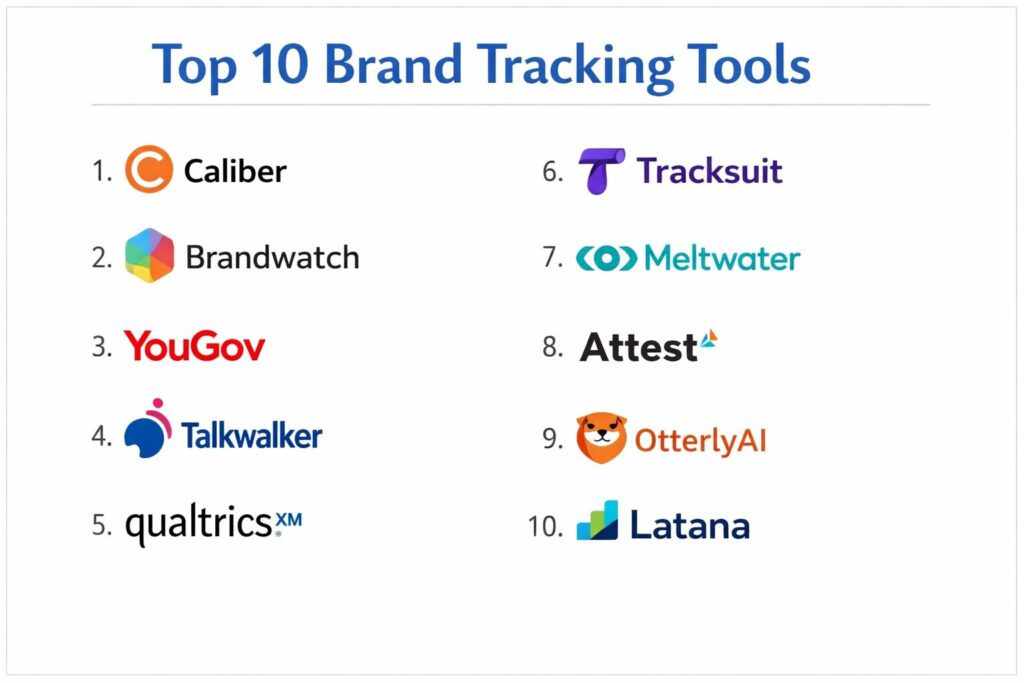
Introduction
Brand tracking has evolved from retrospective quarterly surveys into a real-time, multi-modal intelligence discipline. In the current market, a brand’s reputation is no longer built solely through controlled advertisements but is constantly reshaped by social conversations, review fragments, and—increasingly—generative AI summaries. Brand tracking tools provide the technical infrastructure to quantify “mental availability” and “share of voice” across these fragmented channels. By leveraging natural language processing and high-frequency data collection, these platforms allow organizations to monitor health metrics such as brand awareness, consideration, and sentiment with surgical precision.
For a modern enterprise, these tools serve as an early warning system. They identify emerging PR crises before they go viral and pinpoint competitive shifts in consumer perception. The transition from “static” research to “always-on” tracking allows marketing leaders to correlate brand health KPIs with actual revenue performance, moving brand equity from an intangible asset to a measurable driver of growth. When evaluating a tracking partner, it is essential to look beyond simple keyword monitoring and prioritize data quality, panel integrity, and the ability to extract actionable narratives from unstructured data.
Best for: Marketing directors, brand managers, PR specialists, and consumer insight teams who need to validate the impact of high-budget campaigns and maintain a consistent pulse on market sentiment.
Not ideal for: Small businesses with local footprints where the volume of digital conversation or the cost of high-quality consumer panels may not justify the investment.
Key Trends in Brand Tracking Tools
The most significant shift is the rise of “AI Visibility Tracking.” As consumers move toward conversational search, brands are now measuring how they are cited in LLM responses and AI-generated overviews. This “Generative Engine Optimization” (GEO) has become a core metric alongside traditional SEO. Another major trend is the integration of visual listening, where tools use computer vision to detect brand logos and products in uncaptioned social media videos and images, capturing organic brand usage that text-based queries miss.
Furthermore, there is a distinct move toward “Continuous Stakeholder Intelligence.” Traditional annual studies are being replaced by high-frequency pulses that reflect the rapid pace of digital news cycles. Sustainability and ESG (Environmental, Social, and Governance) perceptions are also being integrated directly into brand health scores, as modern consumers increasingly weigh a company’s ethical stance in their purchasing decisions. Finally, the “human-in-the-loop” model remains critical; while AI handles the data processing, the most advanced platforms now offer expert consultancy to help interpret complex cultural nuances.
How We Selected These Tools
Our selection process focused on platforms that demonstrate technical maturity in three distinct areas: data provenance, analytical depth, and integration capabilities. We prioritized tools that own their respondent panels or use verified, non-incentivized data collection methods to ensure the highest possible data integrity. Market mindshare was also a key factor, as established players often provide better historical benchmarking data, which is essential for tracking long-term brand equity trends.
We also evaluated the tools based on their ability to handle “unstructured” data—meaning they can accurately categorize sentiment and themes from millions of disparate social posts or review entries. Security and compliance were non-negotiable, particularly for global enterprises requiring GDPR and SOC2 adherence. Finally, we looked for a balance of “social-first” listening tools and “survey-first” research platforms to provide a comprehensive view of the brand tracking landscape.
1. Caliber
Caliber is a specialized AI-powered brand tracking tool designed for corporate reputation and stakeholder intelligence. It moves away from the “snapshot” survey model, offering a continuous real-time dashboard that monitors how a brand is perceived by customers, investors, and the general public.
Key Features
The platform utilizes a unique “Real-Time Tracker” that collects daily stakeholder data to provide a consistent model for reputation and trust. It includes a dedicated ESG perception module that tracks how ethical and environmental initiatives are landing with the public. The dashboard features “Predictive Analytics” to forecast how specific news events might impact brand equity. It offers automated alerts for significant sentiment shifts and provides a “License to Operate” score to gauge regulatory and social standing.
Pros
Continuous data collection provides a more accurate view of reputation than periodic surveys. The focus on corporate trust makes it ideal for highly regulated industries.
Cons
The platform is highly specialized for reputation management and may lack some of the granular “marketing campaign” features found in other tools.
Platforms and Deployment
Cloud-based web platform.
Security and Compliance
Enterprise-grade security with full GDPR compliance and secure data silos.
Integrations and Ecosystem
Integrates with major BI tools like Tableau and PowerBI for cross-departmental reporting.
Support and Community
Offers strategic advisory services and a dedicated account management team for enterprise clients.
2. Brandwatch
Brandwatch is a powerhouse in the social listening and consumer intelligence space. It is designed for enterprises that need to ingest and analyze billions of public conversations to understand the broader cultural context surrounding their brand.
Key Features
The tool features “Blue Silk AI,” which automates the categorization of themes and sentiment across massive datasets. It includes a robust “Image Insights” engine that can detect 30,000+ brand logos in social media photos and videos. The platform offers a historical archive of data going back over a decade for deep trend analysis. It provides “Crisis Detection” alerts that use machine learning to identify unusual patterns in conversation volume.
Pros
Unrivaled data depth and historical reach for social and web monitoring. The visualization tools are some of the most advanced in the industry.
Cons
The platform has a steep learning curve and custom pricing that can be prohibitive for smaller organizations.
Platforms and Deployment
Cloud-based web platform with mobile alerts.
Security and Compliance
Adheres to strict data privacy standards and provides role-based access controls for large teams.
Integrations and Ecosystem
Extensive integrations with Salesforce, HubSpot, and various social media management suites.
Support and Community
Provides an extensive “Brandwatch Academy” and 24/7 technical support.
3. YouGov BrandIndex
YouGov BrandIndex is the industry standard for syndicated brand tracking. It monitors thousands of brands daily across dozens of markets, providing a reliable benchmark of brand health based on a massive, proprietary respondent panel.
Key Features
The platform tracks 16 core brand health metrics, including “Buzz,” “Quality,” “Value,” and “Recommendation.” It offers a “Daily Tracking” dashboard that allows users to see how specific events impact their brand in near real-time. The “Profiles” tool allows for deep audience segmentation, linking brand perception to specific consumer behaviors. It also provides “Sector Benchmarking” to compare performance directly against industry competitors.
Pros
The proprietary panel ensures high-quality, verified data that is less susceptible to bot interference. The historical data allows for unmatched long-term trend tracking.
Cons
As a syndicated service, it can be less flexible for highly customized or niche research questions compared to DIY survey tools.
Platforms and Deployment
Web-based insights dashboard.
Security and Compliance
Highly compliant with global research standards and data protection laws.
Integrations and Ecosystem
Data can be exported into standard analytical formats; often used alongside internal CRM data.
Support and Community
Offers expert researcher support and detailed sectoral reports.
4. Talkwalker
Talkwalker is a global listening platform known for its speed and its ability to monitor brand mentions across social, news, blogs, and even broadcast media like TV and radio.
Key Features
The tool features “Visual Listening” that identifies logos, scenes, and objects in videos. It includes a “Predictive Analytics” engine that can forecast the viral potential of a brand-related topic. The “Conversation Clusters” feature uses AI to map out how different topics are interconnected in the public sphere. It also offers dedicated reporting for PR and communications teams to measure earned media value.
Pros
Excellent multi-channel coverage, including traditional media formats often missed by digital-only tools. The AI-driven trend forecasting is highly actionable.
Cons
The interface can be overwhelming due to the sheer volume of data and visualization options.
Platforms and Deployment
Cloud-based web interface.
Security and Compliance
Enterprise-level encryption and compliance with international privacy regulations.
Integrations and Ecosystem
Native integrations with Hootsuite and various marketing automation platforms.
Support and Community
Provides 24/7 global support and a robust knowledge base for users.
5. Qualtrics Brand Tracker
Qualtrics offers an integrated brand tracking solution that sits within its broader “Experience Management” (XM) ecosystem. It is designed for companies that want to link brand health directly to customer and employee experience data.
Key Features
The platform uses “XM Discover” to analyze unstructured feedback from surveys, social media, and support transcripts. It features an “Automated Insights” engine that highlights the key drivers of brand equity. The system allows for highly customized survey designs that can be targeted to specific global audiences. It also includes “Predictive Modeling” to show how changes in brand perception will likely affect future sales.
Pros
The ability to combine brand data with customer and employee data provides a holistic view of the organization. The survey customization is industry-leading.
Cons
The platform is expensive and often requires a significant implementation period.
Platforms and Deployment
Enterprise cloud platform.
Security and Compliance
Highest levels of enterprise security, including SOC2 and HIPAA compliance where applicable.
Integrations and Ecosystem
Deeply integrated with Salesforce, SAP, and other major enterprise software suites.
Support and Community
Offers a dedicated success team and extensive professional services.
6. Tracksuit
Tracksuit is a modern, “always-on” brand tracking platform designed to be more affordable and accessible than traditional enterprise research. It is specifically aimed at fast-growing consumer brands.
Key Features
The platform provides a beautiful, simplified dashboard that focuses on four key metrics: Awareness, Consideration, Preference, and Usage. It uses recurring surveys to provide a continuous view of brand health. The tool includes “Competitor Comparison” views that allow brands to see exactly where they are winning or losing ground in their category. It is designed for “Shareability,” with reports that are easy for marketing teams to present to stakeholders.
Pros
Highly intuitive UI and more cost-effective than traditional syndicated research. It makes brand tracking accessible for mid-market companies.
Cons
The data is less granular than more expensive enterprise tools and may not suit highly complex research needs.
Platforms and Deployment
Web-based dashboard.
Security and Compliance
Standard data protection protocols and secure survey methodologies.
Integrations and Ecosystem
Focused on being a standalone insights tool; offers standard data exports.
Support and Community
Provides excellent customer success support specifically for growth-stage marketers.
7. Meltwater
Meltwater is a comprehensive media intelligence suite that combines social listening with PR monitoring and influencer management, making it a favorite for communications professionals.
Key Features
The tool offers “Media Monitoring” across 300,000+ news sources and millions of social posts. It includes an “Influencer Discovery” tool to find voices that align with your brand’s reputation. The platform features “Sentiment Analysis” in over 100 languages. It also provides a “Newsletter” tool that allows PR teams to share daily brand coverage internally with stakeholders.
Pros
Excellent for PR-heavy brands that need to track both earned media and social conversation in one place.
Cons
The social listening features, while robust, are sometimes seen as less deep than specialized tools like Brandwatch.
Platforms and Deployment
Cloud-based web platform and mobile app.
Security and Compliance
Compliant with major international data standards and privacy laws.
Integrations and Ecosystem
Integrates with Slack, Microsoft Teams, and various CRM platforms for alert routing.
Support and Community
Offers 24/7 online support and a global team of media analysts.
8. Attest
Attest is a consumer research platform that provides “speed-to-insight.” It allows brands to launch custom brand tracking surveys and receive verified results in a matter of days rather than weeks.
Key Features
The platform gives users access to a panel of 150 million consumers across 59 countries. It features a “Survey Builder” with built-in templates for brand health and creative testing. The tool uses a triple-check quality process, combining AI and human review to ensure data accuracy. It provides dynamic “Interactive Dashboards” that allow for real-time filtering of survey results.
Pros
The turnaround time is incredibly fast, making it ideal for agile marketing teams. The data quality is consistently high.
Cons
As a survey-first tool, it lacks the “passive” social listening and media monitoring found in other platforms.
Platforms and Deployment
Cloud-based web platform.
Security and Compliance
Rigorous data verification and compliance with GDPR and MRS guidelines.
Integrations and Ecosystem
Connects with various data visualization tools via API and standard exports.
Support and Community
Includes access to “Research Experts” who can help optimize survey designs.
9. OtterlyAI
OtterlyAI is a niche but critical tool in the 2026 landscape, focusing exclusively on how brands are mentioned and cited within AI-generated search results and LLM responses.
Key Features
The platform monitors brand visibility across major AI engines like ChatGPT, Gemini, and Claude. It analyzes the “Sentiment” and “Context” of how an AI describes your brand compared to competitors. The tool identifies which specific source documents or links the AI is citing to build its answers. It provides a “Share of Mention” metric for AI search queries, giving brands a new way to measure dominance in the generative era.
Pros
Addresses the most significant new frontier in brand tracking: AI search visibility. Highly specialized and actionable for modern SEO/GEO teams.
Cons
It is a focused tool and does not offer traditional social listening or broad consumer surveys.
Platforms and Deployment
Cloud-based dashboard.
Security and Compliance
Focused on public data monitoring with standard security protocols for user accounts.
Integrations and Ecosystem
Growing API support for integration into broader SEO and brand health dashboards.
Support and Community
Provides documentation on the emerging field of Generative Engine Optimization.
10. Latana
Latana is an AI-powered brand tracking platform that specializes in B2C brand perception. It is known for its advanced sampling techniques that reach niche audiences on mobile devices.
Key Features
The platform uses “MRP” (Multilevel Regression and Poststratification) to provide highly accurate brand health estimates even for small audience segments. It focuses on “Non-Incentivized” respondents to ensure more honest and reliable feedback. The dashboard allows users to track “Brand Associations” to see what specific words or emotions consumers link to their brand. It offers a global reach, tracking brands in over 100 countries.
Pros
The methodology for reaching niche audiences is more sophisticated than many traditional survey tools. The UI is clean and focused on high-level decision-making.
Cons
Primarily mobile-focused, which may miss certain older or less tech-savvy demographics depending on the market.
Platforms and Deployment
Web-based platform optimized for desktop analysis.
Security and Compliance
Adheres to strict international market research standards and data privacy laws.
Integrations and Ecosystem
Offers API access and standard data exports for integration into corporate data lakes.
Support and Community
Offers dedicated account management and methodological support for complex tracking needs.
Comparison Table
| Tool Name | Best For | Platform(s) Supported | Deployment | Standout Feature | Public Rating |
| 1. Caliber | Corporate Reputation | Web | Cloud | Real-time Trust Scoring | 4.8/5 |
| 2. Brandwatch | Enterprise Listening | Web | Cloud | Visual Logo Detection | 4.7/5 |
| 3. YouGov BrandIndex | Global Benchmarking | Web | Cloud | Daily Syndicated Data | 4.6/5 |
| 4. Talkwalker | Global PR/Comms | Web | Cloud | Predictive Trend Alerts | 4.5/5 |
| 5. Qualtrics | Integrated Experience | Web | Cloud | XM Discover Engine | 4.7/5 |
| 6. Tracksuit | Growth-Stage Brands | Web | Cloud | SMB-Friendly Dashboard | 4.4/5 |
| 7. Meltwater | Earned Media/PR | Web, iOS, Android | Cloud | 300k+ News Sources | 4.3/5 |
| 8. Attest | Agile Consumer Research | Web | Cloud | 150M Respondent Panel | 4.6/5 |
| 9. OtterlyAI | AI Search Visibility | Web | Cloud | LLM Citation Tracking | 4.2/5 |
| 10. Latana | B2C Niche Perception | Web | Cloud | MRP Sampling Method | 4.4/5 |
Evaluation & Scoring of Brand Tracking Tools
The scoring below is a comparative model intended to help shortlisting. Each criterion is scored from 1–10, then a weighted total from 0–10 is calculated using the weights listed. These are analyst estimates based on typical fit and common workflow requirements, not public ratings.
Weights:
- Core features – 25%
- Ease of use – 15%
- Integrations & ecosystem – 15%
- Security & compliance – 10%
- Performance & reliability – 10%
- Support & community – 10%
- Price / value – 15%
| Tool Name | Core (25%) | Ease (15%) | Integrations (15%) | Security (10%) | Performance (10%) | Support (10%) | Value (15%) | Weighted Total |
| 1. Caliber | 10 | 8 | 8 | 9 | 10 | 9 | 8 | 8.95 |
| 2. Brandwatch | 9 | 6 | 10 | 9 | 9 | 8 | 7 | 8.35 |
| 3. YouGov | 10 | 7 | 7 | 9 | 9 | 9 | 8 | 8.60 |
| 4. Talkwalker | 9 | 7 | 9 | 8 | 9 | 8 | 8 | 8.35 |
| 5. Qualtrics | 9 | 6 | 10 | 10 | 9 | 10 | 6 | 8.45 |
| 6. Tracksuit | 7 | 10 | 6 | 8 | 8 | 9 | 10 | 8.05 |
| 7. Meltwater | 8 | 7 | 8 | 9 | 8 | 9 | 8 | 8.10 |
| 8. Attest | 9 | 9 | 7 | 9 | 9 | 9 | 9 | 8.80 |
| 9. OtterlyAI | 8 | 9 | 6 | 8 | 8 | 7 | 9 | 7.90 |
| 10. Latana | 8 | 8 | 7 | 9 | 9 | 8 | 8 | 8.15 |
How to interpret the scores:
- Use the weighted total to shortlist candidates, then validate with a pilot.
- A lower score can mean specialization, not weakness.
- Security and compliance scores reflect controllability and governance fit, because certifications are often not publicly stated.
- Actual outcomes vary with assembly size, team skills, templates, and process maturity.
Which Brand Tracking Tool Is Right for You?
Solo / Freelancer
For individual consultants or boutique agency owners, a tool like Brand24 or a simplified dashboard like Tracksuit is the best entry point. These provide sufficient mention tracking and brand health overview without the complexity or cost of enterprise-level panels.
SMB
Small to medium businesses should prioritize ease of use and “always-on” dashboards. Tracksuit offers the best balance of professional brand health metrics and affordability, making it easy to report progress to stakeholders without needing a dedicated data analyst.
Mid-Market
Growing brands with a need for speed should look toward Attest. The ability to launch custom surveys and get results in 48 hours allows for rapid testing of campaigns and brand messaging in a way that traditional quarterly trackers cannot match.
Enterprise
Large-scale global organizations require the depth of Brandwatch or Qualtrics. These platforms offer the necessary data governance, complex API integrations, and historical depth to manage a brand’s reputation across multiple continents and languages.
Budget vs Premium
If budget is the primary constraint, “listening” tools often provide more data per dollar than “survey” tools. However, for those where data precision is paramount, investing in the premium, verified panels of YouGov or the specialized methodology of Latana is non-negotiable.
Feature Depth vs Ease of Use
Tools like Brandwatch offer unmatched depth but require significant training. Conversely, Tracksuit and Attest are designed for marketers who need quick, visual insights that can be acted upon immediately without deep methodological training.
Frequently Asked Questions (FAQs)
1. How often should a brand track its health?
In 2026, most brands should move away from annual trackers toward “always-on” or monthly pulses. High-frequency tracking is essential to catch sentiment shifts in the fast-paced digital environment.
2. What is the difference between brand monitoring and brand tracking?
Brand monitoring is the real-time collection of mentions (what is being said), while brand tracking is the strategic measurement of brand health over time (awareness, consideration, and preference).
3. Does brand tracking include social media?
Yes, most modern brand tracking tools integrate social listening to provide a “passive” view of sentiment alongside “active” data from consumer surveys.
4. How do I measure brand awareness?
Awareness is typically measured through surveys asking consumers to name brands in a category (unaided) or select brands they recognize from a list (aided).
5. Can AI tools predict a PR crisis?
Advanced tools like Talkwalker and Brandwatch use machine learning to detect “anomalous” spikes in volume or negative sentiment, often alerting teams before a crisis reaches peak visibility.
6. What is “Share of Voice” (SOV)?
SOV is a percentage-based metric that shows how much of the total conversation or advertising in your industry is focused on your brand compared to competitors.
7. Is survey data still reliable in the age of bots?
It depends on the platform. Premium tools like YouGov and Attest use rigorous verification and non-incentivized models to ensure that respondents are real humans rather than bots.
8. What is “Generative Engine Optimization” tracking?
This is a new field where tools like OtterlyAI track how your brand is cited in AI summaries, such as those provided by ChatGPT or Google’s AI Overviews.
9. Can I track brand perception in specific regions?
Yes, most global tools allow you to filter data by geography, language, and demographic, which is critical for international brands.
10. How do these tools calculate sentiment?
They use Natural Language Processing (NLP) to categorize text as positive, negative, or neutral, though the best tools now also track complex emotions like “frustration” or “joy.”
Conclusion
Navigating the complexities of brand equity requires more than just a passing awareness of social mentions; it demands a structured, technically sound approach to data collection and analysis. As we have seen, the landscape is bifurcating into specialized “listening” platforms that capture organic conversation and “research” platforms that provide deep, verified human insights. For the modern leader, the objective is to synthesize these data points into a single, coherent narrative that informs strategic decision-making. By selecting a brand tracking tool that aligns with your organization’s scale and technical maturity, you move from reactive crisis management to proactive brand building. Ultimately, the brands that win in this era are those that listen most accurately to their audience and adapt their positioning with both speed and authenticity.