Introduction
Politically Exposed Person (PEP) screening tools are specialized compliance platforms designed to identify individuals holding prominent public positions who may pose a higher risk of involvement in bribery or corruption. These systems scan massive global databases of government officials, their family members, and close associates to ensure financial institutions remain compliant with Anti-Money Laundering (AML) regulations. In the current regulatory climate, these tools have moved beyond simple name-matching to become complex risk-intelligence engines that utilize artificial intelligence and graph analytics to uncover hidden relationships.
Implementing a robust PEP screening solution is no longer optional for firms operating in the financial, real estate, or legal sectors. These platforms allow organizations to automate the identification of high-risk entities during onboarding and throughout the customer lifecycle via continuous monitoring. By integrating these tools, compliance officers can focus their efforts on high-value investigations while the software handles the high-volume task of cross-referencing millions of data points across diverse jurisdictions and languages.
Best for: Banks, fintech startups, insurance providers, and luxury goods dealers required to perform Enhanced Due Diligence (EDD) on high-risk individuals.
Not ideal for: General retail marketing, non-regulated consumer goods businesses, or small firms with zero exposure to international financial transactions.
Key Trends in PEP Screening Software
- Perpetual KYC (pKYC): Transitioning from periodic manual reviews to event-driven monitoring where risk scores update instantly based on new global data.
- Graph-Based Relationship Mapping: Using network analysis to automatically identify “Relatives and Close Associates” (RCAs) even when not explicitly listed in a database.
- AI-Driven False Positive Reduction: Machine learning algorithms now pre-triage alerts, suppressing noise and highlighting only the most relevant matches for human review.
- Adverse Media Integration: Real-time scanning of global news sources to identify negative sentiment or criminal allegations associated with a PEP profile.
- Open-Source Intelligence (OSINT) Fusion: Combining private premium watchlists with verified public data from social media and government registries for a 360-degree risk view.
- Native Multi-Language Handling: Advanced phonetic and fuzzy matching that can accurately resolve names across different scripts like Cyrillic, Arabic, and Hanzi.
- Regulatory Explainability: New “white-box” AI models provide a clear audit trail explaining exactly why a specific individual was flagged, satisfying strict auditor requirements.
How We Selected These Tools (Methodology)
The selection methodology for these PEP screening tools involved a rigorous evaluation of data depth, algorithmic precision, and enterprise-grade security. We prioritized vendors that maintain human-curated databases alongside automated data scraping to ensure the highest level of accuracy and the lowest rate of false negatives. Furthermore, we assessed the tools based on their “API-first” architecture, which allows for seamless integration into existing customer onboarding and transaction monitoring workflows.
Operational efficiency was another critical factor; we evaluated how each tool manages the “alert lifecycle,” from initial flag to final disposition and reporting. Data privacy compliance, particularly regarding GDPR and local data residency laws, was heavily weighted to ensure that institutions can screen global entities without violating privacy mandates. Finally, we looked at the scalability of each platform, ensuring they could handle the throughput requirements of both small boutique firms and massive multinational Tier-1 banks.
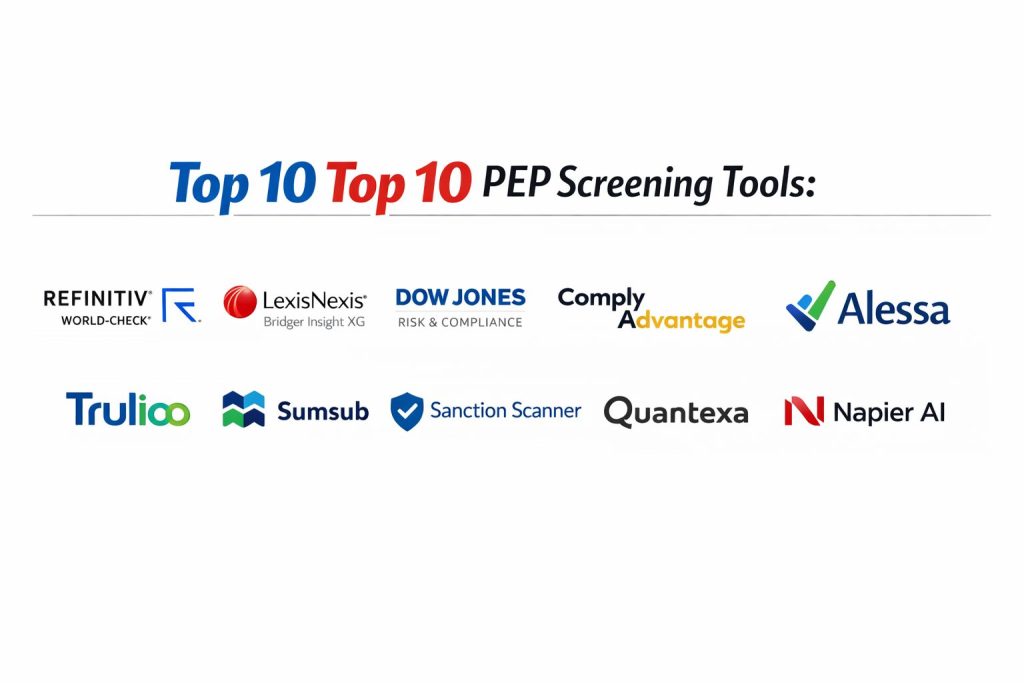
Top 10 PEP Screening Tools
1. Refinitiv World-Check (LSEG)
Refinitiv World-Check remains the industry benchmark for risk intelligence, offering one of the most comprehensive and human-verified databases of PEPs in existence. It is the primary choice for Tier-1 banks that require extreme data depth and historical records to meet the most stringent global regulatory standards.
Key Features
- Human-Curated Data: A global team of researchers manually verifies and updates PEP profiles to ensure high data integrity.
- Extensive RCA Mapping: Automatically identifies and links family members and close associates of political figures.
- Integrated Adverse Media: Connects profiles directly to negative news coverage from thousands of global sources.
- Flexible Delivery Models: Accessible via a web-based portal, a dedicated API, or through batch file transfers for large datasets.
- Customizable Risk Tiers: Allows firms to define their own risk appetite and categorize PEPs by domestic or international influence.
- Global Sanctions Alignment: Syncs PEP data with international sanctions lists to provide a unified view of risk.
Pros
- Unmatched data accuracy and depth, trusted by the world’s largest financial regulators.
- Powerful “fuzzy matching” logic that reduces the impact of spelling variations and aliases.
Cons
- The premium pricing model may be out of reach for smaller startups or non-financial firms.
- The interface can feel data-heavy and may require specialized training for compliance staff.
Platforms / Deployment
- Web-Based / Cloud API
- Desktop (Integration via SDK)
Security & Compliance
- Features: SOC 2 Type II, ISO 27001, and advanced data encryption.
- Compliance: GDPR, CCPA, and AMLD5.
2. LexisNexis Bridger Insight XG
LexisNexis Bridger Insight XG is an enterprise-grade screening platform that combines vast risk data with a powerful orchestration engine. It is designed to help organizations streamline their compliance workflows by consolidating multiple screening types into a single interface.
Key Features
- Bridger Insight XG Engine: A high-speed screening tool that processes massive batches of names against global watchlists instantly.
- WorldCompliance Data: Access to one of the largest databases of high-risk individuals, updated in real-time.
- Advanced Name Normalization: Standardizes names across different languages and scripts to ensure accurate matches.
- Automated Ongoing Monitoring: Notifies compliance teams the moment a customer’s PEP status or risk profile changes.
- Visual Case Management: Provides an intuitive dashboard for investigating flags and documenting decisions for audits.
- Entity Resolution: Uses AI to distinguish between individuals with similar names, significantly reducing false positives.
Pros
- Excellent for high-volume environments that require fast batch processing of millions of records.
- Highly configurable workflows that can be tailored to match specific internal compliance policies.
Cons
- Implementation can be complex, often requiring significant IT involvement for full integration.
- The extensive feature set can lead to a steeper learning curve for smaller compliance teams.
Platforms / Deployment
- Cloud SaaS / On-Premise
- API Integration
Security & Compliance
- Features: Role-based access controls and comprehensive audit logging.
- Compliance: ISO 27001 and GDPR compliant.
3. Dow Jones Risk & Compliance
Dow Jones Risk & Compliance provides premium, news-driven data that is widely considered the gold standard for accuracy and timeliness. It leverages the global news-gathering power of Dow Jones to provide context that other data providers often miss.
Key Features
- Factiva Integration: Uses the world’s largest news archive to provide real-time adverse media signals for every PEP profile.
- Precise Categorization: Clearly distinguishes between different levels of political exposure, from local officials to heads of state.
- Advisory Support: Offers expert guidance on data interpretation to help firms refine their screening logic.
- Continuous Updates: Data is refreshed around the clock to capture sudden shifts in political status or new appointments.
- Dual-Language Screening: Supports native-script screening for regions including China, Russia, and the Middle East.
- Structured Data Feeds: Provides high-quality, structured data that is easy to ingest into third-party AML systems.
Pros
- Exceptionally low false positive rates due to high-quality, editorially maintained data.
- Strongest adverse media component in the market, providing deep context on identified risks.
Cons
- Premium cost structure reflecting the high quality of human-curated data.
- Less focus on automated “behavioral” risk signals compared to some newer tech-native platforms.
Platforms / Deployment
- Web / Cloud API
- Feed Integration
Security & Compliance
- Features: End-to-end encryption and secure API gateways.
- Compliance: Standard global financial compliance certifications.
4. ComplyAdvantage
ComplyAdvantage is a modern, AI-native platform that has disrupted the industry with its real-time data updates and developer-friendly approach. It is the preferred choice for fintechs and fast-growing digital banks that require high automation and scalability.
Key Features
- AI-Generated Profiles: Uses machine learning to ingest and structure data from millions of sources in near real-time.
- Dynamic Risk Scoring: Automatically adjusts the risk level of an entity based on new data points and media mentions.
- Graph Network Analysis: Uncovers hidden connections between PEPs and other high-risk individuals via shared addresses or business ties.
- API-First Design: Built for easy integration into digital onboarding journeys, with extensive documentation for developers.
- Daily Delta Feeds: Delivers only the changes in the database since the last update to save on processing power.
- Unified Case Manager: A sleek, modern interface designed for speed and collaborative alert investigation.
Pros
- Offers some of the fastest data update speeds in the industry, reflecting global events almost instantly.
- User interface is widely regarded as one of the most intuitive and modern in the RegTech space.
Cons
- As an AI-first platform, it may occasionally lack the deep historical context of legacy human-curated databases.
- Younger than established giants, though it has rapidly achieved significant market share.
Platforms / Deployment
- Cloud SaaS
- REST API
Security & Compliance
- Features: SOC 2 Type II and proactive vulnerability scanning.
- Compliance: GDPR and international AML standards.
5. Alessa
Alessa is a unified AML compliance platform that integrates PEP screening with transaction monitoring and fraud detection. It is designed for institutions that want to eliminate “vendor sprawl” by managing all financial crime risks in one place.
Key Features
- Unified Dashboard: Combines screening results with transaction alerts to provide a holistic view of customer risk.
- Custom Scoring Models: Allows users to build their own risk-weighting logic based on geography, role, and department.
- Automated Regulatory Filing: Features built-in tools for generating and filing Suspicious Activity Reports (SARs).
- Entity Link Analysis: Visualizes relationships between customers and external entities to detect complex laundering schemes.
- Configurable Alert Routing: Automatically sends high-priority PEP alerts to senior compliance officers for review.
- Crypto Exposure Monitoring: Includes specialized tools for screening PEPs who interact with virtual asset service providers.
Pros
- Provides a comprehensive suite that covers the entire AML lifecycle, not just initial screening.
- Strong focus on reducing manual labor through automation and intelligent alert prioritization.
Cons
- May offer more features than needed for a small firm only seeking basic PEP screening.
- The broad scope of the platform can lead to a longer implementation time compared to standalone tools.
Platforms / Deployment
- Cloud / On-Premise / Hybrid
- API / Web Interface
Security & Compliance
- Features: Multi-factor authentication and encrypted data storage.
- Compliance: ISO 27001 and GDPR.
6. Trulioo
Trulioo is a global identity verification leader that offers integrated PEP and sanctions screening as part of its “GlobalGateway” platform. It is ideal for businesses that need to verify identity and check risk status in a single, frictionless step.
Key Features
- GlobalGateway Platform: Single API access to thousands of data sources for identity, PEP, and sanctions checks.
- Real-Time Verification: Performs PEP checks at the exact moment a customer uploads their identity documents.
- Market-Leading Coverage: Provides access to risk data in over 190 countries, making it a true global solution.
- Ongoing Monitoring: Automatically re-screens customers on a set schedule to detect new PEP designations.
- Configurable Match Settings: Allows users to adjust “fuzziness” levels to balance risk with onboarding speed.
- No-Code Integration: Offers a “Workflow Builder” that allows compliance teams to design screening logic without writing code.
Pros
- Exceptional for global businesses that need to scale rapidly across many different jurisdictions.
- Combines identity verification (KYC) and risk screening into a single customer experience.
Cons
- Primarily an identity tool; its standalone PEP database management is less specialized than Refinitiv or Dow Jones.
- Costs can scale quickly for businesses with very high volume and multi-step verification needs.
Platforms / Deployment
- Cloud SaaS
- API / Mobile SDK
Security & Compliance
- Features: NIST-compliant data handling and secure cloud infrastructure.
- Compliance: GDPR, SOC 2, and ISO 27001.
7. Sumsub
Sumsub is an “all-in-one” verification platform that provides a highly smooth user experience for both the business and the end-customer. It is particularly popular in the cryptocurrency and gaming sectors for its speed and mobile-friendly interface.
Key Features
- Automated Workflows: Uses AI to guide users through the verification process, flagging PEP status in the background.
- Cross-Check Technology: Compares PEP data against local registries to confirm the validity of a match.
- Liveness Detection: Ensures the person being screened is physically present, preventing spoofing and deepfake fraud.
- Mobile-First Design: Optimized for smartphone users, allowing for high-speed onboarding on the go.
- Integrated Legal Support: Provides templates and guidance for handling high-risk PEP customers legally.
- Advanced Monitoring Alerts: Sends instant notifications via email or webhook when a customer’s status changes.
Pros
- Offers one of the best user experiences for the end-customer, minimizing friction during onboarding.
- Highly effective at detecting and resolving “identity-based” risk alongside PEP status.
Cons
- Its primary strength is in identity; users seeking deep, news-based risk intelligence may find it less comprehensive.
- The automated nature of the platform may not suit legacy institutions requiring high manual oversight.
Platforms / Deployment
- Cloud SaaS
- Web / Mobile SDK / API
Security & Compliance
- Features: End-to-end encryption and secure PII handling.
- Compliance: GDPR, HIPAA, and SOC 2.
8. Sanction Scanner
Sanction Scanner is a highly cost-effective AML solution that provides powerful PEP and sanctions screening with a focus on simplicity. It is an excellent choice for small-to-medium businesses that need professional compliance without excessive cost.
Key Features
- Global List Access: Screens against 3,000+ sanctions and PEP lists from around the world.
- Real-Time API Scanning: Allows for the integration of risk checks into any business process via a lightweight API.
- Adverse Media Screening: Includes a built-in module for checking negative news across various languages.
- Intuitive Case Management: A simple, clean dashboard for reviewing alerts and managing compliance tasks.
- Batch Screening: Enables users to upload existing customer databases for one-time or periodic re-screening.
- Customizable Matching: Features a slider-based interface to easily adjust name-matching sensitivity.
Pros
- One of the most affordable professional-grade tools on the market, offering high value for money.
- Very easy to set up and use, often requiring no specialized technical or compliance background.
Cons
- May lack the advanced graph analytics and network mapping of high-end enterprise competitors.
- Data depth is strong but may not match the massive editorial teams of Dow Jones or Refinitiv.
Platforms / Deployment
- Cloud SaaS
- REST API
Security & Compliance
- Features: Standard data encryption and secure access protocols.
- Compliance: AMLD5 and GDPR.
9. Quantexa
Quantexa is a high-end decision intelligence platform that specializes in entity resolution and network analysis. It is designed for large institutions that need to uncover complex, “hidden” PEP relationships that traditional list-based screening might miss.
Key Features
- Entity Resolution: Merges fragmented data points into a single, accurate view of an individual.
- Dynamic Network Analytics: Maps out the entire “circle of influence” around a PEP, including business partners and shell companies.
- Contextual Decisioning: Evaluates risk within the context of the individual’s entire financial and social network.
- Massive Scale Processing: Built to handle billions of data points across global enterprise environments.
- Automated Investigation Packs: Automatically gathers all relevant data on a flag into a single dossier for analysts.
- Open Source Fusion: Seamlessly integrates internal bank data with external PEP and sanctions watchlists.
Pros
- Unrivaled for detecting sophisticated money laundering and corruption networks.
- Moves beyond simple “name matching” to offer true, context-driven risk intelligence.
Cons
- Extremely high cost and implementation complexity, making it suitable only for large enterprises.
- Requires a highly skilled data and compliance team to manage and interpret results.
Platforms / Deployment
- Cloud / Hybrid / On-Premise
- Enterprise API
Security & Compliance
- Features: Enterprise-grade RBAC, encryption, and auditability.
- Compliance: ISO 27001, SOC 2, and GDPR.
10. Napier AI
Napier AI is a cloud-native compliance platform that leverages artificial intelligence to provide highly agile and customizable screening. It is favored by mid-market firms that want modern technology with strong governance features.
Key Features
- Intelligent Screening Engine: Uses AI to prioritize alerts based on the likelihood of a true match.
- Compliance Sandbox: Allows users to test new screening rules and thresholds on historical data before going live.
- Cloud-First Architecture: Ensures rapid deployment and easy scaling as the business grows.
- Configurable Rule Builder: Enables teams to create complex, multi-factor screening logic without code.
- Holistic Risk View: Integrates PEP screening with transaction monitoring and behavior analysis.
- Real-Time Dashboards: Provides a live view of compliance performance and alert backlogs.
Pros
- The sandbox feature is a major advantage for teams wanting to optimize their “false positive” rates.
- Very agile platform that can be updated and reconfigured quickly as regulations change.
Cons
- Smaller ecosystem compared to the decades-old giants like LexisNexis or Autodesk.
- Requires a proactive compliance team to get the most out of the customizable AI features.
Platforms / Deployment
- Cloud SaaS
- API Integration
Security & Compliance
- Features: Secure multi-tenant architecture and full audit trails.
- Compliance: ISO 27001 and GDPR.
Comparison Table (Top 10)
| Tool Name | Best For | Platform(s) Supported | Deployment | Standout Feature | Public Rating |
| 1. Refinitiv World-Check | Global Enterprises | Web, API | Cloud | Human-Curated Data | 4.7/5 |
| 2. LexisNexis Bridger | High-Volume Batch | Win, Web, API | Hybrid | Mass Processing | 4.5/5 |
| 3. Dow Jones Risk | Precision & Context | Web, Feed, API | Cloud | News-Driven Data | 4.6/5 |
| 4. ComplyAdvantage | Tech-Native Firms | Web, API | Cloud | Real-time AI Data | 4.8/5 |
| 5. Alessa | Unified AML Suite | Win, Web, API | Hybrid | Holistic Compliance | 4.6/5 |
| 6. Trulioo | Global Onboarding | Web, SDK, API | Cloud | Identity + Risk Sync | 4.5/5 |
| 7. Sumsub | UX-Focused Firms | Web, App, API | Cloud | Smooth Onboarding | 4.8/5 |
| 8. Sanction Scanner | Budget-Conscious | Web, API | Cloud | Value for Money | 4.7/5 |
| 9. Quantexa | Network Analytics | Enterprise API | Hybrid | Relationship Mapping | 4.4/5 |
| 10. Napier AI | Agile AI Teams | Web, API | Cloud | Rule Sandbox | 4.5/5 |
Evaluation & Scoring of PEP Screening Tools
The scoring below is a comparative model intended to help shortlisting. Each criterion is scored from 1–10, then a weighted total from 0–10 is calculated using the weights listed. These are analyst estimates based on typical fit and common workflow requirements, not public ratings.
Weights:
- Core features – 25%
- Ease of use – 15%
- Integrations & ecosystem – 15%
- Security & compliance – 10%
- Performance & reliability – 10%
- Support & community – 10%
- Price / value – 15%
| Tool Name | Core (25%) | Ease (15%) | Integrations (15%) | Security (10%) | Performance (10%) | Support (10%) | Value (15%) | Weighted Total |
| 1. Refinitiv World-Check | 10 | 5 | 9 | 10 | 9 | 9 | 6 | 8.25 |
| 2. LexisNexis Bridger | 9 | 6 | 10 | 10 | 10 | 9 | 7 | 8.55 |
| 3. Dow Jones Risk | 10 | 6 | 9 | 10 | 9 | 9 | 6 | 8.25 |
| 4. ComplyAdvantage | 9 | 9 | 10 | 9 | 10 | 8 | 9 | 9.15 |
| 5. Alessa | 9 | 7 | 9 | 9 | 8 | 8 | 8 | 8.40 |
| 6. Trulioo | 8 | 10 | 10 | 9 | 9 | 8 | 8 | 8.70 |
| 7. Sumsub | 8 | 10 | 9 | 9 | 9 | 8 | 9 | 8.75 |
| 8. Sanction Scanner | 7 | 9 | 8 | 8 | 8 | 8 | 10 | 8.10 |
| 9. Quantexa | 10 | 3 | 8 | 10 | 10 | 7 | 5 | 7.60 |
| 10. Napier AI | 8 | 8 | 9 | 9 | 9 | 8 | 8 | 8.30 |
How to interpret the scores:
- Use the weighted total to shortlist candidates, then validate with a pilot.
- A lower score can mean specialization, not weakness.
- Security and compliance scores reflect controllability and governance fit, because certifications are often not publicly stated.
- Actual outcomes vary with assembly size, team skills, templates, and process maturity.
Which PEP Screening Tool Is Right for You?
Solo / Boutique Firms
For the independent professional or small law firm, Sanction Scanner is the top choice. It provides access to high-quality global data without the complex contractual requirements and high setup costs of enterprise software.
SMB & Fintech
Fast-moving fintechs should prioritize ComplyAdvantage or Sumsub. These tools are built for the modern internet, offering developer-friendly APIs and automated workflows that allow for a seamless customer onboarding experience.
Mid-Market Institutions
Mid-sized regional banks and insurance firms will find the best balance of features and cost in Alessa or Napier AI. These platforms offer the advanced AI needed to reduce false positives without the overwhelming complexity of Tier-1 legacy systems.
Enterprise & Tier-1 Banks
For global institutions that manage the highest levels of risk, Refinitiv World-Check and LexisNexis Bridger Insight XG are the mandatory industry standards. Their data depth and historical records are essential for passing international regulatory audits.
Frequently Asked Questions (FAQs)
What is a Politically Exposed Person (PEP)?
A PEP is an individual who holds a prominent public role, such as a head of state, senior politician, or high-ranking judicial official. They are considered high-risk because their position provides opportunities for financial crimes like money laundering.
Why do I need a specialized tool for PEP screening?
Manual screening is impossible due to the sheer volume of global officials and their associates. Specialized tools automate this process, ensuring you check against thousands of updated lists in seconds with high accuracy.
What is “Fuzzy Matching” in screening software?
Fuzzy matching is an algorithm that identifies names that are similar but not identical, accounting for typos, phonetic variations, or different name orderings (e.g., “Jon Smith” vs “John Smyth”).
Does PEP screening include the person’s family members?
Yes, regulations require screening for “Relatives and Close Associates” (RCAs). Professional tools maintain connections between high-profile officials and their immediate family or business partners.
How often should I re-screen my customers?
Industry best practice is “ongoing monitoring,” which means customers are re-screened daily or whenever a global list update occurs. At minimum, periodic re-screening should happen every 6 to 12 months.
What is an “Adverse Media” check?
It is the process of scanning global news, blogs, and social media for negative information about an individual, such as allegations of fraud or corruption, even if they aren’t on a formal sanctions list yet.
How do I handle a “False Positive”?
A false positive occurs when someone with the same name as a PEP is flagged. Compliance tools provide investigation modules where an analyst can use birth dates or location data to clear the match and document the decision.
Are these tools GDPR compliant?
Yes, most reputable vendors are GDPR compliant and offer features like data encryption and role-based access to ensure that sensitive personal identifiable information (PII) is handled legally.
Can these tools integrate with my existing CRM?
Most modern tools like ComplyAdvantage and Trulioo offer REST APIs or pre-built connectors for popular CRMs, allowing you to run checks directly from your existing customer management system.
What is the difference between a PEP check and a Sanctions check?
A Sanctions check looks for people legally banned from financial transactions. A PEP check identifies people who are legal but carry a higher risk, requiring “Enhanced Due Diligence” (EDD) before doing business.
Conclusion
Compliance landscape demands a shift from reactive checking to proactive risk intelligence. Selecting the right PEP screening tool is no longer just about meeting a regulatory checkbox; it is about building an operational foundation that protects your organization’s reputation and bottom line. Whether you choose the data-rich heritage of Refinitiv or the AI-driven agility of ComplyAdvantage, the goal remains the same: ensuring that every high-risk entity is identified with precision and managed with total transparency.
As technology continues to evolve, the integration of graph analytics and real-time adverse media will become standard requirements for every firm. By choosing a scalable, API-first solution now, you ensure your compliance program can adapt to future regulations without requiring a total system overhaul.
This guide on PEP screening tools is super helpful for picking the right platform for our needs.