Introduction
An Execution Management System (EMS) is a specialized software platform designed for institutional traders to execute orders efficiently across multiple trading venues and asset classes. Unlike a traditional Order Management System (OMS) which focuses on the broader lifecycle of a trade—including compliance and portfolio accounting—an EMS is built for speed, precision, and high-performance market interaction. In the current 2026 financial landscape, these systems have become the primary battleground for “Best Execution,” utilizing low-latency connections and advanced algorithms to minimize market impact.
As liquidity becomes increasingly fragmented across global exchanges, dark pools, and electronic communication networks (ECNs), the role of the EMS has shifted from a simple order-entry tool to a sophisticated decision-support engine. Modern platforms now integrate real-time Transaction Cost Analysis (TCA), AI-driven “Algo Wheels,” and deep liquidity aggregation. Whether you are a high-frequency hedge fund or a long-only asset manager, selecting the right EMS is critical for capturing alpha and maintaining a competitive edge in rapidly moving markets.
Best for: Hedge funds, asset managers, and sell-side trading desks requiring low-latency market access, complex algorithmic trading, and real-time execution analytics.
Not ideal for: Retail investors, long-term passive portfolios with low turnover, or firms that do not require direct market access (DMA).
Key Trends in Execution Management Systems
- AI-Optimized Algo Wheels: Platforms are increasingly using machine learning to automatically select the best-performing broker algorithms based on historical performance and real-time market conditions.
- Hyper-Connectivity via OpenUSD and FIX: The industry is standardizing on advanced messaging protocols to ensure that multi-asset data flows seamlessly between different trading desks and regions.
- Real-Time Predictive TCA: Transaction Cost Analysis has moved from a post-trade reporting function to a real-time predictive tool that suggests adjustments during the life of an order.
- Cloud-Native Low Latency: A significant shift toward cloud-based EMS deployment has occurred, with providers using localized edge computing to maintain millisecond-level execution speeds without on-premise hardware.
- Multi-Asset Convergence: Modern systems now handle equities, fixed income, FX, and derivatives within a single unified interface, reducing “swivel-chair” risk for multi-strategy desks.
- Consolidated Tape Integration: New regulatory environments have led to systems that provide a unified view of global liquidity, allowing traders to see the “true” price of an asset across all venues.
- Cyber-Resilient Execution: With the rise of sophisticated digital threats, EMS providers are implementing hardware-level encryption and zero-trust architectures to protect trade data.
How We Selected These Tools (Methodology)
The methodology for selecting the top 10 Execution Management Systems involved a rigorous evaluation of their technical architecture, market connectivity, and operational reliability. We prioritized platforms that offer a “broker-neutral” approach, giving traders the freedom to route orders to any liquidity provider without bias. We also analyzed the depth of their algorithmic suites, specifically looking for systems that allow for custom script development and backtesting of execution strategies.
Performance metrics were heavily weighted, particularly the system’s ability to handle high message rates during periods of extreme market volatility without latency spikes. Furthermore, we assessed the quality of integration with leading Order Management Systems (OMS) to ensure a seamless front-to-back workflow. Finally, we considered the global footprint of each provider, evaluating their support for local markets in Asia, Europe, and the Americas to ensure they meet the needs of international institutional firms.
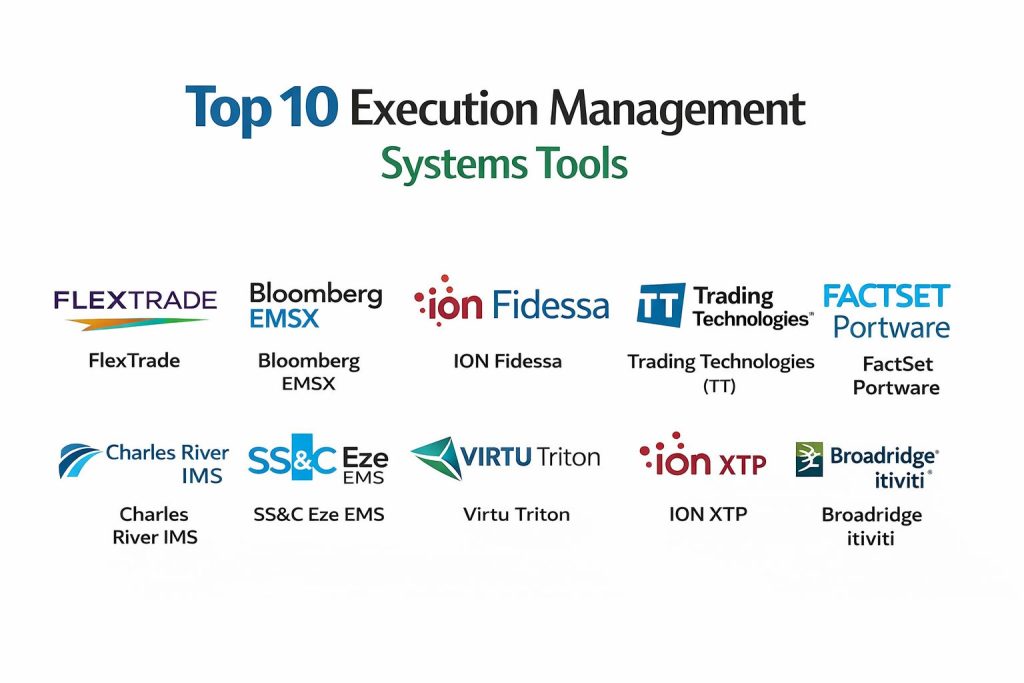
Top 10 Execution Management System (EMS) Tools
1. FlexTrade (FlexTRADER)
FlexTrade’s flagship product, FlexTRADER, is a broker-neutral, multi-asset EMS designed for high-end institutional trading. It is renowned for its extreme configurability and its “Algo Wheel” technology, which helps firms automate the broker selection process based on quantitative performance data.
Key Features
- FlexAlgoWheel: An automated decision-support tool that routes orders to the most effective algorithms based on real-time TCA.
- Open Architecture: Allows for deep integration of proprietary models and third-party data via robust APIs.
- Multi-Asset Coverage: Comprehensive support for equities, FX, fixed income, and exchange-traded derivatives.
- Pre-Trade Analytics: Integrated tools that estimate market impact and risk before an order is placed.
- Customizable UI: Traders can design their own workspaces to match their specific workflow requirements.
- Global Connectivity: Direct access to hundreds of brokers and liquidity venues worldwide.
Pros
- Highly flexible system that can be tailored to the most complex trading strategies.
- Leading-edge automation tools that reduce manual errors in low-touch trading.
Cons
- The high level of customization can lead to a longer implementation period.
- Generally more expensive than basic or broker-bundled execution tools.
Platforms / Deployment
- Windows / Linux
- Cloud-native / On-premise
Security & Compliance
- Features: End-to-end FIX encryption, multi-factor authentication, and robust audit trails for regulatory compliance.
- Compliance: MiFID II, SEC, and MAS compliant.
Integrations & Ecosystem
FlexTrade integrates with almost all major OMS providers and maintains a vast network of broker connections. It also supports various market data feeds and third-party analytics plugins.
Support & Community
The company provides 24/7 global support with dedicated technical account managers for enterprise clients. They host regular user forums and training webinars for the trading community.
2. Bloomberg EMSX
Bloomberg EMSX is a widely used execution platform integrated directly into the Bloomberg Terminal. It offers a seamless bridge between market news, analytics, and trade execution, making it a staple for both buy-side and sell-side firms globally.
Key Features
- Terminal Integration: Instant access to execution tools directly from Bloomberg’s vast data and news ecosystem.
- Broker-Neutral Routing: Ability to route to over 1,300 brokers using the standard FIX protocol.
- Real-Time Monitoring: Live tracking of order status, fills, and cancellations within the Bloomberg interface.
- Staging and Aggregation: Tools to aggregate orders from multiple sources before routing them to market.
- BTCA Integration: Seamless link to Bloomberg Transaction Cost Analysis for detailed execution reporting.
- Mobile Access: Secure order monitoring and basic execution through the Bloomberg Professional app.
Pros
- No additional software installation is required for existing Bloomberg Terminal users.
- Exceptional for high-touch trading where news and instant communication are vital.
Cons
- Traders are tied to the Bloomberg ecosystem and its associated terminal costs.
- Less customizable than “pure-play” EMS platforms for high-frequency or niche strategies.
Platforms / Deployment
- Windows / macOS (via Bloomberg Terminal)
- Terminal-based
Security & Compliance
- Features: Biometric login (B-Unit), encrypted messaging, and comprehensive regulatory reporting tools.
- Compliance: Global regulatory standards.
Integrations & Ecosystem
EMSX is perfectly synced with the Bloomberg AIM (OMS) and other terminal-based tools. It serves as a central hub for the majority of institutional financial communications.
Support & Community
Users have 24/7 access to the “HELP HELP” function on the terminal, providing instant connection to product specialists.
3. ION Fidessa
ION Fidessa provides a high-performance execution platform that is particularly strong in the equities and derivatives space. It is favored by global banks and large institutional desks for its stability and massive throughput capabilities.
Key Features
- Low-Latency Architecture: Engineered for speed, minimizing the time between decision and execution.
- Global Market Data: Consolidated feeds from over 200 markets worldwide.
- Advanced Order Routing: Smart logic that seeks out liquidity across fragmented venues and dark pools.
- Middle-Office Integration: Built-in tools for trade confirmation and allocation.
- Algorithmic Suite: Access to a wide range of standard and bespoke execution algorithms.
- Scalable Infrastructure: Designed to handle millions of messages per day without performance degradation.
Pros
- Reliable and battle-tested in the world’s most demanding trading environments.
- Strong international presence with excellent support for local market nuances.
Cons
- Can feel more rigid and traditional compared to newer, design-focused platforms.
- Integration with non-ION products can sometimes be complex.
Platforms / Deployment
- Windows / Linux
- On-premise / Managed Service
Security & Compliance
- Features: Enterprise-grade security protocols and real-time risk management controls.
- Compliance: SOC 2, ISO 27001.
Integrations & Ecosystem
Fidessa works seamlessly within the ION Group ecosystem, connecting easily to their risk and back-office solutions.
Support & Community
Fidessa offers dedicated regional support teams and a comprehensive training academy for professional traders.
4. Trading Technologies (TT)
Trading Technologies (TT) is the premier EMS for professional derivatives traders, specifically focusing on futures, options, and cryptocurrencies. It is a cloud-native platform known for its “autospreading” and high-speed execution tools.
Key Features
- TT Score: An AI-driven surveillance tool that identifies potentially problematic trading patterns in real-time.
- Autospreader: Allows traders to create and execute complex spread strategies across different exchanges.
- ADL (Algo Design Lab): A visual programming environment where traders can build custom algorithms without writing code.
- Mobile & Web Access: A consistent, high-performance experience across desktop, browser, and mobile devices.
- Crypto Integration: Native support for major digital asset exchanges alongside traditional futures markets.
- Low-Latency Co-location: Strategic server placement near major exchange data centers for maximum speed.
Pros
- Unrivaled for futures and options trading with specialized tools for spreaders.
- Cloud-based architecture means no local hardware maintenance is required.
Cons
- Not as feature-rich for cash equities compared to systems like FlexTrade.
- Pricing structure can be complex, based on volume and specific feature modules.
Platforms / Deployment
- Windows / Web / Mobile
- Cloud (SaaS)
Security & Compliance
- Features: Advanced encryption for all data in transit and multi-factor authentication.
- Compliance: CFTC and exchange-specific regulations.
Integrations & Ecosystem
TT features a robust API (TT .NET and TT REST) that allows firms to build their own custom front-ends or integrate TT execution into other systems.
Support & Community
TT provides an extensive online knowledge base and active community forums, along with 24-hour technical support.
5. FactSet Portware
FactSet Portware is a buy-side focused EMS that leverages AI to simplify complex trading workflows. It is particularly strong in equity and FX markets, providing a high degree of automation for large asset managers.
Key Features
- Portware Enterprise: A highly scalable version for the world’s largest investment firms.
- Alpha Pro: An AI-driven execution assistant that suggests the best time and method to execute a block trade.
- Embedded TCA: Provides real-time and post-trade analytics to prove best execution to regulators.
- Broker Neutrality: Direct FIX connectivity to a global network of brokers and crossing networks.
- Automated Workflows: Rules-based engines that handle low-touch orders, allowing traders to focus on high-touch blocks.
- Multi-Asset Blotter: A unified view of all trade activity across different desks and asset classes.
Pros
- Excellent user interface that prioritizes actionable insights over raw data.
- Deep integration with FactSet’s portfolio and risk analytics tools.
Cons
- Best suited for very large firms; may be “over-engineered” for smaller hedge funds.
- Requires a significant initial investment in setup and integration.
Platforms / Deployment
- Windows
- Cloud / On-premise
Security & Compliance
- Features: Secure data tunneling and role-based access controls.
- Compliance: GDPR and global financial regulations.
Integrations & Ecosystem
As part of the FactSet ecosystem, Portware has native links to market-leading data, research, and portfolio management tools.
Support & Community
FactSet is known for its high-touch customer service model, offering on-site support and dedicated consultants.
6. Charles River IMS
Charles River IMS provides an integrated Order and Execution Management System (OEMS). While it handles the full lifecycle, its EMS capabilities are robust enough to stand against standalone competitors, particularly for firms wanting a single-vendor solution.
Key Features
- Unified OEMS: Eliminates the data gap between order management and execution management.
- Multi-Asset Execution: Full support for global equities, fixed income, FX, and derivatives.
- Compliance Engine: Real-time checking of trade limits and regulatory rules before execution.
- Smart Order Routing: Automatically identifies the best venue for price and liquidity.
- Transaction Cost Analysis: Fully integrated TCA that feeds back into the portfolio management process.
- Cloud Delivery: Hosted on Microsoft Azure for high availability and global scale.
Pros
- Single-platform approach significantly reduces operational risk and data reconciliation issues.
- World-class compliance features that are deeply integrated into the trading blotter.
Cons
- The broad feature set can make the system feel heavy compared to “pure” execution tools.
- Updates can be more complex due to the interconnected nature of the platform.
Platforms / Deployment
- Windows / Web
- Cloud (SaaS)
Security & Compliance
- Features: Azure-backed security with comprehensive encryption and threat detection.
- Compliance: Global enterprise standards (SOC, ISO).
Integrations & Ecosystem
Charles River is part of State Street, providing unique integrations with custodial and back-office services.
Support & Community
Offers a global support network and a mature user community with regular regional conferences.
7. SS&C Eze EMS
Eze EMS (formerly RealTick) is a versatile execution platform popular among hedge funds for its ease of use and speed of deployment. It offers a clean, intuitive interface while maintaining professional-grade features.
Key Features
- Market Data Integration: High-quality, real-time data feeds directly into the execution blotter.
- Advanced Plotting: Real-time charting and technical analysis tools integrated with order entry.
- Global Liquidity: Connectivity to virtually all major exchanges and over 1,000 global brokers.
- Smart Routing Technology: Proprietary logic designed to find hidden liquidity and improve fill rates.
- Mobile Trading: A full-featured mobile app that allows for secure trading on the go.
- Integrated TCA: Provides instantaneous feedback on execution quality versus benchmarks like VWAP.
Pros
- One of the most user-friendly professional EMS platforms on the market.
- Very fast to implement, making it ideal for new fund launches.
Cons
- May lack some of the deeper procedural customization found in FlexTrade or Houdini-level systems.
- Can become expensive as more asset classes and data feeds are added.
Platforms / Deployment
- Windows / Mobile
- Cloud / Desktop
Security & Compliance
- Features: Robust encryption and secure API access.
- Compliance: Fully compliant with SEC and MiFID II reporting.
Integrations & Ecosystem
Eze EMS integrates perfectly with Eze OMS, forming a complete “Eze Investment Suite” for front-to-back management.
Support & Community
SS&C provides a global help desk and an extensive online training portal for users.
8. Virtu Triton EMS
Virtu Triton is a high-performance EMS that leverages Virtu’s massive footprint in market making to provide unique liquidity insights. It is designed for institutional traders who prioritize intelligent routing and algorithmic transparency.
Key Features
- Virtu Frontier: An advanced suite of algorithms that utilize Virtu’s global liquidity insights.
- Broker-Neutral Platform: Seamless routing to any broker or venue in the world.
- Real-Time TCA: Integrated with Virtu’s market-leading analytics (formerly ITG) for deep performance insight.
- Customizable Strategy Templates: Traders can create and save complex execution strategies for recurring use.
- Liquidity Heatmaps: Visual tools that show where liquidity is most active across different venues.
- High-Speed Execution: Built on a low-latency framework optimized for institutional scale.
Pros
- Benefits from Virtu’s deep market expertise and cutting-edge algorithmic research.
- Exceptional analytics that help traders prove “Best Execution” to their clients.
Cons
- The interface is highly technical and may require a period of adjustment for new users.
- Heavy focus on equities; other asset classes may not feel as deeply integrated.
Platforms / Deployment
- Windows
- Desktop / Managed Service
Security & Compliance
- Features: Advanced cyber-surveillance and secure data handling protocols.
- Compliance: Strict adherence to global best execution standards.
Integrations & Ecosystem
Triton is a core part of the Virtu execution ecosystem, providing access to their proprietary dark pools and liquidity sources.
Support & Community
Virtu offers professional consulting services to help firms optimize their execution strategies using the Triton platform.
9. ION Fidessa (XTP)
ION XTP is a high-performance execution system specialized for the cleared derivatives market. It is used by the world’s largest clearing firms and professional trading groups for global market access.
Key Features
- XTP Central: A unified view of all global derivatives trading and clearing activity.
- Ultra-Low Latency: Optimized for high-frequency interaction with major global exchanges.
- Risk Management: Real-time pre-trade and post-trade risk controls for global books.
- Automated Clearing: Direct integration with clearing houses to speed up the post-trade process.
- Multi-Exchange Access: Direct market access to over 80 derivatives exchanges worldwide.
- Scalable API: Allows for the building of automated trading bots and custom interfaces.
Pros
- The gold standard for cleared derivatives and professional futures trading.
- Handles massive transaction volumes with industrial-grade stability.
Cons
- Highly specialized for derivatives; not a general-purpose tool for other asset classes.
- Expensive licensing and setup costs compared to more modern, cloud-only rivals.
Platforms / Deployment
- Windows / Linux
- On-premise / Managed Service
Security & Compliance
- Features: Banking-grade security and full regulatory audit trails.
- Compliance: Global derivatives regulatory standards.
Integrations & Ecosystem
XTP is the core of ION’s derivatives suite, linking execution directly to back-office and clearing systems.
Support & Community
ION provides 24/7 enterprise-level support and professional services for global deployments.
10. Broadridge Itiviti
Broadridge Itiviti (formerly Orc) is a modular EMS known for its powerful connectivity and automation capabilities. It is a favorite for sell-side firms and high-frequency traders who need to build their own custom trading applications.
Key Features
- Modular Architecture: Traders can pick and choose the specific modules they need for their workflow.
- Tbricks Platform: A high-speed algorithmic trading framework that is fully customizable.
- NYFIX Network: Access to one of the world’s largest neutral FIX networks for order routing.
- ETP (Exchange Traded Products): Specialized tools for market making and ETF trading.
- Post-Trade Automation: Seamless flow from execution to clearing and settlement.
- Global Market Connectivity: Pre-built adaptors for hundreds of global exchanges and brokers.
Pros
- Extremely high performance with a focus on low-latency algorithmic trading.
- The NYFIX network provides nearly universal connectivity to the financial world.
Cons
- Requires a high level of technical skill to fully leverage the modular Tbricks platform.
- The interface can be complex for standard buy-side institutional users.
Platforms / Deployment
- Windows / Linux
- Cloud-hybrid / On-premise
Security & Compliance
- Features: Secure network architecture and advanced risk management tools.
- Compliance: Global regulatory compliance.
Integrations & Ecosystem
Broadridge offers an expansive suite of post-trade and proxy voting tools that integrate with the Itiviti platform.
Support & Community
Itiviti provides a dedicated developer portal and global professional services for system customization.
Comparison Table (Top 10)
| Tool Name | Best For | Platform(s) Supported | Deployment | Standout Feature | Public Rating |
| FlexTrade | Custom Algos | Win, Linux | Cloud/On-Prem | FlexAlgoWheel | 4.8/5 |
| Bloomberg EMSX | News-Driven Trading | Win, Mac | Terminal | Terminal Synergy | 4.7/5 |
| ION Fidessa | Global Equities | Win, Linux | Managed | Global Throughput | 4.5/5 |
| Trading Tech | Derivatives/Crypto | Win, Web, Mobile | Cloud (SaaS) | Autospreader | 4.9/5 |
| FactSet Portware | AI-Driven Buy-Side | Windows | Cloud/On-Prem | Alpha Pro AI | 4.6/5 |
| Charles River | Integrated OEMS | Win, Web | Cloud (Azure) | Compliance Engine | 4.5/5 |
| SS&C Eze EMS | Hedge Fund Agility | Windows, Mobile | Cloud | User Experience | 4.6/5 |
| Virtu Triton | Liquidity Insights | Windows | Managed | Virtu Frontier Algos | 4.4/5 |
| ION XTP | Cleared Derivatives | Win, Linux | On-Premise | Clearing Integration | 4.3/5 |
| Broadridge Itiviti | Algo Developers | Win, Linux | Hybrid | Tbricks Framework | 4.4/5 |
Evaluation & Scoring of Execution Management Systems
The scoring below is a comparative model intended to help shortlisting. Each criterion is scored from 1–10, then a weighted total from 0–10 is calculated using the weights listed. These are analyst estimates based on typical fit and common workflow requirements, not public ratings.
Weights:
- Price / value – 15%
- Core features – 25%
- Ease of use – 15%
- Integrations & ecosystem – 15%
- Security & compliance – 10%
- Performance & reliability – 10%
- Support & community – 10%
| Tool Name | Performance (25%) | Liquidity Access (15%) | Analytics (15%) | Security (10%) | Customization (10%) | Support (10%) | Value (15%) | Weighted Total |
| FlexTrade | 10 | 9 | 10 | 9 | 10 | 8 | 7 | 9.05 |
| Bloomberg EMSX | 8 | 10 | 9 | 10 | 6 | 10 | 7 | 8.55 |
| ION Fidessa | 9 | 9 | 8 | 9 | 7 | 8 | 7 | 8.25 |
| Trading Tech | 10 | 8 | 9 | 9 | 9 | 9 | 8 | 9.00 |
| FactSet Portware | 9 | 9 | 10 | 9 | 8 | 9 | 6 | 8.60 |
| Charles River | 7 | 9 | 9 | 10 | 7 | 8 | 8 | 8.15 |
| SS&C Eze EMS | 8 | 9 | 8 | 8 | 7 | 9 | 9 | 8.35 |
| Virtu Triton | 9 | 10 | 10 | 8 | 7 | 8 | 7 | 8.60 |
| ION XTP | 9 | 8 | 7 | 9 | 6 | 8 | 6 | 7.75 |
| Broadridge Itiviti | 10 | 9 | 8 | 9 | 10 | 7 | 6 | 8.55 |
How to interpret the scores:
- Use the weighted total to shortlist candidates, then validate with a pilot.
- A lower score can mean specialization, not weakness.
- Security and compliance scores reflect controllability and governance fit, because certifications are often not publicly stated.
- Actual outcomes vary with assembly size, team skills, templates, and process maturity.
Which Execution Management System (EMS) Tool Is Right for You?
Global Hedge Funds
For multi-strategy hedge funds, FlexTrade or Broadridge Itiviti offer the extreme customization needed to execute niche proprietary strategies. Their ability to integrate custom Python-based algorithms directly into the trading workflow is a decisive factor for firms looking to automate their alpha capture.
Long-Only Asset Managers
Large asset managers prioritizing “Best Execution” and regulatory compliance should lean toward FactSet Portware or Charles River IMS. These platforms focus on high-level automation and providing the audit trails necessary to prove to clients that their trades were handled with minimal market impact.
Derivatives & High-Frequency Specialists
If your primary focus is futures, options, or spread trading, Trading Technologies (TT) is the clear winner. Its cloud-native infrastructure and specialized tools like the Autospreader are purpose-built for the unique mechanics of the derivatives markets.
News-Driven & High-Touch Desks
For desks where institutional knowledge, news flow, and instant broker communication are the primary drivers of trading, Bloomberg EMSX remains the industry standard. The synergy between the Bloomberg Terminal and the execution blotter provides a workflow speed that standalone systems cannot match.
New Fund Launches & SMBs
For smaller funds that need to be up and running quickly with a professional-grade tool, SS&C Eze EMS offers the best balance of user experience and performance. It provides high-quality market data and a clean interface without the massive overhead of more enterprise-focused suites.
Frequently Asked Questions (FAQs)
What is the main difference between an OMS and an EMS?
An OMS manages the entire trade lifecycle, including portfolio accounting and long-term compliance, while an EMS is strictly focused on the speed and quality of execution at the moment the trade hits the market.
Is an EMS only for high-frequency trading?
No, while high-frequency traders use EMS platforms for speed, traditional asset managers use them for their sophisticated algorithms and liquidity-seeking tools to reduce the market impact of large block trades.
Can I use multiple EMS platforms at once?
Yes, many large firms use different EMS platforms for different asset classes—for example, using Trading Technologies for futures and FlexTrade for equities to get the best specialized features for each market.
What does “Broker-Neutral” mean?
A broker-neutral EMS allows you to route your orders to any broker in the world without being restricted to the platforms owned by a specific investment bank.
Do these systems support cryptocurrency trading?
Several modern EMS platforms, most notably Trading Technologies (TT) and Broadridge Itiviti, now offer native support for major digital asset exchanges alongside traditional markets.
What are “Algo Wheels”?
Algo Wheels are automated systems within an EMS that use quantitative data to decide which broker’s algorithm should handle a specific order based on past performance and current market conditions.
Is cloud deployment safe for institutional trading?
Yes, most EMS providers use secure, private cloud instances with dedicated high-speed lines to exchange data centers, providing better uptime and scalability than traditional on-premise servers.
How much do these systems typically cost?
Costs vary wildly based on the number of users, asset classes, and data feeds, but professional institutional EMS platforms typically range from $1,500 to $5,000 per user per month.
Do I need a dedicated programmer to use these tools?
Basic execution does not require programming, but to get the most out of platforms like FlexTrade or Itiviti, having someone on staff who knows Python or C++ can help create custom automated strategies.
What is real-time TCA?
Real-time Transaction Cost Analysis (TCA) allows traders to see how their execution is performing against benchmarks (like the average price of the day) while the trade is still active, allowing them to adjust their strategy mid-stream.
Conclusion
The Execution Management System (EMS) market in 2026 is defined by a push toward total multi-asset integration and AI-enhanced decision making. While veteran platforms like Bloomberg EMSX and ION Fidessa continue to provide the bedrock for global finance, newer cloud-native solutions like Trading Technologies and highly customizable suites like FlexTrade are pushing the boundaries of what is possible in automated trading. Choosing the right tool requires a deep understanding of your firm’s specific liquidity needs, technical capabilities, and the regulatory environment in which you operate.
As markets become more automated, the EMS will continue to evolve into a “trader’s cockpit”—a place where human intuition is augmented by machine learning to navigate the complexities of global liquidity.