
Mainframe systems remain central to enterprise operations, yet they are frequently treated as a separate world from modern DevOps practices. According to figures cited in Compuware’s research materials, the vast majority of new business initiatives involve the mainframe — 57% always and 39% sometimes. That makes it impossible to run a truly end-to-end DevOps pipeline while leaving mainframe development siloed in legacy workflows.
Why Mainframe DevOps Matters
Traditional mainframe development often relies on batch-oriented processes, proprietary editors, and manual promotion workflows that were designed long before continuous integration and continuous delivery (CI/CD) existed. When the rest of your delivery pipeline moves at DevOps speed, a slow mainframe development cycle becomes the bottleneck that limits the entire organisation.
Key challenges teams typically face include:
- Knowledge silos: Mainframe expertise is concentrated in a shrinking pool of experienced engineers, while new hires lack exposure to COBOL, PL/I, JCL, and related technologies.
- Poor documentation: Legacy applications are often underdocumented, making it risky for anyone other than the original author to modify them.
- Toolchain fragmentation: Mainframe teams use ISPF panels and TSO commands while distributed teams use Git, Jenkins, and Jira — with no shared workflow connecting them.
- Performance bottlenecks: Without modern profiling tools, identifying and resolving performance issues in COBOL or Assembler code is a slow, manual process.
How Compuware Addresses Mainframe DevOps
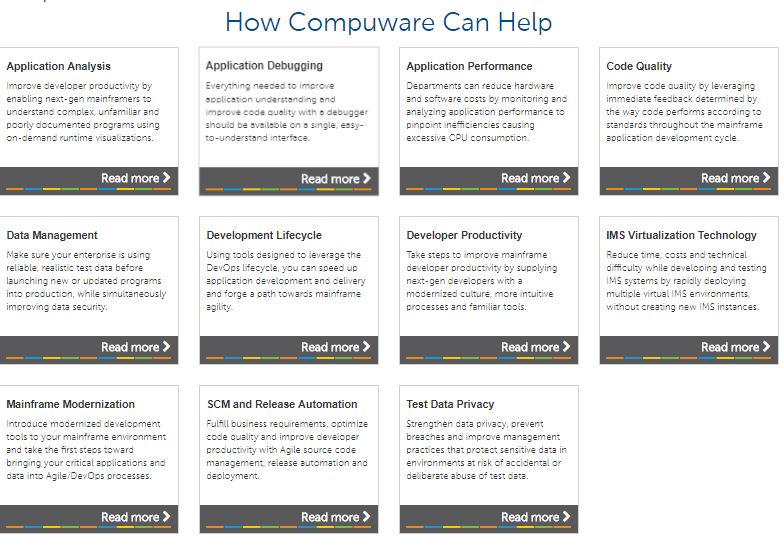
Compuware positions its product suite as a way to bring Agile and DevOps principles to z/OS mainframe development. Its toolset targets three core areas:
1. Source Code Management and Version Control
Compuware ISPW provides mainframe-native source code management with automated promotion pipelines. It integrates with Git-based repositories, allowing mainframe code to participate in the same branching and merging strategies used by distributed teams. This means a single CI/CD pipeline — orchestrated through tools such as Jenkins or Azure DevOps — can include both mainframe and non-mainframe components.
2. Understanding and Working with Underdocumented Applications
Compuware Topaz Workbench provides a modern Eclipse-based IDE for mainframe developers, replacing the green-screen ISPF interface. Its program analysis features help developers understand complex, poorly documented COBOL programs by visualising data flows, copybook usage, and call chains — reducing the risk of unintended side effects when modifying legacy code.
3. Eliminating Performance Bottlenecks
Compuware Strobe is a mainframe application performance management (APM) tool that profiles CPU consumption at the statement level for COBOL, PL/I, and other z/OS languages. Rather than guessing where a batch job is spending its time, developers can pinpoint the exact lines of code responsible and make targeted, evidence-based optimisations.
Cross-Platform Collaboration
One of the more significant aspects of the Compuware approach is its emphasis on integration with mainstream DevOps tooling. Plugins and APIs connect ISPW and Topaz with:
- Jenkins — triggering mainframe builds and deployments from shared pipelines
- Git / GitHub / Bitbucket — synchronising mainframe source with distributed version control
- Jira — linking mainframe change sets to the same issue-tracking workflow used by the broader team
- SonarQube — running static code analysis on COBOL programs alongside analysis of Java or Python code
- XL Release / ServiceNow — including mainframe deployments in enterprise release orchestration
This integration layer is important because it removes the need for separate approval gates and manual hand-offs between mainframe and distributed teams, which are common sources of delay in enterprise release cycles.
Onboarding New Mainframe Developers
A recurring concern in the mainframe industry is the demographic gap: many experienced COBOL developers are approaching retirement, and universities rarely teach mainframe skills. Compuware targets this challenge by providing a development experience that looks and feels like a modern IDE, reducing the learning curve for developers who are unfamiliar with the traditional z/OS toolset. Features such as syntax highlighting, code completion, and integrated debugging in Topaz Workbench are designed to make the mainframe accessible to developers whose background is primarily in distributed or cloud environments.
Key Takeaways
- Mainframe systems are involved in the vast majority of enterprise business initiatives, making mainframe DevOps a strategic necessity rather than a niche concern.
- Compuware’s toolset — including ISPW, Topaz Workbench, and Strobe — addresses source control, code comprehension, and performance profiling on z/OS.
- Integrations with Jenkins, Git, Jira, and SonarQube allow mainframe development to participate in the same CI/CD pipelines as distributed applications.
- A modern IDE experience lowers the barrier for new developers entering mainframe roles.
- Eliminating the mainframe bottleneck is often essential for organisations that want true end-to-end DevOps delivery speed.
If your organisation runs critical workloads on IBM Z and is struggling to align mainframe delivery with the pace of your cloud and distributed teams, evaluating a dedicated mainframe DevOps toolchain is a practical starting point.