Everyone talks about DevOps, and plenty of organizations claim to “just do DevOps” overnight. In practice, a successful DevOps transformation requires clear goals, the right toolchain, and a genuine cultural shift. Before your team takes a single step, ask yourself: why do we need DevOps, and what outcomes are we trying to achieve?
The five steps below cover the foundational ideas every team should address when adopting or improving a DevOps practice.
1. Understand the 6 C’s of the DevOps Cycle
DevOps is a continuous loop, not a one-time project. Familiarize yourself with each phase before you start making changes to your pipeline.
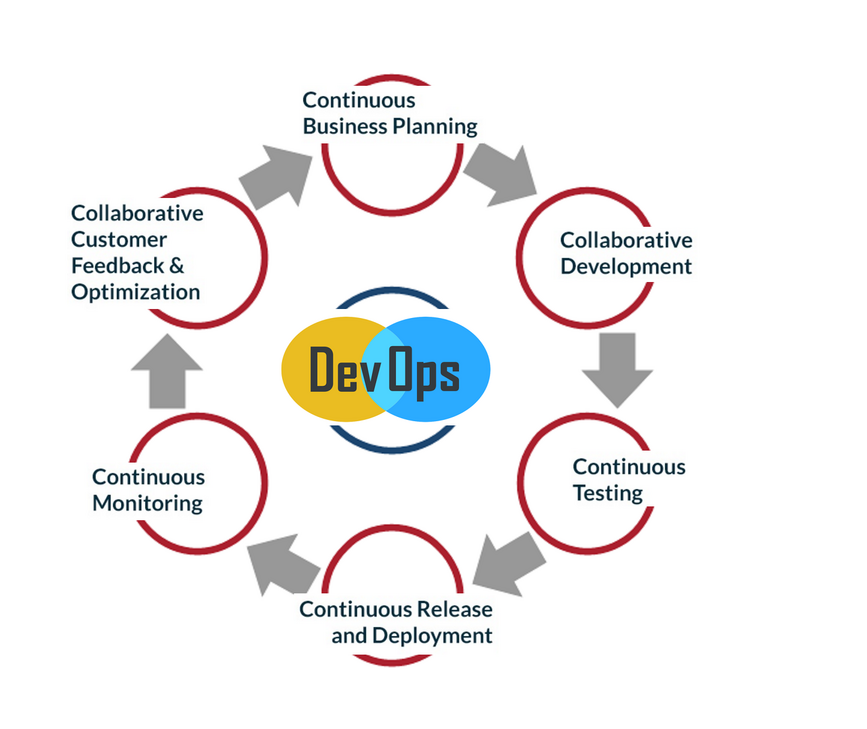
- Continuous Business Planning. Identify the skills, expected outcomes, and resources you need before a single line of code is written. Planning never stops—each release cycle feeds back into the next planning phase.
- Collaborative Development. Development starts with a shared sketch plan. Developers, operations engineers, and product owners work together from the outset rather than handing work over the wall.
- Continuous Testing. Unit tests, integration tests, and automated regression suites run throughout development—not just at release time. Early, frequent testing catches defects when they are cheapest to fix.
- Continuous Release and Deployment. A well-built CD pipeline automates code reviews, gating, and deployment to production or staging environments, making frequent releases safe and repeatable.
- Continuous Monitoring. Once code is deployed, monitoring tools capture performance metrics, error rates, and infrastructure health. Alerts surface problems immediately rather than after users complain.
- Customer Feedback and Optimization. Real user feedback—through feature flags, A/B tests, support tickets, and analytics—drives the next planning cycle, closing the loop between engineering and business value.
2. Choose and Master the Right Tools
DevOps is a culture and a practice, not a toolchain—but the right tools make the practice sustainable. Management must invest in proper training so that developers and operations engineers are genuinely proficient, not just nominally licensed.
Common categories and representative tools include:
- Source Control: GitHub, GitLab, Bitbucket
- Configuration Management & Infrastructure as Code: Ansible, Chef, Puppet, Terraform
- Containerization: Docker, Podman
- Container Orchestration: Kubernetes, Amazon ECS
- Issue & Project Tracking: Jira, Linear
- Cloud Platforms: AWS, Azure, Google Cloud
- CI/CD: Jenkins, GitHub Actions, CircleCI, GitLab CI
- Team Communication: Slack, Microsoft Teams
Start with the tools that address your biggest bottleneck. Adding every tool at once creates complexity without value.
3. Deploy Frequently and Automatically
One of the clearest signals of a healthy DevOps practice is deployment frequency. If your team deploys once a quarter, bugs accumulate, release risk grows, and feedback loops lengthen. The goal is to deploy small, well-tested increments often—ideally multiple times per day in mature organizations.
Frequent, automated deployments require:
- A fully automated CI/CD pipeline that builds, tests, and deploys on every merged commit.
- Feature flags to decouple deployment from release, letting you ship code without exposing it to all users immediately.
- Automated rollback mechanisms so that a bad deployment can be reversed quickly without manual intervention.
- A culture that treats a fast rollback as a success, not a failure—because learning quickly is the point.
4. Adopt Containers and a Microservices Architecture
Automation—the engine of DevOps—is significantly easier when your application is composed of small, independently deployable services running in containers.
- Containers (Docker being the most common runtime) package an application with all its dependencies, producing a consistent artifact that behaves identically in development, testing, and production.
- Microservices architecture breaks a monolithic application into loosely coupled services, each owned by a small team. This lets teams deploy their service independently, reducing coordination overhead and release risk.
A word of caution: microservices introduce operational complexity—service discovery, distributed tracing, and network latency are real concerns. Evaluate whether your team’s scale justifies the trade-off before decomposing a working monolith.
5. Build Constant Communication Between Teams
DevOps collapses the wall between development and operations. That only works when both sides communicate continuously. Siloed teams produce siloed systems—deployments break because an operations engineer didn’t know a developer changed an environment variable.
Effective communication practices include:
- Shared chat channels (Slack, Teams) organized around services or incidents, not just team membership. This gives everyone visibility into what is deployed and what is broken.
- Blameless post-mortems after incidents, so that findings are shared across teams and mistakes become systemic improvements.
- Automated notifications from your CI/CD pipeline posted directly to team channels, so that deployment success or failure is visible without anyone having to ask.
- Regular cross-functional standups or syncs between development, operations, security, and product to surface blockers early.
Putting It Together
Whether you are at the start of your DevOps journey or trying to improve a practice that has stalled, these five areas—understanding the full DevOps cycle, investing in the right tools, deploying frequently and automatically, leveraging containers and microservices, and maintaining constant cross-team communication—give you a solid framework for diagnosis and improvement.
DevOps is not a destination you reach once. It is a continuous improvement loop, and the teams that treat it that way are the ones that see lasting results.
Original source referenced: dzone.com (2017).