Introduction
Digital marketing platforms tools are an all-in-one suite of technologies that help businesses manage customer engagement, automate campaigns, analyze results, and refine strategy across digital channels. In 2026, as artificial intelligence, real-time analytics, and conversational commerce become mainstream, these platforms are crucial for maintaining agility and competitiveness. When choosing a platform, businesses should weigh factors such as integration flexibility, pricing transparency, AI capabilities, ease of use, cross-channel support, and scalability.
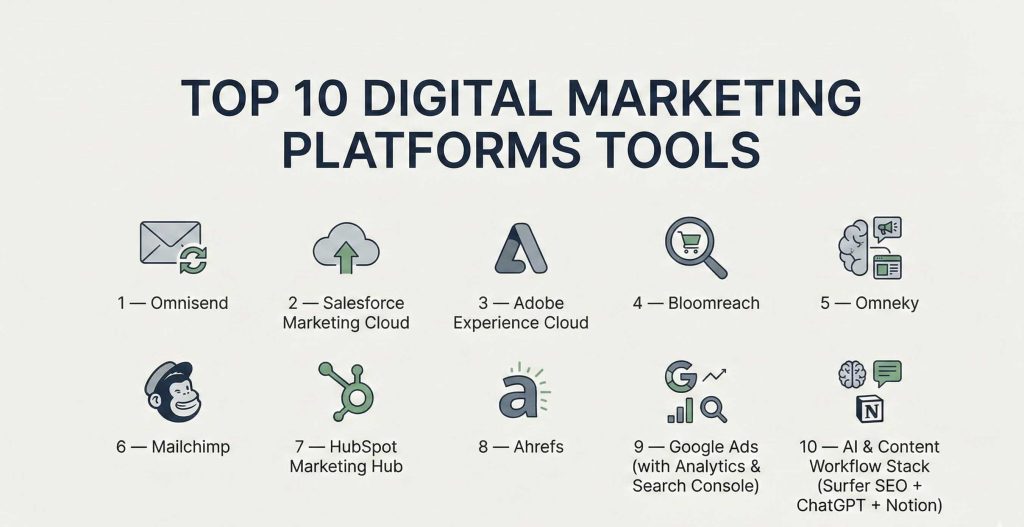
Top 10 Digital Marketing Platforms Tools
Based on expert insights and industry usage, here are 10 standout tools:
1. Omnisend
Short Description: E-commerce-focused email, SMS & push marketing automation.
Key Features:
- Drag-and-drop campaign builder
- SMS, email, and push notifications
- Abandoned cart workflows
- Multi-channel automation
Pros: - Ideal for e-commerce automation
- Affordable plans with scalable features
Cons: - SMS costs can escalate
- Fewer integrations vs enterprise tools
2. Salesforce Marketing Cloud
Short Description: Powerful enterprise-grade marketing automation & analytics.
Key Features:
- Email automation and segmentation
- Journey mapping
- AI-driven personalization
- Cross-channel campaign orchestration
- Deep analytics & reporting
Pros: - Highly scalable and robust for enterprises
- Rich automation and personalization capabilities
Cons: - Expensive; complex setup
- May require dedicated technical resources
3. Adobe Experience Cloud
Short Description: Integrated suite for analytics, advertising, content, and journey orchestration.
Key Features:
- Web analytics
- Advertising & media optimization
- Content and experience management
- Targeting and journey orchestration
Pros: - Comprehensive set of tools under one roof
- Strong for personalized customer experiences
Cons: - High cost; best suited for large enterprises
- Complexity requires training or support
4. Bloomreach
Short Description: AI-powered marketing automation, product discovery, and headless CMS.
Key Features:
- Email & SMS marketing automation (Engagement)
- AI-based product discovery and recommendations (Discovery)
- Headless content management (Content)
Pros: - AI-driven personalization across channels
- Especially strong for e-commerce use cases
Cons: - Less widespread adoption than others
- Enterprise-level pricing
5. Omneky
Short Description: AI tool that generates and optimizes ad creatives across channels.
Key Features:
- AI-driven creative generation
- Multi-channel campaign launching
- Performance insights and optimization
Pros: - Automates creative testing at scale
- Saves time for ad production
Cons: - Focused on creative; limited broader marketing features
- Can lack human touch in art direction
6. Mailchimp
Short Description: Beginner-friendly email marketing with basic CRM integration.
Key Features:
- Campaign automation
- Audience segmentation
- Basic CRM tools
- Built-in templates and analytics
Pros: - Free plan available; easy to use
- Extensive integrations
Cons: - Limited for advanced marketers
- Segmentation options are basic only
7. HubSpot Marketing Hub
Short Description: All-in-one marketing, sales, and CRM platform—ideal for growing businesses.
Key Features:
- Email marketing & automation
- Blogging and content management
- SEO tools and landing pages
- CRM integration and live chat
- Custom dashboards & analytics
- Chatbots & lead tracking
Pros: - Comprehensive suite; strong automation
- Scalable pricing tiers, including free
Cons: - Advanced features locked behind higher-tier plans
- Learning curve for new users due to breadth of tools
8. Ahrefs
Short Description: Robust SEO toolkit for keyword research and link analysis.
Key Features:
- Backlink analysis
- Keyword tracking
- Site audits and competitive research
Pros: - Highly accurate data; trusted in SEO community
- Comprehensive features for organic search optimization
Cons: - Costly for individuals or small teams
- Lacks email, CRM, or automation features
9. Google Ads (with Analytics & Search Console)
Short Description: PPC and SEO tools for visibility and performance tracking.
Key Features:
- Targeted ad campaigns (Search, Display, Shopping)
- Keyword optimization and budget control
- Integration with Google Analytics and Search Console
Pros: - High-intent traffic and reach
- Powerful targeting and budget control
Cons: - Competitive and potentially expensive CPC
- Steep learning curve for optimization
10. AI & Content Workflow Stack (Surfer SEO + ChatGPT + Notion)
Short Description: An integrated workflow for content creation, optimization, and planning.
Key Features:
- Surfer SEO: real-time content optimization
- ChatGPT: idea generation and copywriting
- Notion: collaborative planning and documentation
Pros: - Efficient, modern content workflow
- Collaborative and scalable across teams
Cons: - Requires manual integration
- Results depend on prompt quality
Comparison Table
| Tool Name | Best For | Platform(s) Supported | Standout Feature | Pricing | Rating (G2/Capterra) |
|---|---|---|---|---|---|
| Omnisend | Growing businesses & inbound marketing | Web-based | All-in-one marketing + CRM | Free / Custom tiers | High (popular) |
| Salesforce Marketing Cloud | Enterprises with complex needs | Web-based | Journey mapping & AI personalization | Custom | High |
| Adobe Experience Cloud | Enterprises needing full-suite | Web-based | Content + journey orchestration | Custom | High |
| Bloomreach | E-commerce personalization | Web-based | AI for discovery & content mgmt | Custom | Strong |
| Omneky | Creative ad automation | Web-based | AI creative generation | Custom | Niche |
| Mailchimp | Small teams & email marketing | Web-based | Ease of use + free tier | Free / Paid | High |
| HubSpot Marketing Hub | E-commerce marketing campaigns | Web-based | Multi-channel automation | Paid | Solid |
| Ahrefs | SEO professionals | Web-based | Backlink & keyword insights | Paid | Top-rated |
| Google Ads + Analytics | Paid search marketing | Web-based | PPC targeting + search optimization | Pay-per-use | Industry standard |
| Surfer SEO + ChatGPT + Notion | Content marketing workflows | Web-based | AI-enhanced content creation workflow | Mixed | Growing buzz |
Which Digital Marketing Platforms Tool Is Right for You?
- Startups / Small Businesses:
- Mailchimp or HubSpot Free / Starter provide accessible entry points with easy onboarding.
- E-commerce Stores:
- Omnisend is great for multi-channel automations.
- Bloomreach offers stronger personalization as you scale.
- SEO-focused Teams:
- Ahrefs excels in backlink insights.
- Combine with Google Ads for paid search performance.
- Large Enterprises:
- Salesforce Marketing Cloud and Adobe Experience Cloud offer full-scale automation—though complexity and cost are higher.
- Content Creators & Agencies:
- Use the Surfer SEO + ChatGPT + Notion stack for streamlined ideation to publishing workflows.
- Creative-Heavy Campaigns:
- Omneky can be a powerful addition for automated ad creative testing and scaling.
Conclusion
In 2026’s dynamic marketing environment, selecting the right digital marketing platforms tools is essential to streamline workflows, enable personalized interactions, and harness AI-powered automation. From beginner-friendly options like Mailchimp to enterprise-grade suites like Salesforce or Adobe, there’s a solution for every scale. The landscape continues evolving—so test free plans or request demos to ensure your choice aligns with your team’s workflow and goals.
FAQs
Q1: What’s the difference between marketing platforms and tools?
Marketing platforms, like HubSpot or Salesforce, are integrated suites covering multiple marketing functions; tools, like Ahrefs or Mailchimp, often focus on specific needs (SEO, email).
Q2: Are free tiers enough to get started?
Absolutely! Tools like HubSpot (Free), Mailchimp, and Google Analytics offer substantial capabilities to begin with, though advanced features may require paid plans.
Q3: How important is AI in marketing tools now?
AI is rapidly becoming essential—used for personalization, creative generation, optimization, and analytics. Platforms like Salesforce, Adobe, and Omneky are leading with AI integrations.
Q4: Can I mix multiple tools instead of choosing a platform?
Yes! Many businesses combine best-of-breed tools (e.g., Ahrefs + Surfer + Notion) for flexibility—but this requires smooth integration and management.
Q5: How do I choose the right tool without overspending?
Start with a list of must-have features, test free trials, compare pricing tiers, and prioritize tools that integrate easily with your existing stack.