Why 2017 looks like a year of change for software development jobs
YOUR COSMETIC CARE STARTS HERE Find the Best Cosmetic Hospitals Trusted • Curated • Easy Looking for the right place […]
YOUR COSMETIC CARE STARTS HERE Find the Best Cosmetic Hospitals Trusted • Curated • Easy Looking for the right place […]
YOUR COSMETIC CARE STARTS HERE Find the Best Cosmetic Hospitals Trusted • Curated • Easy Looking for the right place […]
DevOps analysts, practitioners, and vendors shared their forecasts for how DevOps would evolve in 2017. Here are nine predictions that shaped the conversation — from DevOps at scale to monitoring, BizDevOps, and the risks of failed implementations.
Cloud migration trades visibility for agility. Learn the four key requirements for monitoring virtualized networks—horizontal scale, inter-segment security, container support, and DevOps elasticity—without overwhelming your tooling.
Are performance optimization and deep technical learning really irrelevant to the average developer? Here’s why investing in your craft—even two to four hours a week—matters more than you think.
A survey of 1,000 software professionals reveals where database DevOps stands today — from deployment frequency to the biggest barriers teams face when bringing databases into the DevOps pipeline.
APIs are transforming IT infrastructure by enabling automation, operational efficiency, DevOps workflows, disaster recovery, and cost reduction. Here’s how businesses are using them today—and where the technology is headed.
DevOps is far more than a set of tools or a continuous delivery pipeline. Drawing on insights from The DevOps Handbook and HashiCorp co-founder Armon Dadgar, this article unpacks what DevOps really means for teams, culture, and infrastructure provisioning.
Network Function Virtualization (NFV) and DevOps are converging in ways first pioneered by telecoms. Here is what enterprise teams need to know about hybrid cloud NFV, orchestration, and why the convergence matters.
Learn how to automate database migrations in your CI/CD pipeline using Flyway, including practical tips for handling version conflicts, out-of-order migrations, and cross-platform checksum issues.
Successfully adopting DevOps isn’t purely a hiring problem or a training problem—it’s both. Learn why the smartest CIOs combine targeted external hiring with deliberate upskilling of existing staff.
Leading application development analysts reflect on what made 2016 a turning point for DevOps and ALM — from toolchain maturity and CI/CD pipelines to container standardization and enterprise Agile adoption.
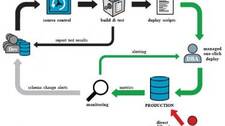
Learn how to design and implement a Continuous Delivery pipeline—from measuring your existing release process and automating builds to orchestrating deployments across environments.
YOUR COSMETIC CARE STARTS HERE Find the Best Cosmetic Hospitals Trusted • Curated • Easy Looking for the right place […]
DevOps unites development and operations into a single, collaborative discipline. Learn how the cultural shift, short sprint cycles, and data-driven insights deliver faster, more reliable software delivery.
Forrester Research outlined six cloud computing predictions for 2017, from the rise of enterprise adoption and hybrid cloud to containers, hyperconverged infrastructure, and cloud cost containment. Here is a breakdown of each trend.
The DevOps hiring process is broken on both sides of the table. Recruiters post unicorn job descriptions that don’t match reality, while candidates list tools instead of demonstrating problem-solving ability. Here’s what both sides are getting wrong—and how to fix it.
A structured review of “Continuous Enterprise Development in Java,” covering its two-part layout, Arquillian testing focus, JEE component walkthroughs, and honest pros and cons for Java enterprise developers.
Front-end performance optimization matters across your entire SaaS organization — not just for engineering. Learn how DevOps and business teams can use performance tooling to ship faster, convert more, and deliver better user experiences.
When DevOps and security teams operate in silos, organizations pay the price in data breaches and compliance failures. Here is why uniting the two disciplines — through automation and shared ownership — is essential.