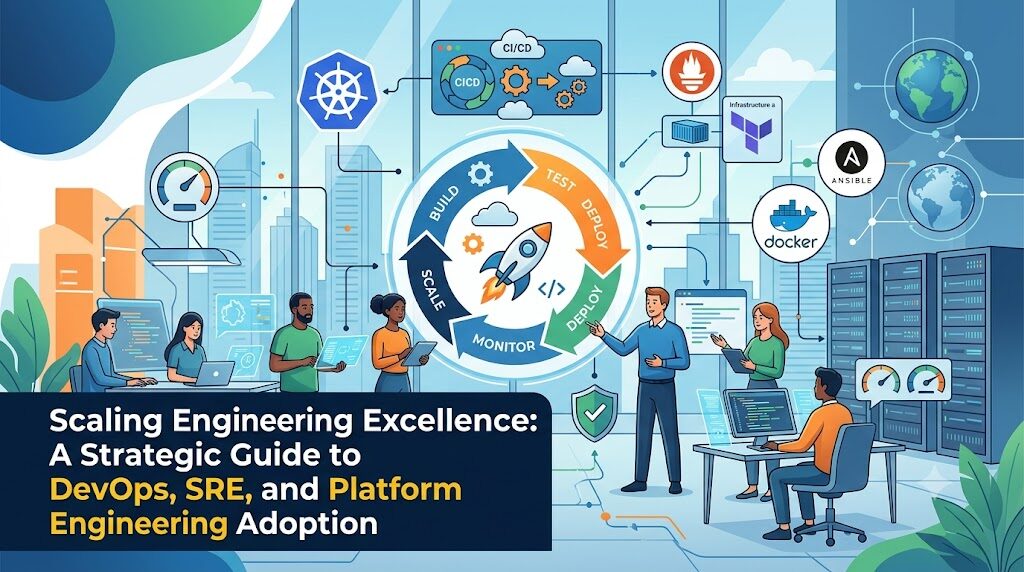
In the modern digital economy, the ability to release software reliably and rapidly is not merely a competitive advantage—it is a baseline requirement for survival. Organizations transitioning from legacy infrastructure to cloud-native environments often encounter significant friction. This complexity requires more than just tool adoption; it demands a fundamental shift in culture, processes, and technical capability. As a DevOps architect and consultant, I have worked with diverse global teams to navigate these shifts, ensuring that technical investments translate into tangible business outcomes. Through Rajesh kumar, I aim to provide the insights and training necessary to bridge the gap between architectural theory and operational reality.
Understanding Current Enterprise Challenges
Many organizations find themselves stuck in what I refer to as the “DevOps illusion.” They have adopted the necessary tools, yet they fail to achieve the agility they expected. The challenges are rarely about the lack of technology; they are about how that technology is applied.
Common obstacles include siloed development and operations teams, inconsistent deployment pipelines, and a lack of standardized environment management. Scaling becomes difficult when teams rely on manual configurations, leading to configuration drift and increased downtime. Furthermore, security is often treated as an afterthought—a final gate before release—rather than an integrated component of the development lifecycle. Addressing these challenges requires a structural overhaul that emphasizes automation, observability, and a unified engineering culture.
Why Skilled DevOps Trainers Matter
Generic online tutorials provide a baseline, but enterprise transformation requires a nuanced approach that addresses specific organizational constraints. This is where an experienced DevOps trainer becomes critical. A trainer brings the perspective of an architect who has navigated production failures, legacy migration hurdles, and team-wide resistance.
Effective training goes beyond teaching syntax; it focuses on decision-making frameworks. When a team engages in DevOps corporate training, they should learn not just how to run a Jenkins pipeline or write a Terraform module, but why certain patterns work in high-scale environments while others fail. An experienced mentor accelerates this learning curve, helping teams avoid common pitfalls and significantly reducing the time it takes to implement scalable solutions.
Essential Skills Every Modern DevOps Professional Needs
To succeed in today’s cloud-centric landscape, engineers must cultivate a T-shaped skill set. While specialization is important, foundational knowledge must span the entire software delivery lifecycle.
- CI/CD Orchestration: Moving beyond basic scripting to build resilient, automated delivery pipelines that include testing and validation.
- Infrastructure as Code (IaC): Treating infrastructure definitions with the same rigor as application code, utilizing tools for provisioning and state management.
- Containerization and Orchestration: Mastering the lifecycle of containerized applications, including efficient image building and complex cluster management.
- Cloud Platforms: Understanding the nuances of AWS, Azure, or GCP services beyond the basic compute and storage modules.
- Observability: Implementing monitoring and logging systems that provide actionable insights into system health.
- Security Automation: Embedding compliance and vulnerability scanning into the CI/CD process.
Kubernetes Training for Enterprise Teams
Kubernetes is the backbone of modern infrastructure, yet its complexity is frequently underestimated. Implementing Kubernetes without a deep understanding of its internal architecture often leads to operational fatigue and inflated cloud costs.
In a professional Kubernetes training setting, the focus should be on the “Day 2” operations. This includes mastery of ingress controllers, service mesh implementation, efficient resource allocation, and advanced debugging techniques. Enterprises need to move past simple deployments and focus on building multi-tenant clusters, implementing robust role-based access control, and ensuring high availability across availability zones.
Site Reliability Engineering (SRE) Training
Site Reliability Engineering (SRE) is the practical application of software engineering principles to operations. Many organizations claim to practice SRE, but they often miss the core tenets: the definition of Service Level Objectives (SLOs) and the management of “Error Budgets.”
SRE training should shift the team’s mindset from “keeping the lights on” to “engineering reliability.” This involves deep dives into incident management, blameless post-mortems, and the systematic reduction of toil. By implementing observability at every layer of the stack, teams can move from reactive firefighting to proactive system management.
DevSecOps in Modern Organizations
DevSecOps is not a separate role or a single tool; it is a collaborative culture. The goal is to shift security to the left, enabling developers to identify and remediate vulnerabilities early in the code-writing process.
Practical training in this domain focuses on integrating static analysis (SAST), dynamic analysis (DAST), and container scanning directly into the build pipeline. Furthermore, it emphasizes the importance of managing secrets and identity access, ensuring that security is seamless for developers rather than a roadblock to innovation.
Platform Engineering and Developer Enablement
The current trend in mature engineering organizations is the evolution of DevOps into Platform Engineering. Instead of expecting every developer to become a Kubernetes expert, organizations are building Internal Developer Platforms (IDPs).
These platforms act as an abstraction layer, providing developers with self-service capabilities for provisioning infrastructure, managing databases, and deploying applications. Platform Engineering training focuses on designing these abstractions to maximize developer productivity while maintaining operational governance. It is about creating a “golden path” that allows teams to move fast without the burden of managing underlying complexity.
How DevOps Consulting Accelerates Transformation
As a DevOps consultant, I have observed that most transformations fail due to a lack of alignment between technology goals and business strategy. Consulting engagements bridge this gap by providing objective assessments of the current state and creating a phased roadmap for improvement.
This process involves evaluating the existing CI/CD maturity, identifying bottlenecks in the delivery pipeline, and assessing team skill gaps. By aligning technical initiatives with business objectives, we ensure that infrastructure investments directly support feature velocity and system reliability.
Suggested Learning Paths for Different Roles
A one-size-fits-all training curriculum is rarely effective. Different roles require distinct areas of focus:
- Developers: Should focus on containerization, basic Kubernetes operations, CI/CD integration, and writing testable code.
- Operations Engineers: Need deep dives into automation, infrastructure scaling, observability, and networking.
- Architects: Should concentrate on high-level system design, security patterns, multi-cloud strategy, and cost optimization.
- Security Professionals: Require knowledge of policy-as-code, supply chain security, and cloud-native threat models.
- Engineering Managers: Need to understand the metrics that matter, such as DORA metrics, to measure the health and velocity of their teams.
Practical Recommendations for Organizations
Transformation is a journey, not a destination. To sustain these practices, organizations must prioritize continuous learning.
- Start with Pilot Projects: Do not attempt a company-wide overhaul overnight. Choose one team or one application to serve as a model for DevOps practices.
- Standardize Tooling: Reduce complexity by standardizing on a core set of tools across the organization.
- Measure Success with Metrics: Track performance using DORA metrics: Deployment Frequency, Lead Time for Changes, Mean Time to Recovery, and Change Failure Rate.
- Foster a Culture of Learning: Provide regular training and dedicated time for professional development.
- Emphasize Automation: If a task is performed more than twice, it should be automated.
Frequently Asked Questions
1. How do you measure the ROI of DevOps corporate training? ROI is measured by tracking improvements in DORA metrics over time. If your lead time for changes decreases and your mean time to recovery improves, the training investment is directly yielding operational efficiency.
2. Is a dedicated Platform Engineering team necessary for mid-sized companies? It depends on your scale. If your developers are spending more than 20% of their time on infrastructure tasks rather than feature development, it is time to invest in a platform-centric approach to offload that burden.
3. What is the biggest hurdle when implementing DevSecOps? The biggest challenge is cultural, not technical. It requires moving away from the “security as a gatekeeper” model toward a model where security is a shared responsibility integrated into the workflow.
4. How does SRE differ from traditional Ops? Traditional Ops focuses on manual task execution and reactive fixes. SRE applies software engineering discipline to automate operations, manage capacity, and define reliability thresholds, making systems self-healing.
5. How do you choose between Jenkins and modern CI/CD tools? Choice depends on your existing ecosystem. Jenkins is highly extensible but requires significant maintenance. Modern tools often offer better out-of-the-box integration for cloud-native workflows. The decision should be based on your team’s capability to manage the tool versus the need for specific features.
6. Is it possible to implement Kubernetes without massive overhead? Yes, by utilizing managed Kubernetes services and focusing on standardizing templates, such as Helm charts or Kustomize, rather than building everything from scratch.
7. How can non-technical managers support DevOps transformation? Managers should prioritize the removal of organizational silos and focus on funding training and reducing technical debt, rather than pushing for artificial deadline pressures that ignore technical health.
8. What is the typical timeline for an enterprise cloud migration? A successful migration is rarely a “lift and shift.” It typically takes 6 to 18 months, depending on the complexity of legacy applications and the readiness of the team to adopt cloud-native operational models.
9. How do you balance speed with security? By automating security checks. If security compliance is part of the automated pipeline, it ceases to be a delay and becomes a standard quality gate that runs in parallel with functional testing.
10. Why is Terraform training essential for AWS DevOps consultants? Terraform is the industry standard for managing infrastructure state. AWS DevOps consultants must master it to ensure that infrastructure environments are reproducible, version-controlled, and consistent across development, staging, and production.
Conclusion
Building a high-performing engineering organization is an ongoing process of refinement. Whether you are seeking a DevOps trainer in India or looking for an AWS DevOps Consultant to guide your cloud migration, the focus must remain on capability building. By investing in standardized training—whether it involves Terraform training, Jenkins training, or Docker Kubernetes training—you empower your team to solve problems independently. Continuous learning and a commitment to architectural excellence are the true drivers of sustainable success in the modern software landscape.