Note: Market data and forecasts in this article are sourced from a third-party market research report originally attributed to scienceofchange.org and Data Bridge Market Research, published circa 2020. Figures reflect estimates current at that time.
Market Overview
The global application container market was valued at approximately USD 1.1 billion in 2017 and was projected to grow at a compound annual growth rate (CAGR) of 33.2% between 2018 and 2026, according to research published by Data Bridge Market Research. The rapid adoption of microservices architectures, the push for DevOps practices, and enterprise demand for portability and scalability have all contributed to this growth trajectory.
What Is an Application Container?
An application container is a lightweight, standalone executable package that bundles an application’s code together with its dependencies, runtime, libraries, and configuration files. Containers solve one of the most persistent problems in software delivery: ensuring that an application runs consistently regardless of where it is deployed — whether on a developer’s laptop, a test server, an on-premises data center, or a public cloud instance.
Unlike traditional hypervisor-based virtualization — where each virtual machine runs its own full operating system — container-based virtualization allows multiple containers to share a single host OS kernel. Each container is isolated at the process level and carries only its own application code and dependencies. This approach results in:
- Faster startup times compared to full virtual machines
- Lower resource overhead due to shared OS kernel usage
- Greater density — more workloads per physical host
- Consistent environments across development, staging, and production
Cloud-based deployment has emerged as the dominant adoption pattern for container technology, enabling elastic scaling and simplified orchestration across distributed infrastructure.
Market Drivers and Restraints
Key Growth Drivers
- Microservices adoption: Organizations decomposing monolithic applications into microservices naturally gravitate toward containers as the standard packaging and deployment unit.
- Modernization of legacy applications: Enterprises are containerizing existing business-critical workloads to reduce infrastructure costs and improve deployment velocity.
- Business agility: Containers shorten the feedback loop between development and production, enabling faster iteration and competitive differentiation.
- Cloud-native development trends: Major cloud providers offering managed container services has lowered the barrier to entry significantly.
Market Restraints
- Security concerns: Shared kernel architecture introduces risks such as container escape vulnerabilities and insufficient isolation for certain compliance-sensitive workloads.
- Skills gap: Expertise in container orchestration, networking, and security remains scarce, increasing implementation complexity and time-to-value.
Market Segmentation
By Platform
The platform segment covers the orchestration and runtime technologies used to deploy and manage containers at scale:
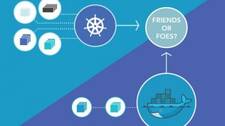
- Kubernetes — The dominant open-source container orchestration platform, originally developed by Google and now maintained by the CNCF.
- Docker Swarm — Docker’s native clustering and orchestration solution, simpler to configure than Kubernetes but with a narrower feature set.
- AWS ECS (Elastic Container Service) — Amazon’s proprietary managed container orchestration service, tightly integrated with the AWS ecosystem.
- Apache Mesos — A distributed systems kernel capable of running containers alongside other workloads.
- HashiCorp Nomad — A flexible workload orchestrator that supports containers, VMs, and standalone binaries.
- Cloud Foundry — An open-source PaaS platform with built-in container runtime support.
- OpenStack Magnum — An OpenStack API service that provisions container orchestration engines.
- Azure Container Service / AKS — Microsoft Azure’s managed Kubernetes offering.
- Internally Developed Tools — Custom-built orchestration solutions used by large enterprises with specific requirements.
By Service
- Consulting
- Container monitoring
- Container security
- Container data management
- Container networking
- Container orchestration
- Support and maintenance
By Deployment Model
- Cloud — Public, private, and hybrid cloud deployments
- On-premises — Self-managed data center deployments
By Organization Size
- Large enterprises
- Small and medium-sized enterprises (SMEs)
By Application Area
- Production workloads
- Collaboration tools
- Application modernization
- Resource optimization and content management
By Industry Vertical
- Banking, Financial Services, and Insurance (BFSI)
- Healthcare and life sciences
- Telecom and IT
- Government and defense
- Energy and utilities
- Manufacturing
- Retail
- Education, media, and entertainment
By Geography
The report covers 28 countries across five major regions:
- North America — United States, Canada
- Europe — Germany, France, United Kingdom, Netherlands, Switzerland, Turkey, Russia
- Asia-Pacific — China, India, Japan, South Korea, Australia, Singapore
- South America — Brazil and others
- Middle East & Africa — Saudi Arabia, South Africa and others
Competitive Landscape
The global application container market is highly fragmented. Vendors have pursued growth through a combination of product launches, strategic acquisitions, partnerships, and geographic expansion. Key players identified in the research include:
- Hyperscalers & Cloud Platforms: Amazon Web Services (AWS), Microsoft Azure, IBM
- Open-Source Ecosystem Leaders: Red Hat (now part of IBM), CoreOS (acquired by Red Hat), VMware
- Orchestration & Infrastructure: Mesosphere, Rancher Labs (acquired by SUSE), HashiCorp
- Container Security: Twistlock (acquired by Palo Alto Networks), Draios (Sysdig)
- Storage & Networking: Portworx (acquired by Pure Storage), Weaveworks, Nimble Storage
- Platform Services: Cisco, BlueData, Apprenda, Apcera
Since the original report was published in 2020, significant consolidation has occurred in this space. Several of the vendors listed above have been acquired by larger platform vendors, reflecting the maturing nature of the market.
Related Video: Container Orchestration Platforms
Research Methodology
According to Data Bridge Market Research, the report used a data triangulation methodology combining:
- Primary research — Interviews with industry experts and practitioners
- Secondary research — Analysis of published data, company filings, and industry sources
- Quantitative modeling — Statistical and market coherence models to derive forecasts
Analytical frameworks applied include vendor positioning grids, market timeline analysis, company market share analysis, and top-down/bottom-up sizing approaches.
Key Takeaways for DevOps Teams
While specific market figures require independent verification, the structural trends identified in this research remain directionally relevant for engineering and platform teams:
- Kubernetes has established itself as the de facto standard for container orchestration across cloud and on-premises environments.
- Managed container services from hyperscalers (AWS ECS/EKS, Azure AKS, Google GKE) continue to absorb significant market share from self-managed alternatives.
- Container security and observability tooling has become a standalone market category, not merely a feature of orchestration platforms.
- SME adoption of containers has grown substantially as managed offerings reduce operational complexity.
- Multi-cloud and hybrid deployment strategies are driving demand for platform-agnostic orchestration tooling.
Source: Market data originally attributed to Data Bridge Market Research via scienceofchange.org (published 2020). Figures should be treated as historical estimates, not current market data.