This article is based on a post originally sourced from Security Boulevard (February 2020). The core concepts remain relevant and have been expanded for clarity.
What Is GitOps?
GitOps is a set of best practices that uses Git as the single source of truth for both application code and infrastructure configuration. The term was coined and popularized by Weaveworks, who first described it publicly as Operations by Pull Request. The idea was to give developers a familiar, Git-based workflow for operating Kubernetes clusters — but the concept has since expanded well beyond Kubernetes.
You may have seen GitOps described as a strategy, a paradigm, a workflow, or a set of practices. All of those descriptions are partially correct. At its core, GitOps applies the developer experience of Git — branching, pull requests, code review, and merge — to the operational side of software delivery: deployment, configuration management, and infrastructure provisioning.
How GitOps Started: Weaveworks and Kubernetes
Weaveworks initially defined GitOps around two ideas working together:
- An operating model for Kubernetes and cloud-native systems — a collection of best practices for deployment, management, and monitoring of containerized clusters and applications.
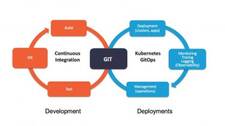
- A developer-centric path to application management — end-to-end CI/CD pipelines and Git workflows applied to both development and operations.
The key insight was that developers already knew Git. Extending that same workflow to infrastructure and deployment reduced cognitive overhead and removed the need for separate, operations-specific tooling.
GitOps Beyond Kubernetes
While GitOps originated in the Kubernetes ecosystem, the underlying principle is broadly applicable. As software organizations adopt DevOps practices and tighten release cadences, both quality testing and security testing have shifted left — moving earlier into the pipeline and into the hands of developers. Deployment is undergoing the same shift.
In environments that do not use Kubernetes, GitOps can still be applied. Developer and writer Everett Toews has described the GitOps pipeline as a general technique: reconciling a desired state held in Git with a runtime environment. The runtime could be a Kubernetes cluster, a set of cloud resources managed by Terraform, a serverless platform, or virtually any environment that can be driven by configuration files.
How the GitOps Pipeline Works
The GitOps workflow maps closely to a standard Git development workflow:
- A developer submits a pull request — containing a change to application code, a Kubernetes manifest, an infrastructure definition, or another configuration file.
- The change is reviewed and merged — following the same code review process the team already uses for application changes.
- A reconciliation system detects the merge — triggered by a push or pull event on the repository.
- The reconciliation system applies the desired state — comparing what is in Git with what is running in the target environment and making any necessary changes to close the gap.
This reconciliation loop is the defining characteristic of GitOps. The environment continuously converges toward the state declared in the Git repository. If something drifts — due to a manual change, an incident response action, or an infrastructure failure — the reconciliation system corrects it.
The Benefits of GitOps
GitOps provides operational capabilities that distributed systems and microservice architectures specifically demand. The main benefits for development and operations teams include:
1. Observability
Because all changes flow through Git, teams gain a clear, timestamped record of every change to their runtime environment. Combined with monitoring and logging tools, this makes it straightforward to correlate a deployment event with a change in system behavior.
2. Version Control and Change Management
Every deployment is version-controlled. If a release introduces a regression, teams can roll back by reverting a Git commit — the reconciliation system takes care of restoring the previous state. This significantly reduces the risk and complexity of rollbacks compared to manual or script-driven deployments.
3. Low Adoption Barrier
Developers do not need to learn new deployment tooling or processes. If they already know how to open a pull request, they already know how to trigger a deployment in a GitOps workflow. This dramatically lowers the barrier to entry and reduces onboarding time for new team members.
4. Deployment Velocity
Automating the link between a merged pull request and a running deployment removes manual handoffs between development and operations teams. Teams can deploy more frequently and with greater confidence, since each change is small, reviewed, and auditable.
5. Auditability and Compliance
Every change to the system is traceable to a specific commit, authored by a specific person, at a specific time. This audit trail is invaluable for incident post-mortems, compliance requirements, and security investigations. There is no ambiguity about what changed and when.
GitOps Tooling: Where to Start
A number of widely adopted tools support GitOps workflows. The right choice depends on your infrastructure and existing toolchain:
- Flux — A Kubernetes-native GitOps operator, originally created by Weaveworks, that continuously reconciles cluster state with a Git repository.
- Argo CD — A declarative GitOps continuous delivery tool for Kubernetes, part of the CNCF ecosystem.
- GitHub Actions — Provides workflow automation that can be configured to trigger deployments on merge events.
- GitLab CI/CD — Offers native pipeline support that integrates well with GitOps patterns.
- Jenkins X — A CI/CD solution for Kubernetes that incorporates GitOps practices by default.
If you are evaluating GitOps for your organization, a reasonable starting point is to pick one application, define its deployment configuration as code in a Git repository, and connect a reconciliation tool to that repository. Observe how drift detection and automated reconciliation behave before rolling the practice out more broadly.
Summary
GitOps is not a single tool or a rigid framework — it is a set of practices that leverages Git as the authoritative source of truth for both infrastructure and application delivery. Its strength lies in giving developers a familiar interface for operations work, while providing operations teams with the auditability, rollback capability, and automation they need to manage complex systems at scale.
As cloud-native architectures grow more complex, the discipline of treating infrastructure configuration with the same rigor as application code will only become more important. GitOps is one of the most practical frameworks available today for doing exactly that.