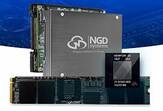
Source: blocksandfiles.com
What Happened
Computational storage vendor NGD Systems announced that it has embedded Microsoft’s Azure IoT Edge service directly inside its Newport NVMe SSDs. The move allows Azure IoT Edge workloads to execute on an ARM processor built into the drive itself, rather than on the host server’s CPU.
Alongside this announcement, NGD unveiled a 32 TB version of the Newport drive in the U.2 (2.5-inch) form factor — double the capacity of the original Newport SSD. The drive connects over NVMe and is rated at under 12 W of power consumption.
What Azure IoT Edge Does
Azure IoT Edge is a Microsoft service that moves cloud workloads — analytics, machine learning inference, and custom business logic — out of Azure data centres and onto on-premises hardware. Instead of streaming raw data to the cloud for every decision, an IoT Edge device processes data locally and only sends results (or relevant subsets) upstream. This reduces latency, lowers bandwidth costs, and allows systems to keep functioning during intermittent connectivity.
In a conventional deployment, Azure IoT Edge runs as a containerised service on a general-purpose server. Data arrives at that server, lands on local storage (typically an SSD or HDD array), and is then read back into system RAM before the host CPU processes it. Every step adds latency.
How NGD Changes the Architecture
NGD’s Newport SSDs include an embedded ARM processor running Ubuntu Linux. By deploying Azure IoT Edge on that in-drive CPU, processing happens directly where the data is stored — eliminating the read-back-to-host-RAM step entirely.
NGD CEO Nader Salessi described the approach as bringing “compute directly to the data, so processing results at the edge, right where data is created, is possible, significantly improving latency of the system.”
The practical data path looks like this:
- Traditional path: Ingest → SSD → Host RAM → Host CPU → Result
- NGD in-storage path: Ingest → SSD (ARM CPU processes data in-situ) → Result
By shortening this path, the drive can react to local events faster than a host-CPU-based architecture — a meaningful advantage in latency-sensitive IoT and edge scenarios such as industrial monitoring, real-time anomaly detection, or autonomous systems.
Code Compatibility Considerations
NGD stated there are “almost no changes to current code requirements” — a claim worth examining carefully. Azure IoT Edge modules are typically compiled for x86-64 hosts. Because the Newport drive’s embedded processor is ARM-based, any native binaries or compiled modules must be recompiled or cross-compiled for ARM before they can run on the drive.
Workloads written in interpreted languages (Python, Node.js) or that run inside cross-architecture containers may require less rework, but developers should audit their module build pipelines for x86-specific dependencies before targeting an ARM-Ubuntu environment.
Availability
According to NGD’s announcement (August 2019), the 32 TB Newport and other NGD computational storage devices running Azure IoT Edge were available for deployment at that time. Organisations evaluating this approach should verify current product availability, firmware support, and Azure IoT Edge runtime version compatibility directly with NGD Systems and Microsoft.
Why This Matters for DevOps and Edge Engineers
- Reduced infrastructure footprint: Processing that previously required a dedicated edge server can potentially move into the storage layer, freeing compute resources.
- Lower latency: Eliminating the host CPU round-trip can measurably reduce response times for data-intensive IoT pipelines.
- Power efficiency: A sub-12 W NVMe drive running its own workload is far more power-efficient than adding a full server node.
- ARM pipeline requirement: Teams must maintain an ARM build target for IoT Edge modules, adding a CI/CD consideration.
- Vendor lock-in surface: The architecture ties Azure IoT Edge module deployment to a specific SSD vendor’s hardware, which warrants evaluation in long-term infrastructure planning.