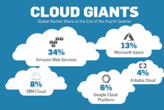
Cloud-based databases have moved from a niche deployment option to a mainstream infrastructure choice for organizations of all sizes. Understanding who dominates the market, which technology segments are growing fastest, and what drives purchasing decisions helps DevOps and platform engineering teams make better architecture choices and anticipate vendor roadmaps.
Why Cloud Databases Are Taking Over
The appeal of cloud-hosted databases comes down to a few structural advantages over self-managed, on-premises deployments:
- Operational offload: Patching, replication, failover, and backups are handled by the provider, reducing the DBA burden on internal teams.
- Elastic scaling: Storage and compute capacity can be adjusted on demand, avoiding over-provisioning costs.
- Global distribution: Multi-region read replicas and geo-redundancy are standard features on major platforms, not custom engineering projects.
- Pay-as-you-go pricing: Consumption-based billing aligns database costs with actual workload, which appeals to finance and engineering leadership alike.
- Ecosystem integration: Cloud databases integrate natively with the analytics, messaging, and compute services offered by the same provider, shortening time-to-production for new services.
Major Vendors Shaping the Market
A broad set of vendors compete across different layers of the cloud database stack. The leading players, based on market presence and product breadth, include:
- Amazon Web Services (AWS): Offers the widest portfolio, including Amazon RDS (managed relational), Aurora (MySQL/PostgreSQL-compatible), DynamoDB (key-value/document NoSQL), Redshift (data warehousing), and ElastiCache (in-memory).
- Microsoft: Azure SQL Database, Azure Cosmos DB (multi-model NoSQL), and Azure Database for PostgreSQL/MySQL are central offerings, with tight integration into the broader Azure ecosystem.
- Google: Cloud SQL (managed relational), Cloud Spanner (globally distributed relational), Firestore (document), and Bigtable (wide-column NoSQL) cover enterprise and developer use cases.
- Oracle: Oracle Autonomous Database and Oracle Database Cloud Service target enterprises already running Oracle workloads on-premises.
- IBM: IBM Db2 on Cloud and IBM Cloudant (CouchDB-based) serve enterprise and hybrid-cloud scenarios, often in regulated industries.
- MongoDB: MongoDB Atlas is one of the most widely adopted developer-facing document database services, available across AWS, Azure, and GCP.
- Couchbase: Couchbase Cloud provides a managed JSON document and key-value store aimed at high-performance mobile and edge applications.
- SAP and Teradata: Target large-enterprise analytics and ERP-adjacent workloads.
- Alibaba and Tencent: Dominant in the Asia-Pacific region, with broad managed database portfolios mirroring the AWS model for Chinese-market and Southeast Asian customers.
- Salesforce and Rackspace Hosting: Serve specific platform and managed-service niches rather than competing directly as general-purpose database providers.
Market Segments: SQL vs. NoSQL
The cloud database market divides broadly into two technology categories, each with distinct use cases:
SQL (Relational) Databases
Managed relational services — MySQL, PostgreSQL, SQL Server, and their cloud-native variants — remain the default choice for transactional workloads where data consistency, referential integrity, and ACID compliance are non-negotiable. Examples include e-commerce order management, financial ledgers, and ERP systems. Cloud-managed SQL services eliminate the need for manual replication setup, storage management, and minor-version patching.
NoSQL Databases
NoSQL encompasses several distinct data models — document (MongoDB, Firestore), key-value (DynamoDB, Redis), wide-column (Cassandra, Bigtable), and graph (Amazon Neptune, Neo4j Aura). These are favored for workloads requiring horizontal scaling, flexible schemas, or very high write throughput: user-session stores, IoT telemetry ingestion, content catalogs, and real-time personalization engines. The managed cloud versions of Cassandra and MongoDB in particular have lowered the operational barrier that previously made NoSQL adoption difficult for smaller teams.
Customer Segments: SMBs vs. Large Enterprises
Cloud databases serve two distinct organizational profiles, and vendor strategies differ accordingly:
- Small and Medium Businesses (SMBs): Prioritize ease of use, low operational overhead, and predictable pricing. Managed services that require no DBA expertise — such as PlanetScale, Supabase, MongoDB Atlas, or Firebase — are especially popular in this segment. Serverless database tiers (e.g., Aurora Serverless, DynamoDB on-demand) align cost with actual usage, which is critical when traffic is unpredictable.
- Large Enterprises: Require enterprise SLAs, private networking (VPC peering, Private Link), audit logging, role-based access control, compliance certifications (SOC 2, ISO 27001, HIPAA, PCI-DSS), and integration with existing IAM systems. Migration from on-premises Oracle or SQL Server to cloud equivalents is a common enterprise workstream, often requiring hybrid-cloud connectivity during transition periods.
Geographic Distribution
Adoption patterns vary significantly by region:
- North America (particularly the United States) leads in overall cloud database spend, driven by a mature cloud adoption culture and the headquarters presence of the largest hyperscalers.
- Europe adoption is strong but shaped by GDPR data-residency requirements, pushing enterprises toward EU-region deployments and sovereign cloud offerings.
- China operates a largely separate cloud ecosystem, with Alibaba Cloud and Tencent Cloud dominating due to regulatory constraints on foreign providers.
- Japan and Southeast Asia are growth markets, with hyperscaler regional expansion (new availability zones in Tokyo, Singapore, Jakarta, and Seoul) accelerating adoption.
- India is one of the fastest-growing cloud markets globally, with significant demand from the software services sector and digital-native startups.
Key Trends Driving the Market Forward
- Serverless databases: Auto-scaling to zero and consumption billing are becoming expected features, not premium add-ons.
- Multi-cloud and interoperability: Organizations are increasingly avoiding single-vendor lock-in by running workloads across AWS, Azure, and GCP, which has benefited independent providers like MongoDB Atlas that run natively on all three.
- Database DevOps and GitOps: Schema migrations, access controls, and configuration drift are being managed through CI/CD pipelines, using tools like Flyway, Liquibase, and Terraform providers for cloud databases.
- AI and vector databases: The rapid adoption of generative AI is creating a new segment of vector-capable databases (pgvector on PostgreSQL, Pinecone, Weaviate) that store and query embedding representations for semantic search and RAG (retrieval-augmented generation) architectures.
- Hybrid and edge deployments: Vendors are extending their managed database offerings to on-premises hardware (AWS Outposts, Azure Arc, Google Distributed Cloud) and to edge locations closer to IoT data sources.
Practical Takeaways for DevOps and Platform Teams
When evaluating cloud database options, consider these decision criteria:
- Workload fit first: Match the data model (relational, document, key-value, wide-column, graph) to your access patterns before evaluating vendors.
- Operational maturity: Assess your team’s capacity to manage database infrastructure. If it’s limited, lean toward fully managed services over cloud VMs with self-installed databases.
- Compliance requirements: Map your regulatory obligations (HIPAA, PCI-DSS, GDPR, FedRAMP) to the certifications held by candidate services before making a shortlist.
- Total cost of ownership: Factor in egress fees, cross-AZ replication costs, and IOPS charges — not just instance or storage pricing — when comparing providers.
- Vendor lock-in risk: Proprietary APIs (e.g., DynamoDB, Cosmos DB) offer the best managed experience but create migration friction. PostgreSQL-compatible services (Aurora, AlloyDB, Cloud SQL) offer a reasonable balance of manageability and portability.
- Observability integration: Confirm that metrics, slow query logs, and audit events integrate with your existing monitoring stack (Prometheus, Datadog, Grafana, OpenTelemetry) before committing to a service.
The cloud database market continues to consolidate around a small number of hyperscaler platforms while simultaneously fragmenting at the edges as specialized databases for AI, time-series, and graph workloads mature. Staying current with vendor capability changes and pricing model shifts is now a routine part of platform engineering work, not a one-time evaluation exercise.