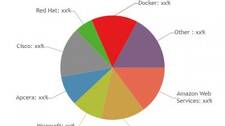
The global application container market has grown from a niche infrastructure technology into a mainstream platform adopted across financial services, healthcare, retail, telecommunications, and beyond. This article summarises the competitive landscape, service categories, and industry verticals that define this market, drawing on publicly available information about the vendors and segments involved.
What Is the Application Container Market?
Application containers package software code together with its dependencies, configuration, and runtime environment so that it runs consistently across development, staging, and production infrastructure. Docker popularised the container image format; Kubernetes (originally from Google) became the dominant orchestration layer. The ecosystem around these core technologies—covering security, networking, monitoring, data management, and professional services—constitutes the application container market.
Major Vendors and Competitive Landscape
The market is characterised by a mix of hyperscale cloud providers, established enterprise software vendors, and specialist startups. Key players include:
- Hyperscale cloud providers: Amazon Web Services (ECS, EKS), Google (GKE, Cloud Run), Microsoft (AKS, Azure Container Registry)
- Enterprise software vendors: IBM (OpenShift via Red Hat acquisition), VMware (Tanzu), Oracle, CA Technologies
- Container-native companies: Docker, Rancher Labs (acquired by SUSE), Mesosphere (now D2iQ)
- Security and observability specialists: Twistlock (acquired by Palo Alto Networks), Sysdig, Weaveworks
- Networking and storage specialists: Portworx (acquired by Pure Storage), Weaveworks, BlueData (acquired by HPE)
- Platform and PaaS vendors: Red Hat (OpenShift), SUSE, Apprenda, Jelastic, Kontena, Joyent, Apcera
- Orchestration and automation: Puppet Enterprise, Nimble Storage (an HPE company)
Several of the companies listed above have since been acquired or merged, reflecting the consolidation phase that matures markets typically experience. Engineers evaluating vendors should verify current product ownership and support commitments before making platform decisions.
Container Market Segments by Service Type
The application container ecosystem is commonly segmented by the type of product or service delivered:
- Consulting and professional services: Architecture design, migration planning, and training for teams adopting containers at scale.
- Container monitoring: Observability tooling that surfaces CPU, memory, network, and application-level metrics at the container and pod level (e.g., Prometheus, Datadog, Sysdig Monitor).
- Container security: Image scanning, runtime threat detection, policy enforcement, and secrets management (e.g., Twistlock/Prisma Cloud, Aqua Security, Snyk).
- Container data management: Persistent storage solutions that decouple stateful data from ephemeral container lifecycles (e.g., Portworx, Rook/Ceph).
- Container networking: Software-defined overlays and CNI plugins that provide service discovery, load balancing, and network policy (e.g., Cilium, Calico, Weave Net).
- Container orchestration: Scheduling, scaling, and lifecycle management of containerised workloads—dominated by Kubernetes, but also including Docker Swarm and Nomad.
- Support and maintenance: Enterprise support subscriptions layered on top of open-source distributions (e.g., Red Hat OpenShift subscriptions, SUSE Rancher support).
Industry Verticals Driving Adoption
Container adoption is not uniform across industries. The following verticals represent the largest end-user segments:
- Banking, Financial Services, and Insurance (BFSI): Containers enable faster release cycles for trading platforms, mobile banking apps, and regulatory reporting pipelines while supporting strict isolation requirements.
- Healthcare and life sciences: Bioinformatics workloads, medical imaging analysis, and EHR integrations benefit from reproducible, portable container environments.
- Telecommunications and IT: Network Function Virtualisation (NFV) and edge computing deployments increasingly rely on container-based workloads to reduce VM overhead.
- Retail and e-commerce: Elastic scaling during peak shopping events and rapid iteration of recommendation and personalisation services drive container adoption.
- Education: Learning management systems and remote lab environments use containers to deliver consistent, isolated environments to students.
- Media and entertainment: Transcoding pipelines, content delivery backends, and streaming platforms leverage containers for burst-scalable processing.
Geographic Distribution
Container adoption is global but geographically uneven. North America—led by the United States—has historically represented the largest share of enterprise container deployments, driven by early cloud-native adopters and a dense concentration of technology vendors. Europe follows, with strong adoption in the UK, Germany, and France, partly shaped by data sovereignty regulations such as GDPR that influence where workloads run. The Asia-Pacific region, particularly China, Japan, India, and Southeast Asia, represents the fastest-growing segment as cloud infrastructure matures and local technology ecosystems expand.
Key Technical and Commercial Considerations
Security
Container security spans the full lifecycle: image build (scanning for CVEs in base images and dependencies), registry (access controls, signing), runtime (syscall filtering via seccomp, read-only filesystems, least-privilege service accounts), and network (restricting pod-to-pod traffic with NetworkPolicy). Supply-chain security—ensuring the integrity of images from source to production—has become a central concern following high-profile incidents involving compromised base images.
Orchestration and Pricing Models
Kubernetes is available as a managed service from all major cloud providers (EKS, GKE, AKS), reducing operational overhead but introducing vendor-specific control-plane abstractions. Pricing models vary: managed Kubernetes control planes are free on GKE but charged on EKS and AKS. Worker node costs depend on instance type and whether spot or preemptible instances are used. On-premises deployments via OpenShift or Rancher carry subscription costs that should be weighed against cloud egress and data residency requirements.
Persistent Storage
Running stateful workloads—databases, message queues, analytics stores—in containers requires a Container Storage Interface (CSI)-compliant driver and a storage backend designed for container lifecycle semantics. Vendors such as Portworx, Rook, and cloud-native storage classes address this need, but performance characteristics and failure modes differ significantly from traditional VM-attached block storage.
Market Trajectory
The container market continues to expand as organisations move workloads from VMs to containers and from containers to serverless or WebAssembly runtimes. Platform engineering—building internal developer platforms on top of Kubernetes—has emerged as the dominant organisational pattern for scaling container adoption beyond individual teams. Security and compliance tooling, GitOps workflows, and FinOps practices for container cost management are growth areas within the broader ecosystem.
Engineers and architects evaluating the container market should prioritise vendor stability (given the consolidation history noted above), support for upstream Kubernetes compatibility, and integration with existing CI/CD and observability stacks over feature breadth alone.