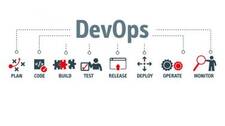
Enterprise DevOps is no longer a forward-looking experiment — it is the baseline expectation for any organisation that wants to compete in a digital market. Yet many business leaders still struggle to articulate exactly how DevOps works at scale, what cultural and architectural prerequisites exist, and where to begin. This article breaks down each of those questions in practical terms.
What Is DevOps?
AWS defines DevOps as “the combination of cultural philosophies, practices, and tools that increases an organisation’s ability to deliver applications and services at high velocity.” That definition is a useful starting point, but it only captures part of the picture.
At its core, DevOps is an evolution of agile thinking applied beyond the software team. Atlassian describes it precisely that way. It brings the delivery (development) and operational support communities closer together, using tooling and processes — continuous integration, continuous deployment, test automation, infrastructure-as-code — to accelerate the flow of code into production. Those releases may represent new features, architectural changes, or bug fixes. As Gordon Cullum, CTO at Mastek, puts it: “It’s a combination of keeping the lights on and changing delivery.”
Reinvigorating a Proven Way of Working
The idea of unified delivery and operations is not new. In the 1980s and 1990s, IT departments were responsible for both running systems and shipping changes — there was no hard division between the two. DevOps revives that ethos, but with a critical difference: modern tooling makes the approach far more controlled, measurable, and repeatable than it ever was before.
Tools such as Puppet and Jenkins — along with their modern equivalents — create the robust, automated pipelines that allow fast delivery without the chaos that characterised ad-hoc deployments of earlier decades. The combination of disciplined tooling and a collaborative culture is what makes contemporary DevOps more powerful than the informal approaches of the past.
Why DevOps Has Become Urgent Now
Several converging forces have pushed DevOps from an option to a near-mandatory practice for enterprises:
- Competitive acceleration: Digital markets move fast. Organisations that cannot release code quickly risk being disrupted by competitors who can.
- Cloud infrastructure: Cloud platforms make it straightforward to spin up environments, platforms, and services on demand, enabling componentised, independently scalable architectures.
- Modern architecture patterns: Microservices and serverless architectures are naturally aligned with DevOps. Each service can be released, modified, and scaled independently, accelerating delivery cadence.
- Mature tooling ecosystem: The pipeline tooling available today — CI/CD platforms, container orchestration, observability tools — provides the quality guardrails that make fast delivery safe.
As Cullum summarises: “Bringing all these things together — the rise of cloud, the need to get things out faster but at a high quality, the rise of all the tooling that enables fast pipeline deliveries, changing culture in IT — what you’ve got is DevOps.”
How DevOps Works in the Enterprise: A Practical Framework
There is no single universal blueprint. The right approach depends on the organisation’s current architecture, culture, and strategic goals. What follows is a practical framework derived from enterprise experience.
1. Define Your “Why” Before You Start
The first and most important step is understanding the business problem you are trying to solve. DevOps adoption driven by a C-level mandate without a clear goal almost always fails. Ask:
- Do you need faster, more frequent releases?
- Do you need more repeatable, higher-quality deployments?
- Do you need to reduce the cost of delivery?
- Do you need to modernise a legacy architecture so it can support faster change?
The answer to each of those questions points to a different starting point and a different set of priorities.
2. Assess Your Architecture Honestly
Agile and DevOps practices only work well with an architecture that supports them. A legacy bank running monolithic applications on a mainframe cannot simply train its IT staff in DevOps techniques and expect deployment frequency to improve. Before adopting DevOps practices, legacy organisations often need an architecture enablement programme — decomposing monolithic systems into components that individual delivery teams can own and release independently.
3. Respect the Cultural Dimension
DevOps is as much a cultural shift as a technical one. Key cultural principles include:
- Shared ownership: Development and operations teams share responsibility for both delivery and reliability.
- Blameless learning: Failures are treated as system problems to be fixed, not as individual failures to be punished.
- Continuous improvement: Teams experiment, measure, and iterate rather than waiting for a perfect plan.
- Minimal upfront documentation: Heavy specification documents slow delivery; favour working software and iterative refinement.
4. Approach Risk Proactively
A common failure mode in enterprise DevOps adoption is paralysis in the face of risk. Patrick Callaghan, enterprise architect and strategic business advisor at DataStax, argues that “DevOps innovators are confident in their code because they both test it and make it fail in order to produce reliable apps.” Building resilience through deliberate failure testing — rather than trying to prevent all failures — is a hallmark of mature DevOps practice.
Building and Upskilling a DevOps Workforce
Skills shortages are a consistent challenge in DevOps adoption. The question most organisations face is whether to retrain existing staff or hire new talent. The honest answer is: both, but attitude matters more than either.
Experienced engineers who have spent 15–20 years in waterfall or siloed environments sometimes resist the mindset shift that DevOps requires. In contrast, junior engineers who have not yet been conditioned by older ways of working tend to adopt DevOps practices more readily. Cullum reflects this from Mastek’s own experience: “It’s harder to change attitude than it is to change a technology skill set.”
When hiring for DevOps roles, organisations should look for the following attributes in addition to specific technical skills:
- Flexibility — willingness to adapt to changing requirements and tooling
- Security awareness — understanding of DevSecOps principles; security baked into the pipeline, not bolted on afterwards
- Collaboration — comfort working across team boundaries between development, operations, QA, and security
- Scripting skills — ability to automate repetitive tasks and contribute to pipeline configuration
- Decision-making — confidence making pragmatic choices under ambiguity
- Infrastructure knowledge — understanding of cloud platforms, networking, and containerisation
- Soft skills — communication, empathy, and the ability to facilitate cross-team problem-solving
DevOps as an Enabler of Digital Transformation
Digital transformation is not a technology programme — it is a wholesale reinvention of how a business operates, culturally and technologically. Any genuine transformation will eventually require large-scale changes to the IT estate, including the decomposition of legacy systems.
As those legacy systems are modernised and replaced with componentised, cloud-native architectures, the need for fast, reliable, automated deployment becomes critical. DevOps is the practice that makes that speed possible without sacrificing stability.
Cullum frames it in terms of pace-layered delivery: “You’re going to put a lot more focus in your systems of differentiation and innovation, and they have to have rapid, relatively robust change going in.” DevOps is what enables that cadence.
Organisations that are not yet practising automated, repeatable deployment pipelines — regardless of what they call it — are not equipped to change at the pace the digital market demands.
Why DevOps Urgency Is Not Overstated
For many industries, DevOps is no longer a differentiator — it is table stakes. Organisations that have not yet started are already behind. Cullum’s warning is direct: “If you aren’t already thinking about it or aren’t already doing it, you’re probably way behind the curve.”
A useful diagnostic for leaders in resistant organisations is to look for internal “guerrilla” DevOps adoption — small teams that have quietly built automated pipelines or adopted agile delivery practices without top-down authorisation. Those pockets of innovation are proof points. The task is to identify them, understand what is working, and create the organisational conditions to scale those practices across the enterprise.
Enterprise Case Study: Netflix and Resilience Testing
Netflix is a widely cited example of DevOps at enterprise scale, particularly in the area of resilience engineering. According to Callaghan, Netflix uses Apache Cassandra for high availability and has built a suite of chaos engineering tools — collectively known as the Simian Army — to validate that availability at scale.
Tools such as Chaos Monkey (which randomly terminates instances), Chaos Kong (which simulates the loss of an entire AWS region), and Chaos Gorilla (which simulates the loss of an availability zone) are used to stress-test Netflix infrastructure continuously. The result is a team that is genuinely confident in the reliability of its systems because they have tested failure modes thoroughly and repeatedly.
This approach — sometimes called chaos engineering — is a natural extension of DevOps principles: if you deploy frequently, automate rigorously, and test failure scenarios in production-like conditions, you build systems that are both fast to change and reliable in operation.
Key Takeaways for Enterprise Leaders
- Start with purpose: Know why you are adopting DevOps before you invest in tooling or training.
- Assess architecture first: DevOps cannot compensate for a monolithic architecture that does not support independent deployment.
- Invest in culture: The hardest part of DevOps adoption is not the tooling — it is changing how people think about responsibility, risk, and collaboration.
- Prioritise attitude in hiring: Technical skills can be taught; a growth mindset and collaborative attitude are harder to develop.
- Treat DevOps as a transformation enabler: Not a standalone initiative, but the operational foundation for everything digital transformation requires.
- Do not wait for perfect conditions: Start with a pilot team, prove value, and scale what works.