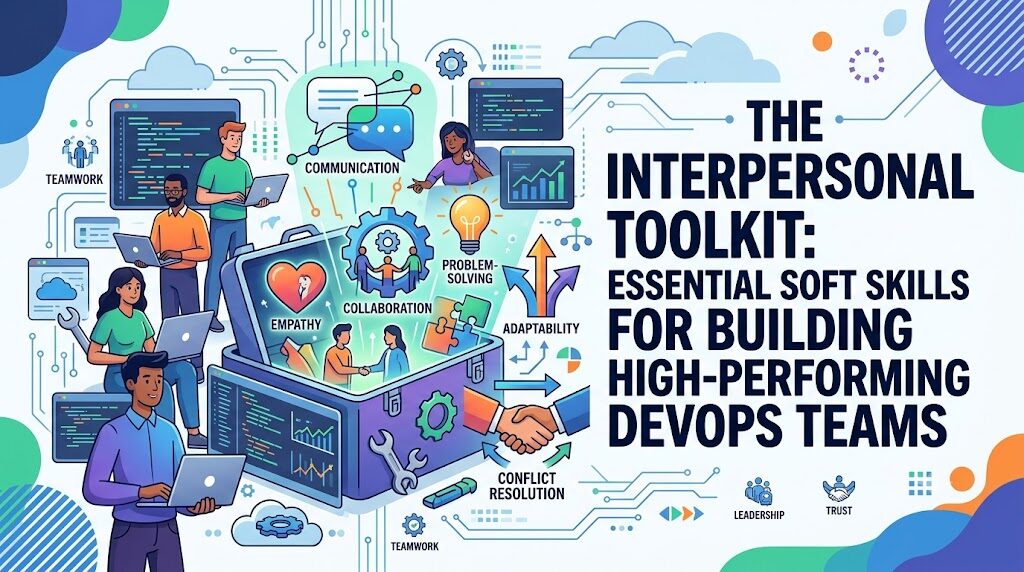
Introduction
Imagine joining a fast-paced engineering team as a new DevOps engineer, only to turn a minor, uncommunicative script adjustment into a massive staging environment crash that leaves developers frustrated and deployment pipelines stalled. This real-world scenario highlights a fundamental truth: modern DevOps is built on collaboration, shared responsibility, and breaking down organizational silos, meaning that technical expertise alone is never enough for long-term career longevity. While mastering the command line is essential, your ability to communicate clearly, collaborate across departments, solve complex problems under pressure, and adapt to change determines your true value as an engineer. For professionals looking to navigate this transition effectively, expert-led training ecosystems like DevOpsSchool provide structured pathways that teach both advanced cloud architecture and the collaborative, human-driven methodologies required to turn junior engineers into trusted, high-performing technical leaders.
What Are DevOps Soft Skills?
To understand DevOps soft skills, we must first separate them from technical or “hard” skills.
- Technical Skills (Hard Skills): These are quantifiable, teachable abilities. They include writing Terraform scripts, configuring CI/CD pipelines, managing Kubernetes clusters, writing Bash scripts, and configuring cloud networking. They are the tools you use to interact with machines.
- Soft Skills (Interpersonal Skills): These are non-technical abilities that dictate how you interact with people, manage your work, solve problems, and adapt to changing situations. They include active listening, clear writing, empathy, conflict resolution, accountability, and adaptability.
+-------------------------------------------------------------+
|                      THE DEVOPS BALANCE                     |
+-------------------------------------------------------------+
|  TECHNICAL SKILLS (Hard)     |   INTERPERSONAL SKILLS (Soft)|
|  - Cloud Architecture (AWS)  |   - Clear & Active Listening |
|  - Infrastructure as Code    |   - Cross-Functional Empathy |
|  - Container Orchestration   |   - Stress Management        |
|  - CI/CD Automation          |   - Teamwork & Shared Goals  |
|  - Monitoring & Logging      |   - Critical Thinking        |
+-------------------------------------------------------------+
|             RESULT: A Well-Rounded, Trusted Engineer         |
+-------------------------------------------------------------+
Code language: JavaScript (javascript)
Organizations value soft skills because systems do not run in a vacuum. A software system is designed, built, maintained, and used by humans. When a production environment goes down, a script alone cannot fix it; it requires a coordinated group of engineers working under pressure, communicating clearly, and making collective decisions to restore services. Soft skills are the glue that prevents these human systems from fracturing.
Why Soft Skills Are Essential in DevOps
The core philosophy of DevOps is the integration of Development (Dev) and Operations (Ops). Historically, these two departments operated as rivals. Developers wanted to push features as fast as possible, while Operations wanted to keep the infrastructure stable, which often meant resisting changes.
DevOps was created to tear down these walls. Here is why soft skills are the foundation of this movement:
- Cross-Functional Collaboration: DevOps engineers sit at the intersection of product management, QA, development, security, and operations. You must speak the language of all these teams. You cannot do this if you cannot empathize with their unique pain points.
- Faster Issue Resolution: During an outage, a team that communicates clearly and remains calm will isolate the issue and apply a fix much faster than a team that falls into finger-pointing, panic, and defensive posturing.
- Better Communication, Less Friction: Writing clear documentation, explaining technical roadblocks to non-technical stakeholders, and articulating the business value of a new automation tool prevent expensive misunderstandings.
- Continuous Improvement: A healthy DevOps culture relies on blameless post-mortems. When things break, the focus is on fixing the system, not punishing the person. This requires psychological safety, humility, and open-mindedness.
- Stronger Customer Focus: Every pipeline built and every server configured ultimately serves an end-user. DevOps engineers need to understand user pain points to design resilient systems that meet real-world demands.
- Higher Team Productivity: When communication is clear, developers spend less time waiting for infrastructure, operations teams face fewer surprises during deployments, and the entire delivery pipeline flows smoothly.
Top Essential Soft Skills for New DevOps Engineers
The table below outlines the critical soft skills required for success in a DevOps career:
| Soft Skill | Why It Matters | Workplace Example |
| Communication | Bridges the gap between technical and non-technical stakeholders, ensuring alignment. | Writing a clear post-mortem document after a production failure so developers know how to avoid repeating the bug. |
| Teamwork & Collaboration | Breaks down silos and fosters shared ownership of code and infrastructure stability. | Pairing with a software developer to troubleshoot a flaky integration test suite in the CI/CD pipeline. |
| Problem-Solving | Helps identify the root cause of complex, multi-layered system failures systematically. | Using logical elimination to trace a slow database response during peak load times instead of guessing. |
| Adaptability | Allows you to pivot smoothly when tools, cloud platforms, or business requirements change. | Migrating from a legacy CI tool to a modern cloud-native platform without complaining about learning a new syntax. |
| Time Management | Helps balance daily operational tasks, unexpected incidents, and long-term automation projects. | Using a Kanban board to prioritize urgent security patches over nice-to-have monitoring dashboards. |
| Critical Thinking | Prevents blind implementation of tools and encourages assessing the actual business value. | Challenging the need for an expensive enterprise tool when a simple open-source script can solve the problem safely. |
| Accountability | Builds deep trust within the engineering team by owning up to errors and fixing them. | Admitting that an unverified Terraform change deleted a testing resource and immediately working to restore it. |
| Continuous Learning | Keeps your skillset relevant in a rapidly evolving cloud-native ecosystem. | Spending time weekly reading release notes of core tools to leverage new optimization features. |
| Leadership Potential | Enables you to guide projects, mentor junior members, and influence technical choices. | Volunteering to lead a migration planning session, ensuring everyone has a voice in the architecture. |
| Customer-Centric Mindset | Focuses technical work on delivering reliable, fast, and secure software to users. | Prioritizing high-availability architecture for critical checkout services over minor backend scripts. |
Detailed Breakdown of Key DevOps Soft Skills
Communication Skills
In DevOps, communication is not about using complex jargon; it is about conveying technical realities in a simple, structured, and actionable manner.
Technical Communication
You must translate complex system behaviors into readable messages. If a database cluster fails, writing a Slack message like “DB is dead” is unhelpful. Instead, effective communication sounds like:
“The primary PostgreSQL database node is experiencing 100% CPU utilization due to an unindexed query on the orders table. I am spinning up a read replica and working with the backend team to add the index. Estimated recovery time is 15 minutes.”
Writing Documentation
A DevOps engineer who does not write documentation leaves a trail of unmaintainable systems. Your documentation should be clear enough for a junior developer to follow at 3:00 AM during an active incident. Use step-by-step guides, architecture diagrams, and plain language. Avoid leaving “tribal knowledge” locked in your head.
Explaining Technical Concepts to Non-Technical Staff
When a product manager asks why a feature deployment is delayed, saying “The Docker daemon is failing to pull the base image due to rate-limiting on Docker Hub” will confuse them. Translate this into business terms:
“We are hitting temporary access limits with our container provider. We are updating our registry settings to bypass this, which will delay the release by about 30 minutes.”
Collaboration and Teamwork
The “wall of confusion” between developers and operations is a historic bottleneck. DevOps engineers serve as the bridge.
       HISTORICAL BARRIER                        DEVOPS BRIDGE
+-------------+     +-------------+       +-------------------------+
| DEVELOPMENT |     | OPERATIONS  |       |  Dev   DevOps   Ops     |
| "Build it"  | --> | "Run it"    |  ==>  |  Shared Responsibility  |
|             |  |  |             |       |  Continuous Feedback    |
+-------------+  v  +-------------+       +-------------------------+
           Silo Wall
Code language: PHP (php)
Working with Developers
Instead of treating developers as people who write buggy code, understand their goals. Developers are measured on how fast they deliver features. Your job is to help them deliver those features safely, securely, and rapidly. If a developer’s pipeline fails, do not just send a generic error log. Sit down with them, explain the deployment policy breach, and show them how to resolve it.
Supporting Operations and QA
Collaborate with QA engineers to automate their regression tests directly inside the delivery pipeline. Ensure operations teams have access to comprehensive dashboards and logging systems so they are never left guessing what code was deployed or how it behaves.
Building Trust Across Departments
Trust is built through predictable behavior. When you promise to set up a staging environment by Thursday, deliver it on time or communicate blockers early. Never act as a gatekeeper who says “No” to changes; instead, be an enabler who asks, “How can we implement this change safely?”
Problem-Solving and Critical Thinking
Systems will fail. How you approach these failures defines your value as an engineer.
Root Cause Analysis (RCA)
When an application crashes, restarting the server is a temporary fix. A true DevOps engineer digs deeper to find the root cause. This involves asking the “5 Whys”:
- Why did the service crash? (The memory limit was exceeded).
- Why was the memory limit exceeded? (The application had a memory leak).
- Why was there a memory leak? (A connection pool was not being closed in a newly added API endpoint).
- Why was the connection pool left open? (The developer was unfamiliar with the connection library framework).
- Why was this missed before production? (We do not run automated memory profiling tests in our staging pipeline).
Troubleshooting Under Pressure
When production is down and executives are asking for updates, panic is your worst enemy. Critical thinking helps you break down complex systems into logical layers: Is it a network issue? Is it an infrastructure issue? Is it an application issue? By isolating variables systematically, you avoid wasting time chasing red herrings.
Adaptability and Continuous Learning
The DevOps space evolves rapidly. Tools that were industry standards five years ago are now legacy.
Learning New Tools Gracefully
You cannot afford to get overly attached to a specific tool. If your company decides to migrate from AWS to Google Cloud Platform, or from Jenkins to GitHub Actions, a successful engineer embraces the change. Understand the core principles behind the tools. If you master the concepts of declarative infrastructure, transitioning from Terraform to Pulumi or OpenTofu becomes a straightforward process of learning new syntax rather than starting from scratch.
Handling Changing Requirements
In a fast-growing business, priorities change overnight. An architectural decision made last month might not fit today’s scaling needs. Instead of complaining about wasted effort, adapt your automation designs to be modular, reusable, and easy to refactor.
Time Management and Prioritization
DevOps engineers are constantly bombarded with competing priorities: writing infrastructure-as-code, helping developers with failing builds, patching security vulnerabilities, and attending planning meetings.
Managing Multiple Tasks
Without proper planning, you will spend your entire day firefighting. Implement the Eisenhower Matrix to prioritize your work:
+------------------------------------+------------------------------------+
|       URGENT & IMPORTANT           |       NOT URGENT & IMPORTANT       |
|  - Active production outage        |  - Automating manual runbooks      |
|  - Critical security vulnerability |  - Writing system documentation    |
|  - Broken delivery pipeline        |  - Planning cluster upgrades       |
+------------------------------------+------------------------------------+
|       URGENT & NOT IMPORTANT       |     NOT URGENT & NOT IMPORTANT     |
|  - Routine ad-hoc system queries   |  - Tweaking minor terminal colors  |
|  - General team status updates     |  - Testing unrequested beta tools  |
+------------------------------------+------------------------------------+
Balancing Long-Term Projects with Daily Operations
Allocate specific blocks of deep-work time for building automation, writing clean code, and upgrading platforms. Protect this time by silencing non-essential notifications. If you spend all your time on manual tasks, you will never build the automation needed to eliminate those tasks in the long run.
Accountability and Ownership
In DevOps, the operational philosophy is simple: “You build it, you run it.”
Taking Responsibility
If a change you made to an IAM policy inadvertently blocked access for the development team, own it immediately. Do not hide the mistake or hope no one notices. Post a message in the team channel:
“I updated the IAM policies ten minutes ago, which restricted access to the development bucket. I am reverting the change now and will review the policy offline.”
This level of transparency builds instant credibility and respect.
Building Professional Credibility
Your team should know that when you are assigned a task, it will be executed thoroughly. This means writing clean scripts, verifying configurations in a safe test environment first, writing corresponding documentation, and monitoring the changes after they go live.
Customer-Centric Thinking
Many engineers forget that infrastructure exists solely to run applications that serve customers.
Understanding User Impact
When you schedule a cluster upgrade that requires a five-minute maintenance window, think about how that affects the end-user. If it is an e-commerce application, doing this during peak shopping hours could result in lost sales and frustrated users. Schedule maintenance during low-traffic hours, implement blue-green deployment strategies to eliminate downtime, and keep user experience at the center of every engineering decision.
Leadership Skills for Future Growth
You do not need a managerial title to show leadership.
Mentoring Others
When a junior developer or a colleague from another team asks how to use a Dockerfile or run a local Kubernetes environment, do not just send them a command to copy-paste. Take ten minutes to explain how the command works, or record a quick video showing your troubleshooting process.
Influencing Without Authority
If you want the team to adopt a new security scanning tool, do not try to force it by complaining. Instead, build a working proof-of-concept, demonstrate how it automatically catches issues before they reach production, and show how it saves developers from painful remediation work later. Let the value of your work persuade others.
Real-World Workplace Scenario: The Broken Production Deployment
To see how these soft skills manifest under pressure, let us walk through a realistic engineering scenario.
+---------------------------------------------------------------------------------+
|                        THE INCIDENT TIMELINE                                   |
+---------------------------------------------------------------------------------+
|  [02:00 PM] Deploy Initiated -> [02:05 PM] Users Report 500 Errors              |
|  [02:10 PM] Team Sync Initiated -> [02:15 PM] Root Cause Found (Config Error)   |
|  [02:20 PM] Collaborative Rollback -> [02:25 PM] Services Restored              |
|  [02:30 PM] Blameless Post-Mortem Scheduled                                     |
+---------------------------------------------------------------------------------+
Code language: JavaScript (javascript)
The Scenario
At 2:00 PM on a Thursday, the team initiates a deployment of a critical microservice. Within five minutes of the deployment completing, the monitoring dashboard displays a surge in HTTP 500 errors on the checkout page. Customers are unable to complete purchases.
How a Low-Soft-Skill Team Handles It
- The Reaction: The operations engineer immediately blames the developers, writing in Slack: “The new code is buggy and throwing errors. Devs, what did you break?”
- The Defense: The lead backend developer responds defensively: “The code passed all local and integration tests. It must be an issue with your database configuration or network routing.”
- The Chaos: While developers and operations argue in a public thread, no one rollback the deployment. Panic sets in, and managers start joining the channel demanding answers. The atmosphere becomes toxic, and the site remains broken for over an hour.
How a High-Soft-Skill Team Handles It
- The Reaction: A junior DevOps engineer sees the alert, immediately spins up a debugging call, and invites key representatives from development and QA.
- The Communication: The engineer says: “We are seeing a spike in 500 errors post-deployment. To minimize customer impact, let’s roll back to the previous stable release first. Once services are stable, we will debug the root cause together.”
- The Collaboration: The team agrees. The rollback is triggered, and traffic returns to normal within three minutes.
- The Investigation: With the pressure off, the developer and DevOps engineer review the logs together. They find that a new environment variable required by the microservice was missing from the production container environment configurations.
- The Resolution: The DevOps engineer updates the secret store, verifies it in the staging environment with the developer, and they safely redeploy the service.
- The Post-Mortem: The next day, they conduct a blameless post-mortem. They do not blame the developer who forgot to mention the environment variable. Instead, they write an automation script that validates the presence of all required configuration variables in the target environment before allowing a deployment pipeline to proceed.
How to Improve Your DevOps Soft Skills
Soft skills are muscles; they must be trained through deliberate, daily practice.
Daily Communication Practice
Before hitting send on any Slack message, pull request review, or email, take thirty seconds to review it. Ask yourself:
- Is this clear and easy to read?
- Is the tone professional and helpful?
- Did I provide enough context, or am I forcing the receiver to ask follow-up questions?
Active Participation in Team Meetings
Do not sit silently in sprint planning or daily stand-ups. If you notice a potential bottleneck in an upcoming task, speak up. Ask questions like: “Do we have the correct testing environments ready for this feature?” or “How will we monitor this new service once it goes live?”
Writing High-Quality Documentation
Whenever you spend more than fifteen minutes troubleshooting a unique system issue, document the solution. Write a brief wiki page or markdown file in the repository explaining what went wrong and how to fix it. This helps consolidate your own learning while saving future time for your teammates.
Seeking Direct Feedback
Ask your teammates and managers for feedback on your collaboration style. During one-on-one sessions, ask:
- “Was my explanation during the database migration planning clear?”
- “How can I better assist you during deployment phases?”
- “Is there anything I can do to make our cross-team handoffs smoother?”
Measuring Your Soft Skill Progress
Because soft skills are qualitative, tracking your progress requires a structured self-assessment framework. Use the table below to evaluate where you stand today and set clear goals for improvement:
| Skill | Beginner | Intermediate | Advanced | Self-Assessment Method |
| Communication | Struggles to explain complex technical concepts; avoids writing documentation. | Writes clear documentation and structured messages; active listener in group discussions. | Translates complex system risks into business impacts; authors team-wide standard templates. | Ask a peer to read a technical guide you wrote and explain the concepts back to you. |
| Collaboration | Works in isolation; blames other departments when pipelines or deployments fail. | Pairs regularly with developers to solve issues; proactively seeks input before making changes. | Facilitates seamless cross-department alignment; builds cultures of shared responsibility. | Review your daily interactions: are you regularly collaborating, or are you working in a silo? |
| Problem-Solving | Relies on quick, temporary fixes; gets overwhelmed during live production outages. | Uses logical isolation to find root causes; contributes constructively during active incidents. | Leads incident response teams calmly; implements system safeguards to prevent recurrence. | Keep a log of recent incidents. Did you identify the true root cause, or did you apply a quick patch? |
| Adaptability | Resists new tooling changes; gets frustrated when technical priorities shift. | Learns new tools when requested; accepts system design changes without complaints. | Anticipates industry shifts; designs highly modular systems ready for future migrations. | Track how long it takes you to comfortably adopt a new tool or workflow without friction. |
Technical Skills vs. Soft Skills
A balanced DevOps professional understands that hard and soft skills serve different but complementary purposes. The table below illustrates this relationship:
| Technical Skills | Soft Skills |
| Learning Approach: Acquired through structured tutorials, labs, documentation, and technical certifications. | Learning Approach: Developed through active listening, real-world experience, feedback, and mentoring. |
| Measurement: Easy to measure via successful code execution, system build times, and certifications. | Measurement: Evaluated through team cohesion, project speed, smooth incident resolution, and feedback. |
| Workplace Impact: Enables you to design pipelines, write scripts, configure cloud services, and run platforms. | Workplace Impact: Enables you to resolve conflicts, explain issues, keep stakeholders aligned, and build trust. |
| Career Growth: Helps you transition from a junior engineer to a solid mid-level individual contributor. | Career Growth: Propels you into architect, technical lead, engineering manager, and director positions. |
| Team Contribution: Delivers the automated infrastructure and tools the team needs to execute their work. | Team Contribution: Cultivates psychological safety, encourages innovation, and reduces burn-out. |
| Leadership Readiness: Focuses on choosing the right tech stack and implementing stable infrastructure configurations. | Leadership Readiness: Focuses on mentoring engineers, guiding strategy, and leading teams through big changes. |
Common Beginner Mistakes
Avoid these frequent interpersonal pitfalls when starting your DevOps career:
- Focusing Exclusively on Tooling: Believing that mastering Kubernetes or Terraform is enough to be a successful DevOps engineer while ignoring how teams collaborate around those tools.
- Poor Communication Practices: Sending unstructured, context-free error logs to developers or failing to notify teams before applying updates.
- Avoiding Team Collaboration: Isolating yourself in siloed infrastructure tasks and failing to understand the workflows and pain points of development or QA teams.
- Neglecting Documentation: Leaving setups undocumented, forcing teammates to struggle with system configurations or depend on you for basic operations.
- Resisting Feedback: Getting defensive when developers criticize an automation pipeline or point out friction in your infrastructure setups.
- Fear of Asking Questions: Spending hours stuck on a configuration issue instead of asking a teammate for guidance or clarifying requirements.
Best Practices for Professional Growth
To build a sustainable, successful career, implement these core practices daily:
- Maintain Curiosity: Always seek to understand how things work under the hood. Understand why developers run certain code patterns and how infrastructure configurations affect application performance.
- Commit to Continuous Learning: Dedicate consistent time each week to learn about new system architectures, security standards, and industry methodologies.
- Prioritize Clarity: Speak and write in a direct, simple, and jargon-free manner. Ensure everyone, from developers to business stakeholders, can follow your insights.
- Support Your Teammates: Be the engineer who is always willing to help. Pair with developers to troubleshoot issues, review pipelines, and optimize local testing environments.
- Embrace Constructive Criticism: Treat feedback as a valuable source of growth. When someone suggests a better way to structure a configuration, listen and adapt.
- Take Complete Ownership: Own your mistakes immediately, resolve them calmly, and build automated systems to prevent them from happening again.
- Build Trust Through Consistency: Deliver reliable work consistently, meet your deadlines, and keep your teammates informed about project statuses and blockers.
Industries That Value Strong DevOps Soft Skills
While all organizations benefit from soft skills, certain highly complex industries find them absolutely critical to operations.
+-------------------------------------------------------------------------+
|                  INDUSTRIES WHERE SOFT SKILLS ARE CRITICAL              |
+-------------------------------------------------------------------------+
|  BANKING & FINANCE   -> Requires strict compliance & clear auditing     |
|  HEALTHCARE          -> Demands high empathy & zero-downtime safety     |
|  SAAS & E-COMMERCE   -> Focuses on fast features & seamless UX          |
|  GOVERNMENT & IT     -> Needs structured security & clear collaboration |
+-------------------------------------------------------------------------+
Banking & Finance
In financial sectors, a minor deployment error can result in millions of dollars of lost revenue or regulatory penalties. DevOps engineers here must have exceptional communication skills to align with compliance, risk management, security, and operations teams before pushing any updates.
Healthcare
Healthcare platforms handle sensitive patient data and life-critical systems. DevOps engineers must exhibit empathy, patience, and absolute accountability, collaborating with clinicians, data privacy officers, and security teams to build secure, highly reliable cloud infrastructures.
SaaS & E-Commerce
SaaS and e-commerce companies compete on feature velocity and system uptime. Engineers in these sectors must communicate effectively with product managers to understand feature goals, collaborate with QA to ensure smooth test pipelines, and prioritize customer satisfaction during system upgrades.
Telecommunications
With massive, distributed networks handling millions of users, telecommunications providers require structured collaboration to implement infrastructure-as-code changes safely. Cross-team alignment prevents costly network disruptions.
Government & Enterprise IT
Legacy infrastructure migrations in large-scale government and enterprise environments require extensive patience, diplomatic communication, and leadership to guide teams through modern DevOps and cloud transformations.
Career Opportunities: Technical and Soft Skill Expectations
Developing a balance of technical and soft skills opens up diverse, high-paying career paths. Here is how different modern roles leverage both skill sets:
DevOps Engineer
- Technical Expectations: Building CI/CD pipelines, writing infrastructure-as-code scripts, configuring monitoring dashboards, and managing container environments.
- Soft Skill Expectations: Clear communication with developers, active troubleshooting during deployment failures, and writing straightforward technical documentation.
- Career Progression: Progresses from a junior execution role to a senior architect who designs automated systems and guides engineering processes.
Platform Engineer
- Technical Expectations: Designing and maintaining Internal Developer Platforms (IDPs), managing core Kubernetes clusters, and building self-service cloud portals.
- Soft Skill Expectations: Empathizing with internal developers, gathering feedback to make the developer platform easy to use, and training teams on self-service infrastructure.
- Career Progression: Moves from managing specific developer tools to leading global platform architecture strategy.
Site Reliability Engineer (SRE)
- Technical Expectations: Configuring high-availability systems, automating incident responses, optimizing query performance, and analyzing platform metrics.
- Soft Skill Expectations: Remaining calm during critical outages, leading blameless post-mortems, and communicating platform reliability risks to stakeholders.
- Career Progression: Evolves from hands-on system troubleshooting to directing enterprise-wide reliability policies.
Cloud Engineer
- Technical Expectations: Implementing secure cloud networks, migrating physical infrastructure to cloud environments, and optimizing cloud resource costs.
- Soft Skill Expectations: Advising business units on cloud migration strategies, explaining security best practices, and collaborating with finance on cloud budgets.
- Career Progression: Advances to Principal Cloud Architect, designing large-scale cloud-native strategies.
DevSecOps Engineer
- Technical Expectations: Integrating automated security scanning into delivery pipelines, managing secret stores, and auditing infrastructure compliance.
- Soft Skill Expectations: Collaborating with development teams to fix vulnerabilities without slowing down release cycles, and teaching security principles.
- Career Progression: Leads enterprise cybersecurity infrastructure divisions.
Engineering Manager
- Technical Expectations: Understanding system architectures, guiding technical stack choices, and reviewing software delivery performance metrics.
- Soft Skill Expectations: Mentoring engineers, managing project priorities, resolving team conflicts, and aligning engineering work with business goals.
- Career Progression: Transitions into Director of Engineering, VP of Technology, or Chief Technology Officer (CTO) roles.
Certifications & Learning Paths
While technical certifications prove you understand cloud and automation platforms, combining them with hands-on practice in collaborative environments accelerates your professional growth.
To help you choose the right path, training portals like DevOpsSchool offer comprehensive preparation structures designed to teach both the tools and the engineering methodologies required in the field.
| Certification | Best For | Skill Level | Focus Area |
| AWS Certified DevOps Engineer | Professionals managing infrastructure on the Amazon Web Services cloud platform. | Professional | Cloud Automation, High Availability, Monitoring |
| Certified Kubernetes Administrator (CKA) | Engineers managing containerized workloads and running orchestration systems. | Intermediate | Container Scheduling, Troubleshooting, Security |
| HashiCorp Certified: Terraform Associate | Engineers focused on writing clean, modular infrastructure-as-code scripts. | Associate | Declarative Infrastructure, State Management |
| Certified DevSecOps Professional (CDP) | Engineers passionate about integrating security checks into automated pipelines. | Advanced | Pipeline Security, Threat Modeling, Compliance |
Future of DevOps Careers
As the tech landscape evolves, the demand for well-rounded engineers is stronger than ever:
- Platform Engineering Adoption: Organizations are shifting toward building internal developer platforms. This requires engineers to treat developers as customers, gather their feedback, and build platforms that make their lives easier.
- AI-Assisted DevOps: As artificial intelligence assists in writing scripts and debugging infrastructure code, your value will shift from writing syntax to designing robust systems, collaborating across teams, and leading strategies.
- DevSecOps Integration: Security is no longer an afterthought. Engineers must foster collaboration between development, security, and operations teams to embed automated security policies directly into the code delivery pipeline.
- Global Collaboration: Working across remote, distributed teams demands exceptional asynchronous communication, clear writing, and cultural empathy to keep large projects aligned.
FAQs (Frequently Asked Questions)
Why are soft skills important in DevOps?
DevOps is a cultural methodology, not just a set of technical tools. Its primary goal is to foster collaboration, shared responsibility, and communication between development and operations teams. Without soft skills like empathy, active listening, and clear writing, teams remain siloed, deployments become risky, and project timelines suffer.
Which soft skill is most valuable for a DevOps engineer?
Clear communication is arguably the most valuable soft skill. DevOps engineers sit at the intersection of multiple departments. Your ability to explain technical configurations simply, write clean documentation, and keep team members aligned during active incidents directly impacts project success and team productivity.
Can I become a DevOps engineer with only technical skills?
While deep technical expertise can help you pass initial technical screens, a complete lack of soft skills will limit your career progression. You will struggle to lead migrations, collaborate with developers, or resolve critical production outages effectively, holding you back from high-level roles.
How do I improve my technical communication skills?
Practice translating complex infrastructure concepts into plain English. Write down your troubleshooting steps, document your system architectures clearly, and ask peer developers to review your documentation to see if they can follow it without your help.
How do DevOps teams collaborate effectively?
DevOps teams collaborate by building shared workflows, integrating automated feedback loops, running blameless post-mortems, and organizing regular syncs. This ensures developers, QA, operations, and security teams share the responsibility of shipping reliable software.
Are leadership skills necessary for junior DevOps engineers?
Yes. Leadership is not about managing people; it is about taking initiative, ownership, and responsibility. A junior engineer can show leadership by updating outdated system documentation, proposing automated fixes for recurring errors, and helping peers resolve issues.
How can I measure my professional growth?
You can evaluate your growth by tracking how smoothly you handle production incidents, how often your team acts on your documentation, how comfortably you adapt to new cloud-native tools, and the direct feedback you receive during regular performance reviews.
Do employers evaluate soft skills during DevOps interviews?
Yes. Employers assess soft skills using behavioral questions, such as asking you to describe a time you handled a production outage, resolved a disagreement with a developer, or learned a new tool quickly. They evaluate how you communicate, handle pressure, and collaborate.
What is a blameless post-mortem?
A blameless post-mortem is a meeting held after a production outage to understand why a failure occurred. The focus is entirely on identifying system vulnerabilities and improving automated processes, rather than assigning blame to any individual engineer.
How does empathy help a DevOps engineer?
Empathy allows you to understand the challenges of other teams. When you realize developers are under pressure to release features quickly and QA teams need stable environments, you can design better, self-service automated tools that support their workflows.
How do I handle a developer who resists using automated pipelines?
Avoid arguing or imposing strict rules. Instead, sit down with the developer to understand their concerns. Demonstrate how the automated pipeline speeds up their feedback loop, catches bugs early, and saves them from tedious manual verification steps.
Why is adaptability critical in modern cloud engineering?
The cloud-native ecosystem evolves rapidly with frequent upgrades to tools, platforms, and methodologies. Engineers who adapt quickly learn new syntaxes easily, handle changing business requirements smoothly, and keep their companies competitive.
What is the role of accountability in a DevOps culture?
Accountability builds trust. When you take responsibility for configuration mistakes, communicate issues openly, and implement automation to prevent those mistakes from repeating, your teammates trust you with critical production infrastructure.
How can I balance firefighting with planned automation tasks?
Use prioritization frameworks like the Eisenhower Matrix. Allocate dedicated, uninterrupted blocks of deep-work time to build long-term automation solutions, and protect that time by silencing non-essential Slack notifications.
How do training platforms like DevOpsSchool help develop soft skills?
Training platforms like DevOpsSchool offer structured learning paths that simulate real-world team environments. They emphasize building collaborative projects, implementing proper documentation standards, and practicing technical communication along with learning tools.
Final Thoughts
Strong technical skills will open doors, but your soft skills build a lasting, impactful career. Automation tools, cloud platforms, and configurations will change over time, but the core need for clear communication, collaboration, adaptability, and continuous learning remains constant. The most successful DevOps engineers are not just experts in code; they are trusted partners, helpful mentors, clear communicators, and lifelong learners who make the entire engineering organization stronger.