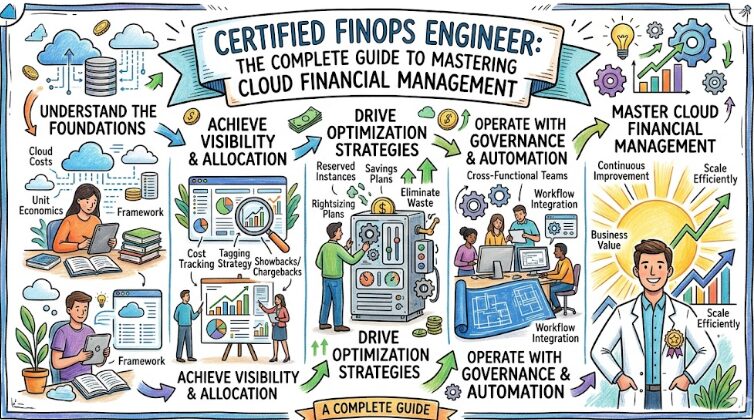
The shift toward cloud-native architectures has made cost management a core engineering responsibility rather than just a finance function. This guide explores the Certified FinOps Engineer program, a specialized certification designed for professionals looking to bridge the gap between cloud operations and financial accountability. Whether you are a DevOps engineer managing scaling costs or a manager overseeing cloud budgets, this resource will help you navigate the learning path and understand the professional impact of this credential.
The Certified FinOps Engineer is a comprehensive validation of an individual’s ability to implement cloud financial management practices within a technical framework. As organizations scale their cloud footprint, the need for engineers who understand unit economics and cost optimization becomes critical. This guide is hosted on finopsschool and provides a roadmap for engineers to transition into high-impact FinOps roles that balance velocity with fiscal responsibility.
What is the Certified FinOps Engineer?
The Certified FinOps Engineer represents a technical evolution in the cloud financial management space. Unlike general cloud certifications that focus on how to build services, this certification focuses on how to run those services efficiently and cost-effectively. It exists to provide a standardized framework for engineers to communicate with finance teams while maintaining the technical agility required in modern DevOps and SRE workflows.
This program emphasizes real-world, production-focused learning, moving beyond the theory of cost-saving to the actual implementation of automation and tooling. It aligns with enterprise practices where “Shift Left” now includes cost awareness during the architecture phase. By mastering this domain, engineers ensure that cloud scalability does not lead to uncontrolled financial waste, making them indispensable to modern enterprises.
Who Should Pursue Certified FinOps Engineer?
This certification is designed for a broad spectrum of technical roles, particularly those involved in infrastructure and platform engineering. Site Reliability Engineers (SREs) and DevOps professionals benefit significantly, as they are often the ones configuring the auto-scaling groups and resource limits that drive costs. Similarly, Cloud Architects need these skills to design cost-effective systems from the ground up rather than optimizing them after a massive bill arrives.
Beyond individual contributors, Engineering Managers and technical leaders should pursue this path to better align their team’s output with the company’s financial goals. In India and across global markets, there is a surging demand for “T-shaped” professionals who possess deep technical skills combined with business acumen. Beginners with a strong cloud foundation can use this to differentiate themselves in a crowded job market, while senior professionals can use it to pivot into strategic FinOps Lead roles.
Why Certified FinOps Engineer is Valuable and Beyond
The demand for FinOps expertise is driven by the massive enterprise adoption of multi-cloud and hybrid-cloud strategies. As organizations move past the “migration phase” into the “optimization phase,” the ability to manage cloud spend becomes a top priority for CIOs. This certification ensures longevity in a career because, while specific cloud tools may change, the fundamental principles of financial accountability and resource efficiency are permanent.
The return on investment for this certification is seen in both personal career growth and organizational savings. Professionals who hold this credential are seen as high-value assets capable of saving an organization millions in wasted cloud spend. As the industry matures, the intersection of finance and engineering will only become more integrated, making this specialization a future-proof career investment for any cloud professional.
Certified FinOps Engineer Certification Overview
The program is delivered via the official course materials and is hosted on finopsschool.com. It is designed to be a rigorous assessment of an engineer’s ability to apply FinOps principles to real-world cloud environments. The certification structure is built around the core pillars of the FinOps framework, ensuring that candidates understand the entire lifecycle of cloud financial management.
The assessment approach is practical, often requiring candidates to demonstrate knowledge of cloud billing data, tagging strategies, and the implementation of automated cost-governance policies. Ownership of the certification resides with the practitioner, providing a verifiable badge of expertise that is recognized by major enterprises globally. It is structured to guide a student from foundational concepts to advanced technical execution.
Certified FinOps Engineer Certification Tracks & Levels
The certification is structured into three distinct levels: Foundation, Professional, and Advanced. The Foundation level is aimed at establishing a common language and understanding of the FinOps framework. It covers the basics of cloud billing, the importance of visibility, and the roles within a FinOps team. This is the entry point for most professionals entering the field.
The Professional and Advanced tracks dive deeper into technical specializations. The Professional level focuses on the “Optimize” and “Operate” phases, teaching engineers how to build automated dashboards and implement rightsizing at scale. The Advanced level is geared toward leadership and organizational change, focusing on building a FinOps culture across large, decentralized engineering teams. These levels align directly with career progression from a FinOps Practitioner to a FinOps Director.
Complete Certified FinOps Engineer Certification Table
| Track | Level | Who it’s for | Prerequisites | Skills Covered | Recommended Order |
| Core FinOps | Foundation | Beginners, Managers | Basic Cloud Knowledge | FinOps Lifecycle, Tagging | 1st |
| Technical FinOps | Professional | SREs, Cloud Engineers | Foundation Cert | Automation, Rightsizing | 2nd |
| Strategic FinOps | Advanced | FinOps Leads, Architects | Professional Cert | Governance, Unit Economics | 3rd |
| FinOps Tooling | Specialist | Platform Engineers | Foundation Cert | SaaS Cost Tools, APIs | Optional |
Detailed Guide for Each Certified FinOps Engineer Certification
Certified FinOps Engineer – Foundation
What it is
This certification validates a foundational understanding of the FinOps framework and the ability to bridge the gap between business, finance, and engineering teams. It covers the basic terminology and the six core pillars of FinOps.
Who should take it
This is suitable for junior cloud engineers, finance professionals working with cloud budgets, and managers who need to understand how cloud costs are managed. No deep coding experience is required, but a general understanding of cloud services is helpful.
Skills you’ll gain
- Understanding the FinOps principles and culture.
- Mastery of the “Inform, Optimize, Operate” lifecycle.
- Ability to interpret cloud bills and usage reports.
- Knowledge of allocation and tagging strategies.
Real-world projects you should be able to do
- Create a basic tagging policy for a multi-account cloud environment.
- Generate a monthly cost report that breaks down spend by department.
- Identify underutilized resources using cloud-native monitoring tools.
Preparation plan
- 7–14 days: Review the official FinOps body of knowledge and take practice quizzes.
- 30 days: Deep dive into cloud billing consoles (AWS/Azure/GCP) to map theoretical concepts to real data.
- 60 days: Not typically required for this level unless the candidate is entirely new to cloud.
Common mistakes
- Treating FinOps as a one-time project rather than a continuous culture.
- Ignoring the importance of organizational buy-in from non-technical teams.
Best next certification after this
- Same-track option: Certified FinOps Engineer – Professional.
- Cross-track option: Cloud Practitioner (AWS/Azure/GCP).
- Leadership option: Certified FinOps Practitioner.
Certified FinOps Engineer – Professional
What it is
The Professional level validates the technical ability to implement FinOps strategies. It focuses on the actual “how-to” of cost optimization, including infrastructure-as-code integration and automated governance.
Who should take it
This is designed for SREs, DevOps engineers, and Platform engineers who are responsible for managing cloud infrastructure and want to automate cost management.
Skills you’ll gain
- Developing automated rightsizing scripts.
- Implementing “Shut-down” schedules for non-production environments.
- Advanced data analysis of Cost and Usage Reports (CUR).
- Setting up automated budget alerts and guardrails.
Real-world projects you should be able to do
- Build a Lambda function to identify and terminate orphaned volumes.
- Create a Grafana dashboard visualizing unit economics for a specific application.
- Implement a Kubernetes cost monitoring solution like Kubecost.
Preparation plan
- 14 days: Focus on technical whitepapers regarding cloud billing APIs.
- 30 days: Hands-on lab work building cost-automation scripts in a sandbox environment.
- 60 days: Comprehensive study of multi-cloud cost nuances and advanced commitment strategies (RIs/Savings Plans).
Common mistakes
- Over-optimizing small costs while ignoring high-impact architectural waste.
- Automating resource deletion without proper communication with application owners.
Best next certification after this
- Same-track option: Certified FinOps Engineer – Advanced.
- Cross-track option: SRE Certification or Kubernetes Administrator (CKA).
- Leadership option: FinOps Team Lead / Manager.
Choose Your Learning Path
DevOps Path
In the DevOps path, the focus is on integrating FinOps into the CI/CD pipeline. Engineers learn to treat “Cost as Code,” ensuring that every deployment includes cost estimates and adheres to budget constraints. This path transforms a traditional DevOps engineer into a performance-and-cost-conscious professional who can justify every dollar spent on infrastructure. It is ideal for those who want to build automated guardrails that prevent cost spikes before they happen.
DevSecOps Path
The DevSecOps path merges financial management with security compliance. Professionals in this track learn how security tools and configurations impact the cloud bill. For example, excessive logging or data egress for security scanning can drive high costs; this path teaches how to optimize those security workflows. It is essential for engineers who need to balance the high cost of data security with the organization’s financial limits.
SRE Path
For SREs, FinOps is about efficiency and reliability. This path focuses on the relationship between performance metrics and cost, often referred to as unit economics. SREs learn to optimize resource utilization without sacrificing Service Level Objectives (SLOs). It involves deep dives into container orchestration and serverless architectures to find the “sweet spot” where the system is both highly available and financially lean.
AIOps Path
The AIOps path focuses on using machine learning and AI to predict and manage cloud costs. Professionals learn to implement predictive scaling and anomaly detection to catch unusual spending patterns instantly. This is the cutting edge of FinOps, where algorithms do the heavy lifting of analyzing millions of billing line items. It is perfect for those interested in the intersection of data science and infrastructure management.
MLOps Path
In MLOps, cost management is critical because training and deploying large models can be prohibitively expensive. This path teaches how to manage GPU utilization, data storage costs for massive datasets, and the financial impact of model inference. MLOps professionals learn to optimize the machine learning lifecycle so that innovation doesn’t break the bank. It is a vital skill set for any organization scaling its AI capabilities.
DataOps Path
The DataOps path addresses the unique financial challenges of data engineering. Data transfer, storage, and processing costs (like BigQuery or Snowflake) can easily spiral out of control. This path teaches data engineers how to optimize queries, manage data lifecycles, and choose the most cost-effective storage tiers. It is designed for those who manage the pipelines that power the organization’s business intelligence.
FinOps Path
The pure FinOps path is for those who want to become dedicated FinOps Practitioners or Analysts. It focuses on the business side of the house, including procurement, vendor management, and internal chargeback models. While it remains technical, the goal is to lead the FinOps center of excellence. This path is ideal for professionals who want to transition from pure engineering into a strategic business-enabling role.
Role → Recommended Certified FinOps Engineer Certifications
| Role | Recommended Certifications |
| DevOps Engineer | Certified FinOps Engineer – Professional |
| SRE | Certified FinOps Engineer – Professional |
| Platform Engineer | Certified FinOps Engineer – Advanced |
| Cloud Engineer | Certified FinOps Engineer – Foundation |
| Security Engineer | Certified FinOps Engineer – Foundation |
| Data Engineer | Certified FinOps Engineer – Professional |
| FinOps Practitioner | Certified FinOps Engineer – Foundation & Professional |
| Engineering Manager | Certified FinOps Engineer – Foundation |
Next Certifications to Take After Certified FinOps Engineer
Same Track Progression
Deepening your specialization within the FinOps domain involves moving toward architectural leadership. After completing the engineer-level certifications, the logical step is to pursue the Advanced Architect or Professional Cloud Architect certifications from major providers like AWS, Azure, or GCP. These allow you to apply FinOps principles at the highest level of system design, ensuring that massive enterprise migrations are financially sound from day one.
Cross-Track Expansion
Broadening your skills into related areas like Site Reliability Engineering or Kubernetes management is a powerful way to increase your value. Certifications like the CKA (Certified Kubernetes Administrator) are excellent follow-ups because container costs are one of the most complex areas of FinOps. By understanding the underlying orchestration layer, you can more effectively implement cost-saving measures like pod autoscaling and spot instance utilization.
Leadership & Management Track
For those looking to transition into management, focusing on ITIL or PMP certifications alongside FinOps is highly effective. The ability to manage people and projects while maintaining a strict focus on cloud financial health is a rare and highly sought-after combination. This leads to roles such as Head of Cloud Operations or Director of FinOps, where you oversee the entire organization’s cloud strategy and financial performance.
Training & Certification Support Providers for Certified FinOps Engineer
DevOpsSchool
DevOpsSchool provides a robust ecosystem for technical training, offering a wide range of courses that complement the FinOps journey. Their curriculum is deeply rooted in practical DevOps practices, making them a strong partner for engineers who need to understand how financial management fits into the broader CI/CD pipeline. With a focus on hands-on labs and real-world scenarios, they help students bridge the gap between theory and actual implementation in production environments.
Cotocus
Cotocus specializes in high-end technical training for modern cloud-native roles, including SRE and FinOps. They are known for their intensive bootcamps and instructor-led sessions that focus on the technical nuances of cloud cost optimization. For professionals in India and beyond, Cotocus offers a structured path to mastering the tools and techniques required to manage large-scale cloud budgets effectively while maintaining high system performance.
Scmgalaxy
Scmgalaxy is a prominent community and training hub for software configuration management and DevOps professionals. They offer a wealth of resources, including blogs, tutorials, and certification guides that assist engineers in navigating the complexities of cloud financial management. Their approach is community-driven, providing a platform where practitioners can share best practices and learn from the collective experience of thousands of members worldwide.
BestDevOps
BestDevOps focuses on delivering top-tier educational content for those looking to excel in the DevOps and FinOps space. Their training programs are designed to be concise yet comprehensive, targeting the specific skills needed to pass industry-recognized certifications. They emphasize the importance of automation in cost management, helping engineers build the scripts and guardrails necessary to sustain a healthy FinOps culture within their organizations.
devsecopsschool.com
DevSecOpsSchool is a dedicated platform for professionals who want to integrate security into their FinOps and DevOps workflows. They understand that cost and security are often two sides of the same coin in the cloud. Their training helps engineers identify where security configurations might be driving unnecessary costs and how to remediate those issues without compromising the organization’s security posture or financial health.
sreschool.com
SRESchool focuses on the reliability and efficiency aspects of cloud infrastructure. Since SREs are often the “owners” of the resources that generate costs, this school provides the specific training needed to balance reliability targets with financial constraints. Their curriculum includes deep dives into observability and monitoring, which are essential for the “Inform” phase of the FinOps lifecycle, ensuring engineers have total visibility.
aiopsschool.com
AIOpsSchool is at the forefront of the shift toward intelligent operations. Their training programs focus on using AI and machine learning to automate the management of complex cloud environments. For FinOps professionals, this means learning how to use predictive analytics to forecast cloud spend and identify anomalies in real-time. This school is ideal for engineers who want to stay ahead of the curve by using advanced technology to manage costs.
dataopsschool.com
DataOpsSchool addresses the specific needs of data professionals who are grappling with the high costs of cloud data warehouses and processing engines. Their courses teach data engineers how to build efficient pipelines and manage data at scale without incurring astronomical bills. They provide the technical depth required to optimize SQL queries, storage tiers, and data transfer paths, which are critical for any data-driven organization.
finopsschool.com
FinOpsSchool is the primary destination for individuals seeking to master the art and science of cloud financial management. As the host of the Certified FinOps Engineer program, it offers the most direct and authoritative path to certification. Their resources are tailored specifically to the FinOps practitioner, providing the templates, case studies, and technical guides needed to build a successful FinOps practice from the ground up.
Frequently Asked Questions (General)
- How difficult is the Certified FinOps Engineer exam?
The exam is considered moderately difficult because it requires both technical cloud knowledge and an understanding of financial principles. It is not just about memorizing terms; you must be able to apply the FinOps framework to solve real-world cost problems. Candidates with a background in cloud engineering or DevOps usually find the technical parts easier, while the financial allocation and governance sections may require more study. - How much time does it take to prepare for the certification?
For an experienced cloud engineer, 30 days of focused study is usually sufficient. For those new to the cloud, it may take 60 to 90 days to first understand cloud basics before diving into the financial management aspects. The key is consistent study and hands-on practice with cloud billing tools and cost-saving automation scripts. - Are there any prerequisites for taking this certification?
There are no mandatory prerequisites, but it is highly recommended that you have a foundational understanding of at least one major cloud provider (AWS, Azure, or GCP). Knowing how instances, storage, and networking work will help you understand why they cost what they do and how they can be optimized. - What is the ROI of becoming a Certified FinOps Engineer?
The ROI is significant, as FinOps is currently one of the highest-paying specializations in the cloud market. Organizations are willing to pay a premium for engineers who can demonstrably reduce their cloud bills. Furthermore, it provides job security as cost optimization is a priority in both booming and recessionary economies. - How does this certification help my career in India?
India has a massive pool of cloud talent, and this certification helps you stand out by adding a specialized business-focused skill to your technical profile. Many Indian IT service providers and startups are looking for FinOps experts to manage their global clients’ cloud infrastructure, leading to better roles and higher salaries. - Is the certification recognized globally?
Yes, the FinOps framework is the industry standard for cloud financial management worldwide. Holding this certification demonstrates that you follow a globally recognized methodology, making you an attractive candidate for multinational corporations and remote roles across the globe. - Can I take the exam online?
Yes, the exam is typically offered in an online proctored format, allowing you to take it from the comfort of your home or office. You will need a stable internet connection, a webcam, and a quiet environment to complete the assessment. - What is the validity period of the certification?
Most professional certifications in this space are valid for two to three years. Because cloud services and billing models evolve so rapidly, recertification ensures that your skills remain current and that you are aware of the latest optimization techniques and tools. - Does this certification cover multi-cloud environments?
Yes, the core principles of FinOps are cloud-agnostic. While the exam may use specific examples from major providers, the goal is to teach you a framework that can be applied to AWS, Azure, Google Cloud, and even private cloud or on-premises environments. - Is there a community for certified professionals?
Absolutely. There is a large and growing community of FinOps practitioners who share advice, job opportunities, and technical solutions. Joining this community is a great way to stay updated on industry trends and network with other professionals in the field. - What tools will I learn to use during this certification?
You will learn to use native cloud tools like AWS Cost Explorer, Azure Cost Management, and GCP Billing Reports. Additionally, the course often touches on third-party tools like Kubecost, CloudHealth, or Apptio to provide a well-rounded view of the tooling landscape. - Is this certification suitable for finance professionals?
Yes, finance professionals who work closely with engineering teams will find the Foundation level extremely valuable. It provides them with the technical context they need to communicate effectively with engineers and understand the “why” behind cloud spending fluctuations.
FAQs on Certified FinOps Engineer
- What makes the engineer track different from the practitioner track?
The engineer track is focused on implementation, automation, and technical architecture, whereas the practitioner track focuses more on the cultural and managerial aspects of FinOps. - Will I learn how to write scripts for cost optimization?
Yes, the professional and advanced levels emphasize technical solutions, including using APIs and scripting (Python/Bash) to automate the discovery and cleanup of wasted resources. - How does FinOps relate to GreenOps or Sustainability?
FinOps and GreenOps are closely linked; reducing cloud waste not only saves money but also reduces the carbon footprint of your digital operations by decreasing unnecessary compute and storage. - Does the certification cover container and Kubernetes costs?
Yes, managing container costs is a major component of modern FinOps, and the certification provides guidance on how to allocate costs in shared Kubernetes environments. - Can I specialize in a specific cloud provider within this certification?
While the framework is general, you are encouraged to apply the principles to the cloud provider you use most. The certification validates your ability to do this across any major platform. - What are the passing criteria for the exam?
The passing score is usually around 70-75%, depending on the specific version of the exam. It consists of multiple-choice questions that test both knowledge and situational judgment. - Are there practice exams available?
Yes, finopsschool.com and other training partners provide practice exams to help you get a feel for the question style and identify areas where you need more study. - How often is the certification curriculum updated?
The curriculum is updated regularly to reflect changes in cloud billing models (like new Savings Plans or tiered pricing) and emerging industry best practices.
Final Thoughts: Is Certified FinOps Engineer Worth It?
In my two decades of experience across DevOps and SRE domains, I have seen many trends come and go. However, the need for financial accountability in engineering is not a trend; it is a fundamental shift in how we build and run software. The days of “growth at any cost” are over, replaced by a requirement for “sustainable, profitable growth.”
The Certified FinOps Engineer certification is an excellent investment because it addresses a real, painful problem that every modern enterprise faces: the unpredictable and often runaway cost of the cloud. By earning this credential, you aren’t just adding another acronym to your resume; you are proving that you can bridge the gap between the basement and the boardroom.
My advice as a mentor is to pursue this certification if you want to move beyond being “just an engineer” and become a strategic partner to the business. It requires a mindset shift from purely technical excellence to operational and financial excellence. If you are willing to make that leap, the rewards in terms of career longevity, salary, and professional impact are well worth the effort.