Introduction
The transition from traditional IT spending to cloud consumption has fundamentally changed how organizations manage their finances. The Certified FinOps Architect is a senior-level credential designed for those who bridge the gap between engineering, finance, and business leadership. This guide is curated for professionals navigating the complexities of cloud-native environments where cost efficiency is as critical as system performance. By focusing on the intersection of DevOps and financial accountability, this program ensures that platform engineering remains sustainable and profitable. Choosing the right path at finopsschool allows engineers to transition from technical execution to strategic cloud value management.
What is the Certified FinOps Architect?
The Certified FinOps Architect represents the pinnacle of cloud financial management expertise, focusing on the architectural decisions that drive long-term cost efficiency. Unlike entry-level certifications that focus on terminology, this program emphasizes production-focused strategies for building and scaling cloud infrastructure. It exists to solve the “bill shock” problem by embedding financial awareness directly into the engineering workflow and architectural design. By aligning modern engineering practices like CI/CD and infrastructure-as-code with financial guardrails, it enables enterprises to maintain agility without sacrificing their margins.
Who Should Pursue Certified FinOps Architect?
This certification is specifically designed for senior engineers, cloud architects, and SREs who have a direct impact on infrastructure spend. Engineering managers and technical leaders who need to justify cloud budgets to stakeholders will find immense value in the strategic frameworks provided here. In the Indian market and global tech hubs, companies are increasingly looking for professionals who can optimize multi-cloud environments across AWS, Azure, and Google Cloud. Even data and security professionals are finding this certification relevant as they manage high-scale, resource-intensive workloads that require precise financial governance.
Why Certified FinOps Architect is Valuable in Beyond
In the current era of enterprise cloud adoption, the demand for professionals who understand the unit economics of the cloud is reaching an all-time high. This certification provides longevity because it focuses on principles and cultural shifts rather than just specific tool features that may change over time. It helps professionals stay relevant by teaching them how to communicate technical debt and architectural choices in the language of business value. The return on career investment is significant, as organizations prioritize candidates who can demonstrate a direct contribution to the company’s bottom line.
Certified FinOps Architect Certification Overview
The program is delivered via the official platform and is formally hosted on the official website. It follows a rigorous assessment approach that evaluates a candidate’s ability to apply FinOps principles to complex, real-world architectural scenarios. The ownership of the program lies with industry experts who ensure the content stays updated with the latest trends in cloud governance and automated cost optimization. Structurally, the certification moves beyond theoretical exams into practical application, ensuring that an architect can actually lead a FinOps transformation within a large enterprise.
Certified FinOps Architect Certification Tracks & Levels
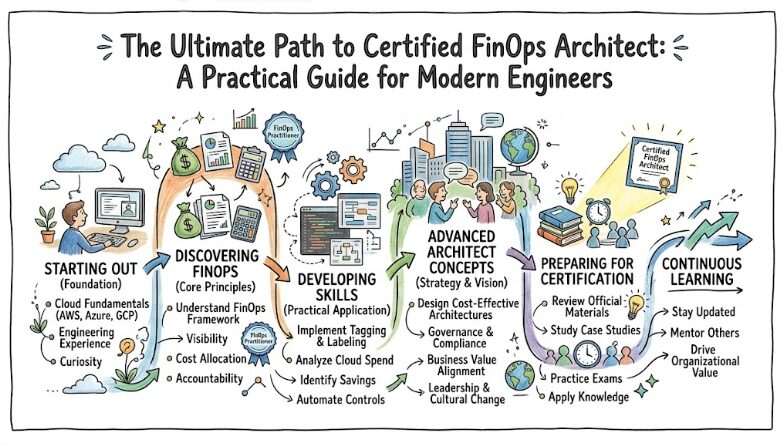
The certification hierarchy begins with a foundation level that introduces core concepts and the lifecycle of Inform, Optimize, and Operate. The professional level deepens this knowledge by focusing on policy automation and advanced reporting for multi-cloud and containerized environments. Finally, the advanced architect level challenges candidates to design organizational-wide frameworks for cloud financial management. This progression ensures that a professional can grow their skills alongside their career responsibilities, moving from individual contributor roles to leadership positions.
Complete Certified FinOps Architect Certification Table
| Track | Level | Who it’s for | Prerequisites | Skills Covered | Recommended Order |
| Core FinOps | Foundation | Beginners and Non-Technical Staff | Basic Cloud Literacy | FinOps Principles, Lifecycle, Personas | First |
| Engineering | Professional | SREs, DevOps, Platform Engineers | Foundation Certification | Tagging, Automation, Rightsizing | Second |
| Architecture | Advanced | Solutions Architects, CTOs, Leads | Professional Certification | Unit Economics, Governance, Multi-cloud | Third |
| Specialized | Expert | FinOps Practice Leads | 5+ Years Experience | Change Management, Executive Reporting | Final |
Detailed Guide for Each Certified FinOps Architect Certification
Certified FinOps Architect – Foundation
What it is
This certification validates a candidate’s understanding of the basic terminology and the cultural shifts required to implement FinOps. It serves as the baseline for all subsequent specialized training.
Who should take it
Entry-level cloud engineers, finance professionals, and procurement teams who interact with cloud billing and resource management daily.
Skills you’ll gain
- Understanding the three phases of the FinOps lifecycle.
- Identifying the different personas involved in cloud financial management.
- Learning the basic metrics for cloud cost reporting.
Real-world projects you should be able to do
- Create a basic cloud cost visibility dashboard.
- Perform a simple audit of unused cloud resources.
Preparation plan
- 7-14 Days: Review the official glossary and attend introductory webinars.
- 30 Days: Complete the self-paced foundation course and practice mock exams.
- 60 Days: Engage in community forums to understand common implementation challenges.
Common mistakes
- Focusing only on cost cutting rather than value realization.
- Ignoring the cultural aspect of cross-departmental collaboration.
Best next certification after this
- Same-track option: Certified FinOps Professional
- Cross-track option: Cloud Practitioner (AWS/Azure/GCP)
- Leadership option: FinOps Certified Professional
Certified FinOps Architect – Professional
What it is
This certification validates the ability to implement technical solutions for cost optimization and automated governance. It focuses on the “how” of engineering financial accountability.
Who should take it
Cloud engineers and DevOps practitioners who are responsible for infrastructure deployment and resource scaling.
Skills you’ll gain
- Developing automated scripts for resource rightsizing.
- Implementing advanced tagging and labeling strategies.
- Managing costs in Kubernetes and containerized environments.
Real-world projects you should be able to do
- Build an automated “stop-start” schedule for non-production environments.
- Implement a showback/chargeback system for different engineering teams.
Preparation plan
- 7-14 Days: Focus on technical documentation for cloud pricing APIs.
- 30 Days: Set up a sandbox environment to test cost-optimization scripts.
- 60 Days: Deep dive into case studies involving large-scale cloud migrations.
Common mistakes
- Over-automating without setting proper safety guardrails.
- Failing to account for the performance impact of rightsizing.
Best next certification after this
- Same-track option: Certified FinOps Architect
- Cross-track option: SRE Professional
- Leadership option: IT Financial Management Professional
Certified FinOps Architect – Advanced Architect
What it is
This is the highest level of certification, focusing on the strategic design of a cloud financial management office. It validates leadership in architectural governance.
Who should take it
Principal architects, lead engineers, and technology executives who define the cloud strategy for their entire organization.
Skills you’ll gain
- Designing a multi-cloud financial governance framework.
- Calculating unit economics for complex microservices architectures.
- Leading organizational change management for FinOps adoption.
Real-world projects you should be able to do
- Create a 3-year cloud financial roadmap for an enterprise.
- Design a centralized governance policy that balances speed and cost.
Preparation plan
- 7-14 Days: Study executive-level reporting and business financial metrics.
- 30 Days: Review complex architectural patterns for cost-efficient cloud designs.
- 60 Days: Conduct a mock organizational audit and gap analysis.
Common mistakes
- Getting lost in technical details while ignoring business objectives.
- Failing to secure executive buy-in for FinOps initiatives.
Best next certification after this
- Same-track option: Master FinOps Practitioner
- Cross-track option: CTO/Engineering Leadership Certification
- Leadership option: MBA or Business Strategy certificates
Choose Your Learning Path
DevOps Path
The DevOps path focuses on integrating financial feedback loops directly into the CI/CD pipeline. Professionals here learn to treat cost as a first-class metric alongside performance and reliability. By mastering FinOps, DevOps engineers can ensure that every code deployment is evaluated for its financial impact before it hits production. This path leads to a more mature “You Build It, You Run It, You Pay For It” culture.
DevSecOps Path
The DevSecOps path emphasizes the intersection of security, compliance, and cost management. Security tools and logging can often become significant cost drivers, and this path teaches how to optimize those resources. Professionals learn to balance the cost of data retention with regulatory requirements and security posture. It ensures that being secure does not mean being financially inefficient or over-provisioned.
SRE Path
The SRE path focuses on the relationship between reliability, error budgets, and cloud spending. Site Reliability Engineers use FinOps to determine the point of diminishing returns when investing in high availability. This path teaches how to manage the trade-offs between system uptime and the cost of redundancy. SREs gain the skills to justify infrastructure investments based on service level objectives and financial data.
AIOps Path
The AIOps path explores how machine learning can be used to predict cloud spending and automate anomalies detection. Professionals in this track learn to use AI-driven tools to identify patterns in resource usage that humans might miss. This path is essential for organizations dealing with massive scales where manual intervention is impossible. It bridges the gap between proactive maintenance and predictive financial modeling.
MLOps Path
The MLOps path specifically addresses the high costs associated with training and deploying machine learning models. Professionals learn to optimize GPU usage and manage the expensive storage requirements of large datasets. This track ensures that data science projects remain economically viable from research to production. It focuses on the specific unit economics of compute-heavy artificial intelligence workloads.
DataOps Path
The DataOps path concentrates on the financial management of data pipelines, warehouses, and analytical platforms. Data engineers learn how to optimize query performance to reduce costs in platforms like Snowflake or BigQuery. This path teaches how to manage data lifecycle policies to ensure that storage costs do not grow exponentially. It is vital for organizations that treat data as a core product and need to manage its overhead.
FinOps Path
The dedicated FinOps path is for those moving into specialized Cloud Financial Management roles. This path covers the full spectrum of the discipline, from technical implementation to procurement and executive reporting. It is ideal for individuals who want to lead a FinOps Center of Excellence. This track provides a comprehensive view of how to drive cloud value across the entire enterprise ecosystem.
Role → Recommended Certified FinOps Architect Certifications
| Role | Recommended Certifications |
| DevOps Engineer | FinOps Foundation, FinOps Professional |
| SRE | FinOps Professional, FinOps Architect |
| Platform Engineer | FinOps Foundation, FinOps Professional |
| Cloud Engineer | FinOps Foundation, FinOps Professional |
| Security Engineer | FinOps Foundation, DevSecOps Specialist |
| Data Engineer | FinOps Foundation, DataOps Specialist |
| FinOps Practitioner | FinOps Foundation, Professional, and Architect |
| Engineering Manager | FinOps Foundation, FinOps Architect |
Next Certifications to Take After Certified FinOps Architect
Same Track Progression
For those looking to go even deeper into the financial domain, pursuing specialized courses in cloud procurement and vendor management is the logical next step. Deep specialization allows a professional to become a subject matter expert in niche areas like Reserved Instance (RI) and Savings Plan (SP) portfolio management. This path is suitable for those who want to be the primary authority on cloud economics within their organization.
Cross-Track Expansion
Expanding into SRE or Platform Engineering certifications helps a FinOps professional understand the technical constraints that lead to certain cost profiles. By broadening your skills, you can better empathize with engineering teams and provide more practical optimization advice. This cross-pollination of skills makes you a more versatile leader who can bridge the gap between finance and engineering effectively.
Leadership & Management Track
Transitioning into leadership requires a shift from technical execution to organizational strategy and people management. Certifications in ITIL, PMP, or general engineering leadership complement the Certified FinOps Architect by providing the soft skills needed for large-scale transformation. This track is designed for those aiming for roles like Director of Infrastructure, VP of Cloud, or Chief Technology Officer.
Training & Certification Support Providers for Certified FinOps Architect
DevOpsSchool
DevOpsSchool provides a robust ecosystem for professionals looking to master the intricacies of cloud financial management through hands-on labs and instructor-led training. Their curriculum is designed to bridge the gap between theoretical knowledge and practical application, ensuring that students can handle real-world infrastructure challenges. With a focus on the latest industry trends, they offer comprehensive support for various cloud platforms and automation tools. The platform is well-regarded for its community-driven approach and its commitment to helping engineers advance their careers through continuous learning and expert mentorship.
Cotocus
Cotocus stands out as a specialized provider that focuses on high-end technical training for modern engineering roles. They offer deep dives into FinOps and SRE practices, providing participants with the tools needed to optimize complex cloud environments effectively. Their training modules are crafted by industry veterans who bring years of experience into the classroom setting. By emphasizing a results-oriented learning path, Cotocus ensures that their graduates are ready to contribute to enterprise-level projects immediately. Their focus on emerging technologies makes them a preferred choice for professionals looking to stay ahead of the curve.
Scmgalaxy
Scmgalaxy is a well-established platform that serves as a central hub for configuration management and DevOps resources. They offer a wide range of training programs that include specialized tracks for cloud financial management and governance. The platform is known for its extensive library of tutorials, webinars, and practical guides that support self-paced learning. Scmgalaxy emphasizes the importance of community interaction, allowing learners to connect with experts and peers from around the world. Their certifications are designed to validate a professional’s ability to manage software delivery pipelines with a focus on efficiency and cost-effectiveness.
BestDevOps
BestDevOps focuses on providing streamlined and efficient training paths for busy professionals who need to acquire new skills quickly. Their courses are structured to deliver maximum value in a concise format, focusing on the most critical aspects of cloud operations and FinOps. They provide a balance of video content, practical assignments, and assessment tools to ensure a well-rounded learning experience. The platform is particularly popular among those looking for certification preparation that is both rigorous and accessible. BestDevOps prides itself on its high success rate and its ability to help engineers transition into more senior roles.
devsecopsschool.com
This provider specializes in the intersection of security and operations, offering a unique perspective on how FinOps integrates with a secure development lifecycle. Their training programs emphasize the financial impact of security decisions and provide strategies for building cost-efficient, secure infrastructure. With a global reach, they cater to a diverse audience of engineers and security professionals. The curriculum is updated regularly to reflect the evolving landscape of cloud security and compliance. Students benefit from expert guidance and a wealth of practical resources that help them implement DevSecOps principles in a financially responsible manner.
sreschool.com
Sreschool.com is dedicated to the discipline of Site Reliability Engineering and its fundamental connection to cloud financial management. Their courses teach engineers how to manage reliability and cost as twin objectives, using data-driven approaches to optimize system performance. The platform offers a variety of learning formats, including interactive workshops and detailed case studies. By focusing on the practical challenges faced by SREs in large-scale environments, they prepare their students for leadership roles in platform engineering. Their commitment to excellence has made them a trusted partner for organizations looking to upskill their engineering teams.
aiopsschool.com
Aiopsschool.com provides cutting-edge training on the application of artificial intelligence to IT operations and financial management. Their programs explore how machine learning can be leveraged to automate cost optimization and detect spending anomalies in real-time. This specialized focus is ideal for professionals working in high-scale environments where traditional management methods are no longer sufficient. The curriculum covers a range of AI and ML tools, providing students with the technical skills needed to build intelligent infrastructure. Aiopsschool.com is at the forefront of the industry, helping engineers navigate the future of automated cloud governance.
dataopsschool.com
This provider focuses on the specific challenges of managing data pipelines and analytical platforms with a FinOps mindset. Their training programs are designed for data engineers and architects who need to optimize the cost and performance of their data infrastructure. The curriculum covers everything from data lifecycle management to the financial governance of cloud-native data warehouses. By providing practical tools and frameworks, they help professionals ensure that their data initiatives are both scalable and economically sustainable. Dataopsschool.com is a vital resource for any organization that relies on data-driven decision-making.
finopsschool.com
As the primary host for the Certified FinOps Architect program, finopsschool.com offers a specialized and authoritative learning environment. Their focus is entirely on the discipline of cloud financial management, providing a comprehensive range of certifications for all experience levels. The platform is backed by a network of experts who define the standards for FinOps across the industry. With a focus on real-world application and architectural governance, they provide the most direct path to becoming a certified expert in the field. Finopsschool.com is the go-to destination for anyone serious about a career in FinOps.
Frequently Asked Questions (General)
- What is the typical difficulty level of the Architect certification?
The Architect certification is considered advanced and requires a deep understanding of both technical infrastructure and business finance. - How long does it take to prepare for the exam?
Most professionals spend between 30 to 60 days preparing, depending on their existing experience with cloud billing and architecture. - Are there any mandatory prerequisites?
While not always strictly enforced, having a Foundation or Professional level certification is highly recommended before attempting the Architect level. - What is the career ROI for this certification?
Professionals often see increased salary potential and opportunities for leadership roles as organizations prioritize cloud cost efficiency. - Is the exam proctored or open-book?The assessment approach typically involves a proctored environment to ensure the integrity and value of the credential.
- Does this certification cover multiple cloud providers?
Yes, the principles taught are cloud-agnostic and applicable to AWS, Azure, Google Cloud, and even hybrid environments. - How often do I need to recertify?
Certifications generally require renewal every two to three years to ensure you are up to date with the latest industry practices. - Can a non-technical manager pass this exam?
It is possible, but the Architect level requires a significant amount of technical knowledge regarding cloud infrastructure and automation. - What resources are provided for exam preparation?
Candidates usually receive access to official study guides, practice exams, and community forums. - Is there a focus on containerization and Kubernetes?
Yes, modern FinOps practices heavily emphasize managing costs within dynamic containerized environments. - How does this differ from a standard Cloud Architect certification?
A standard architect certification focuses on performance and availability, while the FinOps Architect adds a critical layer of financial accountability. - Is this certification recognized globally?
Yes, it is a standard credential recognized by major enterprises and consulting firms worldwide.
FAQs on Certified FinOps Architect
- What specific architectural patterns are covered?
The program focuses on patterns like multi-cloud governance, serverless cost optimization, and tiered storage strategies. - Does it include hands-on lab work?
Yes, practical labs are often included to simulate real-world cost optimization scenarios in a safe environment. - How does it address unit economics?
It teaches how to map cloud costs to business metrics, such as cost per transaction or cost per customer. - Is there a focus on automated governance?
Yes, learning to implement policy-as-code to prevent cost overruns is a core component of the program. - Does the curriculum include change management?
The Architect level places a strong emphasis on the cultural shifts needed to drive FinOps adoption across an organization. - What role does tagging play in the curriculum?
Advanced tagging and resource allocation strategies are treated as the foundation for all financial reporting and accountability. - How are multi-cloud environments managed?
The program provides frameworks for normalizing cost data across different providers to create a unified financial view. - Are real-world case studies used in the training?
Yes, candidates analyze successful (and unsuccessful) FinOps implementations at large-scale enterprises.
Final Thoughts: Is Certified FinOps Architect Worth It?
The transition to cloud-native operations is no longer just about speed; it is about sustainability. The Certified FinOps Architect is one of the few credentials that directly addresses the economic reality of modern engineering. If you are an engineer looking to move into a high-impact leadership role, or a manager trying to bring order to your cloud spend, this certification is a highly practical investment. It moves you away from “guessing” about costs toward a disciplined, data-driven approach to architectural value. In a competitive market, being the person who can balance high-performance engineering with financial health makes you indispensable. This is not about saving money; it is about making sure every dollar spent on the cloud is driving maximum business value.