Introduction
Buy Now, Pay Later (BNPL) platforms have fundamentally restructured the consumer credit industry by offering a frictionless, point-of-sale alternative to traditional revolving debt. At its core, BNPL is a short-term financing model that allows consumers to distribute the cost of a purchase over a series of fixed installments, typically with zero interest if paid on time. Unlike traditional credit cards that rely on complex interest calculations and monthly statements, BNPL tools integrate directly into the merchant’s checkout flow, providing instant approval decisions through algorithmic risk assessment. This transparency in repayment schedules has made it a preferred choice for younger demographics and modern shoppers who prioritize cash flow management over long-term debt accumulation.
For merchants and enterprises, the strategic implementation of BNPL serves as a high-velocity conversion engine. By lowering the psychological and financial barrier to entry at the moment of purchase, these platforms significantly increase average order value (AOV) and reduce cart abandonment rates. From a technical perspective, the modern BNPL stack utilizes sophisticated API-driven architectures and machine learning models to analyze consumer behavior in real-time, enabling “soft” credit checks that do not impact a user’s primary credit score. As we navigate a financial landscape defined by instant gratification and digital-first banking, BNPL stands as a critical pillar of embedded finance, bridging the gap between desire and affordability without the historical baggage of traditional lending.
Best for: E-commerce retailers, digital marketplaces, and service providers looking to boost conversion rates and provide flexible payment options to a credit-conscious customer base.
Not ideal for: High-risk merchants with low margins that cannot absorb transaction fees, or businesses with extremely long fulfillment cycles where payment settlement delays might impact immediate liquidity.
Key Trends in BNPL Platforms
The defining trend in the current BNPL ecosystem is the shift toward “Agentic Finance,” where AI-driven assistants proactively suggest the most favorable repayment terms based on a user’s real-time cash flow and upcoming bills. There is also a significant convergence between BNPL and digital wallets, with major providers moving away from standalone apps and instead embedding their credit lines directly into Apple Pay, Google Pay, and UPI frameworks. This “invisible” integration allows for a seamless transition between paying in full and paying in installments without the user ever leaving the primary transaction interface.
Furthermore, we are seeing a rapid expansion of BNPL into non-traditional sectors such as healthcare, education, and B2B procurement. In the B2B space, platforms are adapting to handle much larger transaction limits and more complex underwriting requirements suited for corporate cash flow cycles. On the regulatory front, “Responsible Lending” has become the industry standard, with platforms now required to provide clearer disclosures and automated “affordability guardrails” to prevent consumer over-leverage, turning compliance from a hurdle into a competitive trust-building advantage.
How We Selected These Tools
Our selection process focused on the technical robustness and market reliability of each platform, prioritizing those that offer high approval rates without compromising risk management. We looked for providers with “API-first” mentalities, ensuring that they can be easily integrated into various e-commerce stacks—from custom-built headless platforms to standard Shopify or WooCommerce setups. Reliability in settlement times and the quality of the merchant dashboard were also heavily weighted, as these are critical for daily business operations and financial reconciliation.
Beyond technical features, we evaluated the brand trust and consumer adoption rates of each tool. A BNPL platform is only as effective as the number of users who are comfortable using it; therefore, we prioritized established players with millions of active users and high satisfaction scores. Security was a paramount criterion, with a focus on platforms that utilize advanced tokenization, biometric authentication, and strict adherence to global financial regulations like PCI DSS and GDPR. Finally, we considered the diversity of payment structures offered, ensuring a mix of “Pay in 4,” longer-term financing, and monthly billing options.
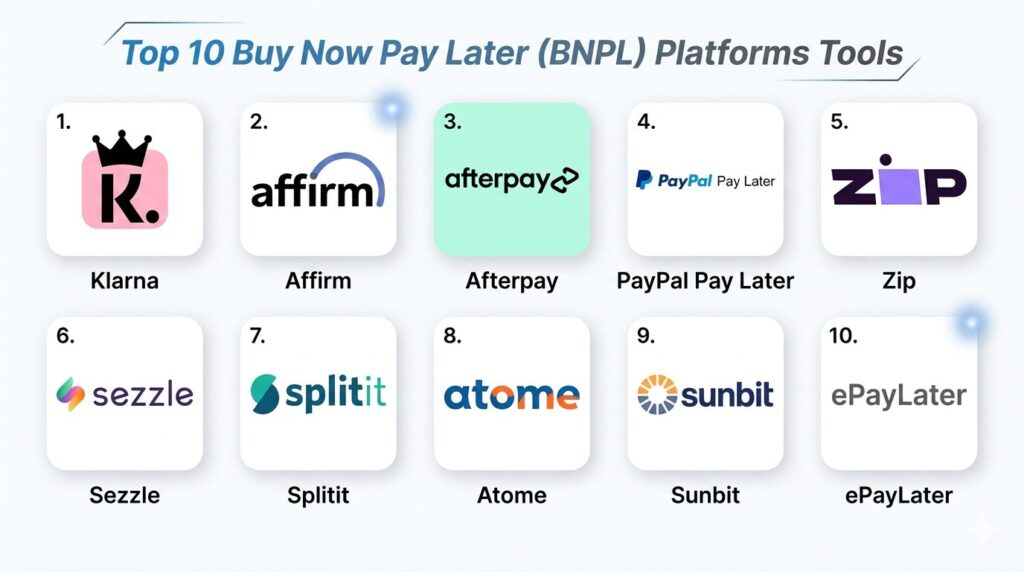
1. Klarna
Klarna is a global powerhouse that has evolved from a simple payment provider into a comprehensive “shopping super-app.” It leverages high-end AI to provide personalized product recommendations while offering a variety of flexible payment options. Its “Pay in 3” or “Pay in 4” models are industry standards, and its global reach makes it the preferred partner for international fashion and lifestyle brands.
Key Features
The platform includes an AI-powered personal shopping assistant that helps users find deals and track price drops. It offers “one-time cards” that allow users to shop with BNPL at any online store, even if the merchant hasn’t officially integrated Klarna. The merchant portal provides deep analytics on customer behavior and purchase patterns. It supports a “Pay in 30 days” option, giving customers a risk-free trial period for their purchases. Additionally, it features a robust loyalty program, “Vibe,” which rewards users for on-time repayments and repeat usage.
Pros
The brand recognition is immense, which instantly builds trust at checkout. The user experience is incredibly polished, leading to high conversion rates for merchants.
Cons
Merchant fees can be significantly higher than traditional credit card processing. The platform’s strong branding can sometimes overshadow the merchant’s own brand identity.
Platforms and Deployment
Cloud-based API, web-based checkout widgets, and a comprehensive mobile app for iOS and Android.
Security and Compliance
Holds a full banking license in several jurisdictions; compliant with PCI DSS Level 1, GDPR, and SOC 2.
Integrations and Ecosystem
Native integrations with Shopify, Salesforce Commerce Cloud, Adobe Commerce (Magento), and BigCommerce.
Support and Community
Extensive merchant success teams and a global 24/7 customer support infrastructure for buyers.
2. Affirm
Affirm focuses on “honest” financing with a strict “no late fees ever” policy. It is particularly popular for high-ticket items like electronics and furniture, offering longer-term financing options that go up to 36 months. Its transparent pricing model shows users exactly what they will pay in total, including interest, before they commit to the purchase.
Key Features
The platform uses a sophisticated underwriting engine that assesses risk on a per-transaction basis rather than just a per-user basis. It offers both 0% APR and interest-bearing loans depending on the merchant’s configuration. It features a “Virtual Card” for use at non-partner retailers. The dashboard provides clear repayment tracking and automated payment reminders. It also offers a “Savings” account feature for users, encouraging a more balanced approach to personal finance alongside its credit products.
Pros
The lack of late fees and hidden charges builds strong long-term customer loyalty. It is the best option for merchants selling high-value products that require extended repayment periods.
Cons
Approval rates can be stricter for certain consumer demographics compared to competitors. The interest-bearing loans can be expensive for users with lower credit scores.
Platforms and Deployment
API-driven integration for web and mobile; mobile application for consumer management.
Security and Compliance
Adheres to strict US financial regulations and uses high-level encryption for all data transmissions.
Integrations and Ecosystem
Direct partnership with Amazon and Shopify, plus deep integrations with most major e-commerce platforms.
Support and Community
Highly rated merchant support and a transparent help center focused on financial literacy.
3. Afterpay (by Block)
Afterpay, owned by Block (formerly Square), is a Gen Z and Millennial favorite due to its simple “Pay in 4” structure. It emphasizes responsible spending by limiting initial credit for new users and gradually increasing it based on successful repayment history. Its integration into the Square ecosystem makes it a leader in omnichannel retail, bridging online and offline sales.
Key Features
The platform features a “Pulse Rewards” loyalty program that gives users perks like payment date changes and exclusive discounts. It offers a “digital card” that can be added to Apple Pay or Google Pay for in-store BNPL transactions. The merchant interface is designed for simplicity, with automated reconciliation features. It provides a “Shop Directory” that drives significant referral traffic to merchant partners. It also includes “clears-on-the-spot” approvals that take seconds during the checkout process.
Pros
Excellent at driving repeat customers and high-frequency, lower-AOV purchases. The integration with Square hardware makes it the gold standard for brick-and-mortar retailers.
Cons
The platform is less flexible for very high-ticket items that require more than four installments. Late fees can be charged if a payment is missed, which may deter some users.
Platforms and Deployment
Web-based checkout and mobile wallet integration (Apple/Google Pay).
Security and Compliance
PCI DSS Level 1 compliant and follows strict anti-money laundering (AML) protocols.
Integrations and Ecosystem
Seamlessly integrated with Square, Shopify, Wix, and WooCommerce.
Support and Community
Strong social media presence and active merchant community forums.
4. PayPal Pay Later
PayPal has leveraged its massive existing merchant and user base to launch “Pay in 4” and “PayPal Credit.” For many businesses, this is the easiest BNPL tool to implement because it is often already included in their existing PayPal integration. It provides a familiar and trusted environment for users who are already comfortable with the PayPal brand.
Key Features
The platform offers a “Pay in 4” interest-free option for smaller purchases and a more traditional “PayPal Credit” line for larger amounts. It provides comprehensive “Buyer Protection” for BNPL transactions, mirroring their standard payment policy. Merchants receive their funds upfront, just like a regular PayPal transaction. The checkout dynamically shows the most relevant “Pay Later” offer to the customer based on their location and cart value. It also includes an automated merchant reporting tool for tracking BNPL performance.
Pros
Extremely easy to activate for existing PayPal merchants with no additional onboarding. Offers one of the highest trust levels in the industry due to its long history.
Cons
The user interface can feel more like a traditional financial tool rather than a modern shopping app. The “Buyer Protection” process can sometimes favor the consumer over the merchant in disputes.
Platforms and Deployment
Embedded directly into the PayPal checkout flow on web and mobile.
Security and Compliance
World-class fraud detection and global regulatory compliance across hundreds of countries.
Integrations and Ecosystem
Works wherever PayPal is accepted, covering millions of online stores globally.
Support and Community
Access to PayPal’s massive global support network and extensive documentation.
5. Zip (formerly Quadpay)
Zip is known for its “Shop Anywhere” philosophy, allowing users to split any purchase into four payments at any retailer that accepts Visa. This flexibility makes it a versatile tool for consumers who want to use BNPL for everything from groceries to travel, even if the merchant hasn’t signed up for a specific BNPL service.
Key Features
The platform generates a virtual Visa card for every transaction, ensuring universal acceptance. It features a “Zip Business” tier that provides capital and payment flexibility for small businesses. The app includes a “Price Protection” feature that can alert users if a price drops after their purchase. It offers “Tap & Pay” functionality for in-store use via mobile wallets. The merchant dashboard provides real-time transaction monitoring and easy refund management.
Pros
Universal acceptance is a huge advantage for consumers; they can use it literally anywhere. The merchant integration is lightweight and non-disruptive.
Cons
Users are often charged a small “convenience fee” per installment, which can add up. It lacks the deep, personalized shopping features of Klarna or Afterpay.
Platforms and Deployment
Consumer mobile app and a virtual card system for web and in-store.
Security and Compliance
Complies with PCI standards and uses encrypted tokenization for virtual card generation.
Integrations and Ecosystem
Integrates with major platforms like Shopify and BigCommerce, but its primary strength is the virtual card.
Support and Community
Provides 24/7 help desk and a comprehensive set of developer APIs for custom integrations.
6. Sezzle
Sezzle is a “mission-driven” platform that focuses on financial empowerment and helping users build their credit scores. It is one of the few BNPL providers that reports on-time payments to credit bureaus (via their Sezzle Up program), making it an attractive choice for credit-builders and ethical consumers.
Key Features
The “Sezzle Up” feature allows users to opt-in to credit reporting, helping them improve their FICO scores. It offers a “reschedule” feature that lets users push back a payment date once for free. The platform includes a “socially responsible” directory of B-Corp and ethical brands. It provides a virtual card for in-store and online use. Merchants get access to “Sezzle University,” a resource center for optimizing their checkout experience and marketing their BNPL offering.
Pros
Strong appeal to Gen Z and ethical shoppers who value credit-building and social responsibility. The “first payment rescheduling” feature reduces the risk of customer late fees.
Cons
The product catalog is smaller and more niche than the “big three” global players. The merchant interface is functional but lacks some of the high-end analytics found elsewhere.
Platforms and Deployment
Web-based integration and a dedicated mobile app for consumers.
Security and Compliance
PCI DSS Level 1 and SOC 2 compliant, with a focus on transparent data practices.
Integrations and Ecosystem
Native support for Shopify, WooCommerce, and Magento, with a focus on SMB growth.
Support and Community
Excellent merchant support and a strong commitment to financial education for users.
7. Splitit
Splitit offers a unique “white-label” BNPL solution that allows consumers to use their existing credit card’s available balance to fund installments. This means there are no new credit applications, no credit checks, and no interest—the platform simply holds the total amount on the user’s card and charges the installments monthly.
Key Features
The platform is completely white-labeled, meaning it lives entirely within the merchant’s brand experience. It works with any existing Visa or Mastercard credit card globally. Since it uses existing credit, it has a 100% approval rate for users with sufficient balance. It supports “Pay in Full” and “Pay in Installments” through a single API. The merchant dashboard provides high-level data on card types and geographical distribution of sales.
Pros
Maintains the merchant’s brand integrity perfectly without introducing a third-party “middleman” brand. High approval rates and zero impact on the consumer’s credit score.
Cons
Only works for customers who already have a credit card with sufficient limit, excluding the “unbanked” or “credit-averse” population. The concept can be harder to explain to consumers at checkout compared to standard BNPL.
Platforms and Deployment
API-first cloud platform that integrates directly into the checkout flow.
Security and Compliance
Uses enterprise-grade encryption and is fully compliant with global card network rules.
Integrations and Ecosystem
Certified partnerships with Shopify, Adobe Commerce, and Salesforce.
Support and Community
Offers dedicated account managers for enterprise clients and professional technical support.
8. Atome
Atome is a leading BNPL provider in the Asian market, particularly in Southeast Asia and Greater China. It bridges the gap between digital payments and physical retail through a massive network of offline QR code integrations. It is the essential choice for brands looking to expand into the fast-growing Asian middle-class market.
Key Features
The platform uses a simple “Pay in 3” interest-free model. It features an incredibly strong mobile-first design, optimized for high-speed mobile internet and QR code scanning. It offers a “personalized rewards” engine that sends location-based offers to users’ phones. The merchant portal supports multi-currency and multi-language management. It includes a “Flash Sale” feature where Atome promotes specific merchant deals directly to its user base via push notifications.
Pros
Dominant presence in Asia with a deep understanding of local consumer habits. Excellent for driving foot traffic to physical stores through its app-based discovery map.
Cons
Limited presence and brand recognition in Western markets. The underwriting models are highly localized and may not translate well for non-Asian consumers.
Platforms and Deployment
QR-code-based mobile app and web checkout integration.
Security and Compliance
Compliant with regional central bank regulations (e.g., MAS in Singapore) and international security standards.
Integrations and Ecosystem
Strong integrations with regional e-commerce giants like Shopee and Lazada, plus Shopify and Wix.
Support and Community
Huge social media community and localized merchant support teams in every operating country.
9. Sunbit
Sunbit is a specialized BNPL platform designed specifically for “essential” services like auto repair, dental work, and optical care. It focuses on providing high approval rates (over 90%) for mid-to-high ticket service costs, helping people manage unexpected life expenses without the stress of traditional high-interest loans.
Key Features
The platform features a “lightning-fast” application process that takes less than 30 seconds at the point of sale. It offers a wide range of repayment terms from 3 to 24 months. It includes a dedicated “Sunbit Card” for repeat users. The merchant portal is designed for service advisors, with tools for explaining financing options to customers in person. It provides automated marketing materials for physical service centers to display at the front desk.
Pros
Extremely high approval rates make it very effective in service-based industries. It fills a critical gap for “need-based” rather than “want-based” BNPL.
Cons
Not suitable for traditional retail or low-AOV e-commerce. The interest rates for longer-term plans can be higher than general retail BNPL platforms.
Platforms and Deployment
Tablet-based point-of-sale app and web-based checkout for service bookings.
Security and Compliance
Strictly compliant with financial and healthcare data privacy laws (HIPAA/PCI).
Integrations and Ecosystem
Integrates with service management software in the automotive and medical sectors.
Support and Community
Offers intensive training for merchant staff and 24/7 technical support for busy service centers.
10. ePayLater
ePayLater is a pioneer in the Indian BNPL market, with a strong focus on B2B procurement and digital payments. It allows small businesses and retailers to purchase inventory with interest-free credit, solving the critical “cash flow gap” that many small-scale entrepreneurs face.
Key Features
The platform offers credit limits up to ₹25 lakhs (approx. $30,000) for business users. It provides an interest-free period of 14 to 30 days. It is integrated into major B2B marketplaces and travel booking sites. The system uses an “instant credit” model that requires no physical documentation. It features a unique “revenue-based financing” option for growing businesses. For individual consumers, it offers a seamless checkout on food delivery and ticket booking apps.
Pros
The best solution for B2B “inventory financing” and small-business credit in the Indian market. It bridges the gap between traditional banking and the informal retail sector.
Cons
Customer service has been reported as slow during peak periods. The focus is heavily on the Indian market, making it irrelevant for global-only merchants.
Platforms and Deployment
API-based integration and a dedicated mobile app for business and consumer credit management.
Security and Compliance
Regulated by the Reserve Bank of India (RBI) guidelines and uses secure, bank-grade encryption.
Integrations and Ecosystem
Partnered with major players like IRCTC, Tata 1mg, and various B2B supply chain platforms.
Support and Community
Offers localized support and a strong network for small-to-medium enterprise (SME) owners.
Comparison Table
| Tool Name | Best For | Platform(s) Supported | Deployment | Standout Feature | Public Rating |
| 1. Klarna | Global Lifestyle | Web, Mobile, API | Cloud | AI Shopping Super-App | 4.8/5 |
| 2. Affirm | High-Value Items | Web, Mobile, API | Cloud | No Late Fees Ever | 4.7/5 |
| 3. Afterpay | Fashion / Omnichannel | Web, In-store | Hybrid | Pulse Rewards Loyalty | 4.6/5 |
| 4. PayPal Pay Later | Existing Merchants | Web, Mobile | Embedded | Trusted Buyer Protection | 4.5/5 |
| 5. Zip | Universal Acceptance | Web, Mobile | Virtual Card | Shop Anywhere (Visa) | 4.3/5 |
| 6. Sezzle | Credit Building | Web, Mobile | Cloud | Sezzle Up Reporting | 4.5/5 |
| 7. Splitit | White-label / Cards | Web, API | Cloud | No New Credit Check | 4.4/5 |
| 8. Atome | Asian Markets | Mobile, QR Code | Cloud | Personalization Engine | 4.6/5 |
| 9. Sunbit | Essential Services | POS, Web | Hybrid | 90%+ Approval Rate | 4.7/5 |
| 10. ePayLater | B2B / India Market | Web, API | Cloud | ₹25L Business Credit | 4.2/5 |
Evaluation & Scoring of BNPL Platforms
The scoring below is a comparative model intended to help shortlisting. Each criterion is scored from 1–10, then a weighted total from 0–10 is calculated using the weights listed. These are analyst estimates based on typical fit and common workflow requirements, not public ratings.
Weights:
- Core features – 25%
- Ease of use – 15%
- Integrations & ecosystem – 15%
- Security & compliance – 10%
- Performance & reliability – 10%
- Support & community – 10%
- Price / value – 15%
| Tool Name | Core (25%) | Ease (15%) | Integrations (15%) | Security (10%) | Performance (10%) | Support (10%) | Value (15%) | Weighted Total |
| 1. Klarna | 10 | 9 | 10 | 10 | 9 | 9 | 7 | 9.15 |
| 2. Affirm | 9 | 8 | 10 | 9 | 9 | 10 | 8 | 8.85 |
| 3. Afterpay | 8 | 9 | 9 | 9 | 9 | 8 | 8 | 8.55 |
| 4. PayPal Pay Later | 7 | 10 | 10 | 10 | 9 | 9 | 9 | 8.80 |
| 5. Zip | 8 | 9 | 7 | 8 | 8 | 8 | 7 | 7.85 |
| 6. Sezzle | 8 | 8 | 8 | 9 | 8 | 9 | 9 | 8.35 |
| 7. Splitit | 7 | 7 | 9 | 9 | 10 | 9 | 8 | 8.10 |
| 8. Atome | 9 | 9 | 8 | 9 | 10 | 8 | 8 | 8.80 |
| 9. Sunbit | 10 | 7 | 6 | 9 | 9 | 9 | 8 | 8.40 |
| 10. ePayLater | 9 | 6 | 7 | 9 | 8 | 7 | 9 | 7.95 |
How to interpret the scores:
- Use the weighted total to shortlist candidates, then validate with a pilot.
- A lower score can mean specialization, not weakness.
- Security and compliance scores reflect controllability and governance fit, because certifications are often not publicly stated.
- Actual outcomes vary with assembly size, team skills, templates, and process maturity.
Which BNPL Platform Tool Is Right for You?
Solo / Freelancer
If you are a solo service provider or small creator, PayPal Pay Later is the path of least resistance. Since you likely already use PayPal for invoicing, adding the BNPL option is a simple toggle switch that requires zero technical overhead and provides instant credibility.
SMB
Small to medium businesses in the retail space should lean toward Afterpay or Sezzle. Afterpay is fantastic for driving new customers through its shop directory, while Sezzle’s focus on credit-building attracts a loyal, responsible customer base that values financial health.
Mid-Market
For growing retailers with higher-value goods, Affirm is the strategic choice. Its ability to offer terms up to 36 months and its “no late fee” promise allows you to capture customers who are making significant investments in their homes or lifestyles without the fear of predatory lending.
Enterprise
Large-scale global brands should choose Klarna for its unmatched marketing reach and AI capabilities, or Splitit for a pure white-label experience. Klarna provides a massive ecosystem of millions of users, while Splitit allows you to keep the entire payment experience within your own brand’s aesthetic.
Budget vs Premium
If you want to keep costs low for the customer, Sezzle and Afterpay’s interest-free models are the winners. However, if you are an enterprise looking for the most “premium” customer experience with dedicated account management and custom routing, Klarna is the gold standard.
Feature Depth vs Ease of Use
Zip offers the most flexibility for consumers but the least brand control for merchants. On the other end, Splitit offers deep technical control but requires a more sophisticated understanding of credit card “holds” to explain to your customer base.
Integrations & Scalability
PayPal and Klarna offer the most robust global integrations, ensuring that as you expand into new countries, your payment stack doesn’t need a complete overhaul. For businesses targeting the Asian market specifically, Atome is the non-negotiable choice for scalability.
Security & Compliance Needs
Sunbit and ePayLater excel in highly regulated environments (healthcare and B2B finance). If your business operates in a sector with strict data privacy or industry-specific lending laws, these specialized providers offer the most secure and compliant frameworks.
Frequently Asked Questions (FAQs)
1. Does using a BNPL platform hurt my credit score?
Most BNPL platforms perform a “soft” credit check, which does not affect your score. However, some (like Sezzle) allow you to report on-time payments to help build your credit, while others may report missed payments to bureaus, which could negatively impact your score.
2. How do BNPL companies make money if they don’t charge interest?
They primarily earn revenue through merchant transaction fees (similar to credit cards but usually slightly higher) and late fees from consumers. Some also offer interest-bearing plans for longer-term financing on high-ticket items.
3. Is BNPL better than using a credit card?
For many, yes, because it offers a fixed repayment schedule and often 0% interest, which helps prevent the “spiral” of revolving debt. However, credit cards often offer better reward points and more robust consumer insurance for travel and large purchases.
4. What happens if I miss a BNPL payment?
Policies vary. Some platforms like Affirm have no late fees, while others like Afterpay or Klarna may charge a fee and freeze your account until the balance is settled. Consistently missing payments will reduce your spending limit and may be reported to credit bureaus.
5. Can I use BNPL for in-store purchases?
Yes, most major providers now offer “digital cards” or QR code systems that integrate with Apple Pay, Google Pay, or their own proprietary apps to allow for installment payments at physical retail locations.
6. Can I return an item I bought with BNPL?
Yes. You follow the merchant’s standard return policy. Once the merchant processes the return, the BNPL platform will automatically adjust your remaining balance or issue a refund for the installments you’ve already paid.
7. Are there purchase limits for BNPL?
Yes. Limits are determined by the platform based on your repayment history, credit signals, and the merchant’s category. New users typically start with lower limits (e.g., $150–$500), which grow over time with on-time payments.
8. Can I use BNPL for my business expenses?
Yes, specialized platforms like ePayLater and “Zip Business” are designed specifically for B2B procurement, allowing businesses to buy inventory or supplies on interest-free credit lines.
9. Do I need a bank account to use BNPL?
Most platforms require a linked debit card, credit card, or bank account for automated repayments. However, some newer fintech models are looking at alternative data sources to serve the “unbanked” population.
10. Why was my BNPL application declined?
Declines can happen due to insufficient funds for the first installment, a low credit signal, or if the platform’s automated risk engine flags the transaction as high-risk. Each transaction is assessed individually, so a decline today doesn’t mean a permanent ban.
Conclusion
The evolution of Buy Now, Pay Later from a niche e-commerce widget into a core component of the global financial infrastructure represents a permanent shift in consumer behavior and credit accessibility. As we move deeper into 2026, the distinction between “paying” and “financing” continues to blur, with AI-driven personalization ensuring that credit is both accessible and responsible. For the modern business owner, the question is no longer whether to offer BNPL, but which platform best aligns with their specific industry, customer demographic, and brand values. By integrating the right tool, merchants can not only drive immediate revenue growth but also build long-term customer relationships based on transparency and financial flexibility. The future of commerce is embedded, and BNPL is the engine driving its most significant growth.