Introduction
Digital asset compliance tools have become the mandatory infrastructure for financial institutions, virtual asset service providers, and enterprises navigating the complex regulatory landscape of the blockchain era. As global frameworks like MiCA in Europe and evolving SEC and CFTC guidelines in the United States take shape, the ability to monitor transactions in real-time is no longer optional. These platforms provide the technical “eyes” for compliance officers, enabling them to identify illicit activity, perform automated risk scoring, and maintain a clear audit trail for regulators. By integrating deep forensic analysis with traditional financial crime-fighting protocols, these tools ensure that digital asset businesses can operate with legitimacy and institutional-grade security.
In the current environment, the definition of compliance has expanded beyond simple Anti-Money Laundering (AML) checks to include sophisticated Know Your Transaction (KYT) and travel rule requirements. The decentralized and pseudonymous nature of distributed ledgers requires a specialized set of technologies that can de-anonymize illicit actors while preserving the privacy of legitimate users. These platforms act as a centralized intelligence layer, correlating on-chain data with real-world entities to prevent money laundering, terrorist financing, and sanctions evasion. When selecting a compliance tool, organizations must prioritize the breadth of supported blockchains, the accuracy of the attribution data, and the seamlessness of integration into existing core banking or exchange systems.
Best for: Cryptocurrency exchanges, institutional investors, hedge funds, traditional banks entering the digital asset space, and regulatory bodies requiring deep forensic oversight of blockchain transactions.
Not ideal for: Individual retail investors with low transaction volumes, or small private businesses that do not handle third-party digital assets or fall under global financial reporting mandates.
Key Trends in Digital Asset Compliance Tools
The most significant shift in the sector is the move toward “Cross-Chain Intelligence,” where compliance tools can track a single entity’s movement across multiple disparate blockchains and layer-2 solutions. This is critical as bad actors increasingly use “chain-hopping” techniques to obscure the origin of funds. We are also seeing the integration of Artificial Intelligence to detect “Peeling Chains” and other complex obfuscation patterns that traditional rule-based systems might miss. This allows for predictive risk scoring, where the software identifies suspicious behavior before a high-risk transaction is even finalized.
Another dominant trend is the automation of the Travel Rule, which requires the exchange of originator and beneficiary information for transactions above certain thresholds. Digital asset compliance platforms are now acting as secure communication hubs to facilitate this data exchange between institutions. There is also an increased focus on Decentralized Finance (DeFi) monitoring, with tools developing specific protocols to analyze smart contract interactions and liquidity pool risks. Furthermore, as the industry matures, we are seeing a move toward unified dashboards that combine traditional fiat AML signals with on-chain crypto signals for a holistic “Total Risk” view of a customer.
How We Selected These Tools
Our selection process involved an exhaustive technical review of the data attribution engines and the regulatory standing of the top providers in the market. We prioritized platforms that maintain a vast database of labeled addresses, including those linked to sanctioned entities, darknet markets, and high-risk jurisdictions. A key criterion was “Attribution Accuracy,” evaluating the platform’s ability to minimize false positives which can lead to unnecessary account freezes and operational friction. We looked for tools that provide real-time alerting capabilities rather than just post-transaction forensic analysis.
Scalability was a major factor, as the selected tools must be capable of processing millions of transactions per second for global exchanges. We also scrutinized the depth of the “Travel Rule” solutions integrated into each platform to ensure compliance with the latest international mandates. Security certifications were a non-negotiable requirement, favoring vendors with SOC 2 compliance and robust data privacy protections. Finally, we assessed the global reach of each tool, ensuring they support the various local regulations across North America, Europe, and Asia-Pacific to provide a truly universal compliance solution.
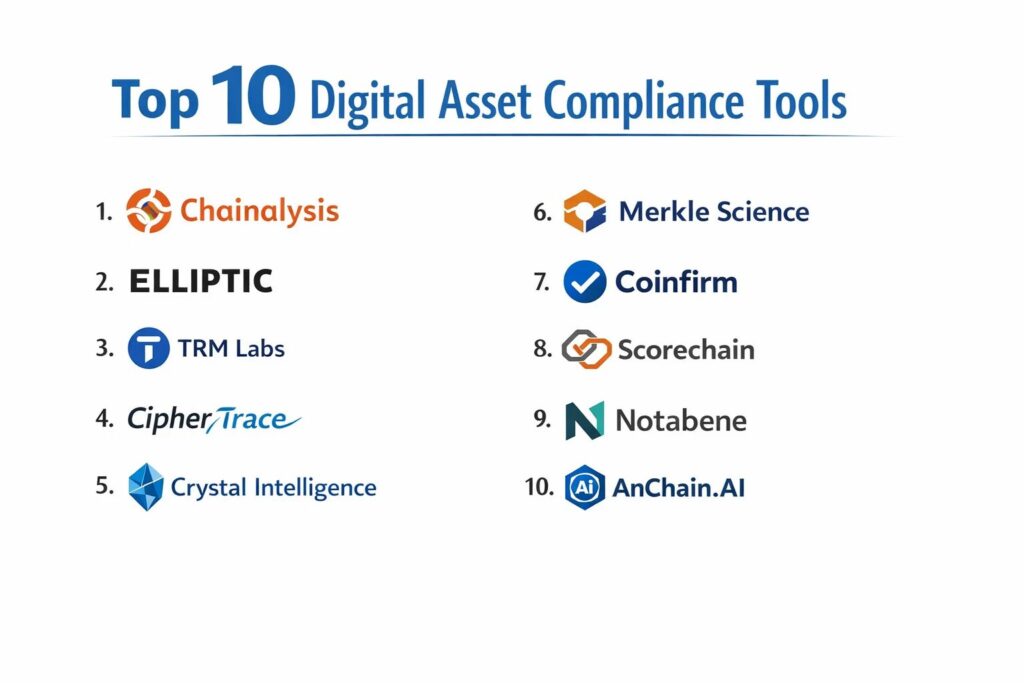
1. Chainalysis
Chainalysis is the global leader in blockchain data platform services, providing data, software, and research to government agencies and financial institutions. It is widely considered the industry standard for mapping the world of digital assets to real-world entities.
Key Features
The platform features “Reactor,” a premier tool for visualizing the flow of funds across nearly all major blockchains. It includes “Know Your Transaction” (KYT) for real-time automated monitoring of high-risk transfers. The system offers a “Business Data” module that helps exchanges understand their customers’ behavior beyond just risk. It features “Market Intel” for institutional-grade transparency into cryptocurrency markets. Additionally, it provides a specialized “Government” suite used by law enforcement for complex investigations and asset recovery.
Pros
It possesses the most comprehensive and well-labeled dataset in the digital asset industry. The platform is trusted by major regulators and central banks worldwide.
Cons
The pricing is at the highest end of the market, often making it inaccessible for smaller startups. The depth of the tool can be overwhelming without specialized training.
Platforms and Deployment
Web-based SaaS with API-first architecture for enterprise integration.
Security and Compliance
SOC 2 Type II certified and adheres to the most stringent global data privacy standards.
Integrations and Ecosystem
Integrates with major core banking systems and provides a robust API for custom exchange development.
Support and Community
Offers the “Chainalysis Academy” for professional certification and high-touch support for government and enterprise clients.
2. Elliptic
Elliptic is a pioneer in digital asset risk management, focusing on providing high-fidelity data for financial institutions and crypto-native businesses. It emphasizes the “Total Risk” approach by combining on-chain and off-chain data points.
Key Features
The platform features “Elliptic Lens,” which provides instant risk scoring for individual wallets during onboarding. It includes “Elliptic Navigator,” an automated transaction monitoring system that scales with the business. The system offers a unique “Holistic Screening” capability that tracks funds as they move between different assets and chains. It features a robust “Sanctions Screening” engine that is updated in real-time. It also provides a comprehensive “Travel Rule” solution to ensure compliant inter-institutional transfers.
Pros
The “Holistic” cross-chain view is among the best in the industry for detecting advanced money laundering. The user interface is highly praised for its clarity and ease of use for compliance teams.
Cons
The depth of coverage for very new or niche altcoins may occasionally lag behind larger competitors. Enterprise customization can require significant lead time.
Platforms and Deployment
Cloud-based SaaS.
Security and Compliance
Maintains ISO 27001 certification and provides full support for GDPR and global AML mandates.
Integrations and Ecosystem
Offers native integrations with various crypto-custody providers and institutional trading platforms.
Support and Community
Provides dedicated account managers and a wealth of regulatory research and webinars.
3. TRM Labs
TRM Labs is a modern, fast-growing compliance platform known for its focus on the “forensics of the future.” It is particularly strong in analyzing complex DeFi transactions and NFT-related risks.
Key Features
The platform features “TRM Wallet Screening,” providing real-time risk scores for millions of digital assets. It includes “TRM Transaction Monitoring,” which allows for the creation of custom risk rules based on specific business needs. The system offers a “DeFi-native” architecture that understands the nuances of smart contract interactions. It features “TRM Forensics,” a tool designed for deep-dive investigations into hacks and exploits. It also provides an automated “Travel Rule” compliance layer that works across different jurisdictions.
Pros
It is widely considered the best tool for organizations heavily involved in the DeFi and NFT sectors. The platform offers a highly modular approach, allowing users to pay only for the features they need.
Cons
As a newer entrant, its historical dataset in certain legacy regions may be less extensive than older competitors. The rapid release of new features requires frequent staff retraining.
Platforms and Deployment
Cloud-native SaaS.
Security and Compliance
SOC 2 Type II compliant and follows international standards for data residency and privacy.
Integrations and Ecosystem
Strong API capabilities with specific focus on integrating with decentralized applications.
Support and Community
Offers a proactive customer success team and a library of “TRM Insights” on emerging blockchain threats.
4. CipherTrace (Mastercard)
CipherTrace, now part of Mastercard, is a major player in the blockchain security space. It specializes in making crypto-assets safe for banks and providing tools for tracing even the most difficult privacy-focused coins.
Key Features
The platform features “Armada,” a tool designed specifically for banks to monitor their customers’ interactions with crypto-exchanges. It includes “Inspector,” a deep forensic tool for law enforcement and technical investigators. The system offers a specialized “Monero Tracing” capability, which is a key differentiator in the market. It features “Sentry,” an automated transaction monitoring system for virtual asset service providers. It also provides a “Travel Rule” solution that emphasizes privacy-preserving data exchange.
Pros
Being a Mastercard company provides a level of institutional stability and global reach that is hard to match. It offers unique insights into the intersection of traditional card payments and digital assets.
Cons
The integration into the broader Mastercard ecosystem is still ongoing, which can lead to changing product names and structures. It is primarily focused on the B2B banking sector.
Platforms and Deployment
Web-based SaaS and hybrid options for certain enterprise bank deployments.
Security and Compliance
Adheres to global financial security standards and provides enterprise-grade data protection.
Integrations and Ecosystem
Deeply integrated with traditional financial rails and Mastercard’s broader security suite.
Support and Community
Provides professional forensic training and high-level consulting for financial institutions.
5. Crystal Intelligence
Crystal Intelligence provides an all-in-one blockchain analytics platform that is popular in the European and Asian markets. It is known for its user-friendly interface and highly competitive pricing for mid-market businesses.
Key Features
The platform features “Crystal Expert,” a comprehensive tool for forensic investigations and fund tracing. It includes “Crystal Case Management,” which helps compliance teams manage and document their investigations for regulators. The system offers “Real-time Risk Scoring” for both wallets and individual transactions. It features a “Connections Map” that visually identifies the proximity of funds to illicit sources. It also provides an integrated “Travel Rule” solution designed for international interoperability.
Pros
The pricing is very accessible for mid-sized exchanges and startups. The platform provides excellent coverage of European and Eastern European crypto-asset service providers.
Cons
The analytical tools, while robust, may lack some of the extreme depth found in Chainalysis for government-level work. The English-language community resources are slightly smaller than some competitors.
Platforms and Deployment
Web-based SaaS.
Security and Compliance
Full GDPR compliance and follows international AML/KYC guidelines.
Integrations and Ecosystem
Provides a robust REST API and integrates with common back-office compliance tools.
Support and Community
Known for very responsive customer support and a dedicated onboarding team.
6. Merkle Science
Merkle Science is a predictive blockchain monitoring and investigative platform. It distinguishes itself by moving away from static blacklists toward dynamic, behavior-based risk monitoring.
Key Features
The platform features “Compass,” a behavior-based transaction monitoring system that allows for highly customized risk rules. It includes “Tracker,” a forensic tool for tracing stolen funds across multiple blockchains. The system offers “Predictive Risk Scoring,” which uses machine learning to identify suspicious patterns before they are linked to a known illicit address. It features a “Case Management” system designed for collaboration between different compliance team members. It also provides a unified view of “Travel Rule” data alongside transaction risks.
Pros
The focus on behavioral analysis rather than just known addresses makes it more effective against new types of crime. The rule-builder is very flexible, allowing for fine-tuned compliance policies.
Cons
The predictive nature of the scores can lead to a higher initial rate of false positives until the system is properly tuned. It has a smaller market presence in the United States compared to Europe and Asia.
Platforms and Deployment
Cloud-based SaaS.
Security and Compliance
Maintains standard enterprise security protocols and is fully compliant with global data privacy laws.
Integrations and Ecosystem
Integrates with various custody and core banking platforms through a modern API.
Support and Community
Offers a dedicated customer success manager for all enterprise accounts and regular training sessions.
7. Coinfirm
Coinfirm is a prominent blockchain analytics provider that offers one of the largest databases of risk-labeled addresses in the industry. It is highly focused on providing automated, “one-click” compliance reports for financial institutions.
Key Features
The platform features the “AML Risk Report,” which provides a detailed breakdown of an address’s risk profile in seconds. It includes “Entity Analytics,” which groups multiple addresses into a single real-world actor. The system offers a “Reclaim Crypto” service that helps victims of hacks trace and recover assets. It features specialized “Oracle” integrations that bring compliance data directly on-chain for DeFi applications. It also provides a robust “Travel Rule” solution that facilitates secure data messaging between providers.
Pros
The “AML Risk Report” is incredibly detailed and easy to present to regulators. It offers some of the best coverage for a wide variety of tokens and less common blockchains.
Cons
The interface can feel a bit more technical and “developer-heavy” than some of the more polished competitor suites. The pricing can be complex depending on the number of reports generated.
Platforms and Deployment
Web-based SaaS and API.
Security and Compliance
Complies with international standards like GDPR and is a member of major global compliance associations.
Integrations and Ecosystem
Offers unique integrations with various blockchain protocols to provide “Compliance as a Service” natively on-chain.
Support and Community
Provides extensive technical documentation and a responsive support desk.
8. Scorechain
Scorechain is a European-based leader in crypto-asset compliance, particularly strong in the banking and institutional investment sectors. It provides a highly granular risk assessment framework that is adaptable to different regulatory environments.
Key Features
The platform features a “Customizable Risk Scoring” engine where users can weight different types of risk based on their internal policies. It includes “Full Traceability,” allowing users to see the entire history of an asset from its creation. The system offers “Entity Grouping,” which helps identify the true owners of multiple digital wallets. It features a “DEX & DeFi Monitoring” module that tracks swaps and liquidity pool activity. It also provides an integrated “Travel Rule” module that supports the most common industry protocols.
Pros
The granular control over risk weights is a major advantage for institutional compliance departments. It has a very strong reputation for accuracy in the European regulatory landscape.
Cons
The platform is primarily focused on the B2B sector and may lack some of the investigative features needed for high-level law enforcement work. The mobile experience is limited compared to the web platform.
Platforms and Deployment
Web-based SaaS.
Security and Compliance
Adheres to the highest European data protection standards and is fully GDPR compliant.
Integrations and Ecosystem
Integrates with various portfolio management and trading systems used by institutional investors.
Support and Community
Offers professional training and a dedicated support team based in Europe.
9. Notabene
Notabene is a specialized compliance platform that focuses almost exclusively on the “Travel Rule” and institutional identity. It acts as a bridge between different digital asset service providers to facilitate secure data exchange.
Key Features
The platform features a “VASP Directory,” which allows institutions to identify and verify the compliance status of their counterparties. It includes a “Rule Engine” that automatically determines which transactions require Travel Rule data exchange based on the local jurisdiction. The system offers “Secure Data Messaging” to transmit PII without storing it on a central server. It features “Integrated Risk Scoring” through partnerships with blockchain analytics firms. It also provides a “Customer Dashboard” where end-users can provide necessary information for their transfers.
Pros
It is the most specialized and effective tool for solving the complex “Travel Rule” problem. The focus on inter-institutional communication makes it a vital piece of the global compliance puzzle.
Cons
It is not a full forensic or transaction monitoring tool; it must be used in conjunction with a tool like Chainalysis or Elliptic. The pricing is dependent on the volume of messages exchanged.
Platforms and Deployment
Cloud-based SaaS.
Security and Compliance
Employs zero-knowledge proofs and advanced encryption to ensure that PII is never exposed or misused.
Integrations and Ecosystem
Integrates with almost all major blockchain analytics providers to provide a complete compliance stack.
Support and Community
Known for its deep expertise in global Travel Rule regulations and proactive support for its customers.
10. AnChain.AI
AnChain.AI is an AI-powered cybersecurity and compliance platform that focuses on identifying smart contract risks and automated threat detection in the Web3 ecosystem.
Key Features
The platform features “CISO,” an automated blockchain security and compliance dashboard. It includes “BEI” (Blockchain Ecosystem Intelligence) for identifying high-risk actors through machine learning. The system offers “Smart Contract Auditing” tools that check for vulnerabilities that could lead to hacks or compliance breaches. It features “Real-time Alerting” for suspicious movements in DeFi protocols. It also provides a “Forensic Investigation” suite for tracing assets after a security incident.
Pros
Its focus on smart contract security makes it a unique and vital tool for companies building their own decentralized applications. The AI-driven threat detection is highly effective at finding new types of exploits.
Cons
The platform is more focused on security and cybersecurity than traditional “check-the-box” AML compliance. Its database of labeled physical entities may be smaller than the largest competitors.
Platforms and Deployment
Cloud-native SaaS.
Security and Compliance
Adheres to enterprise security standards and provides tools to help developers meet compliance requirements.
Integrations and Ecosystem
Strong focus on developer tools and integrations with various blockchain development frameworks.
Support and Community
Provides a technical support team with deep expertise in blockchain security and smart contract auditing.
Comparison Table
| Tool Name | Best For | Platform(s) Supported | Deployment | Standout Feature | Public Rating |
| 1. Chainalysis | Global Standard / Gov | Web-Based | Cloud SaaS | Reactor Visualization | 4.9/5 |
| 2. Elliptic | Institutional / Holistic | Web-Based | Cloud SaaS | Cross-Chain Analytics | 4.8/5 |
| 3. TRM Labs | DeFi / NFT Forensic | Web-Based | Cloud SaaS | Smart Contract Risk | 4.7/5 |
| 4. CipherTrace | Banks / Privacy Coins | Web-Based | Hybrid | Monero Tracing | 4.5/5 |
| 5. Crystal Intelligence | Mid-Market / EU | Web-Based | Cloud SaaS | Case Management | 4.6/5 |
| 6. Merkle Science | Predictive / Custom | Web-Based | Cloud SaaS | Behavior Rule-Builder | 4.5/5 |
| 7. Coinfirm | Institutional Reports | Web, API | Cloud SaaS | One-Click AML Reports | 4.4/5 |
| 8. Scorechain | Institutional / Granular | Web-Based | Cloud SaaS | Custom Risk Weights | 4.6/5 |
| 9. Notabene | Travel Rule Expert | Web-Based | Cloud SaaS | VASP Directory | 4.8/5 |
| 10. AnChain.AI | Smart Contract Security | Web-Based | Cloud SaaS | AI Threat Detection | 4.5/5 |
Evaluation & Scoring of Digital Asset Compliance Tools
The scoring below is a comparative model intended to help shortlisting. Each criterion is scored from 1–10, then a weighted total from 0–10 is calculated using the weights listed. These are analyst estimates based on typical fit and common workflow requirements, not public ratings.
Weights:
- Core features – 25%
- Ease of use – 15%
- Integrations & ecosystem – 15%
- Security & compliance – 10%
- Performance & reliability – 10%
- Support & community – 10%
- Price / value – 15%
| Tool Name | Core (25%) | Ease (15%) | Integrations (15%) | Security (10%) | Performance (10%) | Support (10%) | Value (15%) | Weighted Total |
| 1. Chainalysis | 10 | 4 | 10 | 10 | 10 | 9 | 5 | 8.35 |
| 2. Elliptic | 9 | 8 | 9 | 10 | 9 | 9 | 7 | 8.65 |
| 3. TRM Labs | 9 | 8 | 8 | 9 | 10 | 8 | 8 | 8.65 |
| 4. CipherTrace | 8 | 6 | 9 | 9 | 8 | 8 | 7 | 7.60 |
| 5. Crystal Intelligence | 8 | 8 | 7 | 8 | 8 | 9 | 9 | 8.00 |
| 6. Merkle Science | 8 | 7 | 8 | 8 | 9 | 8 | 8 | 7.90 |
| 7. Coinfirm | 9 | 6 | 8 | 8 | 8 | 8 | 8 | 7.85 |
| 8. Scorechain | 8 | 8 | 8 | 9 | 8 | 8 | 8 | 8.10 |
| 9. Notabene | 6 | 9 | 10 | 10 | 9 | 9 | 8 | 8.15 |
| 10. AnChain.AI | 7 | 7 | 7 | 9 | 9 | 8 | 8 | 7.60 |
How to interpret the scores:
- Use the weighted total to shortlist candidates, then validate with a pilot.
- A lower score can mean specialization, not weakness.
- Security and compliance scores reflect controllability and governance fit, because certifications are often not publicly stated.
- Actual outcomes vary with assembly size, team skills, templates, and process maturity.
Which Digital Asset Compliance Tool Is Right for You?
Solo / Freelancer
For independent developers or early-stage founders building a specialized crypto-app, the focus should be on a tool that offers a powerful API with a “pay-as-you-go” model. You need a system that can be integrated quickly without a six-month onboarding process, allowing you to demonstrate compliance to early investors and banking partners.
SMB
Organizations accepting digital asset donations should prioritize “one-click” risk reports. You need a platform that can quickly verify that a donation isn’t coming from a sanctioned source or a known hack. A user-friendly dashboard that doesn’t require a full-time compliance officer is the most efficient choice for this scale.
Mid-Market
Growing exchanges and payment processors require a system that balances forensic depth with automated “Know Your Transaction” alerts. You should look for a tool that offers customizable risk rules, allowing you to tune the system to your specific business model and reduce the operational cost of investigating false positives.
Enterprise
For major financial institutions and global virtual asset service providers, the priority is “Total Risk” visibility and regulatory peace of mind. You need a platform that offers cross-chain intelligence, SOC 2 security, and dedicated account management to help you navigate the complexities of global travel rule mandates and local AML laws.
Budget vs Premium
Budget-conscious teams should look for modular platforms where they can start with basic wallet screening and add features like deep forensics as they grow. Premium platforms provide the most extensive attribution databases and the highest level of regulatory recognition, which can be invaluable during a formal audit or when applying for new licenses.
Feature Depth vs Ease of Use
If your team consists of former law enforcement or career compliance officers, a deep forensic tool with infinite visualization options is a major asset. However, if your staff is mostly generalist operations personnel, a platform that provides clear “High/Medium/Low” risk scores with documented reasoning is far more effective.
Integrations & Scalability
Your compliance tool must act as a seamless layer in your existing transaction stack. Ensure the platform has a robust API that can handle your current and future transaction volume. The ability to integrate with both your hot-wallet systems and your back-office case management software is vital for long-term operational health.
Security & Compliance Needs
In the world of digital asset compliance, the tool itself must be above reproach. Ensure the vendor has the necessary security certifications for your industry and can manage data residency requirements. The ability to perform Travel Rule data exchange securely without exposing sensitive customer PII is a non-negotiable legal requirement.
Frequently Asked Questions (FAQs)
1. What is the difference between KYC and KYT?
KYC (Know Your Customer) refers to verifying the identity of the person opening an account. KYT (Know Your Transaction) involves monitoring the actual movement of funds in real-time to identify suspicious patterns, such as funds coming from a darknet market or a mixer.
2. How do compliance tools de-anonymize blockchain transactions?
These tools use “clustering” algorithms and massive databases of labeled addresses to group multiple pseudonymous wallets together and link them to real-world entities like exchanges, gambling sites, or known illicit actors.
3. What is the “Travel Rule” in digital assets?
The Travel Rule requires virtual asset service providers to share specific originator and beneficiary information for transactions that exceed a certain value. This ensures that the identities of the parties involved are known to the institutions at both ends of the transfer.
4. Can these tools trace privacy coins like Monero?
While tracing privacy coins is significantly more difficult than tracing transparent ledgers like Bitcoin, some specialized tools use advanced statistical analysis and off-chain data points to provide varying degrees of traceability for these assets.
5. Are blockchain compliance tools only for law enforcement?
No, the majority of users are private financial institutions and crypto-businesses that must prove to regulators and banking partners that they are actively preventing money laundering and other financial crimes on their platforms.
6. Do these tools store my customers’ private keys?
No, compliance tools only analyze public blockchain data and do not require access to an organization’s private keys. They are purely diagnostic and investigative tools that sit outside the actual custody of funds.
7. How often is the attribution data updated?
The top-tier providers update their address labels and risk scores in real-time or near real-time, constantly ingesting data from new hacks, darknet postings, and government sanction lists.
8. Can a compliance tool prevent a transaction from happening?
When integrated via API, a compliance tool can provide a risk score in milliseconds. An organization’s internal system can then use this score to automatically block a high-risk transaction before it is broadcast to the blockchain.
9. What is a “false positive” in crypto compliance?
A false positive occurs when a legitimate transaction is flagged as high-risk by the software. This can happen due to an address being incorrectly labeled or a user’s legitimate activity mimicking a suspicious pattern.
10. Do these tools support every blockchain?
Most platforms support the most popular chains like Bitcoin and Ethereum, as well as thousands of ERC-20 tokens. However, support for newer layer-1s or very niche layer-2 solutions varies by provider and is a key evaluation criterion.
Conclusion
In the rapidly maturing digital asset ecosystem, compliance technology has shifted from a back-office utility to a front-end business enabler. Organizations that implement robust transaction monitoring and travel rule solutions are not just avoiding regulatory fines; they are building the institutional trust necessary to scale in the global financial market. By selecting a platform that provides deep cross-chain intelligence and accurate data attribution, compliance teams can move away from reactive investigation and toward a proactive risk management strategy. The ideal tool is one that secures your current operations while providing the technical flexibility to adapt to the next generation of decentralized finance and regulatory mandates.