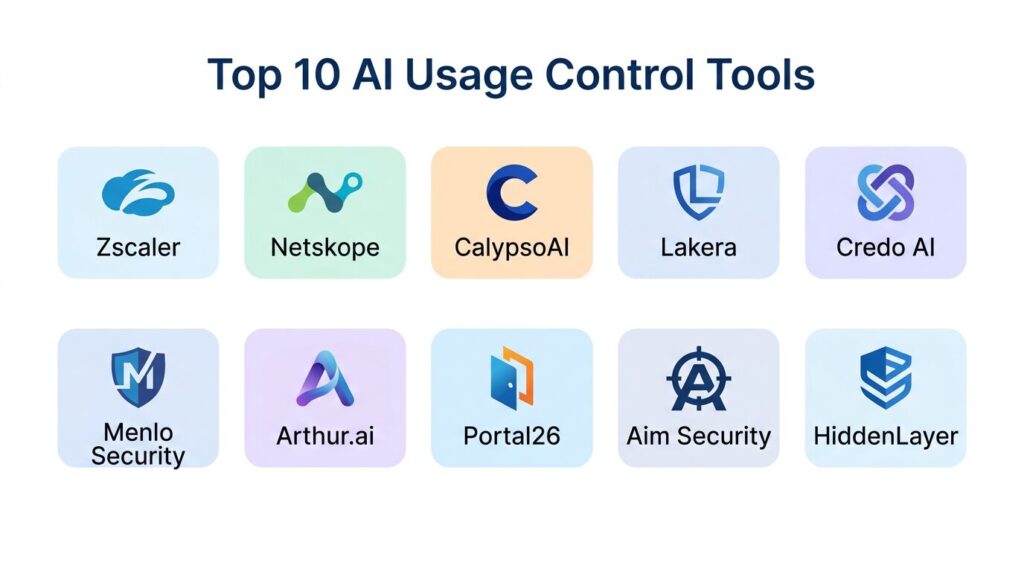
Introduction
AI usage control tools have emerged as a critical governance layer for the modern enterprise, designed to manage, monitor, and restrict how artificial intelligence models are utilized within an organization. As generative AI and large language models become ubiquitous in the workplace, businesses face significant risks ranging from data leakage and intellectual property infringement to non-compliant shadow AI. These tools act as a “secure gateway,” providing visibility into every prompt and response while enforcing corporate policies in real-time. By sitting between the end-user and the AI provider, usage control platforms ensure that proprietary data remains within the corporate perimeter while allowing teams to leverage the productivity gains of automation.
In the current landscape, the necessity of AI usage control is driven by the rapid expansion of regulatory frameworks like the EU AI Act and the increasing sophistication of cyber threats. Organizations can no longer rely on simple “block or allow” mentalities; they require granular controls that can redact personally identifiable information (PII), detect toxic outputs, and manage API costs across multiple vendors. A robust AI control system serves as a centralized policy engine, enabling chief information security officers to define exactly which departments can access specific models and for what purposes. When selecting a platform, leadership must evaluate the latency impact of the proxy, the depth of the automated redaction library, the strength of the audit logging, and the ability to integrate with existing identity providers.
Best for: Security teams, compliance officers, and IT managers in highly regulated industries—such as finance, healthcare, and legal—who need to enable AI adoption while mitigating data privacy and security risks.
Not ideal for: Organizations with zero AI adoption, or individual hobbyists using consumer-grade AI tools without a need for enterprise-level auditing, data masking, or centralized policy enforcement.
Key Trends in AI Usage Control Tools
The integration of real-time PII redaction and “data de-identification” has moved from a niche feature to a core requirement for any AI gateway. Modern tools now utilize their own specialized small language models to identify and mask sensitive information within a prompt before it ever reaches the external AI provider. We are also seeing a significant shift toward “cost-aware routing,” where control tools automatically direct queries to the most cost-effective model that meets the required quality threshold, preventing massive overspending on high-end tokens for simple tasks.
There is a dominant trend toward “Explainable AI Control,” where tools not only block an action but provide a clear, policy-based explanation to the user, fostering a culture of secure AI usage. Collaborative governance is also on the rise, with platforms offering “Human-in-the-Loop” workflows for reviewing flagged prompts that may contain sensitive but necessary context. Furthermore, as organizations move toward multi-model strategies, usage control tools are becoming the centralized “Model Hub” where API keys are managed securely and rotated automatically. Finally, the rise of “Shadow AI Discovery” allows IT teams to identify unauthorized AI browser extensions or unauthorized API calls across the corporate network, bringing hidden risks into the light.
How We Selected These Tools
Our selection process involved a comprehensive analysis of the security architecture and policy flexibility of tools specifically designed for AI governance. We prioritized platforms that operate as a low-latency proxy or an endpoint agent, ensuring that they can intercept and analyze AI traffic in real-time without disrupting user productivity. A primary criterion was the “precision of redaction,” evaluating how effectively the tool identifies sensitive data patterns across different languages and industry-specific terminologies. We looked for systems that provide an “out-of-the-box” policy library aligned with global standards like GDPR, HIPAA, and the EU AI Act.
Scalability was also a major factor; we selected tools that can handle high-frequency API traffic from large-scale enterprise applications without introducing significant lag. We scrutinized the depth of the forensic logging and reporting suites, favoring those that provide detailed “audit trails” for compliance investigations. Security certifications were a non-negotiable requirement, specifically looking for SOC 2 Type II and ISO 27001 alignments to ensure the control tool itself doesn’t become a vulnerability. Finally, we assessed the ease of integration with common Single Sign-On (SSO) providers and Data Loss Prevention (DLP) ecosystems to ensure a seamless fit into the existing corporate security stack.
1. Zscaler AI Visibility and Control
Zscaler is an enterprise security leader that has extended its Zero Trust Exchange to provide comprehensive visibility and granular control over AI application usage. It operates as a cloud-native proxy that monitors and secures all AI traffic across the organization, preventing data exfiltration while enabling safe access to popular generative AI tools.
Key Features
The platform features “AI Application Discovery,” which automatically identifies and categorizes hundreds of AI tools being used across the network. It includes advanced Data Loss Prevention (DLP) engines that can detect and block sensitive data from being uploaded to AI prompts. The system offers granular policy controls, such as allowing access to ChatGPT for research while blocking the ability to paste text or upload files. It features real-time threat protection against malicious AI-generated content. Additionally, it provides a centralized dashboard for monitoring AI usage trends and potential security risks across the entire workforce.
Pros
It integrates seamlessly with the existing Zscaler security ecosystem, requiring no additional agents. The global proxy architecture ensures consistent policy enforcement regardless of the user’s location.
Cons
The platform is primarily an enterprise-level solution and may be overly complex for smaller organizations. It requires an existing Zscaler deployment for maximum efficiency.
Platforms and Deployment
Cloud-native (SaaS) and edge-based proxy. It supports Windows, macOS, Linux, iOS, and Android.
Security and Compliance
Industry-leading security including SOC 2 Type II, ISO 27001, and FedRAMP compliance.
Integrations and Ecosystem
Deeply integrated with major identity providers like Okta and Azure AD, and feeds into various SIEM platforms.
Support and Community
Offers premium enterprise support, a dedicated Customer Success model, and an extensive online technical knowledge base.
2. Netskope SkopeAI
Netskope SkopeAI provides a suite of advanced security capabilities designed to protect sensitive data and defend against AI-driven threats. It focuses on using AI to secure AI, offering deep context-aware data protection and real-time intervention for web and cloud applications.
Key Features
The platform features a specialized “AI App Risk Assessment” that scores the safety and compliance of various AI vendors. It includes real-time PII and PHI redaction that automatically masks sensitive data in prompts. The system offers “Coach” notifications that educate users on secure AI practices when they attempt a risky action. It features high-speed inspection of encrypted traffic to ensure no hidden data leaks occur. It also provides advanced threat protection to detect and block malicious AI-generated code or malware.
Pros
Its context-aware engine is exceptionally good at distinguishing between sensitive corporate data and harmless general information. The user education prompts help improve the organization’s overall security posture.
Cons
As an enterprise-grade SASE (Secure Access Service Edge) provider, the cost can be high for mid-market firms. Initial configuration of complex DLP rules requires specialized expertise.
Platforms and Deployment
Cloud-based SaaS. Supports all major desktop and mobile operating systems via an agent or proxy.
Security and Compliance
Adheres to rigorous standards including GDPR, HIPAA, and SOC 2 Type II certifications.
Integrations and Ecosystem
Integrates with major cloud suites like Microsoft 365 and Google Workspace, as well as endpoint security tools.
Support and Community
Provides 24/7 technical support and a robust community forum for security professionals.
3. CalypsoAI
CalypsoAI is a specialized AI security and enablement platform that focuses specifically on the “AI Proxy” model. It is designed to give organizations the confidence to adopt large language models by providing a rigorous security and monitoring layer between users and the AI.
Key Features
The platform features “Prompt Engineering Guardrails” that prevent users from bypassing security filters through jailbreaking techniques. It includes real-time PII and secret detection, masking credentials and sensitive data before they are sent to the model provider. The system offers custom policy enforcement, allowing different teams to have different levels of access and model capabilities. It features an audit-ready logging system that captures every interaction for forensic review. It also provides a centralized API management hub for secure model access.
Pros
It is one of the few platforms built from the ground up specifically for LLM security rather than being an extension of a general web proxy. The “anti-jailbreak” features are a significant differentiator.
Cons
It is a dedicated tool, meaning it adds another layer to the security stack that must be managed. It may lack some of the broader web security features found in all-in-one SASE providers.
Platforms and Deployment
Cloud-based SaaS or self-hosted (Hybrid) deployment options for maximum data sovereignty.
Security and Compliance
Maintains high standards for data privacy and is designed to meet the requirements of the EU AI Act and GDPR.
Integrations and Ecosystem
Integrates natively with major LLM providers like OpenAI, Anthropic, and Google Vertex AI.
Support and Community
Offers dedicated technical onboarding and support for enterprise security teams.
4. Lakera
Lakera is an AI security platform that focuses on protecting enterprise AI applications from vulnerabilities and usage risks. It provides a real-time protection layer that defends against prompt injections, data leakage, and toxic outputs in AI-driven workflows.
Key Features
The platform features “Lakera Guard,” an ultra-low latency API that scans prompts and responses for a wide range of security threats. It includes a comprehensive database of prompt injection patterns that is updated continuously. The system offers real-time PII detection and redaction to prevent accidental data disclosure. It features a “Toxicity Filter” that ensures AI-generated content adheres to corporate brand safety standards. It also provides detailed analytics on the types of threats intercepted by the security layer.
Pros
The latency is remarkably low, making it ideal for real-time customer-facing AI applications. The focus on prompt injection defense is among the strongest in the market.
Cons
It is primarily a developer-focused tool, meaning it requires technical implementation within the application code. It is less suited for general “employee monitoring” compared to web proxies.
Platforms and Deployment
Available as an API-based service (SaaS) or as a containerized deployment for on-premises environments.
Security and Compliance
Fully GDPR compliant and designed to support organizations in meeting high-security requirements for AI development.
Integrations and Ecosystem
Integrates easily with modern development frameworks and major cloud-based AI service providers.
Support and Community
Provides excellent developer documentation and technical support for integration teams.
5. Credo AI
Credo AI is a leading governance, risk, and compliance (GRC) platform for artificial intelligence. While many tools focus on the technical proxy, Credo AI provides the overarching policy and accountability framework required for enterprise AI usage control.
Key Features
The platform features “Governance Plans” that help organizations define their AI risk tolerance and policy requirements. It includes an “AI Registry” that centralizes all AI models and applications being used across the organization. The system offers automated “Risk Assessments” that evaluate models for bias, fairness, and security vulnerabilities. It features a policy-to-code bridge that helps translate legal requirements into technical guardrails. It also provides comprehensive “Impact Reports” for regulatory compliance and board-level reporting.
Pros
It is the most comprehensive tool for organizations that need to prove “Responsible AI” compliance to regulators. It bridges the gap between legal/compliance teams and technical developers.
Cons
It is a governance and management platform rather than a real-time technical proxy, so it must be paired with other tools for active prompt blocking.
Platforms and Deployment
Cloud-based SaaS.
Security and Compliance
Adheres to the NIST AI Risk Management Framework and is fully aligned with the EU AI Act.
Integrations and Ecosystem
Integrates with technical monitoring tools and various project management systems like Jira.
Support and Community
Offers high-level strategic consulting and a robust library of AI governance resources.
6. Menlo Security (AI Safeguards)
Menlo Security has applied its “Browser Isolation” technology to AI usage control, providing a unique approach where all AI interactions happen in a secure, isolated environment that prevents data from ever reaching the local device.
Key Features
The platform features “Isolated AI Access,” where the browser session is executed in a secure cloud container, preventing malicious code from touching the end-user’s device. It includes real-time “Copy/Paste Control” that can block or redact sensitive data when a user tries to move it into an AI prompt. The system offers deep visibility into all AI interactions with full-text search and forensic logging. It features automated PII identification and masking. It also provides a centralized policy engine for restricting access to specific categories of AI tools.
Pros
The isolation technology provides a “zero-trust” approach to AI that is virtually impossible for malware to bypass. It offers exceptional protection against “Shadow AI” browser extensions.
Cons
The isolated browsing experience can occasionally introduce a slight delay or minor layout issues on some websites. It is most effective when used as part of the broader Menlo Security suite.
Platforms and Deployment
Cloud-based SaaS. Compatible with all modern web browsers.
Security and Compliance
SOC 2 Type II compliant and maintains high standards for data privacy and session isolation.
Integrations and Ecosystem
Integrates with existing DLP solutions and identity management platforms.
Support and Community
Provides 24/7 global support and a dedicated success team for enterprise deployments.
7. Arthur.ai (Arthur Shield)
Arthur is a model monitoring and observability platform that has launched “Arthur Shield,” a specialized usage control layer designed to protect companies from the risks associated with large language models.
Key Features
The platform features real-time “Prompt Filtering” that blocks malicious inputs and prompt injections. It includes “Data Leakage Detection” that identifies sensitive corporate information before it leaves the network. The system offers “Hallucination Detection” to warn users when the AI output may be factually incorrect. It features a “Toxic Content Filter” for both inputs and outputs. It also provides a detailed monitoring dashboard that tracks model performance, cost, and security metrics in a single view.
Pros
The focus on “hallucination detection” is a unique and valuable feature for maintaining data accuracy. It provides deep observability that helps optimize AI usage costs.
Cons
The platform is very technically oriented and may require a data science background to fully utilize its advanced monitoring features.
Platforms and Deployment
Available as a SaaS offering or as a self-hosted solution on private cloud (VPC).
Security and Compliance
Designed for enterprise security standards with a focus on auditability and responsible AI governance.
Integrations and Ecosystem
Integrates with major AI development platforms and model providers through a standard API.
Support and Community
Offers professional technical support and is actively involved in the AI ethics and research community.
8. Portal26
Portal26 is a specialized AI governance and security platform that provides a “Data Privacy Vault” approach to AI usage control. It is designed to help organizations manage the risk of PII and sensitive data exposure in generative AI.
Key Features
The platform features “Prompt Anonymization,” which replaces sensitive data with representative tokens before it reaches the AI model. It includes a “Privacy Vault” that securely maps the anonymous tokens back to the original data for authorized users. The system offers granular usage policies based on user roles and data sensitivity. It features automated “Risk Scoring” for every AI interaction. It also provides comprehensive dashboards for tracking AI spending and compliance across different model providers.
Pros
The tokenization approach is superior for organizations that need to use real data in AI workflows without exposing it to the provider. It offers a very clear view of AI ROI alongside security.
Cons
The tokenization process can add complexity to the initial setup and data mapping phase. It requires careful configuration to ensure the AI still has enough context to be useful.
Platforms and Deployment
Cloud-based SaaS.
Security and Compliance
Focuses on GDPR, HIPAA, and CCPA compliance through its specialized privacy vault technology.
Integrations and Ecosystem
Offers broad compatibility with major LLM APIs and integrates with existing data security tools.
Support and Community
Provides technical onboarding and dedicated support for privacy and security teams.
9. Aim Security
Aim Security is a holistic AI defense platform that provides a comprehensive “AI Gateway” for the secure adoption of generative AI. It is designed to manage the entire lifecycle of AI usage from discovery to active protection.
Key Features
The platform features an “AI Discovery” engine that map all AI tools being used by employees, including “Shadow AI.” It includes a “Security Proxy” that enforces real-time policies on prompts and responses. The system offers “Sensitive Data Redaction” with a high degree of accuracy for various industries. It features “Model Access Management,” allowing IT to control who uses which API keys and models. It also provides detailed “Cost Management” tools to prevent unexpected surges in AI token spending.
Pros
It provides an excellent “all-in-one” solution for organizations that want to manage discovery, security, and cost in a single tool. The user interface is clean and accessible for IT generalists.
Cons
As a newer entrant in the market, the feature set is evolving rapidly and may change over time. It is a dedicated gateway that must be integrated into the network flow.
Platforms and Deployment
Cloud-based SaaS.
Security and Compliance
Aligned with global AI governance standards and maintains high data security protocols.
Integrations and Ecosystem
Integrates with popular collaboration tools like Slack and Teams to monitor AI app integrations.
Support and Community
Offers fast-response support and a growing community of AI security professionals.
10. HiddenLayer
HiddenLayer is a specialized AI security platform that protects the “models themselves” as well as their usage. It provides a unique “MLSecOps” approach to securing the AI infrastructure of an organization.
Key Features
The platform features “Model Detection and Response” (MDR) that identifies attacks on AI models in real-time. It includes “Usage Monitoring” that tracks interactions for signs of intellectual property theft or data scraping. The system offers “Prompt Injection Defense” to protect AI applications from malicious inputs. It features “Vulnerability Scanning” for AI models and their dependencies. It also provides a centralized “Security Operations” dashboard for managing AI risks alongside traditional cyber threats.
Pros
It is the only tool on the list that focuses deeply on “adversarial AI” and the security of the model weights and architecture. It is ideal for organizations developing their own AI products.
Cons
It is highly specialized and may be more than what a typical enterprise needs if they are only “using” external AI rather than building their own models.
Platforms and Deployment
Cloud-based SaaS or private cloud deployment.
Security and Compliance
Designed for high-security environments and follows the latest adversarial AI defense standards.
Integrations and Ecosystem
Integrates with major ML platforms and enterprise security stacks like CrowdStrike and Splunk.
Support and Community
Provides expert-level security consulting and is a leader in the adversarial AI research space.
Comparison Table
| Tool Name | Best For | Platform(s) Supported | Deployment | Standout Feature | Public Rating |
| 1. Zscaler | Full Web / SASE Sec | Win, Mac, Linux, Mob | Proxy / Edge | AI App Discovery | 4.8/5 |
| 2. Netskope | Context-Aware DLP | Win, Mac, Linux, Mob | Cloud SaaS | User Security Coaching | 4.7/5 |
| 3. CalypsoAI | Dedicated LLM Proxy | Web-Based | Cloud/Hybrid | Anti-Jailbreak Defense | 4.6/5 |
| 4. Lakera | Real-time App Sec | API / Container | Cloud/Self-Host | Ultra-Low Latency API | 4.7/5 |
| 5. Credo AI | AI Governance / GRC | Web-Based | Cloud SaaS | EU AI Act Alignment | 4.5/5 |
| 6. Menlo Security | Browser Isolation | All Browsers | Cloud SaaS | Isolated AI Session | 4.6/5 |
| 7. Arthur.ai | Model Observability | Web-Based | Cloud/VPC | Hallucination Detection | 4.4/5 |
| 8. Portal26 | Data Tokenization | Web-Based | Cloud SaaS | Privacy Vault | 4.6/5 |
| 9. Aim Security | Unified Gateway | Web-Based | Cloud SaaS | Integrated Cost Control | 4.5/5 |
| 10. HiddenLayer | MLSecOps / Adversarial | Web-Based | Cloud/VPC | Model MDR | 4.8/5 |
Evaluation & Scoring of AI Usage Control Tools
The scoring below is a comparative model intended to help shortlisting. Each criterion is scored from 1–10, then a weighted total from 0–10 is calculated using the weights listed. These are analyst estimates based on typical fit and common workflow requirements, not public ratings.
Weights:
- Core features – 25%
- Ease of use – 15%
- Integrations & ecosystem – 15%
- Security & compliance – 10%
- Performance & reliability – 10%
- Support & community – 10%
- Price / value – 15%
| Tool Name | Core (25%) | Ease (15%) | Integrations (15%) | Security (10%) | Performance (10%) | Support (10%) | Value (15%) | Weighted Total |
| 1. Zscaler | 9 | 7 | 10 | 10 | 9 | 9 | 8 | 8.85 |
| 2. Netskope | 9 | 8 | 9 | 9 | 9 | 9 | 8 | 8.70 |
| 3. CalypsoAI | 10 | 6 | 8 | 9 | 8 | 8 | 7 | 8.20 |
| 4. Lakera | 8 | 6 | 9 | 9 | 10 | 8 | 9 | 8.25 |
| 5. Credo AI | 7 | 8 | 8 | 8 | 8 | 9 | 8 | 7.75 |
| 6. Menlo Security | 8 | 9 | 8 | 10 | 8 | 8 | 8 | 8.35 |
| 7. Arthur.ai | 8 | 5 | 8 | 8 | 9 | 8 | 7 | 7.60 |
| 8. Portal26 | 9 | 6 | 7 | 9 | 8 | 8 | 8 | 7.85 |
| 9. Aim Security | 8 | 8 | 8 | 8 | 9 | 8 | 9 | 8.20 |
| 10. HiddenLayer | 10 | 4 | 9 | 10 | 9 | 9 | 7 | 8.50 |
How to interpret the scores:
- Use the weighted total to shortlist candidates, then validate with a pilot.
- A lower score can mean specialization, not weakness.
- Security and compliance scores reflect controllability and governance fit, because certifications are often not publicly stated.
- Actual outcomes vary with assembly size, team skills, templates, and process maturity.
Which AI Usage Control Tool Is Right for You?
Solo / Founder-Led
For independent developers or small startups, the primary goal is often application security without the overhead of enterprise SASE. A tool that provides an easy-to-integrate API with low latency is the most efficient choice, ensuring that your AI features are protected from prompt injection and data leaks from day one.
Small Nonprofit
Organizations with a small staff should prioritize ease of use and automated PII redaction. You need a solution that works within the browser to ensure volunteers and staff aren’t accidentally putting sensitive donor or beneficiary data into public AI models, without needing a dedicated IT security team to manage it.
Mid-Market
Mid-sized organizations need to balance employee productivity with risk management. A dedicated AI gateway that provides both security and cost management is the ideal middle ground, allowing you to monitor AI spending while ensuring compliance with emerging data privacy regulations.
Enterprise
For large, global organizations, AI usage control should be an extension of the broader Zero Trust architecture. Integrating AI security with existing SASE and DLP providers ensures consistent policy enforcement across thousands of users and multiple geographical regions, while providing the forensic logging required for international compliance.
Budget vs Premium
If budget is the primary concern, start with basic AI control features already built into your existing web security suite. Premium, specialized tools are worth the investment when you require advanced features like adversarial defense, hallucination detection, or specialized tokenization for highly sensitive medical or financial data.
Feature Depth vs Ease of Use
Highly specialized “MLSecOps” tools offer the deepest protection but require expert staff to manage. For most organizations, a tool that provides “out-of-the-box” policies for the most common LLMs will provide a much higher return on investment and a faster time-to-deployment.
Integrations & Scalability
Your AI control tool must integrate with your identity provider to enforce role-based access. As your AI adoption scales, the ability to monitor multiple model providers and aggregate costs in a single view will become just as important as the security features themselves.
Security & Compliance Needs
Organizations in the EU or those handling data for European citizens must prioritize tools that are explicitly designed for the EU AI Act. Ensure the provider has a clear roadmap for compliance and can provide the necessary documentation for your organization’s own regulatory filings.
Frequently Asked Questions (FAQs)
1. What is an AI usage control tool?
An AI usage control tool is a security platform that monitors and regulates how employees or applications interact with artificial intelligence models. It typically sits as a proxy between the user and the AI, enforcing policies on data privacy, security, and usage limits.
2. How do these tools prevent data leaks?
They use real-time scanning engines to identify sensitive data patterns like credit card numbers, social security numbers, or API keys. When detected, the tool can either block the prompt or “redact” the information by replacing it with generic tokens before it reaches the AI.
3. What is prompt injection and can these tools stop it?
Prompt injection is a technique where a user tries to trick an AI into ignoring its safety rules. Specialized usage control tools have specific filters designed to detect these malicious patterns and block the interaction before the model is compromised.
4. Can these tools help me manage AI costs?
Yes, many modern AI gateways provide centralized cost tracking across multiple model providers. They can enforce “budgets” at the user or department level and can even route prompts to cheaper models when high-end capabilities aren’t required.
5. Do I need to install software on every employee’s computer?
It depends on the tool. Some use an “agentless” cloud proxy or browser isolation, while others require a lightweight agent to be installed on the device for more granular control over all applications.
6. Will these tools slow down my AI prompts?
While adding a security layer introduces some latency, most leading tools are designed to have a minimal impact, often adding less than 100 milliseconds to the interaction—a delay that is usually imperceptible to the end-user.
7. Can these tools block “Shadow AI”?
Yes, tools with discovery features can monitor network traffic to identify unauthorized AI browser extensions or API calls to known AI domains, allowing IT to bring these hidden tools under formal corporate governance.
8. Is “hallucination detection” a standard feature?
No, it is currently a specialized feature found in more advanced observability platforms. It works by cross-referencing the AI’s output with trusted data sources or by using other models to verify the factual accuracy of the response.
9. Can I use these tools for my own custom-built AI apps?
Yes, many providers offer an API-based version of their security layer that developers can integrate directly into their own applications to protect them from user misuse or adversarial attacks.
10. How do these tools help with the EU AI Act?
They provide the logging, monitoring, and data governance features required to meet the “high-risk” AI requirements of the act. This includes maintaining audit trails, ensuring data quality, and preventing the generation of prohibited content.
Conclusion
In the modern enterprise, AI usage control has transitioned from an optional security measure to a fundamental requirement for operational integrity. As artificial intelligence becomes deeply integrated into every facet of business, the ability to govern its usage, protect proprietary data, and manage costs is the primary differentiator between successful adoption and catastrophic risk. By implementing a robust control layer, organizations can empower their teams to innovate with confidence, knowing that the structural guardrails are in place to prevent non-compliance and data exposure. The ideal strategy involves selecting a platform that balances deep technical security with the operational speed required to maintain a competitive edge in the AI-driven economy.
I find that this breakdown of the Top 10 AI Usage Control Tools serves as a vital survival guide for any organization trying to balance the competitive edge of Generative AI with the absolute necessity of data sovereignty. From my perspective as a Chief Information Security Officer (CISO), I learned that the era of simply blocking AI is over; we now need “secure gateways” like Zscaler or CalypsoAI that can redact PII in real-time and provide deep visibility into every prompt and response.
In my professional experience, the real-world challenge isn’t just stopping data leaks, but managing “Shadow AI”—those unauthorized browser extensions and API calls that bypass traditional firewalls. This blog helped me realize that a modern control layer does more than just secure data; it optimizes costs through “smart routing” and educates our workforce in real-time. For other organizations, these tools will provide the governance framework required to comply with strict regulations like the EU AI Act without killing productivity. My advice for anyone studying this list is to prioritize tools that offer a “Human-in-the-Loop” workflow—sometimes the most sensitive prompts are also the most necessary, and having a path for secure review is the only way to enable true innovation.