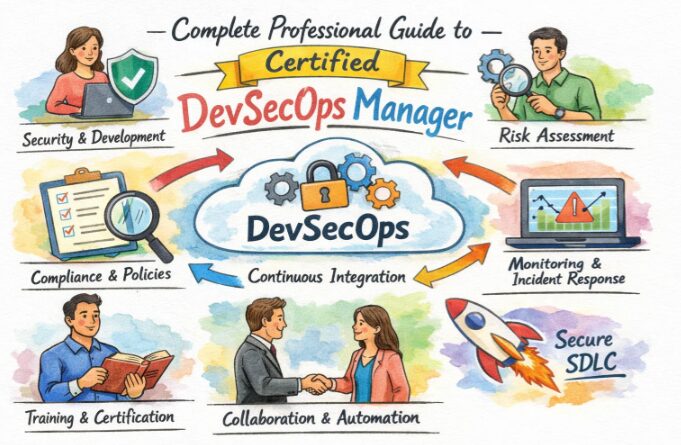
Security is no longer a “final check” at the end of a release cycle. In my years of navigating complex enterprise environments, I have seen far too many projects stall because security was treated as an afterthought. Today, the role of a manager has shifted. You are not just managing people or timelines; you are managing the risk, the culture, and the automated guardrails that keep a company safe.
This guide focuses on the Certified DevSecOps Manager credential, a strategic path for those who want to lead high-performing teams in a world where “move fast and break things” has been replaced by “move fast and stay secure.”
Mastering the Modern Ecosystem: Top Certifications
Choosing the right certification is about more than just a badge; it is about finding a curriculum that matches your career trajectory. Whether you are a developer looking to move into leadership or a manager wanting to understand the technical depth of security automation, here is a breakdown of the current landscape.
| Track | Level | Who it’s for | Prerequisites | Skills Covered | Recommended Order |
| DevSecOps | Manager | Managers, Leads, Architects | DevOps basics, security awareness | Governance, Risk, Tooling, Culture | After DevOps Professional |
| SRE | Professional | SREs, Reliability Leads | Cloud & System Admin experience | SLOs, Incident Mgmt, Resilience | Parallel to DevSecOps |
| Observability | Master | Senior Engineers, Managers | Basic Scripting, DevOps flow | Telemetry, OpenTelemetry, SLOs | After SRE/DevOps |
| AIOps/MLOps | Professional | Data & DevOps Engineers | ML basics, DevOps concepts | ML Pipelines, Model Security | After Core DevOps |
| DataOps | Professional | Data Engineers, Architects | SQL, ETL, DevOps concepts | Data Quality, Pipeline Security | Parallel to AIOps |
| FinOps | Practitioner | Cloud & Finance Teams | Cloud fundamentals | Cost Mgmt, Governance | After Cloud/DevOps |
Certified DevSecOps Manager: Deep Dive
What it is
The Certified DevSecOps Manager program is a strategic leadership certification. It is designed to bridge the gap between technical security automation and high-level business governance. Instead of focusing only on “how to scan code,” this program teaches you “how to build a culture where code is scanned automatically” and how to report those risks to stakeholders.
Who should take it
- Engineering Managers who need to oversee secure delivery.
- Team Leads and Architects designing modern CI/CD pipelines.
- Security Program Managers transitioning from traditional security to Agile workflows.
- CTOs and CISOs looking for a framework to scale security across multiple product lines.
Skills you’ll gain
This program moves you from a tactical contributor to a strategic leader. You will learn to manage the “Three Pillars” of DevSecOps: People, Process, and Technology.
- Governance & Compliance: Mapping automated checks to frameworks like ISO 27001, SOC 2, and GDPR.
- Risk Management: Implementing threat modeling at scale and making risk-based decisions on tool selection.
- Culture Engineering: Strategies to overcome resistance between Dev and Security teams.
- Metrics & KPIs: Measuring the success of security programs (e.g., Mean Time to Remediate, Vulnerability Density).
Real-world projects you should be able to do
After completing this certification, you won’t just know the theory. You will be able to lead tangible organizational changes.
- Design a DevSecOps Roadmap: Creating a 12-month transformation plan with clear milestones for your organization.
- Toolchain Orchestration: Evaluating and selecting SAST, DAST, and SCA tools that fit your team’s specific stack.
- Policy-as-Code Implementation: Rolling out automated guardrails that prevent non-compliant code from ever reaching production.
Preparation plan
- 7–14 Days: Focus on the core vocabulary. Understand the difference between Shift-Left and Shift-Right. Review the official curriculum and focus on the DevSecOps lifecycle.
- 30 Days: Read case studies on organizational change. Start mapping your current company’s workflow to a DevSecOps maturity model.
- 60 Days: Engage in hands-on labs for tool integration. Practice building a mock “Security Dashboard” for executives to simulate reporting.
Common mistakes
In my experience, even the most seasoned managers trip over these common hurdles:
- Tool-First Thinking: Buying expensive security software before fixing the communication gap between teams. Tools don’t fix broken cultures.
- Alert Fatigue: Turning on every security scan at once and drowning developers in “Critical” alerts that are actually false positives.
- Ignoring the “Ops” in DevSecOps: Focusing so much on the code that you forget to secure the runtime environment and the cloud infrastructure.
Best next certification after this
Once you have mastered the management of DevSecOps, the most logical progression is toward Master in Observability Engineering. Understanding security is vital, but being able to “see” into your system’s health in real-time is how you maintain long-term reliability.
Choose Your Path: 6 Learning Paths
- DevOps Path: Focuses on the speed of delivery. This is for those who want to master automation and CI/CD.
- DevSecOps Path: The guardian’s path. Focuses on integrating security into every heartbeat of the development cycle.
- SRE Path: The reliability path. Focuses on SLOs, error budgets, and ensuring the system stays up under pressure.
- AIOps/MLOps Path: The future-ready path. Focuses on using machine learning to automate operations and managing ML lifecycles.
- DataOps Path: The data-integrity path. Focuses on the flow and quality of data through automated pipelines.
- FinOps Path: The efficiency path. Focuses on cloud cost optimization and financial accountability in engineering.
Role → Recommended Certifications
- DevOps Engineer: Certified DevOps Professional
- SRE: SRE Professional
- Platform Engineer: Certified DevSecOps Engineer
- Cloud Engineer: Cloud Architect Professional
- Security Engineer: Certified DevSecOps Manager
- Data Engineer: DataOps Professional
- FinOps Practitioner: FinOps Certified Professional
- Engineering Manager: Certified DevSecOps Manager, Master in Observability Engineering
Next Certifications to Take
- Same Track: Certified DevSecOps Engineer (to deepen technical tool knowledge).
- Cross-Track: SRE Professional (to balance security with system reliability).
- Leadership: Master in Observability Engineering (to oversee the full operational lifecycle).
Top Training and Certification Providers
DevOpsSchool
This institution is widely recognized for its deep technical labs and expert-led sessions. They focus heavily on real-world scenarios, making them a top choice for those who want practical knowledge over just passing an exam.
Cotocus
Known for its specialized consulting-led training approach, Cotocus helps professionals understand how to apply DevSecOps in massive enterprise environments. Their curriculum is updated frequently to reflect current market trends.
Scmgalaxy
A community-driven platform that provides extensive resources, documentation, and training on Source Code Management and DevOps toolchains. They are excellent for those looking to master the technical details of the pipeline.
BestDevOps
This provider offers a streamlined learning experience focused on the most in-demand tools and methodologies. Their training is highly structured and great for busy professionals.
This platform focuses exclusively on security-driven engineering. They provide the official curriculum and specialized certifications for the DevSecOps Manager role.
sreschool
An essential provider for those looking to master Site Reliability Engineering. Their programs are highly complementary to DevSecOps management.
aiopsschool
Specializes in the intersection of AI and Operations. This is the go-to place for managers looking to lead the next generation of automated systems.
dataopsschool
Focuses on the security and efficiency of data pipelines. Their training helps managers handle complex data environments securely.
finopsschool
The primary destination for cloud financial management. They provide the framework for managers to control cloud costs without sacrificing speed or security.
FAQs on Certified DevSecOps Manager
1. Is this certification difficult for non-technical managers?
While you don’t need to be a core developer, you must understand the logic of a CI/CD pipeline. The exam focuses more on strategy and governance than on writing code.
2. How long does it typically take to get certified?
Most working professionals complete the preparation in 30 to 60 days, depending on their existing familiarity with DevOps.
3. What are the prerequisites?
A basic understanding of DevOps and cloud environments is recommended. Having 3+ years of IT experience is helpful but not a hard block.
4. What is the recommended sequence of certifications?
It is best to start with a DevOps foundation, move into DevSecOps Manager, and then pursue Observability for a complete management stack.
5. What is the value of this certification in the market?
With cyber threats increasing, companies are desperate for managers who can lead secure teams. It significantly boosts your leadership profile.
6. Does it cover cloud security?
Yes, it covers securing cloud-native applications and the shared responsibility model.
7. How does this help career outcomes?
It opens doors to roles like DevSecOps Lead, Engineering Manager, and strategic leadership positions in top-tier tech firms.
8. Can I take the exam online?
Yes, the certification is globally accessible through proctored online examination platforms.
9. Is the training hands-on or purely theoretical?
The training provided by partners like DevOpsSchool and Cotocus includes extensive hands-on labs. This ensures you aren’t just memorizing definitions but actually seeing how a secure pipeline is constructed and managed.
10. How do I start the preparation if I am very busy?
I recommend the “30-Day Plan.” Spend one hour a day on the theoretical concepts during the week and use a few hours on the weekend for hands-on labs. This consistent pace prevents burnout while ensuring steady progress.
11. Is this certification recognized by major tech companies?
Yes, the curriculum is aligned with industry standards and the skills taught are those currently in high demand by top-tier tech firms and global enterprises looking to scale their security operations.
12. What is the best sequence for my learning?
Ideally, you should have a foundational knowledge of DevOps. Once you have that, the Certified DevSecOps Manager is the perfect way to specialize in security leadership before moving into high-level tracks like Observability or AIOps.
Additional FAQs on Certified DevSecOps Manager
1. How does this differ from traditional security certifications?
Traditional security often happens after development. This certification focuses on integrating security “inside” the development process.
2. What skills will I gain for the modern era?
You will gain the ability to automate security scans, manage team culture shifts, and report security risks as business risks.
3. Is there a focus on specific tools?
The course focuses on the framework of selecting tools like SAST, DAST, and SCA rather than being tied to a single vendor.
4. How does it improve team productivity?
By teaching you how to reduce false positives and automate guardrails, it helps your team move faster without manual security bottlenecks.
5. Is the training hands-on?
Yes, the recommended providers use lab-based learning to ensure you can apply the management principles to real pipelines.
6. Who is the target audience for this guide?
This is specifically for working engineers looking to move into management and current managers wanting to specialize in security.
7. Does it address compliance?
Yes, it includes how to automate compliance checks for frameworks like SOC2 and ISO.
8. Why is it important for managers now?
Because security is no longer a separate department; it is a core feature of the software development lifecycle that every manager must own.
Conclusion
Navigating the transition to a DevSecOps model is one of the most challenging but rewarding moves a manager can make. It requires a shift in mindset—from being a gatekeeper who says “no” to being an enabler who says “here is how we do this safely.” By pursuing the Certified DevSecOps Manager credential, you are committing to a future where speed and security live in harmony. The industry is moving fast, and the demand for leaders who can bridge the gap between development and security is only going to grow. This path not only secures your applications but also secures your career in the modern engineering landscape, providing you with the tools to lead with confidence and the knowledge to drive real organizational change.