Introduction
Asset Liability Management (ALM) software is a specialized suite of financial tools designed to help banking institutions, corporate treasuries, and insurance firms manage the risks arising from mismatches between assets and liabilities. In the complex financial landscape of 2026, these platforms are critical for navigating interest rate volatility, liquidity constraints, and foreign exchange fluctuations. By utilizing sophisticated stochastic modeling and deterministic forecasting, ALM tools allow treasury departments to simulate various economic scenarios and ensure that the organization remains solvent and profitable under stress. This software acts as the “nervous system” of financial risk management, providing a unified view of the balance sheet.
The strategic importance of ALM software lies in its ability to transform raw financial data into actionable intelligence for the board and regulatory bodies. Modern treasury departments use these tools to ensure compliance with global standards like Basel III and IV, while simultaneously optimizing the Net Interest Margin (NIM). As markets become more interconnected, the speed and accuracy of risk calculation have become competitive advantages. When evaluating an ALM partner, decision-makers must prioritize calculation performance, the depth of the instrument library, and the ability to integrate with core banking or ERP systems. A robust ALM solution ensures that liquidity is maintained and interest rate risk is hedged effectively.
Best for: Commercial banks, credit unions, large corporate treasuries, insurance companies, and investment firms that manage complex balance sheets with diverse interest-rate-sensitive instruments.
Not ideal for: Small businesses with simple cash-flow needs or retail investors. If an organization does not hold significant debt or interest-earning assets that require sophisticated risk modeling, standard accounting software is usually sufficient.
Key Trends in Treasury ALM Software
The adoption of artificial intelligence and machine learning is the most significant shift in ALM, with algorithms now providing predictive insights into depositor behavior and loan prepayment speeds. There is a massive trend toward real-time liquidity monitoring, moving away from traditional month-end reporting to a continuous, live view of the “Liquidity Coverage Ratio.” Regulatory pressure has led to the integration of climate-related financial risk modeling, where firms must now simulate how environmental shifts might impact the long-term value of their portfolios.
Cloud-native deployments have become the standard, offering the massive compute power required for Monte Carlo simulations without the need for expensive on-site server farms. Interoperability has also reached a new level, with modern ALM tools using APIs to pull data directly from various trading desks and core banking platforms. Furthermore, there is an increased focus on “Integrated Balance Sheet Management,” where ALM, funds transfer pricing, and capital management are all handled within a single, unified analytical engine to prevent data siloing.
How We Selected These Tools
The selection of these top ten ALM platforms involved a rigorous analysis of their analytical depth and regulatory compliance capabilities. We prioritized vendors that demonstrate a strong track record in meeting stringent global banking standards, as reliability is the most critical factor in risk management. Market presence and “mindshare” among Chief Risk Officers were key signals, as established tools typically offer more comprehensive documentation and a wider network of specialized consultants.
Technical performance was evaluated based on the software’s ability to process large datasets and run complex stress tests in a reasonable timeframe. We also examined the flexibility of the reporting engines, ensuring that they can produce both high-level executive summaries and detailed regulatory filings. Security was a top priority; we selected platforms that offer robust encryption, multi-factor authentication, and clear audit trails for all data modifications. Finally, we assessed the user interface, looking for tools that translate complex mathematical models into clear, visual dashboards.
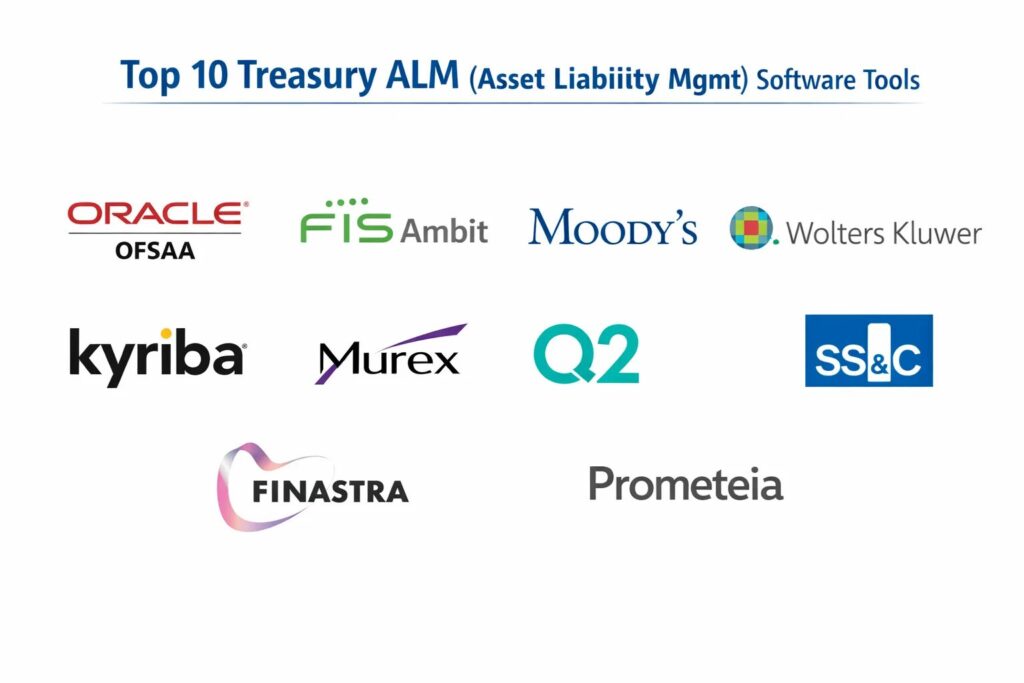
1. Oracle Modern Risk and Analytical Applications (OFSAA)
Oracle’s ALM solution is widely regarded as the global benchmark for large-scale financial institutions. It provides a comprehensive framework for interest rate risk, liquidity risk, and balance sheet forecasting. The platform is built on a unified data architecture, ensuring that the information used for ALM is consistent with that used for financial reporting and regulatory compliance.
Key Features
The platform features an advanced cash flow engine that handles millions of records with high precision. It provides comprehensive support for both deterministic and stochastic modeling of interest rate risk. The system includes built-in templates for Basel reporting and other global regulatory requirements. It offers a sophisticated funds transfer pricing module to help banks understand the profitability of different business units. Additionally, its simulation engine allows for “what-if” analysis across hundreds of different economic variables simultaneously.
Pros
Unmatched scalability makes it suitable for the world’s largest and most complex banks. The deep integration with other Oracle financial products creates a seamless end-to-end data pipeline.
Cons
The software is notoriously complex and usually requires a dedicated team of specialists for implementation and maintenance. The total cost of ownership is among the highest in the market.
Platforms and Deployment
Cloud, On-premise, and Hybrid deployments are supported.
Security and Compliance
Features enterprise-grade security with full RBAC, data masking, and multi-layered encryption. It is compliant with all major global financial regulations.
Integrations and Ecosystem
Integrates natively with Oracle’s ERP and Core Banking suites, with robust APIs for connecting to external market data providers.
Support and Community
Offers global 24/7 premium support and access to a vast network of certified implementation partners and user groups.
2. FIS Ambit Focus
FIS Ambit Focus is a leading ALM and liquidity risk management solution specifically designed for the banking sector. It focuses on providing a single platform that covers everything from interest rate risk in the banking book (IRRBB) to regulatory reporting, making it a favorite for mid-sized and large banks.
Key Features
The software features a powerful “Ready-to-Use” regulatory reporting engine that stays updated with the latest changes from central banks. It provides high-speed simulation capabilities for stress testing and scenario analysis. The system includes an integrated liquidity management module for tracking the LCR and NSFR. It offers a intuitive dashboard for visualizing maturity gaps and repricing risks. The platform also includes a robust hedge accounting module to help firms manage the impact of derivatives on their balance sheet.
Pros
It is known for its relatively faster implementation times compared to other enterprise-level suites. The reporting engine is highly regarded for its clarity and accuracy in meeting regulatory demands.
Cons
Some users find the interface less modern than newer cloud-native competitors. Customizing highly non-standard financial instruments can occasionally be challenging.
Platforms and Deployment
Available as a Cloud-based solution or as a traditional local installation.
Security and Compliance
Maintains high-security standards with detailed audit logs and secure data storage protocols.
Integrations and Ecosystem
Strong connectivity with the broader FIS fintech ecosystem and major core banking providers.
Support and Community
Comprehensive global support with a strong presence in European and North American banking markets.
3. Moody’s Analytics ALM
Moody’s Analytics provides a highly sophisticated ALM platform that leverages their world-class economic research and data. It is particularly strong in credit risk integration and stochastic modeling, making it a preferred choice for institutions that require deep analytical rigor.
Key Features
The platform features integrated economic scenarios provided directly by Moody’s researchers. It provides a unified view of credit, market, and liquidity risk within a single analytical engine. The software includes advanced tools for modeling non-maturity deposits and loan prepayments. It offers highly granular reporting capabilities that can be customized for different stakeholder groups. The system also includes a robust capital management module to ensure the bank maintains optimal capital ratios.
Pros
The access to Moody’s proprietary economic data and credit research provides a unique advantage for risk modeling. The platform is exceptionally strong in stress testing and long-term strategic planning.
Cons
The high level of analytical sophistication requires a team with strong quantitative backgrounds to fully utilize the tool. The pricing is premium, reflecting its position as a high-end analytical suite.
Platforms and Deployment
Primarily Cloud-based with options for private cloud configurations.
Security and Compliance
Top-tier data security with SOC 2 compliance and advanced encryption for sensitive financial data.
Integrations and Ecosystem
Integrates with a wide range of market data feeds and internal risk management systems via a robust API.
Support and Community
Offers expert-level support and specialized training through the Moody’s Analytics network.
4. Wolters Kluwer OneSumX
OneSumX is a modular financial risk management suite that covers ALM, liquidity risk, and market risk. It is designed to help financial institutions navigate the ever-changing regulatory landscape while maintaining a clear view of their balance sheet health.
Key Features
The platform features a “Regulatory Update Service” that automatically incorporates new rules into the reporting engine. It provides a centralized data repository that ensures consistency across all risk and finance functions. The software includes powerful gap analysis tools for both interest rate and liquidity risks. It offers sophisticated scenario-based forecasting for net interest income. The platform also supports the calculation of sophisticated risk metrics like Value at Risk (VaR) and Economic Value of Equity (EVE).
Pros
The automatic regulatory updates significantly reduce the manual burden on compliance teams. Its modular design allows institutions to start with basic ALM and add more modules as they grow.
Cons
Integrating the software into older, legacy core banking systems can be a time-consuming process. The user interface can feel data-heavy for non-technical executives.
Platforms and Deployment
Cloud and On-premise deployment options.
Security and Compliance
Standard-setting security protocols with extensive audit trails and secure multi-tenant cloud options.
Integrations and Ecosystem
Excellent integration with major accounting and financial systems, with a focus on data consistency across departments.
Support and Community
Global professional services and a dedicated support team with deep knowledge of local regulatory requirements.
5. SS&C Algorithmics
Algorithmics is a high-performance risk management solution that excels in market risk and balance sheet analytics. It is particularly popular among large banks and investment firms that need to manage complex portfolios of derivatives and structured products.
Key Features
The platform features a high-speed vector-based calculation engine for rapid stress testing. It provides integrated management of market, credit, and liquidity risk. The software includes a sophisticated scenario generation engine that can model extreme market events. It offers a comprehensive library of financial instruments, including complex derivatives. The system also features a real-time risk dashboard that allows treasury managers to monitor exposures as they happen.
Pros
Its calculation speed is among the fastest in the industry, making it ideal for high-frequency risk monitoring. The depth of its instrument library is a major advantage for sophisticated trading desks.
Cons
The platform’s high level of technicality may be overkill for smaller banks with simpler balance sheets. It requires a significant investment in both licensing and specialized hardware or cloud compute.
Platforms and Deployment
Cloud-native and Hybrid architectures.
Security and Compliance
Enterprise-grade security with advanced encryption and robust access control mechanisms.
Integrations and Ecosystem
Deeply integrated with the SS&C financial ecosystem and major market data providers.
Support and Community
Offers high-touch professional support and a community focused on advanced quantitative risk management.
6. Kyriba
Kyriba is a cloud-native treasury management system that has expanded significantly into ALM and liquidity forecasting. It is the leading choice for corporate treasuries and mid-market banks that want a streamlined, modern experience.
Key Features
The platform features an automated cash-positioning tool that pulls data from thousands of bank connections globally. It provides intuitive liquidity forecasting tools with built-in variance analysis. The software includes a dedicated module for managing interest rate and foreign exchange risk. It offers a sleek, modern dashboard that provides a real-time view of global liquidity. The system also includes an integrated “FinOps” module to help optimize bank fees and transaction costs.
Pros
The user interface is widely considered the best in the market, making it accessible to both treasurers and CFOs. The cloud-native design ensures rapid deployment and automatic updates.
Cons
While excellent for liquidity, its analytical depth for complex stochastic “banking book” modeling is not as deep as Oracle or Moody’s. It is more focused on corporate treasury than complex regulatory banking.
Platforms and Deployment
100% Cloud-based (SaaS).
Security and Compliance
SOC 2 and ISO 27001 certified, with robust multi-factor authentication and data encryption.
Integrations and Ecosystem
Features a massive library of pre-built connections to over 1,000 banks and major ERP systems like SAP and Oracle.
Support and Community
Provides 24/7 global support and an active “Kyriba Academy” for user training.
7. Murex MX.3
Murex is a powerhouse in the trading and risk management space, and its MX.3 platform offers a highly integrated ALM module. It is designed for large institutions that want to unite their front-office trading with their back-office risk and ALM functions.
Key Features
The platform features a unified cross-asset data model that eliminates the need for data reconciliation between departments. It provides powerful real-time Greeks and risk sensitivities for the banking book. The software includes a comprehensive stress-testing framework that meets all major global standards. It offers a sophisticated funds transfer pricing engine that is tightly integrated with the trading desk. The system also supports high-volume transaction processing for global operations.
Pros
Eliminating the silos between the trading floor and the treasury department provides a level of data accuracy that is hard to match. It is highly extensible and can be tailored to the most unique business models.
Cons
The complexity and cost of a Murex implementation are significant. It is generally only feasible for large, tier-one financial institutions.
Platforms and Deployment
Cloud-enabled with support for private and public cloud environments.
Security and Compliance
Meets the highest global security standards for financial data and transactional integrity.
Integrations and Ecosystem
Designed to be the central platform for all capital markets and treasury activities, with deep API support.
Support and Community
Offers high-level consulting and support services with a global network of specialized technical partners.
8. Q2 (formerly PrecisionLender)
Q2 provides an ALM and pricing solution that is uniquely focused on the “relationship” side of banking. It helps banks understand the risk and profitability of individual loans and deposits at the point of sale.
Key Features
The platform features a real-time deal coaching tool that helps lenders price loans based on the bank’s current ALM strategy. It provides a clear view of how a new deal will impact the bank’s overall interest rate risk and capital ratios. The software includes a sophisticated profitability modeling engine that accounts for risk-adjusted return on capital (RAROC). It offers a intuitive dashboard for bank executives to monitor the health of the commercial portfolio. The system also integrates liquidity costs directly into the pricing model.
Pros
It is the only tool that effectively bridges the gap between ALM strategy and the actual behavior of lenders on the front line. It helps banks improve their Net Interest Margin through better pricing discipline.
Cons
It is not a full-scale regulatory ALM reporting tool; it is designed to be used alongside a system like FIS or Oracle. Its focus is more on strategic pricing than technical stress testing.
Platforms and Deployment
Cloud-based SaaS.
Security and Compliance
Maintains high standards for banking data security and is compliant with major US and European banking regulations.
Integrations and Ecosystem
Integrates with all major CRM and core banking platforms to pull deal data in real-time.
Support and Community
Offers excellent training for lenders and a community focused on strategic bank growth.
9. Finastra Fusion Risk
Finastra’s Fusion Risk is a modern, modular solution for ALM, liquidity, and regulatory reporting. It is designed for banks that want to move away from legacy systems toward a more agile, data-driven risk management approach.
Key Features
The platform features an “Insights” engine that uses advanced data visualization to explain complex risk trends. It provides a unified calculation engine for both IRRBB and LCR/NSFR. The software includes a powerful automated data-validation layer to ensure reporting accuracy. It offers a flexible scenario-builder for multi-period balance sheet forecasting. The system also supports the management of collateral and pledged assets within the ALM framework.
Pros
The modular approach allows banks to replace legacy parts of their risk stack incrementally. The platform is known for its excellent reporting visuals that make risk data easy for the board to understand.
Cons
As a result of Finastra’s large product range, navigating the different support channels for various modules can sometimes be complex. Implementation requires careful data mapping from core systems.
Platforms and Deployment
Cloud-native (Azure) and On-premise.
Security and Compliance
Fully compliant with global banking standards and features advanced multi-tenant cloud security.
Integrations and Ecosystem
Part of the FusionFabric.cloud ecosystem, allowing for easy integration with various fintech apps.
Support and Community
Global support network with specialized regional teams for local regulatory expertise.
10. Prometeia ERMAS
Prometeia is a highly respected European-based vendor that offers ERMAS, a specialized ALM and risk management suite. It is widely used by banks that require high-precision modeling for complex regulatory environments like the Eurozone.
Key Features
The platform features a state-of-the-art behavioral modeling engine for non-maturity deposits and prepayments. It provides an integrated framework for ALM, FTP, and IFRS 9 impairment. The software includes a detailed liquidity risk module that handles both tactical and structural liquidity. It offers a sophisticated stochastic engine for modeling market and interest rate volatility. The system also provides a “Strategic Planning” module that aligns risk management with the bank’s business goals.
Pros
The depth of their behavioral modeling is considered some of the best in the industry. It is highly localized for the specific needs of European regulatory frameworks.
Cons
It has a smaller market presence in North America compared to competitors like Oracle or FIS. The technical complexity requires a high level of user expertise.
Platforms and Deployment
Available as a Cloud or On-premise solution.
Security and Compliance
Adheres to the strictest European financial security and data privacy standards.
Integrations and Ecosystem
Strong APIs for connecting to a wide range of core banking and data providers.
Support and Community
Provides high-touch consulting and support, particularly strong in the EMEA region.
Comparison Table
| Tool Name | Best For | Platform(s) Supported | Deployment | Standout Feature | Public Rating |
| 1. Oracle OFSAA | Tier 1 Global Banks | Win, Linux, Cloud | Hybrid | Unified Data Model | 4.8/5 |
| 2. FIS Ambit Focus | Mid-to-Large Banks | Win, Cloud | Hybrid | Regulatory Reporting | 4.6/5 |
| 3. Moody’s ALM | Deep Risk Analytics | Cloud | Cloud | Proprietary Econ Data | 4.7/5 |
| 4. Wolters Kluwer | Regulatory Compliance | Win, Cloud | Hybrid | Auto-Reg Updates | 4.5/5 |
| 5. SS&C Algorithmics | Market Risk/Trading | Win, Linux, Cloud | Cloud | Vector Calculation | 4.6/5 |
| 6. Kyriba | Corporate Treasury | Web, API | SaaS | Global Bank Connect | 4.8/5 |
| 7. Murex MX.3 | Integrated Markets | Linux, Cloud | Hybrid | Cross-Asset Unity | 4.7/5 |
| 8. Q2 | Strategic Pricing | Web, API | SaaS | Deal Coaching | 4.4/5 |
| 9. Finastra Fusion | Agile Risk Mgmt | Web, Cloud | Cloud | Visual Insights | 4.3/5 |
| 10. Prometeia ERMAS | Behavioral Modeling | Win, Linux | Hybrid | Deposit Modeling | 4.5/5 |
Evaluation & Scoring of Treasury ALM Software
The scoring below is a comparative model intended to help shortlisting. Each criterion is scored from 1–10, then a weighted total from 0–10 is calculated using the weights listed. These are analyst estimates based on typical fit and common workflow requirements, not public ratings.
Weights:
- Core features – 25%
- Ease of use – 15%
- Integrations & ecosystem – 15%
- Security & compliance – 10%
- Performance & reliability – 10%
- Support & community – 10%
- Price / value – 15%
| Tool Name | Core (25%) | Ease (15%) | Integrations (15%) | Security (10%) | Performance (10%) | Support (10%) | Value (15%) | Weighted Total |
| 1. Oracle OFSAA | 10 | 4 | 10 | 10 | 9 | 10 | 6 | 8.55 |
| 2. FIS Ambit | 9 | 7 | 8 | 9 | 8 | 9 | 7 | 8.15 |
| 3. Moody’s | 10 | 6 | 9 | 9 | 9 | 9 | 7 | 8.65 |
| 4. Wolters Kluwer | 9 | 7 | 8 | 9 | 8 | 9 | 8 | 8.30 |
| 5. SS&C | 10 | 5 | 8 | 9 | 10 | 9 | 7 | 8.40 |
| 6. Kyriba | 7 | 10 | 10 | 9 | 8 | 9 | 9 | 8.60 |
| 7. Murex | 10 | 3 | 9 | 10 | 10 | 9 | 5 | 8.15 |
| 8. Q2 | 6 | 9 | 8 | 9 | 7 | 8 | 8 | 7.45 |
| 9. Finastra | 8 | 8 | 9 | 9 | 8 | 8 | 8 | 8.25 |
| 10. Prometeia | 9 | 6 | 7 | 9 | 9 | 8 | 7 | 7.95 |
How to interpret the scores:
- Use the weighted total to shortlist candidates, then validate with a pilot.
- A lower score can mean specialization, not weakness.
- Security and compliance scores reflect controllability and governance fit, because certifications are often not publicly stated.
- Actual outcomes vary with assembly size, team skills, templates, and process maturity.
Which Treasury ALM Software Tool Is Right for You?
Solo / Freelancer
This category of software is generally not designed for individuals. However, independent financial consultants assisting banks should prioritize learning Kyriba or Blender-based (open source) modeling tools, as Kyriba is the most accessible for small-scale project-based treasury management.
SMB
Smaller financial institutions or credit unions should look at Kyriba or Finastra. These platforms provide a modern, cloud-based experience that does not require a massive internal IT team to maintain, while still meeting the primary requirements for liquidity and interest rate monitoring.
Mid-Market
For mid-sized regional banks, FIS Ambit Focus or Wolters Kluwer are excellent choices. They offer a strong balance between advanced analytical depth and pre-built regulatory reporting templates, which helps a smaller compliance team manage heavy regulatory burdens.
Enterprise
Tier-one global banks must consider Oracle OFSAA, Moody’s Analytics, or Murex. These systems are built to handle the immense scale and complexity of global balance sheets, offering the technical rigor and security necessary for the highest levels of financial risk management.
Budget vs Premium
Budget: While no enterprise ALM tool is “cheap,” Kyriba and Finastra offer modular entry points.
Premium: Oracle, Murex, and Moody’s represent the premium end of the market, where the cost reflects the high-performance computing and proprietary data included in the package.
Feature Depth vs Ease of Use
Depth: Houdini-like complexity is found in Prometeia and Murex, which offer deep behavioral and stochastic modeling.
Ease of Use: Kyriba and Q2 lead the market in user-friendly design, making complex financial data understandable for non-technical users.
Integrations & Scalability
If your primary goal is to unite a global network of banks, Kyriba is the leader. For those who need to scale their risk calculations across massive, data-heavy portfolios, Oracle OFSAA and SS&C Algorithmics provide the most robust infrastructure.
Security & Compliance Needs
All vendors on this list meet high banking security standards. However, if your institution is under heavy European scrutiny, Prometeia and Wolters Kluwer offer the most localized expertise in meeting specific Eurozone and global regulatory shifts.
Frequently Asked Questions (FAQs)
1. What is the primary purpose of ALM software?
The main goal is to manage the “gap” between an institution’s assets and its liabilities to ensure that interest rate changes or liquidity shortages do not lead to financial loss or insolvency.
2. How does ALM software differ from a standard Treasury Management System (TMS)?
While a TMS focuses on daily cash positioning and payments, ALM software focuses on long-term risk modeling, stress testing, and the strategic health of the balance sheet.
3. What is “Interest Rate Risk in the Banking Book” (IRRBB)?
This refers to the risk that changes in market interest rates will negatively impact a bank’s earnings or the value of its equity, specifically within its non-trading accounts like loans and deposits.
4. Why is “Behavioral Modeling” important in ALM?
Because customers don’t always behave as a contract suggests (e.g., they might pay off a loan early or keep money in a savings account forever), ALM software uses AI to predict these behaviors for more accurate risk forecasting.
5. Is cloud deployment safe for sensitive banking data?
Modern cloud-native ALM tools use advanced encryption, private cloud instances, and meet strict global security standards (SOC 2), often providing better security than aging on-premise servers.
6. Can ALM software help with ESG compliance?
Yes, many top-tier tools now include modules to simulate how climate-related risks or social shifts might impact the long-term value and liquidity of balance sheet assets.
7. How long does a typical ALM software implementation take?
For mid-market solutions, it can take 3–6 months. For global enterprise systems like Oracle or Murex, the process can take 12–24 months due to the complexity of data integration.
8. Do these tools handle Foreign Exchange (FX) risk?
Yes, most ALM tools include modules to track how fluctuations in different currencies will impact the value of assets and liabilities held in those currencies.
9. What is “Funds Transfer Pricing” (FTP)?
FTP is a method used by banks to measure the performance of different business units by assigning costs to those who use liquidity and credits to those who generate it.
10. How often should stress tests be run?
While regulatory requirements vary, best-in-class institutions now use their ALM software to run stress tests weekly or even daily to stay ahead of rapid market movements.
Conclusion
Navigating the complexities of a modern balance sheet requires more than just spreadsheets; it demands a robust, integrated Asset Liability Management framework. Choosing the right ALM software is a definitive strategic move that directly impacts an institution’s ability to survive economic volatility and maintain regulatory standing. Whether your priority is the high-performance stochastic modeling found in Oracle and Moody’s, or the streamlined, cloud-native visibility of Kyriba, the goal remains the same: transforming risk into a manageable variable. As we move into an era of real-time data and AI-driven behavior prediction, the successful treasury department will be the one that leverages these tools to bridge the gap between technical risk and strategic growth.