Introduction
Yard Management Systems (YMS) represent a critical layer of supply chain technology designed to bridge the visibility gap between transport in transit and warehouse operations. While Warehouse Management Systems (WMS) handle the movement of goods inside the four walls and Transportation Management Systems (TMS) manage the road, the YMS governs the “black hole” of the yard where trailers often sit idle. These platforms provide real-time coordination of trailers, tractors, and drivers within the facility’s perimeter, optimizing the flow of assets to loading docks. By automating yard check-ins and dock scheduling, a YMS eliminates manual gate logs and the costly inefficiencies associated with “lost” trailers or excessive detention fees.
In the current global logistics landscape, the yard has become a primary bottleneck for high-volume distribution centers and manufacturing plants. The move toward “just-in-case” inventory and the increase in drop-and-hook operations have made manual yard tracking virtually impossible to maintain at scale. Modern YMS platforms leverage IoT sensors, GPS tracking, and automated gate systems to provide a live digital twin of the yard environment. For operations managers, this technology is the key to increasing throughput, improving carrier relations, and ensuring that high-priority shipments are staged correctly for immediate processing. When selecting a system, organizations must prioritize real-time asset visibility, the seamlessness of gate automation, and the robustness of the integration with existing ERP and warehouse systems.
Best for: Large-scale distribution centers, manufacturing facilities, third-party logistics (3PL) providers, and retail hubs that manage high volumes of daily trailer movements and require precise dock scheduling.
Not ideal for: Small businesses with minimal daily truck traffic, or facilities where all loading is live and trailers never remain on-site without a driver.
Key Trends in Yard Management Systems
The integration of autonomous yard trucks and drone-based inventory counting has moved from experimental phases into active deployment, allowing for 24/7 yard reshuffling without human intervention. We are also seeing a significant shift toward “Smart Gate” technology, which utilizes Optical Character Recognition (OCR) and high-definition cameras to automatically check in trailers by scanning license plates and equipment IDs. Real-time location systems (RTLS) are replacing periodic manual yard audits, using active tags to provide the exact coordinate of every asset on a digital map.
Sustainability has become a core requirement, with YMS platforms now offering optimization algorithms to minimize “shifter” or “hostler” travel distance, directly reducing fuel consumption and carbon emissions. There is a growing trend toward “Predictive Dock Scheduling,” where AI analyzes historical carrier performance and real-time traffic data to suggest the most efficient appointment times. Furthermore, mobile-first applications for drivers and yard spotters have become standard, ensuring that task assignments and gate passes are handled digitally to eliminate physical paperwork and reduce gate congestion.
How We Selected These Tools
Our selection methodology involved a deep assessment of operational reliability and the ability to handle high-density trailer environments. We prioritized platforms that have demonstrated the capability to integrate deeply with the broader supply chain ecosystem, specifically looking for native connections to leading WMS and TMS providers. A primary criterion was the “Visibility Factor,” evaluating how effectively each system provides a real-time, bird’s-eye view of yard assets and their current status.
Scalability was a major factor; we selected tools that can support single-site operations while also providing a unified view for global enterprises managing hundreds of yards. We scrutinized the depth of the reporting and analytics suites, favoring systems that offer actionable insights into carrier performance and gate processing times. Security and data integrity were also reviewed to ensure that asset data is protected against unauthorized access. Finally, we assessed the user experience for both office staff and yard spotters, ensuring the tools provide an intuitive interface that facilitates rapid task execution under high-pressure logistics conditions.
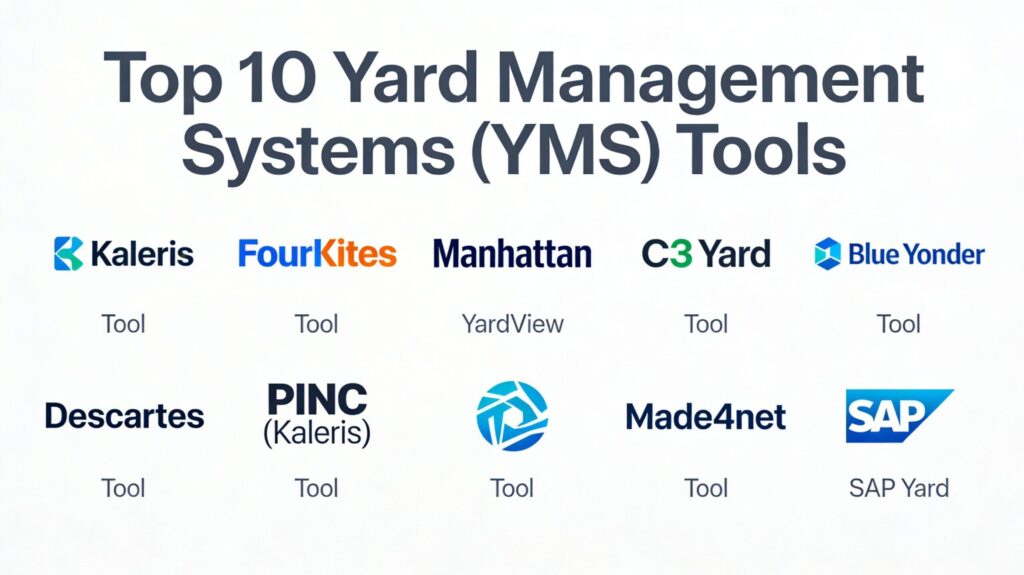
1. Kaleris Yard Management
Kaleris offers a leading enterprise YMS that focuses on providing a single pane of glass for multi-modal logistics operations. It is designed to synchronize yard activities with rail and truck movements, making it a favorite for large industrial and manufacturing facilities that handle diverse asset types.
Key Features
The platform features a highly visual digital yard map that provides real-time drag-and-drop trailer movements. It includes a robust “Carrier Self-Service” portal that allows transporters to schedule their own appointments and check the status of their assets. The system offers automated gate workflows that use OCR technology to speed up entry and exit. It features advanced “Spotter Management” tools that optimize the routes of yard trucks to reduce idle time. Additionally, its reporting engine provides deep insights into detention and demurrage costs.
Pros
It is one of the most comprehensive tools for facilities that manage both rail and truck assets. The automation features significantly reduce the administrative burden at the gatehouse.
Cons
The implementation process for multi-site deployments is intensive and requires careful planning. The platform’s vast feature set may be overkill for simpler distribution centers.
Platforms and Deployment
Web-based SaaS with dedicated mobile applications for yard spotters and gate guards.
Security and Compliance
Maintains high-tier cloud security standards, including SOC 2 compliance and encrypted data transmission.
Integrations and Ecosystem
Offers extensive pre-built integrations with major ERP, WMS, and TMS providers to ensure data fluidness.
Support and Community
Provides 24/7 technical support and a professional services team for custom configuration and onboarding.
2. FourKites Dynamic Yard
FourKites has revolutionized the category by combining traditional yard management with advanced in-transit visibility. It is designed for organizations that want to see not just what is in their yard, but exactly when incoming trailers will arrive based on real-time road data.
Key Features
The standout feature is the “Dynamic Yard” view, which merges real-time GPS tracking of trucks on the road with internal yard status. It includes automated yard audits that utilize hardware-agnostic tracking to locate trailers. The system features an AI-powered appointment manager that suggests dock times based on real-time delays. It offers a “Driver App” that facilitates contactless check-ins and digital gate passes. The platform also provides a “Carrier Performance” dashboard to track arrival punctuality and dwell times.
Pros
The integration of in-transit visibility with yard management is unique and highly effective for predictive planning. The user interface is exceptionally modern and intuitive.
Cons
The full value of the system is best realized if carriers are already integrated into the FourKites visibility network. Premium pricing reflects its advanced AI capabilities.
Platforms and Deployment
Cloud-native SaaS accessible via any modern web browser.
Security and Compliance
Adheres to global data privacy regulations and maintains SOC 2 Type II certification.
Integrations and Ecosystem
Features a robust API and native connections to hundreds of telematics and supply chain software providers.
Support and Community
Offers a dedicated customer success model and a comprehensive online learning center for users.
3. Manhattan Active Yard Management
Manhattan Associates provides a yard management solution that is deeply embedded within its market-leading Warehouse Management System. It is the gold standard for high-volume retail and grocery distribution centers that require perfect synchronization between yard and dock.
Key Features
The platform features “Unified Distribution” capabilities, allowing yard tasks to be triggered automatically by warehouse priority. It includes advanced “Dock Door Management” that optimizes door assignments based on labor availability inside the warehouse. The system offers real-time visibility into trailer contents, including temperature tracking for cold chain compliance. It features a sophisticated task interleaving engine for yard spotters to maximize productivity. The reporting suite offers granular views of yard aging and trailer dwell times.
Pros
The seamless synchronization between the WMS and YMS ensures that the highest-priority stock is always at the dock. It is built to handle the most extreme volumes in the retail sector.
Cons
It is most effective when used as part of the broader Manhattan Active suite, which may be a high barrier for some. The configuration can be complex due to its deep functionality.
Platforms and Deployment
Cloud-native SaaS with mobile capabilities for yard operations.
Security and Compliance
Enterprise-grade security with regular audits and compliance with global supply chain standards.
Integrations and Ecosystem
Part of the Manhattan Active Omni and Supply Chain ecosystem, providing a unified data model.
Support and Community
Backed by a global support network and an active user group focused on supply chain excellence.
4. C3 Yard
C3 Solutions offers a specialized YMS known for its high degree of configurability and focus on dock scheduling. It is a preferred choice for mid-to-large enterprises that need to manage complex gate workflows and diverse carrier requirements.
Key Features
The platform features a “Visual Yard” with real-time status updates and color-coded asset tracking. It includes a comprehensive “Dock Management” module that allows for complex appointment rules and constraints. The system offers “Automated Gate” functionality that supports driver self-check-in kiosks. It features “Shunt Management” to track and assign tasks to yard truck drivers in real-time. The platform also provides automated alerts for detention thresholds and trailer aging.
Pros
The system is highly flexible and can be tailored to very specific operational workflows. It offers one of the strongest dock scheduling modules on the market.
Cons
The interface, while functional, may feel more traditional compared to some of the newer cloud-native competitors. Advanced customization requires significant initial setup time.
Platforms and Deployment
Web-based SaaS with support for mobile devices in the yard.
Security and Compliance
Maintains secure data environments and follows industry-standard privacy and security protocols.
Integrations and Ecosystem
Provides a flexible API for connecting to various WMS, TMS, and gate hardware systems.
Support and Community
Known for having a highly responsive and knowledgeable technical support team.
5. Blue Yonder Yard Management
Blue Yonder provides a YMS that emphasizes AI-driven optimization and end-to-end supply chain synchronization. It is designed for large global enterprises that need to manage complex, multi-site yard operations with a focus on labor and asset efficiency.
Key Features
The platform features “Luminate” technology, which uses AI to predict potential yard bottlenecks before they occur. It includes a robust “Yard Task Management” system that prioritizes moves based on real-time warehouse demand. The system offers “Smart Gate” integrations to automate the flow of traffic and reduce manual data entry. It features advanced “Labor Management” to track the productivity of yard spotters. The platform also provides high-fidelity visibility into trailer locations and mechanical status.
Pros
The AI-driven insights help large operations proactively manage exceptions rather than just reacting to them. It scales effectively across hundreds of global locations.
Cons
The total cost of ownership can be high for mid-market organizations. Implementation usually requires a dedicated project team due to the system’s depth.
Platforms and Deployment
Cloud-based SaaS.
Security and Compliance
Complies with major global security standards including ISO 27001 and SOC 2.
Integrations and Ecosystem
Deeply integrated with the Blue Yonder Luminate platform and major third-party ERP systems.
Support and Community
Offers professional services, global support tiers, and a large community of supply chain professionals.
6. YardView
YardView is a focused, “purpose-built” YMS that prioritizes ease of use and rapid deployment. It is ideal for facilities that want to move away from spreadsheets and whiteboards without the complexity of a massive enterprise software project.
Key Features
The platform features a “Clean Yard” interface that provides an instant visual of every trailer and its current status. It includes a simple but effective “Gate Management” tool for recording arrivals and departures. The system offers “Spotter Tasking” that can be managed via any mobile device with a browser. It features automated email and SMS alerts for trailers that have exceeded their allowed dwell time. The platform also provides a history of all asset movements for audit and carrier performance review.
Pros
It is one of the fastest systems to implement, often going live in a matter of days. The learning curve is minimal, making it easy for yard staff to adopt.
Cons
It may lack some of the advanced AI and predictive features found in premium enterprise suites. The integration capabilities are focused on standard data exchanges.
Platforms and Deployment
Web-based SaaS accessible on any device.
Security and Compliance
Standard cloud security and data protection measures are in place for all client data.
Integrations and Ecosystem
Supports standard EDI and API connections for basic WMS and TMS integration.
Support and Community
Provides personal, high-touch support and a direct line to technical experts for troubleshooting.
7. Descartes Yard Management
Descartes offers a YMS that is part of its broader Logistics Technology Platform. It is particularly strong for organizations that need to coordinate yard activities with complex transportation networks and global customs requirements.
Key Features
The platform features “Real-Time Asset Tracking” that uses various hardware options to maintain yard accuracy. It includes a “Carrier Portal” for collaborative dock scheduling and asset status updates. The system offers “Gate Automation” that integrates with physical barriers and cameras. It features automated task assignment for yard drivers based on proximity and priority. The reporting engine provides detailed views of yard utilization and carrier turnaround times.
Pros
Being part of the Descartes network provides unique advantages for organizations with heavy international freight. It offers a very stable and reliable platform for high-traffic environments.
Cons
The system is most powerful when used alongside other Descartes modules, which can be an investment. The UI is professional and functional but less “flashy” than some competitors.
Platforms and Deployment
Cloud-based SaaS.
Security and Compliance
Adheres to strict international security and data privacy standards.
Integrations and Ecosystem
Integrates natively with the Descartes Global Logistics Network and various external WMS systems.
Support and Community
Offers global support services and a dedicated account management model for large clients.
8. PINC (Kaleris Platform)
PINC, now part of the Kaleris family, is famous for pioneering the use of drone-based yard audits and high-precision RTLS. It is the preferred choice for facilities that require 100% yard accuracy through automated data collection.
Key Features
The platform features “Autonomous Yard Audits” using drones to scan entire yards in minutes. It includes high-precision RTLS tags that provide the exact location of a trailer within inches. The system offers a “Digital Twin” of the yard that updates in real-time as assets move. It features advanced “Gate Automation” with integrated OCR and driver kiosks. The platform also provides sophisticated analytics for identifying “hidden” costs in yard operations.
Pros
The level of automation in data collection is unparalleled, virtually eliminating the need for manual yard checks. It provides the highest degree of location accuracy available.
Cons
The hardware-heavy approach (tags and drones) involves a higher upfront cost and maintenance. It is best suited for extremely large yards where manual audits are ineffective.
Platforms and Deployment
Cloud SaaS with integrated hardware components.
Security and Compliance
Enterprise-grade security for both the cloud platform and the localized IoT hardware.
Integrations and Ecosystem
Strong APIs for connecting to various warehouse and transportation management systems.
Support and Community
Provides specialized support for both the software and the autonomous hardware components.
9. Made4net YardExpert
Made4net provides a modular YMS that is known for being lightweight yet powerful. It is part of the “ActiveWMS” suite but can be deployed as a standalone tool for mid-sized distribution hubs.
Key Features
The platform features “Real-Time Visual Yard Management” with an interactive map of all locations and docks. It includes a “Task Execution” engine that assigns work to yard spotters based on the most efficient sequence. The system offers “Gate Log” automation to capture trailer, driver, and seal information quickly. It features automated alerts for “Hot” trailers that need to be moved to the dock immediately. The platform also provides a history of trailer maintenance and inspections.
Pros
It offers an excellent balance between feature depth and ease of deployment. The system is highly scalable and can grow with the organization.
Cons
It is less focused on the “Autonomous” or drone-based features found in specialized high-end tools. Some reporting features may require custom configuration.
Platforms and Deployment
Web-based SaaS or on-premise deployment options.
Security and Compliance
Standard data encryption and secure access controls for all deployment models.
Integrations and Ecosystem
Features a robust integration layer for connecting to ERP and WMS systems.
Support and Community
Offers a dedicated help desk and professional implementation services.
10. SAP Yard Logistics
SAP Yard Logistics is an enterprise-level solution designed specifically for organizations that run their global operations on the SAP S/4HANA platform. It provides unparalleled integration with the broader SAP supply chain and financial modules.
Key Features
The platform features “Deep ERP Integration,” allowing yard costs to be reflected directly in financial accounts. It includes advanced “Process Automation” for gate check-ins and weighbridge integrations. The system offers a “3D Yard Map” for high-fidelity visualization of asset locations. It features “Internet of Things” (IoT) connectivity for real-time sensor data from trailers and tractors. The platform also provides a comprehensive suite of analytics for cross-facility benchmarking.
Pros
For an SAP-centric organization, the data consistency and process alignment are superior to any third-party tool. It handles the most complex, multi-modal industrial yards with ease.
Cons
The software is very complex and requires specialized SAP consultants for implementation. It is one of the most expensive options on the market.
Platforms and Deployment
On-premise or cloud (SAP S/4HANA) deployment.
Security and Compliance
Maintains the highest possible enterprise security standards as part of the SAP ecosystem.
Integrations and Ecosystem
Seamless integration with SAP EWM (Extended Warehouse Management) and TM (Transportation Management).
Support and Community
Backed by the massive SAP global support network and an extensive community of consultants.
Comparison Table
| Tool Name | Best For | Platform(s) Supported | Deployment | Standout Feature | Public Rating |
| 1. Kaleris | Multi-Modal Industrial | Web, Mobile | Cloud SaaS | Rail & Truck Sync | 4.6/5 |
| 2. FourKites | Predictive Visibility | Web-Based | Cloud SaaS | In-Transit Integration | 4.8/5 |
| 3. Manhattan | High-Volume Retail | Web, Mobile | Cloud SaaS | WMS Synchronization | 4.7/5 |
| 4. C3 Yard | Dock Scheduling | Web, Mobile | Cloud SaaS | Configurable Workflows | 4.5/5 |
| 5. Blue Yonder | AI-Driven Global Ops | Web-Based | Cloud SaaS | Predictive Luminate AI | 4.6/5 |
| 6. YardView | Mid-Market / Rapid Use | Web, Mobile | Cloud SaaS | 3-Day Implementation | 4.8/5 |
| 7. Descartes | Global Logistics Net | Web-Based | Cloud SaaS | International Sync | 4.4/5 |
| 8. PINC (Kaleris) | Autonomous Audits | Web, Mobile | Cloud SaaS | Drone Yard Audits | 4.7/5 |
| 9. Made4net | Flexible / Mid-Size | Web, Mobile | Hybrid | Modular Execution | 4.5/5 |
| 10. SAP Yard | SAP-Centric Enterprise | Web-Based | Hybrid | S/4HANA Integration | 4.3/5 |
Evaluation & Scoring of Yard Management Systems
The scoring below is a comparative model intended to help shortlisting. Each criterion is scored from 1–10, then a weighted total from 0–10 is calculated using the weights listed. These are analyst estimates based on typical fit and common workflow requirements, not public ratings.
Weights:
- Core features – 25%
- Ease of use – 15%
- Integrations & ecosystem – 15%
- Security & compliance – 10%
- Performance & reliability – 10%
- Support & community – 10%
- Price / value – 15%
| Tool Name | Core (25%) | Ease (15%) | Integrations (15%) | Security (10%) | Performance (10%) | Support (10%) | Value (15%) | Weighted Total |
| 1. Kaleris | 10 | 6 | 9 | 9 | 9 | 9 | 7 | 8.60 |
| 2. FourKites | 9 | 8 | 10 | 9 | 9 | 8 | 8 | 8.80 |
| 3. Manhattan | 10 | 5 | 10 | 10 | 9 | 9 | 6 | 8.40 |
| 4. C3 Yard | 8 | 7 | 8 | 9 | 8 | 9 | 8 | 8.05 |
| 5. Blue Yonder | 9 | 6 | 9 | 10 | 9 | 8 | 7 | 8.25 |
| 6. YardView | 6 | 10 | 6 | 8 | 8 | 10 | 10 | 8.00 |
| 7. Descartes | 8 | 7 | 8 | 9 | 8 | 8 | 8 | 7.90 |
| 8. PINC (Kaleris) | 10 | 5 | 8 | 9 | 10 | 8 | 7 | 8.35 |
| 9. Made4net | 8 | 8 | 8 | 8 | 8 | 8 | 9 | 8.10 |
| 10. SAP Yard | 9 | 4 | 10 | 10 | 9 | 8 | 5 | 7.75 |
How to interpret the scores:
- Use the weighted total to shortlist candidates, then validate with a pilot.
- A lower score can mean specialization, not weakness.
- Security and compliance scores reflect controllability and governance fit, because certifications are often not publicly stated.
- Actual outcomes vary with assembly size, team skills, templates, and process maturity.
Which Yard Management System Tool Is Right for You?
Solo / Freelancer
For smaller operations or specialized logistics consultancies, a system that focuses on immediate visibility without heavy hardware requirements is best. You need a platform that can be managed by a single person and provides instant reports for carrier negotiations, allowing you to prove detention claims and improve gate efficiency with minimal overhead.
SMB
Organizations managing disaster relief or community food banks may find a simplified YMS valuable for coordinating donation arrivals. The focus should be on a cost-effective, web-based tool that requires no specialized hardware, enabling volunteer staff to keep track of incoming trailers and ensure that perishable goods reach the dock quickly.
Mid-Market
Mid-sized distribution hubs should look for a YMS that offers a balance of dock scheduling and gate automation. As your volume increases, the manual coordination of carriers becomes a primary source of friction. A modular system that can integrate with your existing WMS will provide the necessary scalability without the cost of a full enterprise suite.
Enterprise
Global enterprises with multiple yards must prioritize AI-driven optimization and centralized visibility. You require a system that can handle diverse asset types, automate gate check-ins across different time zones, and provide a single source of truth for all global yard activities to satisfy both operational and financial reporting needs.
Budget vs Premium
If budget is the primary concern, choose a SaaS platform that offers rapid deployment and a “per-site” pricing model. These systems provide the core visibility needed to reduce detention fees. Premium systems, while more expensive, offer autonomous auditing and deep WMS synchronization that can provide a higher return on investment for very high-volume facilities.
Feature Depth vs Ease of Use
A system with drone-based auditing and AI prediction offers incredible depth but requires a more sophisticated staff to manage. Often, a simpler, more intuitive visual yard map that all spotters and gate guards actually use is more effective for maintaining day-to-day operational flow.
Integrations & Scalability
Your YMS must be able to share data with your WMS and TMS to be effective. As your logistics network grows, the ability to add new sites and carriers without significant technical rework is essential for maintaining long-term technical health and operational agility.
Security & Compliance Needs
In sectors like pharmaceuticals or high-value electronics, the security of the yard is a top priority. Ensure that the YMS provides detailed audit logs of every move, supports secure gate access controls, and complies with the data protection regulations of every region where you operate.
Frequently Asked Questions (FAQs)
1. What is the main difference between a WMS and a YMS?
A Warehouse Management System (WMS) handles the movement of inventory inside the building. A Yard Management System (YMS) manages the trailers, tractors, and yard trucks in the parking areas and at the loading docks, filling the gap between the warehouse and the open road.
2. How does a YMS reduce detention fees?
A YMS tracks exactly when a trailer arrives and how long it sits. By providing real-time alerts for trailers approaching their detention limit and optimizing dock schedules, the system ensures that trailers are emptied and released before extra charges are incurred.
3. Do I need special hardware like GPS tags for a YMS?
Not necessarily. While some high-end systems use active GPS or RFID tags for 100% accuracy, many modern YMS platforms can function effectively using “passive” tracking, where yard spotters update trailer locations via a mobile app during their routine moves.
4. Can a YMS help with cold chain compliance?
Yes, many professional YMS tools integrate with reefer monitoring systems to track internal trailer temperatures while they are in the yard, triggering alerts if a temperature falls outside of the required range.
5. How long does a YMS implementation typically take?
Implementation can range from a few days for a simple, cloud-based visual yard to several months for a complex enterprise system with automated gates, weighbridge integrations, and deep ERP synchronization.
6. Does a YMS help with driver safety?
A YMS improves safety by reducing the need for people to walk through the yard to perform manual audits. It also optimizes yard truck routes to minimize traffic and ensures that drivers are directed to the correct docks via digital instructions.
7. Can a YMS manage rail assets?
Some enterprise-grade YMS platforms, like Kaleris and SAP, are designed to manage multi-modal yards, providing visibility and task management for both truck trailers and rail cars within the same facility.
8. What is a “Smart Gate”?
A Smart Gate uses technology like OCR cameras, sensors, and driver kiosks to automatically identify trailers and drivers as they enter the facility, allowing for “contactless” check-ins and reducing gate congestion.
9. Why is a “Digital Twin” useful in yard management?
A Digital Twin is a real-time virtual map of your physical yard. It allows managers to see the exact status and location of every asset from their office, enabling better planning without having to physically go out into the yard.
10. Do these systems provide carrier performance data?
Yes, a YMS records every arrival and departure, allowing you to generate reports on which carriers are consistently late, how long they spend at your facility, and how accurately they follow your dock scheduling rules.
Conclusion
In the modern logistics environment, the yard is no longer just a parking lot—it is a strategic staging area that determines the overall velocity of the supply chain. Implementing a Yard Management System is a critical step for organizations looking to eliminate operational “blind spots” and reduce the mounting costs associated with trailer detention and gate congestion. By transforming the yard into a visible, data-driven environment, businesses can ensure that their physical assets are always synchronized with their digital orders. The right YMS not only secures your current operations but provides the scalable foundation needed to adopt future innovations like autonomous yard trucks and drone-based auditing.