Introduction
Supply Chain Management (SCM) suites have transitioned from back-office execution tools into centralized “control towers” that define an organization’s agility. In a global landscape characterized by sudden geopolitical shifts and resource scarcity, these suites provide the predictive intelligence required to move beyond simple logistics toward true supply chain orchestration. They integrate disparate functions—such as procurement, demand planning, warehouse management, and transportation—into a unified data environment. This enables businesses to visualize the “flow” of goods and capital in real-time, allowing them to anticipate bottlenecks before they manifest as costly delays.
The complexity of modern global trade means that a single point of failure in a sub-tier supplier can ripple through an entire industry. Consequently, the leading SCM platforms of the current era are heavily invested in end-to-end visibility and multi-enterprise collaboration. They allow companies to communicate seamlessly with third-party logistics (3PL) providers, manufacturers, and raw material suppliers. When choosing a suite, organizations must look past basic automation; the real value lies in the platform’s ability to perform complex scenario modeling and “what-if” analysis, providing a roadmap for maintaining resilience even during significant market disruptions.
Best for: Global manufacturers, multi-channel retailers, and logistics providers who need to synchronize high-volume inventory movements across complex international networks.
Not ideal for: Small local businesses with a single warehouse and a domestic supplier base, or organizations that only require simple shipping labels without inventory or demand planning needs.
Key Trends in Supply Chain Management Suites
The most significant shift in SCM technology is the rise of Autonomous Planning and Agentic AI. Rather than just flagging an exception, modern suites now utilize AI agents that can autonomously re-route shipments or re-balance inventory across nodes based on pre-defined business rules. Digital Twin technology has also become a standard feature, allowing companies to create a virtual replica of their physical supply chain to stress-test their operations against hypothetical disasters or peak-demand surges without risking real-world inventory.
We are also seeing a major push toward Sustainability and Circularity tracking. Regulatory requirements now demand that companies track the carbon footprint and ethical sourcing of every component in their product. Leading SCM suites have integrated “Green Ledger” features that treat carbon as a currency alongside traditional financial metrics. Additionally, the industry is moving toward Real-Time Visibility (RTV) via IoT integration. Instead of waiting for a manual update, platforms now pull live GPS and temperature data directly from containers, providing a continuous “heartbeat” of the entire supply chain.
How We Selected These Tools
Our selection process for the top SCM suites focused on “Concurrency”—the ability of a platform to reflect changes across the entire network instantly. We prioritized suites that offer a broad, integrated architecture rather than siloed point solutions, ensuring that a change in demand planning immediately updates the procurement and logistics schedules. We evaluated the depth of the underlying AI and machine learning engines, specifically their accuracy in demand sensing and their ability to automate complex decision-making processes.
Scalability was another critical factor; we looked for platforms that can manage millions of SKUs and thousands of global locations without performance degradation. We also heavily weighted the quality of the “Multi-Enterprise Network,” favoring suites that already have deep, pre-built connections to global carriers and suppliers. Finally, we assessed the user experience, particularly the move toward “Low-Code” or “No-Code” configurations that allow supply chain planners to adjust business logic without waiting for IT intervention.
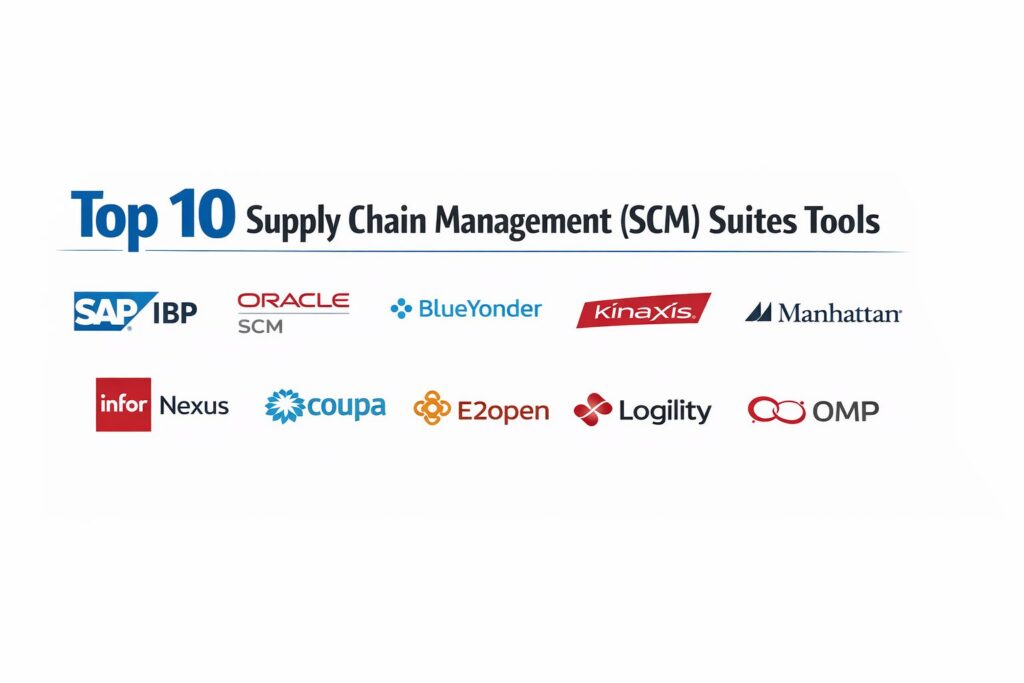
1. SAP Integrated Business Planning (IBP)
SAP IBP is an enterprise-grade, cloud-based planning suite designed to bridge the gap between financial strategy and operational execution. It is the gold standard for organizations that already run on the SAP ecosystem and need high-level synchronization across their global business units.
Key Features
The platform features “Harmonized Planning Areas,” which allow for continuous planning across short, mid, and long-term horizons in a single environment. It includes advanced “Demand Sensing” that uses machine learning to refine short-term forecasts based on real-time market signals. The system offers “Multi-Stage Inventory Optimization” to buffer against supply chain risk while minimizing working capital. It features a robust “Sales and Operations Planning” (S&OP) module that aligns different departments under a single plan. Additionally, its native integration with SAP S/4HANA ensures real-time data flow from the core ERP to the planning engine.
Pros
It provides the most robust integration for existing SAP users, eliminating data silos between planning and execution. The platform’s predictive analytics are world-class, offering deep insights into complex global supply networks.
Cons
The implementation is notoriously complex and often requires specialized consultants. It can be prohibitively expensive for companies not already invested in the broader SAP ecosystem.
Platforms and Deployment
Cloud-SaaS, specifically optimized for private and public cloud environments.
Security and Compliance
Top-tier security including SOC 2 Type II, ISO 27001, and FedRAMP compliance.
Integrations and Ecosystem
Seamless, native integration with SAP S/4HANA, SAP Ariba, and SAP SuccessFactors.
Support and Community
Supported by the massive SAP Global Partner Network and extensive professional training via SAP Learning Hub.
2. Oracle Fusion Cloud SCM
Oracle Fusion Cloud SCM is a comprehensive, natively built cloud suite that covers everything from product lifecycle management to global logistics. It is designed for agility, allowing organizations to respond rapidly to changing market conditions through a unified data model.
Key Features
The platform features “Oracle AI Apps for Supply Chain,” which include built-in AI agents for automated alternative sourcing and order release. It includes a sophisticated “Warehouse Management” (WMS) system that optimizes picking and packing through machine learning. The system offers “Global Trade Management” for navigating complex international customs and compliance regulations. It features “Product Lifecycle Management” (PLM) to manage a product from initial concept to retirement. Additionally, the platform utilizes the “Redwood UX,” a modern and intuitive interface designed to reduce user fatigue and increase productivity.
Pros
Being a “natively cloud” suite, it receives continuous updates without the need for disruptive upgrades. It offers an incredibly broad range of features, reducing the need for third-party add-ons.
Cons
The sheer breadth of the platform means that navigating the various modules can be overwhelming for smaller teams. Some advanced customizations require deep technical knowledge of the Oracle cloud infrastructure.
Platforms and Deployment
Native Cloud-SaaS with a strong mobile-first experience for logistics operators.
Security and Compliance
Meets strict global standards including GDPR, HIPAA, and various government-specific security certifications.
Integrations and Ecosystem
Deeply integrated with Oracle Cloud ERP and HCM, with robust APIs for third-party connections.
Support and Community
Offers “Oracle University” for training and a highly active “Customer Connect” community for peer-to-peer troubleshooting.
3. Blue Yonder (formerly JDA Software)
Blue Yonder is a leader in “Cognitive” supply chain management, focusing heavily on retail and manufacturing sectors. It utilizes a powerful AI-driven engine called Luminate to synchronize planning and execution across the entire value chain.
Key Features
The platform features the “Luminate Control Tower,” which provides end-to-end visibility and uses machine learning to identify risks. It includes “Category Management” and “Space Planning” tools specifically designed for high-volume retail environments. The system offers “Transportation Management” (TMS) that optimizes inbound and outbound logistics across all modes of transport. It features “Omnichannel Fulfillment” capabilities that allow retailers to ship from stores or specialized distribution centers. Additionally, it provides “Production Planning” tools that balance plant capacity with real-time demand.
Pros
It is arguably the best suite for retail-specific challenges like assortment and floor planning. The platform’s ability to merge planning and execution in one flow significantly reduces cycle times.
Cons
Implementation can be lengthy, often taking 12 to 24 months for full-scale global rollouts. The user interface has been described by some as less intuitive than newer cloud-native competitors.
Platforms and Deployment
Cloud-SaaS with specialized mobile applications for store and warehouse associates.
Security and Compliance
Industry-standard security protocols with robust data encryption and privacy controls.
Integrations and Ecosystem
Strong partnerships with Microsoft Azure and integrations with major ERP and WMS providers.
Support and Community
Provides “Blue Yonder University” for training and dedicated professional services for complex implementations.
4. Kinaxis Maestro
Kinaxis Maestro (the evolution of RapidResponse) is the industry leader in “Concurrent Planning.” It is designed for manufacturers who need to understand how a change in one part of the supply chain instantly impacts every other link.
Key Features
The platform features a “Single Integrated Data Model” that allows planners to collaborate in real-time across different time zones and functions. It includes “AI-Powered Scenario Management,” where users can create thousands of “what-if” scenarios in seconds. The system offers “Demand-Supply Balancing” with high-speed computational performance, even for millions of SKUs. It features “Global Collaboration” tools that allow stakeholders to chat and share data directly within the planning interface. Additionally, it provides a “Low-Code” environment for creating custom dashboards and reporting workbooks.
Pros
The speed of the calculation engine is unparalleled, often processing MRP runs 50x faster than traditional ERPs. It is exceptionally effective at fostering a “single version of truth” across a global organization.
Cons
The platform is highly specialized for planning and requires a separate execution system (like a WMS) for physical logistics. The initial design phase requires a very deep understanding of supply chain processes.
Platforms and Deployment
Fully cloud-native SaaS.
Security and Compliance
SOC 2 Type II and ISO 27001 certified, focusing on high-stakes manufacturing security.
Integrations and Ecosystem
Excellent “certified connectors” for major ERPs like SAP and Oracle, ensuring data stays synchronized.
Support and Community
Features the “Kinaxis Learning Center” and a strong user community focused on agile planning techniques.
5. Manhattan Active Supply Chain
Manhattan Associates is a specialist in supply chain execution, specifically warehouse and transportation management. Their “Active” suite is built on a microservices architecture that ensures it is always current and never needs upgrading.
Key Features
The platform features “Manhattan Active WMS,” the most advanced warehouse management system for high-volume, automated distribution centers. It includes “Active TMS,” which optimizes transportation routes and carrier selection in real-time. The system offers “Labor Management” tools to optimize workforce productivity and engagement within the warehouse. It features “Unified Distribution,” which combines warehouse, labor, and transportation into a single application. Additionally, its cloud-native architecture allows for instant scaling during seasonal peaks like Black Friday.
Pros
It is the undisputed leader for complex fulfillment and warehouse robotics integration. The “Versionless” cloud model means you never have to go through a painful upgrade project again.
Cons
The suite is very execution-focused and may lack the deep strategic demand planning found in suites like SAP or Kinaxis. The cost is high, reflecting its status as a premium tier-1 solution.
Platforms and Deployment
Modern, microservices-based Cloud-SaaS.
Security and Compliance
Adheres to strict enterprise security standards with specialized focus on physical warehouse data safety.
Integrations and Ecosystem
Natively integrates with robotics providers and offers robust APIs for connecting to any major ERP.
Support and Community
Offers “Manhattan Customer Care” and an annual user conference for deep-dive technical training.
6. Infor Nexus
Infor Nexus is a unique “Single-Instance Business Network” that focuses on multi-enterprise orchestration. It is designed for companies that outsource a significant portion of their manufacturing and logistics to third-party partners.
Key Features
The platform features “Supply Chain Orchestration,” which provides a single view of orders, shipments, and inventory across thousands of suppliers. It includes “Supply Chain Finance,” allowing for automated payments and early-payment discounts to improve supplier liquidity. The system offers “Predictive Intelligence” that identifies late shipments and recommends alternative routes. It features “Procure-to-Pay Automation” to streamline the financial settlement of global trade. Additionally, it provides “Direct GPS Tracking” of ocean and air freight for highly accurate ETAs.
Pros
It is the best platform for managing “Extended Supply Chains” where you do not own the factories or trucks. The focus on the financial flow of the supply chain is a major differentiator.
Cons
The user interface can feel somewhat dated compared to more modern consumer-grade SaaS. Implementation costs can be high due to the complexity of onboarding thousands of external partners.
Platforms and Deployment
Cloud-based business network.
Security and Compliance
Maintains ISO 27001 and SOC certifications with a focus on cross-border data privacy.
Integrations and Ecosystem
Acts as a “connectivity hub” between different organizations’ ERP and WMS systems.
Support and Community
Provides high-touch professional services and a dedicated “Network Support” team for onboarding partners.
7. Coupa Supply Chain Design & Planning
Coupa (which acquired LLamasoft) focuses on the “Design” and “Spend” aspects of the supply chain. It is the premier tool for organizations that want to optimize their global footprint and manage total business spend.
Key Features
The platform features “Supply Chain Modeler,” which uses digital twin technology to design the optimal network of warehouses and factories. It includes “Spend Management” tools that provide total visibility into all organizational purchasing. The system offers “Inventory Optimization” that uses AI to set safety stock levels based on varying service level targets. It features “Risk Management” modules that identify financial or environmental risks in the supplier base. Additionally, it provides “App Studio” for building custom supply chain applications on top of the Coupa platform.
Pros
It is the world leader in network design and optimization, helping companies save millions by locating facilities correctly. The platform’s focus on “Business Spend Management” provides a unique financial perspective on the supply chain.
Cons
The advanced modeling features have a very steep learning curve for non-data scientists. It is less focused on daily execution (like WMS or TMS) than other suites.
Platforms and Deployment
Cloud-SaaS.
Security and Compliance
Highly secure with SOC 1/2, PCI, and HIPAA compliance, focusing on financial data integrity.
Integrations and Ecosystem
Integrates with all major financial and ERP systems to pull spend and logistics data.
Support and Community
Offers the “Coupa Community” and extensive training through the “LLamasoft Academy.”
8. E2open
E2open is a comprehensive cloud-based suite that focuses on “Demand-Driven” supply chain management. It is designed to create a “closed-loop” between consumer demand and supplier response.
Key Features
The platform features “Channel Shaping,” which helps manufacturers understand and influence demand at the retail level. It includes “Multi-Tier Supply Management” for visibility into sub-tier suppliers (the suppliers of your suppliers). The system offers “Transportation & Global Trade” tools that manage the move and compliance of goods worldwide. It features “Harmony,” a unified user interface that connects all various modules. Additionally, it provides “Collaborative Manufacturing” modules to manage outsourced production partners.
Pros
It offers exceptional visibility into the “downstream” (retail) and “upstream” (sub-tier suppliers) parts of the chain. The suite is highly modular, allowing companies to start small and expand.
Cons
Pricing is not transparent and can vary wildly based on the number of modules and partners. Some users have reported that customer support response times can be slow.
Platforms and Deployment
Cloud-SaaS.
Security and Compliance
Adheres to global data protection standards with a focus on multi-party data security.
Integrations and Ecosystem
Provides a robust “Integration Engine” designed to take data from any source without data loss.
Support and Community
Provides a library of “Best Practice” guides and a dedicated customer success model.
9. Logility Digital Supply Chain
Logility focuses on mid-market and large enterprises that need a balance of sophisticated planning and ease of use. It is known for its high-performance AI analytics that empower proactive decision-making.
Key Features
The platform features “AI-Powered Forecasting” that automatically selects the best statistical models for different product categories. It includes “Product Portfolio Management” to help companies manage the introduction of new products (NPI). The system offers “Inventory Optimization” that dynamically adjusts safety stocks based on demand volatility. It features “Sourcing & Sustainability” tools to track environmental impacts and supplier compliance. Additionally, it provides “Digital Supply Chain Twin” capabilities for rapid scenario testing.
Pros
The platform is generally faster to implement than the massive suites from SAP or Oracle. The AI analytics are designed to be “explainable,” helping planners understand why a certain forecast was generated.
Cons
While strong in planning, it may not have the depth of execution features found in a specialized TMS or WMS. The documentation for advanced features can be somewhat sparse.
Platforms and Deployment
Cloud-SaaS.
Security and Compliance
Standard enterprise-grade security including SOC 2 and GDPR compliance.
Integrations and Ecosystem
Flexible integration layer that connects easily with mid-market ERPs like Microsoft Dynamics or NetSuite.
Support and Community
Known for having an approachable professional services team and a robust set of educational webinars.
10. OMP Unison Planning
OMP is a specialized supply chain planning suite that is highly favored in specific industries like chemicals, metals, and consumer goods. It focuses on solving extremely complex, constraint-based planning problems.
Key Features
The platform features “Unison Planning,” an all-in-one platform for demand, supply, and production planning. It includes “Industry-Specific Templates” that come pre-configured for the unique logic of sectors like paper or life sciences. The system offers “Smart Scenario Management” that allows for collaborative decision-making between planners and executives. It features “Self-Learning Algorithms” that improve their accuracy over time. Additionally, it provides an “Intuitive UX” designed to handle massive datasets without clutter.
Pros
The platform’s ability to model complex, industry-specific constraints is among the best in the world. It is highly regarded for its user-friendly interface despite the complexity of the underlying math.
Cons
It is a “best-of-breed” planning tool, meaning you will still need separate systems for warehouse and transportation execution. It is highly specialized and might be overkill for simpler supply chains.
Platforms and Deployment
Cloud-SaaS.
Security and Compliance
High-level security architecture designed to protect sensitive industrial process data.
Integrations and Ecosystem
Strong integration history with SAP and other major ERP systems, acting as a “Planning System of Record.”
Support and Community
Provides high-touch expert support with deep domain knowledge in specialized manufacturing industries.
Comparison Table
| Tool Name | Best For | Platform(s) Supported | Deployment | Standout Feature | Public Rating |
| 1. SAP IBP | SAP Ecosystem | Cloud, Web | SaaS | Harmonized Planning Area | 4.7/5 |
| 2. Oracle SCM | Global Agility | Web, Mobile | Native Cloud | Built-in AI Agents | 4.6/5 |
| 3. Blue Yonder | Retail/Omnichannel | Web, Mobile | SaaS | Luminate Control Tower | 4.5/5 |
| 4. Kinaxis | Concurrent Planning | Web-Based | Cloud Native | 50x Faster MRP | 4.8/5 |
| 5. Manhattan | Fulfillment/WMS | Web, Mobile | Microservices | Versionless Cloud | 4.7/5 |
| 6. Infor Nexus | Partner Networks | Web-Based | Business Network | Supply Chain Finance | 4.4/5 |
| 7. Coupa | Design & Spend | Web-Based | SaaS | Digital Twin Modeling | 4.6/5 |
| 8. E2open | Demand-Driven | Web-Based | SaaS | Multi-Tier Visibility | 4.3/5 |
| 9. Logility | Mid-Market AI | Web-Based | SaaS | Explainable AI Forecasts | 4.5/5 |
| 10. OMP | Specialized Mfg | Web-Based | SaaS | Unison Planning | 4.7/5 |
Evaluation & Scoring of SCM Suites
The scoring below is a comparative model intended to help shortlisting. Each criterion is scored from 1–10, then a weighted total from 0–10 is calculated using the weights listed. These are analyst estimates based on typical fit and common workflow requirements, not public ratings.
Weights:
- Core features – 25%
- Ease of use – 15%
- Integrations & ecosystem – 15%
- Security & compliance – 10%
- Performance & reliability – 10%
- Support & community – 10%
- Price / value – 15%
| Tool Name | Core (25%) | Ease (15%) | Integrations (15%) | Security (10%) | Performance (10%) | Support (10%) | Value (15%) | Weighted Total |
| 1. SAP IBP | 10 | 4 | 10 | 10 | 9 | 9 | 6 | 8.35 |
| 2. Oracle SCM | 9 | 7 | 9 | 10 | 9 | 9 | 8 | 8.65 |
| 3. Blue Yonder | 9 | 6 | 8 | 9 | 8 | 8 | 7 | 7.95 |
| 4. Kinaxis | 10 | 6 | 9 | 9 | 10 | 9 | 7 | 8.50 |
| 5. Manhattan | 10 | 7 | 8 | 9 | 10 | 8 | 7 | 8.45 |
| 6. Infor Nexus | 8 | 5 | 9 | 9 | 8 | 8 | 8 | 7.75 |
| 7. Coupa | 9 | 5 | 8 | 9 | 8 | 8 | 7 | 7.70 |
| 8. E2open | 8 | 6 | 9 | 9 | 8 | 7 | 8 | 7.85 |
| 9. Logility | 8 | 8 | 8 | 9 | 9 | 9 | 9 | 8.50 |
| 10. OMP | 9 | 8 | 8 | 9 | 9 | 9 | 7 | 8.50 |
How to interpret the scores:
- Use the weighted total to shortlist candidates, then validate with a pilot.
- A lower score can mean specialization, not weakness.
- Security and compliance scores reflect controllability and governance fit, because certifications are often not publicly stated.
- Actual outcomes vary with assembly size, team skills, templates, and process maturity.
Which SCM Suite Is Right for You?
Solo / Freelancer
For smaller, founder-led operations, a full SCM suite is likely over-engineered. You should prioritize “SCM-lite” features found within a modern Cloud ERP like NetSuite or Microsoft Dynamics. These provide enough inventory and shipping automation to manage a growing business without the complexity of multi-echelon planning or global trade compliance tools.
SMB
Small manufacturers should focus on suites that excel in “Production Scheduling” and “Inventory Control.” You need a tool that can help you balance your limited machine capacity with incoming orders. Look for mid-market options like Logility or the SCM modules within Infor, which offer professional-grade planning without the multi-million dollar price tag of the tier-1 giants.
Mid-Market
Mid-sized companies are in a “growth squeeze” where manual spreadsheets no longer work, but they can’t afford a 2-year implementation. The priority here should be “Time-to-Value.” Select a suite like Logility or a modular E2open implementation that can be phased in over 6 months, focusing first on the most painful bottlenecks like demand forecasting or warehouse efficiency.
Enterprise
For global enterprises, the choice is usually between SAP, Oracle, or a best-of-breed combination like Kinaxis and Manhattan. The decision should be driven by your existing IT landscape and your primary competitive differentiator. If your success depends on world-class fulfillment, Manhattan is the choice; if it depends on high-speed global planning, Kinaxis is the leader.
Integrated vs Best-of-Breed
An “Integrated” suite (like Oracle or SAP) offers a single data model and one vendor relationship, which simplifies IT governance. A “Best-of-Breed” strategy (combining a specialized planner like OMP with a specialized WMS like Manhattan) offers superior functionality in each specific area but requires a more robust internal IT team to manage the various integrations and data flows.
Feature Depth vs Ease of Use
Highly specialized industries like chemicals or pharmaceuticals require “Feature Depth”—the ability to model expiration dates, hazardous material constraints, and temperature-controlled logistics. Conversely, for a general consumer goods company, “Ease of Use” and a modern UX are more important to ensure that planners actually adopt the tool and don’t revert to their old Excel habits.
Integrations & Scalability
Your SCM suite must be able to “talk” to the outside world. Prioritize platforms with a strong track record of EDI and API connectivity to global carriers and suppliers. Scalability is equally important; the platform must be able to handle a 10x surge in data during peak seasons without a drop in system performance or calculation speed.
Security & Compliance Needs
If you operate globally, your SCM suite is the guardian of your trade secrets and customer data. Ensure the platform meets the highest international security standards (ISO, SOC, FedRAMP). Furthermore, with new sustainability laws, the ability of the suite to provide a “Chain of Custody” and ESG reporting is now a critical compliance requirement for modern boards of directors.
Frequently Asked Questions (FAQs)
1. What is the difference between SCM and ERP?
An ERP (Enterprise Resource Planning) is the broad system of record for the whole company, including finance and HR. SCM (Supply Chain Management) is a specialized suite focused specifically on the physical and logical flow of goods, often offering much deeper planning and logistics features than a standard ERP.
2. What is “Concurrent Planning” in a supply chain?
Concurrent planning means that a change in one area (like a delayed shipment) is instantly reflected across all other areas (like production and sales). This eliminates the “lag” found in traditional sequential planning where each department updates its plan once a week or month.
3. Do these suites help with sustainability tracking?
Yes, most modern SCM suites now include “Green Supply Chain” modules. These track the carbon footprint of transport routes and the ethical certifications of suppliers, allowing companies to report on their environmental and social impact accurately.
4. Can I use these tools if I outsource my manufacturing?
Absolutely. Platforms like Infor Nexus and E2open are specifically designed for “Multi-Enterprise Orchestration,” allowing you to see and manage the activities of your manufacturing and logistics partners as if they were your own internal departments.
5. What is a “Supply Chain Digital Twin”?
A Digital Twin is a complete virtual model of your physical supply chain. It allows you to run simulations—such as “what happens if a major port closes?”—to see the impact on your inventory and service levels without actually disrupting your business.
6. How long does a typical SCM suite implementation take?
For a mid-market company, a modular rollout can take 6-9 months. For a global enterprise, a full-scale implementation of a suite like SAP IBP or Oracle SCM typically takes 18 to 24 months to ensure all global units and partners are synchronized.
7. Is AI in SCM just a marketing buzzword?
No, AI is practically applied in “Demand Sensing” (to predict trends) and “Prescriptive Analytics” (to suggest actions). It replaces manual statistical modeling with dynamic algorithms that can process thousands of external variables like weather or social media trends.
8. What is the “Bullwhip Effect” and can these suites stop it?
The Bullwhip Effect is when small changes in consumer demand cause massive, distorted fluctuations in orders as they move up the supply chain. SCM suites mitigate this by providing “Real-Time Visibility,” so suppliers see actual consumer demand rather than just a distorted order from a distributor.
9. Why are these suites moving to a “Microservices” architecture?
Microservices allow the platform to be updated in small pieces rather than as one giant system. This means the vendor can add new features every week without the customer needing to go through a risky, multi-month “upgrade project.”
10. Do I need a WMS if I already have an SCM suite?
Many SCM suites include a WMS (Warehouse Management System) module. However, if you have extremely high-volume or automated robotic warehouses, you may still choose a specialized, “best-of-breed” WMS that integrates into your broader SCM planning suite.
Conclusion
In an era defined by volatility and the rapid “death of distance” via digital commerce, a sophisticated Supply Chain Management suite is the ultimate competitive lever. These platforms have moved beyond simple cost-cutting; they are now the primary engines of business resilience, enabling organizations to navigate global complexity with scientific precision. By integrating predictive planning with real-time execution, companies can finally achieve the elusive goal of an “agile” supply chain—one that senses disruption and responds before the customer even notices. Selecting the right suite is not just a technical upgrade; it is a strategic commitment to operational excellence and long-term viability in a fragmented global market.