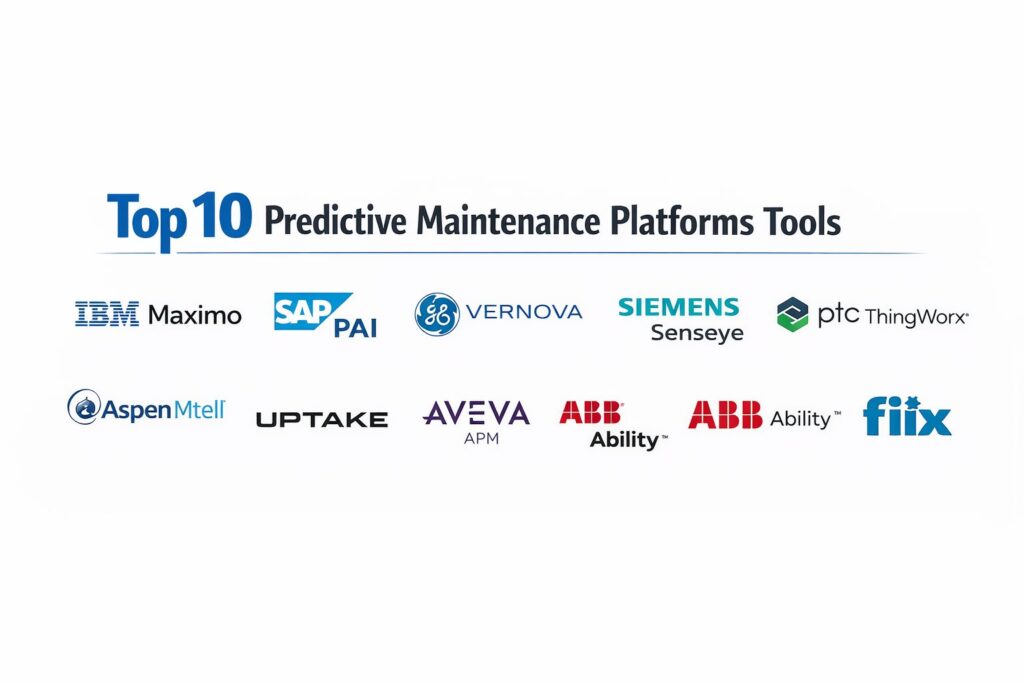
Introduction
Predictive maintenance (PdM) platforms have redefined the industrial landscape by shifting asset management from a reactive “fix-it-when-it-breaks” mentality to a proactive “predict-and-prevent” strategy. These platforms utilize advanced sensors, Internet of Things (IoT) connectivity, and machine learning (ML) algorithms to monitor equipment health in real-time, identifying the subtle signatures of impending failure long before they manifest as catastrophic breakdowns. For capital-intensive sectors like manufacturing, energy, and transportation, PdM technology is no longer a luxury—it is a critical requirement for maintaining operational continuity, ensuring worker safety, and optimizing maintenance budgets. By analyzing vibration, temperature, and acoustics, these tools provide the empirical evidence needed to schedule repairs exactly when they are required, maximizing the remaining useful life of every component.
The current generation of predictive maintenance software has moved beyond simple threshold alerts to “prescriptive” insights, where the system not only identifies a potential failure but also recommends the specific corrective action and the required spare parts. This evolution is driven by the rise of Digital Twins—virtual replicas of physical assets that simulate performance under various conditions to improve forecast accuracy. As industries move toward autonomous operations, these platforms serve as the central nervous system for asset reliability, integrating seamlessly with Enterprise Resource Planning (ERP) and Computerized Maintenance Management Systems (CMMS) to automate the entire maintenance lifecycle. For organizations navigating the complexities of Industry 4.0, choosing the right predictive platform is the most impactful decision they can make to safeguard their physical infrastructure.
Best for: Maintenance managers, reliability engineers, and plant directors who oversee critical machinery where unplanned downtime results in significant financial loss or safety risks.
Not ideal for: Small businesses with low-complexity equipment that can be easily and cheaply replaced, or facilities without the digital infrastructure to support continuous sensor data streaming.
Key Trends in Predictive Maintenance Platforms
The most significant trend in the industry is the integration of “Generative AI” and Natural Language Processing (NLP), allowing maintenance technicians to query their equipment’s health through voice or text. Instead of interpreting complex vibration charts, a worker can simply ask, “What is the probability of a bearing failure on pump six this week?” and receive a plain-language assessment backed by historical data. We are also seeing a rapid shift toward “Edge AI,” where predictive models are deployed directly on the sensors or local gateways. This reduces the need for massive cloud bandwidth and allows for millisecond-level reaction times, which is vital for high-speed robotic assembly lines or critical energy grids.
Sustainability is also becoming a core driver for PdM adoption, as platforms now correlate equipment degradation with energy inefficiency. By identifying a misaligned motor early, the software not only prevents a breakdown but also reduces the excess power consumption caused by friction and heat. Furthermore, the “democratization of data science” is a major movement; modern platforms are increasingly “low-code,” enabling mechanical engineers with deep domain expertise to build and tune their own predictive models without needing a PhD in computer science. Finally, the rise of specialized, industry-specific “Failure Mode Libraries” allows new users to benefit from pre-trained AI models that already understand the typical wear patterns of specific machinery like wind turbines or CNC machines.
How We Selected These Tools
Our selection process for the top predictive maintenance platforms was centered on “Proven Reliability” and “Scalability.” We prioritized platforms that have demonstrated success in complex, high-stakes environments such as aerospace, oil and gas, and global manufacturing. A key criterion was the quality of the AI engine—specifically its ability to distinguish between “noisy” operational data and true anomaly signals to minimize false positives, which can lead to unnecessary maintenance and “alert fatigue.” We looked for tools that offer a clear path from data ingestion to actionable work orders, evaluating how effectively they bridge the gap between digital insights and physical labor.
Interoperability was another major factor in our assessment. We selected platforms that feature robust APIs and pre-built connectors for major industrial protocols like OPC-UA and MQTT, as well as enterprise systems like SAP and IBM Maximo. We also considered the “Time-to-Value,” favoring platforms that offer pre-trained models and “Maestro” assistants that speed up the initial configuration process. Security certifications were non-negotiable, given that these platforms connect to critical national infrastructure; we only included vendors with rigorous standards for encryption, data residency, and cyber-resilience. Finally, we assessed the global support ecosystem, ensuring that users have access to both technical experts and a community of reliability professionals.
1. IBM Maximo Predict
IBM Maximo Predict is a cornerstone of the Maximo Application Suite, leveraging IBM Watson’s AI to transform historical and real-time sensor data into highly accurate failure forecasts. It is designed for large-scale enterprises that require a unified, intelligent asset management ecosystem.
Key Features
The platform features “Health Scoring,” which provides a color-coded visualization of asset condition based on sensor data and maintenance history. It includes “Failure Probability” models that estimate the remaining useful life (RUL) of specific components. The system offers “Anomaly Detection” which flags irregular patterns that don’t match known failure modes. It features deep integration with the Maximo Manage module, allowing predictive alerts to automatically trigger work orders. It also provides “Digital Twin” simulations that allow engineers to test “what-if” scenarios for various operating environments and load levels.
Pros
It offers the most mature AI engine in the industry, backed by decades of IBM’s research into cognitive computing. The platform is exceptionally scalable, capable of managing millions of assets across global sites.
Cons
The implementation process is notoriously complex and often requires specialized consultants. The total cost of ownership is high, making it inaccessible for most small to mid-sized businesses.
Platforms and Deployment
Runs on Red Hat OpenShift, supporting Cloud (SaaS), On-premises, and Hybrid deployments.
Security and Compliance
Industry-leading standards including ISO 27001, SOC 2 Type II, and FedRAMP compliance.
Integrations and Ecosystem
Native integration with the entire IBM Maximo suite and major ERP systems like SAP and Oracle.
Support and Community
Offers a massive global user community and “IBM Training” for professional certification.
2. SAP Predictive Asset Insights
SAP Predictive Asset Insights (PAI) is a sophisticated IoT-based platform that brings predictive analytics directly into the heart of the SAP S/4HANA ecosystem. It is the premier choice for organizations that manage their entire business through SAP and want a seamless flow from equipment health to financial planning.
Key Features
The platform features “Machine Learning Rule-Based Alerts,” which combine automated AI detection with custom engineering thresholds. It includes “Asset Central,” a global registry that serves as a single source of truth for all technical data and documentation. The system offers “Geospatial Analytics” for tracking the health of distributed assets like pipelines or power lines. It features “Prescriptive Maintenance” recommendations that guide technicians through the exact steps for repair. It also provides “Risk-Based Inspection” (RBI) tools that prioritize maintenance tasks based on the potential impact of an asset failure.
Pros
Provides unparalleled data continuity for existing SAP users, linking maintenance directly to the supply chain and finance modules. The “Equipment 360” view offers a holistic look at an asset’s entire lifecycle.
Cons
The user interface can feel dated and overly technical compared to modern, mobile-first SaaS rivals. It is highly dependent on the broader SAP infrastructure for maximum effectiveness.
Platforms and Deployment
Cloud-based SaaS, primarily integrated with SAP Business Technology Platform.
Security and Compliance
Adheres to strict international standards including GDPR, ISO 27001, and SOC 1/2.
Integrations and Ecosystem
Seamless integration with SAP S/4HANA, SAP EAM, and various third-party IoT gateways.
Support and Community
Backed by a global network of SAP partners and a comprehensive knowledge base for developers.
3. GE Vernova Asset Performance Management (APM)
GE Vernova (formerly GE Digital) offers a specialized APM suite designed for heavy industries like aviation, energy, and oil and gas. It is built on “SmartSignal” technology, which has been refined over decades to monitor massive rotating equipment.
Key Features
The platform features “SmartSignal” predictive analytics, which provide early warnings for equipment failures through advanced pattern recognition. It includes “Reliability Centered Maintenance” (RCM) modules that help engineers design optimal maintenance strategies. The system offers “Sustainability Metrics” that track the carbon footprint and energy efficiency of industrial assets. It features “Digital Ghost” technology for cybersecurity, identifying cyber-attacks that masquerade as mechanical failures. It also provides specialized “Fleet Health” dashboards for monitoring identical assets across multiple global locations.
Pros
Unmatched domain expertise in heavy mechanical engineering and turbines. The platform is excellent for “Risk-Based Inspection” and managing high-criticality assets where failure is not an option.
Cons
The implementation timeline is often very long, sometimes spanning several months. It is less suited for “discrete” manufacturing compared to “process” industries.
Platforms and Deployment
Cloud-native platform with hybrid and edge computing options.
Security and Compliance
Enterprise-grade security with ISO 27001 and specialized industrial control system (ICS) protections.
Integrations and Ecosystem
Integrates with major historians like OSIsoft PI and various Enterprise Asset Management (EAM) tools.
Support and Community
Provides high-touch consulting services and an annual “Accelerate” user conference for industry experts.
4. Siemens Senseye Predictive Maintenance
Siemens Senseye is a cloud-based PdM solution designed to be simple, cost-effective, and usable by workers on the shop floor. It focuses on rapid ROI and ease of use, making it ideal for large-scale manufacturing environments.
Key Features
The platform features an “Automated Attention Index,” which ranks assets by their need for maintenance, allowing teams to focus on the most critical issues. It includes “Auto-Configuration” tools that learn “normal” operating behavior in just 120 hours without manual modeling. The system offers “Remaining Useful Life” (RUL) forecasting that is easy for non-data scientists to interpret. It features a “ROI Tracker” that shows the actual money saved by avoiding unplanned downtime. It also provides a mobile-first interface that allows technicians to receive and respond to alerts directly from their devices.
Pros
One of the fastest platforms to deploy, often showing value within the first three months. It is designed specifically for the “frontline worker” rather than just the reliability engineer.
Cons
While excellent for general manufacturing, it lacks the deep “physics-based” modeling required for hyper-specialized equipment like jet engines. It is a SaaS-only model, which may not suit “air-gapped” facilities.
Platforms and Deployment
Web-based SaaS with full support for iOS and Android devices.
Security and Compliance
Highly secure architecture with TLS 1.2 encryption and full GDPR compliance.
Integrations and Ecosystem
Part of the Siemens Xcelerator ecosystem with strong links to Siemens automation hardware.
Support and Community
Offers dedicated onboarding support and a rich library of case studies across various manufacturing sectors.
5. PTC ThingWorx Asset Advisor
ThingWorx Asset Advisor is part of PTC’s broader Industrial IoT (IIoT) platform, focusing on real-time monitoring and anomaly detection for connected assets. It is particularly popular among Original Equipment Manufacturers (OEMs) who want to offer “Maintenance-as-a-Service.”
Key Features
The platform features “Unified Asset Visibility,” providing a single pane of glass for all connected machinery regardless of the manufacturer. It includes “Alert Management” that uses machine learning to filter out false alarms. The system offers “Remote Diagnostics,” allowing experts to troubleshoot machines from anywhere in the world. It features deep integration with “Vuforia” for Augmented Reality (AR) maintenance instructions. It also provides a “Low-Code” environment for building custom dashboards and predictive workflows without heavy programming.
Pros
Exceptional for organizations that need to combine IoT connectivity with predictive insights. The AR integration provides a futuristic and highly efficient way for technicians to perform repairs.
Cons
The platform’s predictive features are heavily reliant on the broader ThingWorx infrastructure. It can be complex to set up for legacy equipment that is not already “smart.”
Platforms and Deployment
Flexible deployment across Cloud, On-premises, and Edge.
Security and Compliance
Rigorous security framework with SOC 2 Type II and ISO 27001 certifications.
Integrations and Ecosystem
Strongest in the market for connecting to Kepware and other industrial OPC servers.
Support and Community
Offers “PTC University” for training and a large partner network for global implementations.
6. AspenTech Mtell
Aspen Mtell is a specialized predictive maintenance platform known for its “Failure Agents”—autonomous AI models that are trained to recognize the specific patterns of mechanical degradation. It is widely used in the chemical, refinery, and mining industries.
Key Features
The platform features “Aspen Maestro,” an AI assistant that automates the selection and cleaning of sensor data for model building. It includes “Autonomous Failure Agents” that monitor equipment 24/7 for specific failure signatures. The system offers “Prescriptive Advice” that links predicted failures directly to the appropriate maintenance codes in a CMMS. It features “Transfer Learning,” allowing models built for one pump to be quickly adapted for a fleet of similar assets. It also provides “Root Cause Analysis” tools to help engineers understand why a failure is developing.
Pros
Requires significantly less data science effort than other platforms because the AI models are largely self-building. It is exceptionally scalable, allowing companies to roll out PdM across thousands of assets quickly.
Cons
The reporting features have been criticized for being less intuitive than more modern SaaS platforms. It focuses heavily on “prediction” and may lack broader maintenance workflow features.
Platforms and Deployment
Available as a cloud-based solution or as an on-premises enterprise installation.
Security and Compliance
Follows strict industrial cybersecurity protocols and is fully compliant with global data privacy laws.
Integrations and Ecosystem
Deeply integrated with the AspenTech performance engineering suite and major EAM tools.
Support and Community
Provides extensive technical documentation and specialized training for reliability professionals.
7. Uptake
Uptake is an “AI-first” industrial intelligence platform that specializes in predictive maintenance for mobile fleets, heavy equipment, and the federal sector. It is known for its massive library of pre-trained models for industrial machinery.
Key Features
The platform features “Uptake Fleet,” a specialized module for trucks, trains, and construction vehicles. It includes a “Global Asset Library” of pre-trained failure models based on billions of hours of industrial data. The system offers “Work Order Analytics” that analyze historical maintenance logs to identify hidden inefficiencies. It features “Real-Time Health Scores” for every asset in a fleet, allowing for rapid prioritization. It also provides “API-First” connectivity, making it easy to feed predictive insights into any existing business application.
Pros
The “pre-trained” nature of their models allows for a much faster startup compared to platforms that have to “learn” from scratch. It is arguably the best choice for transport and mobile heavy equipment.
Cons
The focus is predominantly on fleet and federal sectors, which may make it less relevant for static manufacturing plants. It can be difficult to integrate with niche, non-partner hardware.
Platforms and Deployment
Cloud-native (SaaS) with strong support for mobile “field” access.
Security and Compliance
Features specialized “Uptake Federal” for high-security government and defense applications.
Integrations and Ecosystem
Integrates with major telematics providers and enterprise systems like Geotab and Salesforce.
Support and Community
Offers a rich resource library and a dedicated customer success team for large-scale fleet deployments.
8. AVEVA APM
AVEVA APM (which now incorporates the legendary OSIsoft PI System) is a comprehensive asset performance platform that focuses on data-driven decision-making for process industries. It excels at managing the “Big Data” generated by modern industrial plants.
Key Features
The platform features the “AVEVA PI System,” the industry standard for real-time industrial data collection and historians. It includes “Predictive Analytics” based on advanced pattern recognition and machine learning. The system offers “Decision Support” tools that help operators balance reliability, safety, and production goals. It features “Cloud-to-Edge” connectivity, ensuring that critical alerts are processed locally for speed. It also provides a “Modular Design” that allows companies to start with simple monitoring and scale to full predictive analytics.
Pros
The integration with OSIsoft PI makes it the most powerful tool for handling massive, high-velocity data streams. It is the gold standard for power generation and chemical processing.
Cons
The initial data mapping phase can be extremely resource-intensive for IT teams. Advanced features often require moving to the most expensive pricing tiers.
Platforms and Deployment
Supports Cloud (AVEVA Connect), Hybrid, and On-premises deployments.
Security and Compliance
SOC 2 Type II compliant with advanced data-at-rest encryption and full audit logging.
Integrations and Ecosystem
Deeply integrated with the AVEVA engineering and operations portfolio and major ERPs.
Support and Community
Provides a dedicated online learning portal and a massive global presence in the process industries.
9. ABB Ability Predictive Maintenance
ABB Ability is a cross-industry digital platform that leverages ABB’s deep heritage in power and automation. It is specifically designed to optimize the performance and health of electrical and robotic systems.
Key Features
The platform features “Powertrain Diagnostics,” specialized for motors, drives, and pumps. It includes “Energy Optimization” tools that correlate equipment health with power consumption. The system offers “Condition Monitoring” for robotic arms, predicting mechanical wear in precision assembly. It features “Smart Sensor” integration, allowing even “dumb” motors to be connected to the cloud easily. It also provides “Executive Dashboards” for tracking the health and reliability of a global plant network.
Pros
Incredible depth of knowledge in electrical systems and robotics. It is the best choice for plants that rely heavily on ABB automation and power infrastructure.
Cons
The software interface is very “engineering-heavy” and can be technical for non-experts. It is primarily focused on electrical/mechanical assets and less on “process” data.
Platforms and Deployment
Cloud-based SaaS with support for Android and iOS mobile monitoring.
Security and Compliance
Adheres to strict ISO 27001 and industrial control system (ICS) security standards.
Integrations and Ecosystem
Native integration with ABB hardware and a specialized network of certified partners.
Support and Community
Offers global technical support and specialized consulting for different industrial verticals.
10. Fiix (by Rockwell Automation)
Fiix is a modern, AI-powered CMMS that focuses on making predictive maintenance accessible to the mid-market. It is designed to be the “central hub” for maintenance data, focusing on ease of use and rapid adoption.
Key Features
The platform features “Fiix Foresight,” an AI engine that analyzes maintenance data to spot patterns and predict future failures. It includes “Automated Parts Ordering,” which triggers a purchase request when a predictive alert suggests a repair is needed. The system offers “Mobile Maintenance” support, allowing technicians to scan QR codes on equipment to see health history. It features “KPI Dashboards” that track metrics like Mean Time Between Failures (MTBF). It also provides a “Simple Workflow Builder” for automating recurring tasks.
Pros
One of the most user-friendly and modern interfaces in the market. It offers a great balance of price and features for mid-sized manufacturing organizations.
Cons
The predictive features are newer and slightly less mature than the heavy enterprise suites like GE or IBM. It is primarily a CMMS with PdM features, not a dedicated “physics-based” APM.
Platforms and Deployment
Cloud-based SaaS with a highly-rated mobile application.
Security and Compliance
SOC 2 compliant with robust encryption and role-based access controls.
Integrations and Ecosystem
Deeply integrated with the Rockwell Automation FactoryTalk ecosystem and major ERPs.
Support and Community
Known for excellent customer service and a growing community of reliability experts.
Comparison Table
| Tool Name | Best For | Platform(s) Supported | Deployment | Standout Feature | Public Rating |
| 1. IBM Maximo | Global Enterprise | Cloud, On-Prem, Hybrid | OpenShift | Digital Twin + Watson AI | 4.4/5 |
| 2. SAP PAI | SAP Ecosystem Users | Cloud-Based | SAP BTP | S/4HANA Integration | 4.3/5 |
| 3. GE Vernova | Heavy Industry Fleet | Cloud, Hybrid, Edge | Cloud-Native | SmartSignal Analytics | 4.1/5 |
| 4. Siemens Senseye | Manufacturing ROI | Web, iOS, Android | Cloud SaaS | Attention Index ranking | 4.6/5 |
| 5. PTC ThingWorx | Connected OEMs | Cloud, On-Prem, Edge | Flexible | AR-Enabled Repairs | 4.2/5 |
| 6. Aspen Mtell | Process Industries | Cloud, On-Prem | Enterprise | Failure Agents (AI) | 4.0/5 |
| 7. Uptake | Mobile Fleets / Gov | Cloud, Mobile | Cloud SaaS | Pre-trained ML Models | 4.2/5 |
| 8. AVEVA APM | Big Data Process | Cloud, Hybrid, On-Prem | Modular | OSIsoft PI Integration | 4.4/5 |
| 9. ABB Ability | Electrical / Robotics | Cloud, Android, iOS | Cloud-Native | Powertrain Diagnostics | 4.3/5 |
| 10. Fiix | Mid-Market / CMMS | Cloud, iOS, Android | Cloud SaaS | AI-Driven CMMS Hub | 4.5/5 |
Evaluation & Scoring of Predictive Maintenance Platforms
The scoring below is a comparative model intended to help shortlisting. Each criterion is scored from 1–10, then a weighted total from 0–10 is calculated using the weights listed. These are analyst estimates based on typical fit and common workflow requirements, not public ratings.
Weights:
- Core features – 25%
- Ease of use – 15%
- Integrations & ecosystem – 15%
- Security & compliance – 10%
- Performance & reliability – 10%
- Support & community – 10%
- Price / value – 15%
| Tool Name | Core (25%) | Ease (15%) | Integrations (15%) | Security (10%) | Performance (10%) | Support (10%) | Value (15%) | Weighted Total |
| 1. IBM Maximo | 10 | 4 | 10 | 10 | 9 | 9 | 6 | 8.35 |
| 2. SAP PAI | 9 | 5 | 10 | 9 | 9 | 8 | 6 | 8.00 |
| 3. GE Vernova | 10 | 4 | 8 | 9 | 9 | 8 | 6 | 7.85 |
| 4. Siemens Senseye | 8 | 10 | 8 | 9 | 9 | 9 | 9 | 8.75 |
| 5. PTC ThingWorx | 8 | 7 | 10 | 9 | 9 | 9 | 8 | 8.45 |
| 6. Aspen Mtell | 9 | 7 | 8 | 9 | 9 | 8 | 7 | 8.15 |
| 7. Uptake | 8 | 9 | 8 | 9 | 9 | 8 | 8 | 8.40 |
| 8. AVEVA APM | 10 | 5 | 9 | 10 | 10 | 8 | 7 | 8.35 |
| 9. ABB Ability | 9 | 6 | 8 | 9 | 9 | 8 | 7 | 7.95 |
| 10. Fiix | 7 | 10 | 9 | 9 | 8 | 9 | 9 | 8.50 |
How to interpret the scores:
- Use the weighted total to shortlist candidates, then validate with a pilot.
- A lower score can mean specialization, not weakness.
- Security and compliance scores reflect controllability and governance fit, because certifications are often not publicly stated.
- Actual outcomes vary with assembly size, team skills, templates, and process maturity.
Which Predictive Maintenance Platform Tool Is Right for You?
Solo /Freelancer
For smaller industrial consultants or facility owners, the focus should be on “CMMS-first” tools like Fiix. You need a platform that helps you organize your basic maintenance tasks while providing a gentle introduction to AI-driven insights. Look for a solution that offers mobile access so you can manage your assets while on the move without needing a full-time IT or data science team.
SMB
Small manufacturers should prioritize “Time-to-Value” and ease of use. A platform like Siemens Senseye is ideal because it automates much of the initial configuration, allowing you to see health alerts within a few days of installation. Avoid complex enterprise suites that require months of data mapping; instead, choose a SaaS model that allows you to start with your most critical machines and scale as you see results.
Mid-Market /
As your operations expand, you need a balance between deep analytical power and organizational efficiency. Look for platforms that offer robust integration with your existing ERP or supply chain software. Tools that feature “Pre-trained Models” or “Fleet Management” are particularly valuable at this stage, as they allow you to maintain high reliability across multiple sites without exponentially increasing your maintenance staff.
Enterprise
For global organizations, “Data Governance” and “Scalability” are the most important factors. You need a platform like IBM Maximo or SAP PAI that can unify data from thousands of diverse assets into a single strategic view. These platforms should support complex security requirements and offer the flexibility to deploy on-premises or in a hybrid cloud environment to comply with international data laws.
Budget vs Premium
Budget-conscious teams should opt for modular SaaS platforms where you pay only for the assets you are actively monitoring. This allows for a “pilot and prove” approach. Premium platforms, while expensive, provide “Prescriptive” analytics and high-touch consulting that can save millions in avoided downtime, often paying for themselves through a single prevented catastrophic failure in high-value machinery.
Feature Depth vs Ease of Use
If your organization employs dedicated reliability engineers, they will benefit from the “Physics-based” modeling and deep statistical tools found in AVEVA or GE Vernova. However, if maintenance is handled by generalists, a platform with a “ranking” system like Senseye’s Attention Index will be much more effective at ensuring the right problems are addressed at the right time.
Integrations & Scalability
A predictive maintenance platform is only as good as the action it triggers. Ensure your chosen tool has a “Direct-to-Work-Order” integration with your CMMS or EAM. This ensures that when a failure is predicted, the mechanic is automatically notified, the parts are ordered, and the downtime is scheduled, creating a closed-loop system for asset reliability.
Security & Compliance Needs
In the era of cyber-physical threats, your maintenance platform must be as secure as your financial systems. Prioritize platforms with SOC 2 and ISO 27001 certifications. For industries like energy or defense, look for specialized modules like “Uptake Federal” or “Digital Ghost” that provide advanced protection against sophisticated cyber-attacks targeting industrial controls.
Frequently Asked Questions (FAQs)
1. What is the difference between preventive and predictive maintenance?
Preventive maintenance is scheduled based on time or usage (e.g., changing oil every 5,000 miles), regardless of actual condition. Predictive maintenance uses real-time sensor data to determine the actual health of the machine and only performs maintenance when failure is genuinely imminent.
2. How much data is needed to start a predictive maintenance program?
While more data is generally better, many modern platforms use “Transfer Learning” or “Pre-trained Models” that can provide value almost immediately. Some systems require as little as one week of “normal” operating data to begin identifying anomalies.
3. Do I need to install new sensors on all my old machines?
Not necessarily. Many platforms can ingest data from existing PLC (Programmable Logic Controller) systems or “historians” that are already in your plant. For older equipment, low-cost wireless “bolt-on” vibration and temperature sensors are often used to provide the necessary data.
4. What is a “False Positive” in predictive maintenance?
A false positive occurs when the system predicts a failure that isn’t actually happening. This can lead to unnecessary downtime and “alert fatigue.” High-quality platforms use advanced AI to filter out these errors by comparing data against known “noisy” operating conditions.
5. Can predictive maintenance predict all types of failures?
PdM is most effective for “degradative” failures (wear and tear, bearing failure, leaks). It is less effective for “instantaneous” failures like a sudden electrical surge or a structural break caused by an external impact, which don’t provide early warning signals.
6. What is “Remaining Useful Life” (RUL)?
RUL is a metric provided by PdM platforms that estimates how much longer a component can operate safely before it must be replaced. This allows maintenance teams to wait until the very last safe moment to perform a repair, maximizing the value of the part.
7. Is cloud connectivity required for predictive maintenance?
Most modern platforms are cloud-based, but many offer “Edge” or on-premises options for facilities with strict security needs or poor internet connectivity. In these cases, the AI models run locally on a server within the plant.
8. How do I measure the ROI of a PdM platform?
ROI is typically calculated by comparing the cost of the platform against the “Avoided Cost” of unplanned downtime, emergency repair labor, and lost production capacity. Many users see a total return on investment within 6 to 12 months.
9. What is “Prescriptive Maintenance”?
Prescriptive maintenance is the next level after predictive. It not only tells you that a machine will fail but also provides the specific “prescription”—such as “reduce speed by 10%” or “replace the intake valve”—to extend the asset’s life or fix the issue.
10. Can these platforms help with sustainability goals?
Yes. By ensuring equipment is running at peak efficiency and identifying friction or leaks early, PdM platforms significantly reduce wasted energy and raw materials, helping organizations meet their environmental and carbon reduction targets.
Conclusion
Predictive maintenance platforms represent the most significant advancement in industrial asset management since the invention of the assembly line. By replacing guesswork with mathematical certainty, these tools allow organizations to operate with a level of reliability and efficiency that was previously impossible. As machine learning models become more accessible and sensor costs continue to drop, the barrier to entry for predictive technology has vanished, making it a viable strategy for companies of all sizes. The journey toward zero unplanned downtime is no longer a theoretical goal; it is a practical reality for any organization willing to embrace the power of data-driven maintenance. Selecting a platform that aligns with your technical maturity and operational scale is the first step toward a future of resilient, optimized, and sustainable industrial performance.