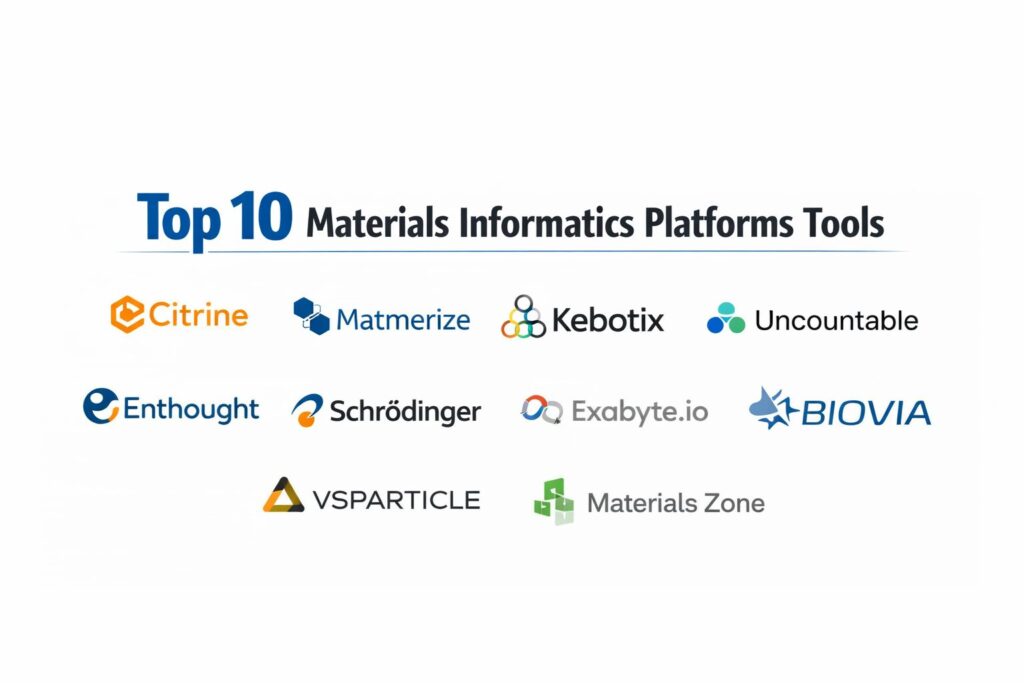
Introduction
Materials Informatics (MI) represents the strategic intersection of materials science, high-performance computing, and data science. These platforms leverage artificial intelligence and machine learning to accelerate the discovery, development, and deployment of new materials, transforming a process that traditionally took decades into one that takes years or even months. By utilizing large-scale datasets—ranging from atomic structures to macroscopic properties—MI platforms allow researchers to perform virtual screening, predict material behavior under various conditions, and optimize manufacturing parameters before a single physical experiment is conducted in a laboratory.
In the current industrial landscape, the shift toward a data-driven approach is no longer optional for organizations aiming to lead in sectors like aerospace, clean energy, and semiconductor manufacturing. Materials Informatics platforms provide the infrastructure to break down data silos, allowing global teams to collaborate on complex chemical spaces and crystalline structures. When evaluating these tools, leadership must look for features such as high-throughput screening capabilities, integration with density functional theory (DFT) simulations, and robust data management systems. A successful MI implementation enables an enterprise to maximize its research and development ROI by focusing laboratory resources only on the most promising material candidates.
Best for: R&D departments in chemicals, metals, and electronics; academic research institutions; and materials engineering firms seeking to reduce time-to-market for innovative substances.
Not ideal for: Organizations focused solely on standard commodity distribution or low-complexity manufacturing that does not involve the development of proprietary chemical compositions or material structures.
Key Trends in Materials Informatics Platforms
The move toward automated “Autonomous Labs” or “Self-Driving Labs” is the most significant shift, where MI platforms are directly integrated with robotic experimental setups to create closed-loop research cycles. Generative AI is increasingly being used to propose entirely new crystal structures and molecular designs that have never been documented in existing databases. There is also a strong trend toward “Multi-Scale Modeling,” where platforms bridge the gap between quantum-level simulations and continuum-level mechanical properties within a single unified workflow.
Cloud-native architectures have become the standard, enabling the massive computational power required for high-throughput screening without the need for localized supercomputing clusters. We are seeing a major focus on data democratization, with platforms offering low-code or no-code interfaces that allow traditional materials scientists to build machine learning models without being experts in Python or R. Furthermore, integration with sustainability metrics is rising, allowing researchers to optimize materials not only for performance but also for carbon footprint and recyclability from the earliest stages of design.
How We Selected These Tools
The selection of these platforms was based on their ability to handle the “full stack” of materials data, from ingestion and cleaning to predictive modeling and experimental validation. We prioritized platforms that demonstrate strong interoperability with existing simulation software and experimental hardware. Market mindshare was evaluated through corporate partnerships and presence in high-impact research publications. We also looked for tools that provide enterprise-grade security, as materials data often represents a company’s most valuable intellectual property.
Technical performance was assessed by looking at the scalability of the platforms’ machine learning architectures and their ability to process diverse data types, including unstructured laboratory notes and structured simulation outputs. We considered the strength of the underlying material databases—such as those containing millions of known crystal structures—that these platforms provide access to. Finally, we evaluated the quality of the user experience, ensuring that the selected tools offer a balance between technical depth for data scientists and accessibility for materials engineers.
1. Citrine Platform
Citrine Informatics is a pioneer in the field, providing an enterprise-grade platform specifically designed to handle the complexity of materials and chemicals data. It excels at managing sparse and noisy datasets, which are common in materials science, and offers a robust suite of AI tools to suggest next-best experiments.
Key Features
The platform features a specialized data model that captures the hierarchical relationship between materials, processing steps, and properties. It includes a powerful AI engine that guides researchers toward optimal material compositions through sequential learning. The system allows for the creation of customized workflows that integrate historical lab data with new simulation results. It provides high-level visualization tools to explore multidimensional design spaces. Additionally, it offers automated data ingestion pipelines to minimize manual entry errors and ensure data consistency across the organization.
Pros
The platform is built specifically for materials science, meaning its AI models are physically informed and highly accurate. It offers excellent collaborative features for large, global research teams.
Cons
The cost of entry is significant, making it more suited for large enterprises than small startups. The initial setup and data migration process require a high level of organizational commitment.
Platforms and Deployment
Cloud-based SaaS platform accessible via web browsers.
Security and Compliance
SOC 2 Type II compliant with robust role-based access control and encryption for data at rest and in transit.
Integrations and Ecosystem
Integrates with standard laboratory information management systems and major simulation packages through a comprehensive API.
Support and Community
Offers dedicated professional services and scientific consulting to ensure successful platform adoption and model development.
2. Matmerize Polymere
Matmerize focuses on the polymer and soft materials industry, offering a cloud-based platform that utilizes deep learning to predict the properties of complex polymeric systems. It is designed to bridge the gap between chemical structure and macroscopic performance.
Key Features
The platform includes a massive pre-trained database of polymer properties, allowing for rapid model deployment. It features a virtual “Polymer Designer” that can suggest chemical modifications to meet specific thermal or mechanical targets. The system supports high-throughput virtual screening of millions of monomer combinations. It provides uncertainty quantification for every prediction, helping researchers assess the risk of their experimental choices. The platform also includes specialized tools for handling copolymers and blends, which are notoriously difficult to model using traditional methods.
Pros
The specialized focus on polymers makes it the most effective tool for industries like plastics, adhesives, and coatings. Its pre-trained models significantly reduce the amount of data a user needs to provide.
Cons
Its narrow focus means it is less effective for researchers working on metals, ceramics, or semiconductors. The user interface is highly technical and specialized for polymer chemists.
Platforms and Deployment
Web-based SaaS deployment.
Security and Compliance
Standard enterprise encryption and secure multi-tenant architecture to protect proprietary chemical structures.
Integrations and Ecosystem
Supports data export to standard chemical modeling formats and provides API access for custom workflow integration.
Support and Community
Direct access to materials science experts and a growing library of polymer-specific technical documentation.
3. Kebotix
Kebotix is at the forefront of the “Self-Driving Lab” movement, offering a platform that combines AI-driven discovery with automated laboratory robotics. Their goal is to create a closed-loop system where the software designs, predicts, and then instructs a robot to perform an experiment.
Key Features
The platform utilizes a proprietary “closed-loop” AI that learns from both successful and failed experiments in real-time. It includes a generative modeling engine that proposes novel molecules with specific target functions. The system features a direct interface for controlling automated chemical synthesis hardware. It provides a unified dashboard for managing both virtual simulations and physical lab results. The platform also offers specialized modules for electronic materials and functional coatings.
Pros
The integration with robotics makes it one of the most advanced systems for accelerating physical discovery. Its generative AI capabilities are excellent for exploring completely new chemical spaces.
Cons
Requires a significant investment in laboratory automation hardware to realize its full potential. The complexity of the system can be daunting for teams without a background in robotics.
Platforms and Deployment
Hybrid deployment with cloud-based AI and local hardware controllers.
Security and Compliance
Adheres to industrial security standards for hardware-software communication and secure data storage.
Integrations and Ecosystem
Strongest integration is with laboratory automation hardware and high-performance computing clusters for DFT simulations.
Support and Community
Focused on high-touch enterprise partnerships and collaborative research projects.
4. Uncountable
Uncountable provides a modern, unified data platform that replaces traditional ELNs and LIMS for materials and chemicals companies. It is designed to be the “central nervous system” of an R&D organization, connecting data from every stage of the lifecycle.
Key Features
The platform features a highly flexible structured data entry system that adapts to any laboratory workflow. It includes built-in machine learning tools that automatically build predictive models as data is entered. The system provides powerful visualization tools, including contour plots and parallel coordinate charts to analyze trade-offs. It features a robust collaboration engine that allows researchers to share datasets and models across departments. The platform also offers automated report generation to streamline the documentation of R&D findings.
Pros
Its greatest strength is its user-friendly interface, which encourages high adoption rates among lab scientists. It excels at turning messy historical lab data into structured, searchable assets.
Cons
The machine learning capabilities, while strong, are more general-purpose than the deeply specialized physics-informed models of some competitors.
Platforms and Deployment
Web-based SaaS with support for all major modern browsers.
Security and Compliance
Enterprise-grade security featuring SSO, MFA, and comprehensive audit logs.
Integrations and Ecosystem
Offers a robust API and a library of connectors for existing laboratory equipment and enterprise software.
Support and Community
Renowned for high-quality customer success teams and rapid feature development based on user feedback.
5. Enthought Edge
Enthought has long been a leader in scientific computing, and their Edge platform provides a specialized environment for materials science R&D. It focuses on digital transformation, helping organizations build proprietary AI capabilities on top of a secure, scientific data infrastructure.
Key Features
The platform provides a centralized hub for managing scientific data, models, and specialized analysis applications. It includes a suite of tools for data cleaning and normalization tailored to materials science. The system supports the development and deployment of custom Python-based machine learning models. It features a “Data Governance” module to ensure that all research data is findable, accessible, interoperable, and reusable (FAIR). The platform also offers specialized capabilities for image analysis and microstructural characterization.
Pros
Excellent for organizations that want to build their own custom, proprietary MI tools on a solid foundational infrastructure. It is highly flexible and can be tailored to very specific research niches.
Cons
Requires a higher degree of programming knowledge (specifically Python) to fully exploit the platform’s capabilities. It is more of an enablement platform than a “turnkey” AI solution.
Platforms and Deployment
Cloud, on-premise, or hybrid deployment options are available.
Security and Compliance
Designed to meet the stringent security requirements of global aerospace and defense firms.
Integrations and Ecosystem
Deeply integrated with the scientific Python ecosystem (SciPy, NumPy, Pandas) and standard simulation tools.
Support and Community
Offers extensive training programs and scientific consulting to help teams build their digital skills.
6. Schrödinger MS Suite
Schrödinger is a giant in the world of molecular modeling, and their Materials Science (MS) Suite provides a comprehensive platform that integrates physics-based simulation with machine learning for advanced material design.
Key Features
The suite features a powerful interface for building and visualizing complex atomic structures. It includes an automated machine learning framework that uses simulation data to train predictive models. The system provides world-class simulation engines for DFT, molecular dynamics, and kinetic Monte Carlo. It features a specialized module for organic electronics and battery materials. The platform also includes a collaborative dashboard for project management and data sharing among research teams.
Pros
The combination of high-fidelity physics simulations and AI makes it one of the most accurate platforms on the market. It is the gold standard for researchers who need atomic-level precision.
Cons
The software is computationally intensive and can be expensive to run at scale. The interface is highly complex and requires significant training for non-computational scientists.
Platforms and Deployment
Local installation with support for high-performance computing (HPC) and cloud-bursting capabilities.
Security and Compliance
Standard high-level software security for academic and commercial research environments.
Integrations and Ecosystem
Extensive support for standard materials data formats and deep integration with its own industry-leading simulation engines.
Support and Community
Exceptional technical support, a massive library of tutorials, and an active global community of computational materials scientists.
7. Exabyte.io (Matereality)
Exabyte.io provides a cloud-native platform that streamlines the process of running large-scale materials simulations and analyzing the resulting data with machine learning. It is designed to make high-performance materials modeling accessible through a web browser.
Key Features
The platform provides a unified interface for setting up and running simulations across multiple HPC providers. It includes an automated data extraction engine that turns raw simulation outputs into structured datasets. The system features a built-in library of thousands of material structures and properties. It provides a collaborative environment where users can share simulation workflows and results. The platform also offers machine learning tools to predict material properties based on accumulated simulation data.
Pros
It removes the hardware barrier for materials modeling, allowing teams to run massive simulations without owning a supercomputer. The interface is highly streamlined and efficient for managing large numbers of jobs.
Cons
The ongoing cost of cloud compute can add up quickly for high-volume users. It is primarily focused on simulation data, with fewer tools for managing physical laboratory results.
Platforms and Deployment
100% cloud-based SaaS.
Security and Compliance
Secure data silos for each tenant and encrypted communication with cloud compute providers.
Integrations and Ecosystem
Integrates with all major open-source and commercial simulation codes and cloud infrastructure providers like AWS and Azure.
Support and Community
Good technical documentation and a responsive support team focused on simulation workflows.
8. Dassault Systèmes (BIOVIA)
BIOVIA, under the Dassault Systèmes umbrella, offers a massive, enterprise-scale platform for materials informatics and laboratory management. It is designed to connect the entire product lifecycle, from initial material discovery to final manufacturing.
Key Features
The platform features a world-class Electronic Lab Notebook (ELN) integrated with advanced data analytics. It includes the Pipeline Pilot tool for creating automated data processing and machine learning workflows. The system provides specialized modules for formulation design, polymers, and catalysts. It features deep integration with the 3DEXPERIENCE platform for digital twin modeling. The platform also offers comprehensive quality and regulatory compliance management tools.
Pros
It is the most complete “end-to-end” solution for large-scale industrial R&D. The ability to connect materials data to the broader manufacturing and design process is unique.
Cons
The platform is exceptionally large and complex, often requiring dedicated IT teams to manage and maintain. It can feel restrictive for researchers who prefer a more agile, lightweight tool.
Platforms and Deployment
Available as an on-premise, cloud, or hybrid solution.
Security and Compliance
Meets the highest global standards for security and regulatory compliance, including GxP and ISO certifications.
Integrations and Ecosystem
Part of the massive Dassault Systèmes ecosystem, with connectors for almost every imaginable enterprise and engineering tool.
Support and Community
Global enterprise support network with specialized consulting and training services.
9. VSPARTICLE
VSPARTICLE focuses on the informatics of nanomaterials and thin-film coatings. Their platform is unique in that it integrates physical nanoparticle generation hardware with a digital design environment for rapid material development.
Key Features
The system features a digital library of nanoparticle-based material properties and structures. It includes tools for predicting the behavior of thin-film coatings based on nanoparticle composition. The platform provides a software interface that controls the deposition and synthesis of nanomaterials in real-time. It features specialized modules for catalysis and gas sensing materials. The system also includes machine learning algorithms to optimize the deposition parameters for desired material outcomes.
Pros
It is the only platform that offers this specific level of integration between nanoparticle synthesis and digital informatics. It is highly effective for researchers in the hydrogen and sensor industries.
Cons
The platform is highly specialized for nanomaterials and is not applicable for bulk metals or structural ceramics. It requires specific hardware to be fully effective.
Platforms and Deployment
Local hardware control software with cloud-based data analysis.
Security and Compliance
Standard industrial security protocols for hardware-software integration.
Integrations and Ecosystem
Strongest integration is with its own proprietary nanoparticle generation and deposition hardware.
Support and Community
Niche community of nanomaterials experts and direct support from the hardware-software engineering teams.
10. Materials Zone
Materials Zone offers a collaborative materials informatics platform that focuses on data management and AI-driven experimentation for a wide range of industries, from energy storage to consumer electronics.
Key Features
The platform features a flexible data ingestion engine that can handle data from diverse sources including CSV, Excel, and API feeds. It includes an automated machine learning pipeline that identifies key correlations in material datasets. The system provides a collaborative workspace for managing multi-partner research projects. It features specialized visualization tools for analyzing material performance across different environmental conditions. The platform also offers a “Marketplace” of pre-built models and datasets for common materials problems.
Pros
It is highly versatile and can be applied to many different types of material challenges. Its collaborative features make it excellent for joint ventures and university-industry partnerships.
Cons
The breadth of the platform means it may lack the extreme technical depth found in specialized tools like Schrödinger or Matmerize.
Platforms and Deployment
Web-based SaaS platform.
Security and Compliance
Complies with standard data protection regulations and offers secure data sharing controls.
Integrations and Ecosystem
Provides a robust API for connecting with laboratory instruments and other third-party software tools.
Support and Community
Offers a professional services team to help users onboard their data and build their first AI models.
Comparison Table
| Tool Name | Best For | Platform(s) Supported | Deployment | Standout Feature | Public Rating |
| 1. Citrine Platform | Enterprise AI R&D | Web | Cloud | Physics-informed AI | 4.8/5 |
| 2. Matmerize | Polymer Science | Web | Cloud | Pre-trained Polymer Models | 4.6/5 |
| 3. Kebotix | Autonomous Labs | Web, Local | Hybrid | Robotic Integration | N/A |
| 4. Uncountable | Lab Data Management | Web | Cloud | User-friendly Structured Data | 4.7/5 |
| 5. Enthought Edge | Custom MI Solutions | Win, Mac, Linux | Hybrid | Scientific Python Core | 4.5/5 |
| 6. Schrödinger MS | Atomic Simulation | Win, Mac, Linux | Local/HPC | DFT & AI Integration | 4.9/5 |
| 7. Exabyte.io | Cloud Simulation | Web | Cloud | Automated HPC Workflows | 4.4/5 |
| 8. BIOVIA | End-to-End Lifecycle | Win, Web | Hybrid | 3DEXPERIENCE Integration | 4.3/5 |
| 9. VSPARTICLE | Nanomaterials | Windows, Web | Local/Cloud | Hardware-Software Sync | N/A |
| 10. Materials Zone | Collaborative Research | Web | Cloud | Versatile Data Ingestion | 4.2/5 |
Evaluation & Scoring of Materials Informatics Platforms
The scoring below is a comparative model intended to help shortlisting. Each criterion is scored from 1–10, then a weighted total from 0–10 is calculated using the weights listed. These are analyst estimates based on typical fit and common workflow requirements, not public ratings.
Weights:
- Core features – 25%
- Ease of use – 15%
- Integrations & ecosystem – 15%
- Security & compliance – 10%
- Performance & reliability – 10%
- Support & community – 10%
- Price / value – 15%
| Tool Name | Core (25%) | Ease (15%) | Integrations (15%) | Security (10%) | Performance (10%) | Support (10%) | Value (15%) | Weighted Total |
| 1. Citrine | 10 | 6 | 9 | 10 | 9 | 9 | 7 | 8.65 |
| 2. Matmerize | 9 | 7 | 8 | 9 | 8 | 8 | 8 | 8.30 |
| 3. Kebotix | 9 | 4 | 7 | 9 | 10 | 8 | 7 | 7.75 |
| 4. Uncountable | 7 | 10 | 9 | 9 | 8 | 10 | 9 | 8.60 |
| 5. Enthought | 8 | 5 | 10 | 10 | 9 | 9 | 8 | 8.10 |
| 6. Schrödinger | 10 | 3 | 10 | 9 | 10 | 9 | 6 | 8.05 |
| 7. Exabyte.io | 8 | 7 | 9 | 8 | 9 | 8 | 8 | 8.10 |
| 8. BIOVIA | 9 | 5 | 10 | 10 | 8 | 8 | 6 | 7.95 |
| 9. VSPARTICLE | 7 | 6 | 6 | 8 | 9 | 8 | 7 | 7.15 |
| 10. Materials Zone | 8 | 8 | 8 | 9 | 8 | 8 | 8 | 8.15 |
How to interpret the scores:
- Use the weighted total to shortlist candidates, then validate with a pilot.
- A lower score can mean specialization, not weakness.
- Security and compliance scores reflect controllability and governance fit, because certifications are often not publicly stated.
- Actual outcomes vary with assembly size, team skills, templates, and process maturity.
Which Materials Informatics Platform Tool Is Right for You?
Solo / Freelancer
For an independent researcher or consultant, a cloud-native platform with a pay-as-you-go or lower entry cost is ideal. Exabyte.io or Materials Zone provide the necessary computational power and data management without requiring an expensive local infrastructure.
SMB
Small to medium businesses should prioritize ease of adoption and immediate value. Uncountable is excellent for organizing lab data quickly, while Matmerize provides pre-trained models that allow a small team to start predicting polymer properties without massive internal datasets.
Mid-Market
Organizations in this tier often need a balance of customizability and power. Enthought Edge provides the framework to build a proprietary competitive advantage, while Citrine Informatics offers a structured path to scaling AI across a growing R&D department.
Enterprise
Large-scale enterprises require the deep integration and regulatory compliance of BIOVIA or the world-class simulation-AI hybrid approach of Schrödinger. These tools are built to handle the massive datasets and complex security requirements of global leaders.
Budget vs Premium
The budget choice often involves utilizing open-source tools within a platform like Enthought, whereas premium solutions like Citrine or Schrödinger offer specialized physics-informed AI that can provide more accurate results with less data.
Feature Depth vs Ease of Use
Schrödinger and Houdini (in other fields) represent the peak of depth, requiring significant expertise. In contrast, Uncountable and Materials Zone prioritize a user-friendly experience that ensures data is captured and utilized by every member of the lab.
Integrations & Scalability
If your goal is to move from discovery to manufacturing, BIOVIA’s link to the broader Dassault Systèmes ecosystem is unmatched. For scaling computational workflows across different cloud providers, Exabyte.io offers the most flexibility.
Security & Compliance Needs
For organizations in aerospace, defense, or pharmaceuticals, the high-level compliance and “on-premise” options provided by BIOVIA and Enthought are often a mandatory requirement to protect high-value material secrets.
Frequently Asked Questions (FAQs)
1. What is the difference between a LIMS and a Materials Informatics platform?
A LIMS is primarily for tracking samples and managing lab workflows, while an MI platform uses the data within those samples to build predictive machine learning models and discover new materials.
2. How much data is needed to start using machine learning for materials?
While more is always better, some platforms can produce useful results with as few as 50 to 100 high-quality experimental data points by using physics-informed algorithms that understand basic chemical principles.
3. Do I need a supercomputer to run these platforms?
No, most modern MI platforms are cloud-based and handle the computational heavy lifting on their own servers or by “bursting” to cloud providers like AWS or Azure.
4. Can these tools predict a material’s lifespan?
Yes, by training models on historical degradation data and environmental conditions, many platforms can predict fatigue, corrosion, and overall service life with high accuracy.
5. Is Materials Informatics only for chemicals and plastics?
Not at all. It is widely used in the development of high-strength alloys, semiconductor thin films, battery electrolytes, and even carbon-capture materials.
6. How do these platforms handle proprietary “secrets”?
Enterprise platforms use dedicated data silos, encryption, and strict role-based access to ensure that your chemical formulations and experimental results are never shared with other users.
7. What is “Physics-Informed” Machine Learning?
This is an AI approach where the model is constrained by known laws of physics, ensuring it doesn’t suggest a material that is mathematically possible but physically impossible to create.
8. Can I integrate my existing Excel spreadsheets?
Almost all MI platforms have bulk-upload tools for Excel and CSV, although the goal of these platforms is eventually to move teams away from fragmented spreadsheets into structured databases.
9. How do these tools speed up discovery?
They reduce the “trial and error” in the lab. Instead of testing 1,000 different mixtures, the AI might identify the top 5 most likely candidates, saving months of laboratory time.
10. Do I need a team of data scientists to use these?
Some platforms require coding, but many are now “low-code,” designed to be used by traditional materials scientists and chemists who understand the lab better than they understand Python.
Conclusion
The adoption of a Materials Informatics platform is a defining step in the digital transformation of any R&D organization. As we move further where sustainability and speed-to-market are the primary drivers of success, the ability to leverage historical data for predictive discovery is a significant competitive advantage. Success in this field requires more than just high-end algorithms; it demands a cultural shift toward structured data capture and cross-disciplinary collaboration. Whether you are optimizing a single polymer or managing a global catalog of advanced alloys, the right MI partner will allow your team to transcend traditional experimental limits. By focusing on interoperability, security, and physics-informed AI, organizations can ensure that their research efforts are always directed toward the most promising frontiers of innovation.