Introduction
Grid operations software represents the mission-control layer of the modern electrical infrastructure, primarily categorized into Energy Management Systems (EMS) for high-voltage transmission and Distribution Management Systems (DMS) for medium-to-low voltage networks. These platforms act as the centralized intelligence hub that integrates SCADA telemetry, geospatial data, and advanced physics-based modeling to ensure the continuous balance of supply and demand. In the current energy landscape, these systems have evolved into Advanced Distribution Management Systems (ADMS), which unify monitoring, outage management, and optimization into a single architectural framework. By processing millions of data points per second, these tools provide operators with the situational awareness required to prevent blackouts, manage frequency stability, and orchestrate complex switching sequences across vast geographical areas.
The necessity for sophisticated grid software has intensified due to the rapid decentralization of energy resources and the increasing volatility of weather patterns. Modern grids are no longer one-way streets; they must now accommodate bidirectional power flows from residential solar, battery storage, and electric vehicle charging stations. For utility organizations, the selection of an EMS or DMS is a generational investment that dictates their ability to meet carbon neutrality goals and maintain resilience against cyber threats. When evaluating these platforms, enterprise buyers must scrutinize the software’s alignment with Common Information Models (CIM), its sub-second latency for real-time control, and the robustness of its contingency analysis engines. Furthermore, as the industry shifts toward “software-defined grids,” the capacity for cloud-native deployment and AI-driven load forecasting has become a critical differentiator for long-term operational success.
Best for: Transmission System Operators (TSOs), Distribution System Operators (DSOs), integrated utilities, and large-scale industrial microgrid managers requiring real-time stability and automated fault restoration.
Not ideal for: Small-scale commercial building managers or standard facility electricians who only require simple energy metering. These platforms are designed for the high-stakes environment of public utility infrastructure and require specialized power systems engineering expertise.
Key Trends in Grid Operations Software
The most significant trend is the transition from reactive monitoring to proactive, “look-ahead” grid management. Advanced platforms now use high-fidelity digital twins to simulate the impact of weather events or equipment failures before they occur, allowing operators to pre-emptively adjust grid topology. There is also a massive shift toward the integration of Distributed Energy Resource Management Systems (DERMS) directly into the ADMS core. This allows utilities to treat thousands of small-scale batteries and solar inverters as a single, controllable “virtual power plant” to support grid frequency and voltage levels.
Cybersecurity has moved to the absolute forefront of development, with a focus on “zero-trust” architectures and hardware-level encryption for field-to-control-room communications. Regulatory compliance, particularly NERC CIP in North America and similar frameworks in Europe, is now baked into the software’s automated audit and patch management workflows. Additionally, there is an increasing move toward hybrid cloud deployments, where the mission-critical “heart” of the grid control remains on-premise for latency and security, while heavy data analytics and long-term forecasting modules are offloaded to scalable cloud environments for better processing power.
How We Selected These Tools
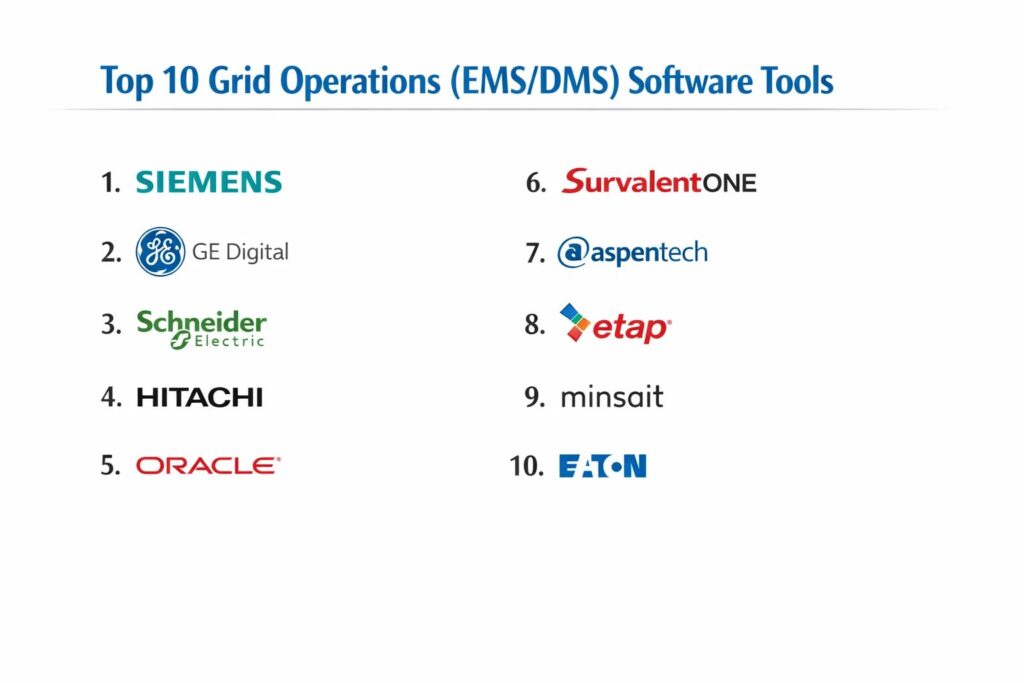
Our selection process for these top 10 platforms focused on technical maturity, global deployment footprint, and the ability to handle the “triple threat” of modern grid management: decarbonization, decentralization, and digitalization. We prioritized vendors with a long-standing history in power systems engineering who have successfully modernized their legacy codebases into modular, service-oriented architectures. Market adoption was a primary filter, as the value of these systems often depends on a robust ecosystem of third-party integrators and a steady supply of trained operators.
We also conducted a deep-dive into the “Advanced Apps” provided by each suite, specifically looking for best-in-class performance in Fault Location, Isolation, and Service Restoration (FLISR) and Volt/VAR Optimization (VVO). The ability to integrate seamlessly with Geospatial Information Systems (GIS) and Advanced Metering Infrastructure (AMI) was a critical requirement for inclusion. Finally, we assessed the vendor’s commitment to open standards, ensuring that the selected platforms can operate in multi-vendor environments without creating proprietary data silos that hinder future innovation.
1. Siemens Spectrum Power
Siemens Spectrum Power is a highly modular platform designed for the full spectrum of grid management, from small municipal utilities to massive national transmission networks. It is renowned for its “Multi-Control” capability, which allows different grid segments (Transmission, Distribution, and Market) to be managed through a single, unified architectural interface.
Key Features
The platform features a world-class state estimation engine that provides highly accurate grid models even with incomplete sensor data. It includes advanced “Gridscale X” modules for low-voltage management and renewable orchestration. The system offers integrated heads-up displays for operators that prioritize alarms based on their potential impact on grid stability. It supports automated “Islanding” detection for microgrids and features high-fidelity simulation for operator training. Additionally, it provides deep integration with PSS SINCAL for advanced offline planning and protection studies.
Pros
The software is exceptionally stable and follows a modular “future-proof” design that allows utilities to add features as their grid matures. It has one of the strongest global support networks in the industry.
Cons
The initial implementation and customization process can be extremely lengthy and technically demanding. The total cost of ownership is among the highest in the market.
Platforms and Deployment
Windows and Linux. Supports on-premise, hybrid, and secure private cloud deployments.
Security and Compliance
Full NERC CIP compliance and adherence to IEC 62443 standards. Includes multi-layer security verified by regular third-party audits.
Integrations and Ecosystem
Seamlessly integrates with Siemens’ broader energy portfolio and major third-party GIS, AMI, and ERP systems via standard CIM interfaces.
Support and Community
Provides 24/7 global mission-critical support and hosts extensive user group conferences for knowledge sharing.
2. GE Digital GridOS
GE Digital’s GridOS is a modern, orchestration-focused platform designed to manage the complexities of a sustainable energy transition. It is particularly strong in “Advanced Energy Management” (AEMS) and features a unique “DERMS Gateway” for high-scale connectivity with residential energy resources.
Key Features
GridOS utilizes a dedicated “Grid Data Fabric” that unifies data from across the enterprise, including weather and market signals. Its AEMS module offers industry-leading inertia management and renewable forecasting. The platform includes AI-driven modeling for complex “what-if” scenarios and real-time contingency analysis. It features a modern, web-native user interface that reduces operator fatigue and improves reaction times during disturbances. The software also includes specialized tools for dynamic line rating, allowing utilities to maximize transmission capacity based on real-time ambient conditions.
Pros
It is widely considered the best-in-class for managing grids with high penetrations of solar, wind, and electric vehicles. The real-time visual analytics are highly advanced.
Cons
The shift to the new GridOS architecture may require significant upgrade efforts for existing legacy GE customers. It requires powerful, modern server infrastructure to run optimally.
Platforms and Deployment
Cloud-native architecture that supports hybrid and on-premise configurations.
Security and Compliance
Natively built with a zero-trust security model; compliant with NERC CIP and SOC2 standards.
Integrations and Ecosystem
Strongest integration with GE’s own hardware and software ecosystem, but also provides robust APIs for third-party DER and AMI platforms.
Support and Community
Extensive online “Education Services” and a global network of specialized systems integrators.
3. Schneider Electric EcoStruxure ADMS
EcoStruxure ADMS is a market-leading distribution management solution that merges SCADA, DMS, and Outage Management (OMS) into a single, cohesive platform. It is designed to maximize the efficiency of distribution networks through advanced automation and data-driven optimization.
Key Features
The platform features over 50 advanced functions, including highly automated FLISR and VVO for reducing energy losses. It provides a “step-wise” deployment model, allowing utilities to start with basic SCADA and grow into a full ADMS. The system includes a sophisticated “Network Planning” module that uses real-time data to inform future infrastructure investments. It offers a unified representation of the entire distribution network, including underground and complex urban grids. It also features “Major Event Mitigation” tools to help control rooms manage large-scale storm responses.
Pros
It is highly praised for its modularity and its ability to significantly reduce outage durations through automated restoration logic. The user interface is highly intuitive for distribution operators.
Cons
Managing the transition of GIS data into the ADMS model can be labor-intensive. Some users find the advanced configuration menus to be overly complex.
Platforms and Deployment
Windows-based with SaaS and hybrid cloud options available.
Security and Compliance
Adheres to IEC 62443 and NERC CIP; includes robust encryption for all field and substation communications.
Integrations and Ecosystem
Exceptional connectivity with Schneider Electric’s wide range of smart grid hardware and building management systems.
Support and Community
Massive global footprint with specialized local support teams in almost every major region.
4. Hitachi Energy Network Manager
Network Manager is a powerhouse platform for managing large-scale, high-voltage transmission and complex distribution networks. Following the acquisition of ABB’s Power Grids business, this tool has become a central pillar for managing some of the world’s most critical electrical infrastructure.
Key Features
The platform is optimized for the management of High-Voltage Direct Current (HVDC) links and massive inter-regional power transfers. It includes a sophisticated “Generation Management System” for balancing supply in real-time. The DMS component offers advanced fault management and load shedding logic. It features a high-performance historical archiver for post-event analysis and regulatory reporting. The software also includes an “Operator Training Simulator” that can recreate thousands of grid failure scenarios for staff certification.
Pros
Unmatched reliability in high-voltage transmission environments. The software is designed to handle extremely large datasets without performance degradation.
Cons
The platform has a more traditional “industrial” user interface that may feel less modern than some cloud-native competitors. It requires a high degree of specialized training to manage.
Platforms and Deployment
Windows and Linux supported. Primarily deployed on-premise for maximum security and low-latency control.
Security and Compliance
Rigorous NERC CIP compliance and FIPS 140-2 encryption for sensitive data.
Integrations and Ecosystem
Strongest when paired with Hitachi/ABB hardware, but maintains high interoperability through standard utility protocols (ICCP, DNP3, IEC 61850).
Support and Community
Provides deep technical support and has a long history of partnership with national and regional grid authorities.
5. Oracle Utilities Network Management System (NMS)
Oracle NMS is a specialized, data-heavy platform that excels in outage management and the orchestration of complex network activities for large-scale utilities. It is known for its “Supportability” and its ability to handle massive spikes in data during extreme weather events.
Key Features
The software provides a “second-to-none” Outage Management System (OMS) that automates the entire restoration workflow from customer call to truck roll. It features a sophisticated “Switching Tool” that prevents operator error during hazardous manual switching. The platform includes a “Study Mode” where operators can test switching plans in a private environment before execution. It offers AI-assisted load and weather forecasting to predict outage locations. The system also integrates deeply with workforce management to coordinate thousands of field crews in real-time.
Pros
The scalability of the underlying Oracle database allows it to handle data volumes that would crash smaller systems. It is the gold standard for storm response and outage orchestration.
Cons
The platform is very technical and requires a strong internal IT/DBA team to maintain. Customization requests can take longer to implement compared to more agile vendors.
Platforms and Deployment
Leverages Oracle’s “Hardened” cloud and database infrastructure; supports hybrid and on-premise.
Security and Compliance
Enterprise-grade security; NERC CIP, GDPR, and SOC2 ready.
Integrations and Ecosystem
Deepest integration with the broader Oracle Utilities suite, including Billing (CIS) and Asset Management (EAM).
Support and Community
Features a very strong and vocal user community that helps drive the product’s long-term roadmap.
6. SurvalentONE ADMS
SurvalentONE is a highly integrated SCADA, OMS, and DMS solution designed primarily for municipal and cooperative utilities. It is focused on providing a “low total cost of ownership” while delivering high-end functionality.
Key Features
The platform utilizes a single, unified database and graphical interface for all roles, which simplifies maintenance and training. It includes a unique “IED Control Panel” that provides photo-realistic representations of substation equipment for remote operation. The system features “WebSurv,” giving authorized users read-only access to grid data from any browser. It provides advanced VVO and FLISR capabilities that are easy to configure without complex coding. The software also supports NERC-compliant Area Control Error (ACE) calculations for balancing authorities.
Pros
Outstanding value; it provides approximately 80% of the features of the “giants” at a fraction of the cost. It is widely praised for its ease of use and rapid deployment.
Cons
It may lack some of the deepest transmission-level “Stability Analysis” tools found in Siemens or Hitachi systems. The product catalog is more focused on distribution than high-voltage bulk power.
Platforms and Deployment
Windows-based. Supports local and secure cloud-hosted configurations.
Security and Compliance
Includes sophisticated authentication and secure multi-level tagging to prevent unauthorized control of devices.
Integrations and Ecosystem
Highly compatible with standard Microsoft Office productivity tools for easy reporting and data dissemination.
Support and Community
Extremely high customer satisfaction ratings for their direct support and regional training sessions.
7. AspenTech OSI Monarch
AspenTech’s OSI Monarch is a flexible, real-time platform that provides a “Unified Architecture” for SCADA, EMS, and DMS. It is favored by utilities that want a modern, high-performance system that is easy to upgrade.
Key Features
Monarch features an “Evergreen” upgrade path that allows utilities to stay on the latest version without painful re-implementations. It includes a powerful “Generation Management System” for balancing transmission-level assets. The platform offers best-in-class visualization with advanced situational awareness tools that highlight grid anomalies. It features a cloud-scalable SCADA solution that addresses the needs of modern, distributed networks. The software also provides a high-fidelity “Operator Training Simulator” that covers the full spectrum of grid emergencies.
Pros
The software is exceptionally fast and responsive, even with high polygon-count geospatial maps. It has a very high reputation for cybersecurity readiness and ease of maintenance.
Cons
Following its acquisition by AspenTech, some users are closely watching how the product will be integrated into the broader industrial software suite. It requires a disciplined approach to data modeling.
Platforms and Deployment
Windows and Linux supported. Offers a managed cloud-hosted offering for smaller utilities.
Security and Compliance
Leading cybersecurity posture with best-in-class tools for NERC CIP compliance.
Integrations and Ecosystem
Aligned with open IT standards, enabling easy enterprise integration with GIS and historical data warehouses.
Support and Community
Provides excellent training programs and has a very loyal install base across North America and Asia.
8. ETAP ADMS
ETAP is a “Model-Driven” platform that uses a unified digital twin to manage the entire power system lifecycle, from design and analysis to real-time operation. It is the preferred choice for utilities that require high-precision physics-based calculations.
Key Features
The platform features an “eSCADA” system that is directly linked to its world-famous analytical engine. It offers “Intelligent Load Shedding” (ILS) that uses machine learning to prevent blackouts during rapid frequency drops. The system includes specialized “Grid Code” compliance modules for renewable interconnection. It provides real-time “Arc Flash” analysis to ensure operator safety during switching operations. The software also features an integrated Microgrid Controller that can manage the transition from grid-connected to islanded mode autonomously.
Pros
The accuracy of the underlying power flow and transient stability engines is unmatched. It is the only platform that truly bridges the gap between engineering design and real-time control.
Cons
The platform’s high level of technical detail can make it “heavy” for operators who only need simple monitoring. It requires a high level of engineering skill to set up correctly.
Platforms and Deployment
Windows-based. Supports local, hybrid, and secure cloud environments.
Security and Compliance
Complies with the highest mission-critical standards, including U.S. Code of Federal Regulations and NERC CIP.
Integrations and Ecosystem
Excellent integration with ETAP’s own line of control hardware (iCE) and a wide range of CAD and GIS tools.
Support and Community
Global reputation for deep domain expertise; provides some of the most technical training in the industry.
9. Minsait ACS PRISM ADMS
Minsait (an Indra company) offers the PRISM ADMS, which is a modular system designed for the digital transformation of utilities. It focuses on the convergence of SCADA, DMS, and OMS into a single real-time operational environment.
Key Features
The platform includes an advanced “Volt-VAR Management” system for loss reduction and voltage profile optimization. It features an integrated “FDIR” (Fault Detection, Isolation, and Restoration) engine that is highly customizable for different feeder topologies. The system provides a unified visualization for all operational data, including real-time AMI alerts. It offers specialized “DER Hosting Capacity” analysis to help utilities plan for new solar connections. The software also features a robust historical archive and an automated reporting engine for regulatory KPIs.
Pros
The platform is highly flexible and can be customized for specific regional grid requirements. It offers a very modern and clean user interface that simplifies complex grid states.
Cons
The brand has a stronger presence in Europe and Latin America than in North America. Documentation and community resources are less abundant than the top three vendors.
Platforms and Deployment
Windows and Linux supported. Cloud-ready and hybrid deployment options.
Security and Compliance
Compliant with international standards like ISO 27001 and IEC 62443; includes advanced RBAC (Role-Based Access Control).
Integrations and Ecosystem
Uses standard Web Services and CIM-based adapters to integrate with third-party GIS and asset management systems.
Support and Community
Offers dedicated regional support teams and a growing ecosystem of utility partners.
10. Eaton (CYME / Visual T&D)
Eaton’s grid software suite, centered around CYME and Visual T&D, provides a robust environment for distribution network analysis and real-time operational monitoring. It is known for its strong synergy between power hardware and software logic.
Key Features
The platform features advanced “Network Modeling” that allows for sub-second analysis of distribution feeders. It includes specialized tools for “Protective Device Coordination” to prevent false tripping and misoperation. The software offers real-time visualization of SCADA data alongside historical performance metrics. It provides a dedicated “Microgrid Management System” that optimizes the use of on-site generation and storage. The system also includes automated “Switching Management” to improve crew safety and network reliability during maintenance.
Pros
The software is built by one of the world’s leading electrical equipment manufacturers, ensuring it deeply understands hardware limitations. It is very reliable in industrial and utility distribution settings.
Cons
It is often seen more as an “Analysis” tool that has been expanded into operations, rather than a “Control-first” platform like Maya or Spectrum. The UI is functional but lacks some of the modern flair of competitors.
Platforms and Deployment
Windows-only. Primarily local installation with some hybrid monitoring capabilities.
Security and Compliance
Robust cybersecurity features are built into both the software and the supporting Eaton hardware; NERC CIP ready.
Integrations and Ecosystem
Exceptional integration with Eaton’s massive portfolio of transformers, switchgear, and protective relays.
Support and Community
Massive global service network and a very strong reputation for hardware-software synergy and long-term reliability.
Comparison Table
| Tool Name | Best For | Platform(s) Supported | Deployment | Standout Feature | Public Rating |
| 1. Siemens Spectrum | Global Regional Grids | Win, Linux | Hybrid | Unified Multi-Control | 4.8/5 |
| 2. GE Digital GridOS | Renewable Integration | Cloud-Native | Cloud/Hybrid | Grid Data Fabric | 4.9/5 |
| 3. Schneider ADMS | Distribution Efficiency | Windows | Hybrid/SaaS | Step-wise Modular ADMS | 4.7/5 |
| 4. Hitachi Network Mgr | High-Voltage/HVDC | Win, Linux | On-prem | Transmission Stability | 4.6/5 |
| 5. Oracle Utilities NMS | Storm/Outage Orchest. | Oracle Cloud | Hybrid | OMS Scalability | 4.5/5 |
| 6. SurvalentONE | Munis & Cooperatives | Windows | Cloud/Local | Unified Toolset/UX | 4.4/5 |
| 7. AspenTech Monarch | Agile Grid Control | Win, Linux | Cloud/Local | Evergreen Upgrade Path | 4.6/5 |
| 8. ETAP ADMS | Model-Driven Control | Windows | Cloud/Local | Physics-based Engine | 4.7/5 |
| 9. Minsait PRISM | European/LATAM Grids | Win, Linux | Cloud-ready | Volt-VAR Optimization | 4.3/5 |
| 10. Eaton Visual T&D | Industrial Distribution | Windows | Local | Hardware-Software Synergy | 4.2/5 |
Evaluation & Scoring of Grid Operations Software
The scoring below is a comparative model intended to help shortlisting. Each criterion is scored from 1–10, then a weighted total from 0–10 is calculated using the weights listed. These are analyst estimates based on typical fit and common workflow requirements, not public ratings.
Weights:
- Core features – 25%
- Ease of use – 15%
- Integrations & ecosystem – 15%
- Security & compliance – 10%
- Performance & reliability – 10%
- Support & community – 10%
- Price / value – 15%
| Tool Name | Core (25%) | Ease (15%) | Integrations (15%) | Security (10%) | Performance (10%) | Support (10%) | Value (15%) | Weighted Total |
| 1. Siemens | 10 | 6 | 10 | 10 | 9 | 10 | 6 | 8.85 |
| 2. GE Digital | 10 | 8 | 9 | 10 | 10 | 9 | 7 | 9.10 |
| 3. Schneider | 10 | 7 | 10 | 9 | 9 | 10 | 7 | 8.90 |
| 4. Hitachi | 10 | 5 | 8 | 10 | 10 | 9 | 6 | 8.35 |
| 5. Oracle | 9 | 6 | 9 | 10 | 9 | 9 | 7 | 8.30 |
| 6. SurvalentONE | 7 | 10 | 7 | 8 | 8 | 10 | 10 | 8.40 |
| 7. AspenTech | 9 | 7 | 9 | 10 | 9 | 9 | 8 | 8.60 |
| 8. ETAP | 10 | 5 | 8 | 10 | 10 | 10 | 8 | 8.65 |
| 9. Minsait | 8 | 8 | 8 | 9 | 8 | 8 | 8 | 8.10 |
| 10. Eaton | 7 | 7 | 8 | 9 | 8 | 9 | 8 | 7.80 |
How to interpret the scores:
- Use the weighted total to shortlist candidates, then validate with a pilot.
- A lower score can mean specialization, not weakness.
- Security and compliance scores reflect controllability and governance fit, because certifications are often not publicly stated.
- Actual outcomes vary with assembly size, team skills, templates, and process maturity.
Which Grid Operations Tool Is Right for You?
Solo / Freelancer
For independent microgrid operators or small industrial site managers, a tool like SurvalentONE or Eaton Visual T&D is often the best choice. These platforms provide high-end SCADA and monitoring without the massive overhead and technical complexity of national-scale systems.
SMB
Small and medium-sized cooperatives benefit from integrated solutions that combine SCADA, OMS, and DMS into a single interface. SurvalentONE is specifically designed for this market, offering a “one-stop-shop” that is easy for a small IT team to manage.
Mid-Market Utility
Mid-market organizations often require the advanced optimization features of an ADMS (like VVO and FLISR) but still prioritize ease of maintenance. Schneider Electric’s EcoStruxure ADMS is highly effective here, providing a modular path to a fully digitalized grid.
Enterprise
Large Transmission System Operators (TSOs) require the absolute highest level of stability and analytical depth. Siemens Spectrum Power and Hitachi Energy Network Manager are the industry standards for these massive, high-voltage environments where failure is not an option.
Budget vs Premium
If the primary goal is maximum features per dollar, SurvalentONE and AspenTech OSI offer incredible value. However, for organizations that require the most advanced AI forecasting and renewable integration, the premium cost of GE Digital GridOS is justified by the operational gains.
Feature Depth vs Ease of Use
ETAP provides the most profound feature depth for engineering-heavy teams, while Siemens and GE offer the best “Heads-up” displays for real-time operations. If ease of use and rapid operator training are the priority, Survalent and Schneider lead the way.
Integrations & Scalability
GE Digital and Oracle offer the best scalability for data-heavy utilities, leveraging modern “Data Fabric” and database technologies. Siemens and Hitachi remain the leaders for integrating complex power hardware into a unified control logic.
Security & Compliance Needs
For utilities under strict NERC CIP or critical infrastructure regulations, Siemens, Hitachi, and OSI provide the most mature compliance toolsets. These platforms are designed to handle the rigorous auditing and secure segmentation required for national security assets.
Frequently Asked Questions (FAQs)
1. What is the main difference between EMS and DMS?
Energy Management Systems (EMS) are used by transmission operators to balance bulk power generation and high-voltage transport. Distribution Management Systems (DMS) manage the delivery of that power to end-users, focusing on voltage regulation, outages, and local feeder stability.
2. How does an ADMS differ from a traditional DMS?
An Advanced Distribution Management System (ADMS) integrates the traditional DMS with SCADA and an Outage Management System (OMS) into a single unified platform. This allows for automated actions like self-healing grids (FLISR) that were previously manual.
3. Is cloud deployment safe for grid operations?
Modern grid platforms use “Hybrid Cloud” models where the real-time control stays on-premise for security and speed, while data-heavy analytics like long-term forecasting run in secure, hardened cloud environments like Azure or Oracle Government Cloud.
4. What is FLISR?
FLISR stands for Fault Location, Isolation, and Service Restoration. It is an automated system that detects a grid fault, isolates the damaged section, and automatically reroutes power to unaffected customers, often in under a minute.
5. How do these platforms handle solar and wind power?
Advanced systems use DERMS (Distributed Energy Resource Management Systems) modules to monitor and forecast renewable output. They can automatically adjust grid parameters or command smart inverters to stabilize the grid when clouds pass or wind drops.
6. What is a “Digital Twin” in grid operations?
A Digital Twin is a software-based replica of the physical electrical network. Operators use it to run “what-if” simulations, such as testing a switching plan or a new generator connection, to see the results before making changes in the real world.
7. Do I need a GIS system to use these tools?
Yes, a Geographic Information System (GIS) is the “system of record” for where poles, wires, and transformers are located. The ADMS imports this data to build its electrical model; without accurate GIS, the ADMS cannot function effectively.
8. What is the learning curve for these platforms?
The learning curve is significant, typically requiring 3–6 months for basic proficiency and up to two years for expert-level mastery. Most vendors provide specialized “Operator Training Simulators” (OTS) to help accelerate this process.
9. Can these tools prevent cyberattacks?
While no software is 100% immune, these platforms include “Defense-in-Depth” security like role-based access, encrypted field communications, and automated audit logs that make it significantly harder for an attacker to gain control of the grid.
10. How long does a typical implementation take?
For a mid-sized utility, a full ADMS implementation can take anywhere from 12 to 24 months. This includes data cleaning, model building, hardware installation, and extensive user acceptance testing before going “live.”
Conclusion
The transition to a decentralized, renewable-heavy energy system has turned grid operations software from a back-office tool into the primary engine of utility survival. Selecting between these top 10 platforms requires a deep understanding of your organization’s specific technical maturity and the unique physical characteristics of your network. Whether you prioritize the high-voltage stability of a system like Hitachi, the data-driven outage management of Oracle, or the physics-based precision of ETAP, the goal remains the same: ensuring a resilient, efficient, and safe supply of electricity. The ability of these tools to automate the “self-healing” grid and orchestrate millions of distributed assets will be the defining factor in the global race toward energy security and decarbonization.