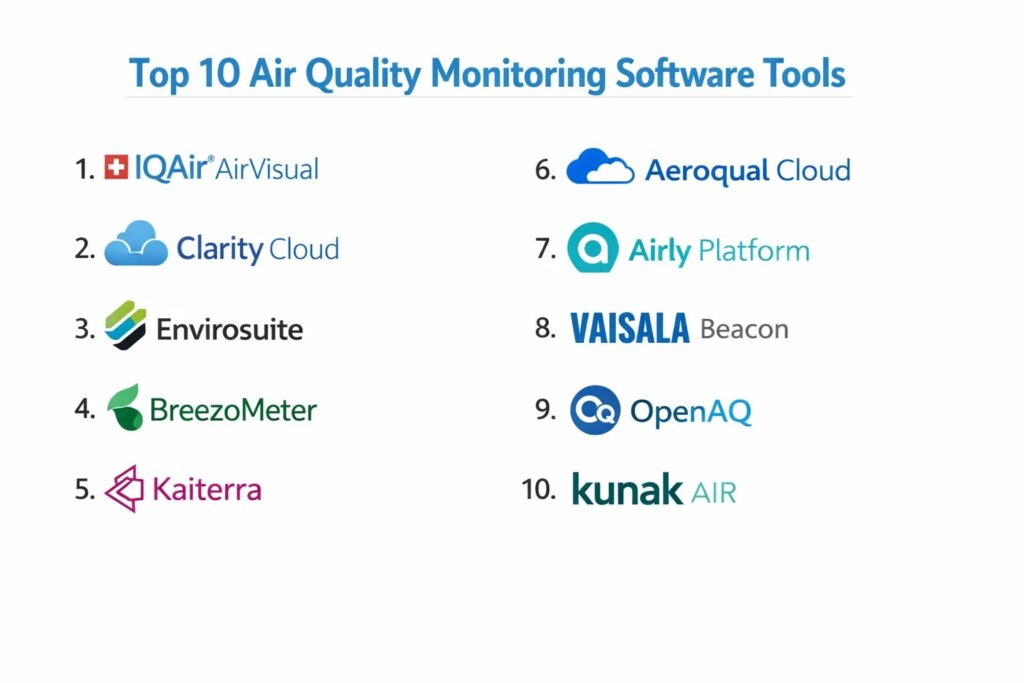
Introduction
Air quality monitoring software has transitioned from a niche environmental tool to a mission-critical component of modern industrial operations and urban management. These platforms serve as the intelligence layer that aggregates raw data from distributed sensor networks—measuring pollutants such as particulate matter ($PM_{2.5}$, $PM_{10}$), Nitrogen Dioxide ($NO_{2}$), and Volatile Organic Compounds (VOCs)—and transforms it into actionable insights. For a career professional in DevOps or SRE, these systems represent a complex intersection of IoT telemetry, real-time data processing, and rigorous regulatory compliance. They enable organizations to move beyond reactive reporting toward predictive environmental management, using atmospheric modeling to anticipate pollution events before they impact public health or operational uptime.
The strategic deployment of these software solutions is essential for navigating the evolving landscape of Environmental, Social, and Governance (ESG) mandates. Beyond simple data visualization, high-tier air quality platforms offer automated calibration, sensor health diagnostics, and integration with Building Management Systems (BMS) to optimize indoor ventilation. In industrial contexts, these tools act as an early warning system for leak detection and emission excursions, protecting both the workforce and the surrounding community. Choosing the right software requires a deep understanding of data high-availability, the precision of underlying algorithms, and the ability to maintain a secure, tamper-proof audit trail for regulatory submission.
Best for: Environmental Health and Safety (EHS) managers, smart city planners, industrial plant operators, and facilities managers seeking to meet LEED or WELL building certifications.
Not ideal for: Small residential users looking for basic home weather updates, or businesses without a requirement for localized, high-precision atmospheric data.
Key Trends in Air Quality Monitoring Software
A primary trend in the sector is the move toward “Sensing-as-a-Service,” where the software platform is bundled with hardware maintenance and automated remote calibration. This reduces the total cost of ownership and ensures that data remains scientifically defensible without requiring a team of chemists on-site. Artificial Intelligence is also playing a larger role through “virtual sensing,” where machine learning models fill in data gaps between physical stations by correlating weather patterns, traffic flow, and satellite imagery.
Furthermore, there is an increasing focus on hyper-local data granularity. Modern software can now provide street-level resolution, which is vital for urban planning and “active routing” for pedestrians and cyclists. We are also seeing a convergence between indoor and outdoor monitoring, with unified dashboards that show how external pollution affects internal air changes. This holistic view is becoming a standard requirement for “Green Building” initiatives and corporate wellness programs.
How We Selected These Tools
The selection process for these ten platforms focused on technical robustness and the ability to handle large-scale, high-velocity data streams. We prioritized software that offers advanced API capabilities, allowing for seamless integration into broader enterprise ecosystems and automated reporting workflows. Stability and uptime were critical metrics, as environmental monitoring often supports safety-critical decisions in industrial environments.
We also looked for geographic versatility and the ability to integrate diverse data sources, from low-cost IoT sensors to regulatory-grade reference stations. Security was a major factor; we selected tools that demonstrate a commitment to data integrity and offer secure, role-based access control. Finally, we evaluated the “actionability” of the software—how effectively it translates complex chemical concentrations into clear, threshold-based alerts and long-term trend analysis for executive decision-making.
1. IQAir AirVisual
IQAir AirVisual is the most globally recognized platform for aggregating public and private air quality data. It provides a comprehensive ecosystem that combines satellite imagery with data from over 10,000 monitoring stations worldwide, making it the gold standard for global situational awareness and public communication.
Key Features
The platform offers a high-resolution global map with real-time Air Quality Index (AQI) tracking and 7-day forecasting. It includes an enterprise dashboard for managing fleets of indoor and outdoor sensors across multiple global locations. The software provides health recommendations based on specific pollutant levels and integrates with a public-facing API for developers. It also features a “Community” module where users can share local data to fill in gaps in the global grid.
Pros
Unmatched global dataset and a highly intuitive user interface. It is excellent for multi-country corporate footprints that need a unified view of employee exposure.
Cons
High-resolution historical data and certain advanced analytics features are locked behind a professional subscription tier.
Platforms and Deployment
Web-based dashboard with native mobile applications for iOS and Android.
Security and Compliance
Standard data encryption with secure API endpoints and GDPR-compliant data handling for individual users.
Integrations and Ecosystem
Strong API for third-party websites and integration with various smart home and building automation systems.
Support and Community
Extensive documentation and a massive global community of environmental advocates and researchers.
2. Clarity Cloud
Clarity Cloud is designed for high-density urban and industrial monitoring using a “Sensing-as-a-Service” model. It focuses on providing reliable, scalable data through a network of ruggedized IoT sensors that require minimal manual intervention.
Key Features
The software specializes in “Remote Calibration,” using machine learning to adjust sensor data based on nearby reference stations. It features a robust fleet management dashboard that tracks the battery life and signal strength of every node in the network. The platform provides automated alerts and specialized tools for “co-location” studies. It also offers a public-facing web portal for cities to share data directly with residents in a transparent, easy-to-digest format.
Pros
Highly reliable for large-scale outdoor deployments where manual maintenance is difficult. The automated calibration significantly increases data accuracy over time.
Cons
Primarily optimized for use with Clarity’s own hardware, which may limit flexibility for teams with existing sensor infrastructure.
Platforms and Deployment
Fully cloud-based SaaS platform accessible via any modern web browser.
Security and Compliance
Strong focus on data integrity with encrypted transmission and secure cloud storage.
Integrations and Ecosystem
Open API for integration with Smart City platforms and environmental data management systems.
Support and Community
Dedicated environmental project managers and technical support for large-scale government and industrial clients.
3. Envirosuite
Envirosuite is an enterprise-grade environmental intelligence platform used by airports, mines, and heavy industries. It provides sophisticated predictive modeling to help operators understand how their activities impact the surrounding environment.
Key Features
The platform features “Impact Modeling,” which uses real-time weather data to predict the dispersion of dust, odor, and noise. It provides a dedicated module for incident management and community complaint investigation. The software includes high-level risk assessment tools that allow operators to adjust activities before they violate regulatory thresholds. It also offers automated compliance reporting tailored to specific regional environmental agencies.
Pros
The predictive capabilities are industry-leading, allowing for proactive operational adjustments. It handles multiple environmental factors (air, noise, water) in one platform.
Cons
The software is complex and requires specialized training to utilize its full modeling potential.
Platforms and Deployment
Enterprise SaaS with high-availability cloud deployment.
Security and Compliance
ISO 27001 certified with SOC 2 Type II compliance, ensuring it meets the strictest corporate security requirements.
Integrations and Ecosystem
Integrates with industrial SCADA systems and high-precision meteorological stations.
Support and Community
Professional enterprise support with 24/7 technical assistance for critical operations.
4. BreezoMeter (by Google)
Now part of Google, BreezoMeter is an API-first software platform that focuses on street-level air quality intelligence. It uses sophisticated atmospheric modeling rather than relying solely on physical hardware at every location.
Key Features
The software provides hyper-local air quality data with a 5-meter resolution, including detailed information on pollen and wildfires. It uses a proprietary algorithm that calculates data based on traffic patterns, satellite data, and weather. The API is designed for high-volume requests, making it ideal for integration into health apps, automotive navigation, and real estate portals. It also includes “Health Recommendations” that are dynamically updated based on the specific pollutants present.
Pros
Extremely high resolution in urban areas and a developer-friendly API. It provides a wealth of secondary data like pollen counts and fire tracking.
Cons
Because it relies heavily on modeling, its accuracy in remote areas without reference stations can be less certain than direct sensing.
Platforms and Deployment
API-driven cloud service with a web dashboard for enterprise monitoring.
Security and Compliance
Leverages Google’s world-class cloud security infrastructure and global data privacy standards.
Integrations and Ecosystem
Natively integrated with Google Cloud and a wide range of consumer health and fitness applications.
Support and Community
Extensive developer documentation and enterprise support through Google Cloud channels.
5. Kaiterra Enterprise
Kaiterra focuses on the commercial real estate and workplace sector, specializing in high-performance Indoor Air Quality (IAQ) monitoring to meet building certifications like WELL and LEED.
Key Features
The platform provides a centralized dashboard for managing the air quality of entire building portfolios. It features a “Smart Building” integration that allows the software to trigger HVAC adjustments when $CO_{2}$ or VOC levels rise. It offers specialized reporting for ESG compliance and building certification audits. The software includes “Kiosk Mode” for public displays in lobbies to show occupants that the air is safe and well-managed.
Pros
Tailor-made for the needs of facilities managers and property owners. The integration with Building Management Systems (BMS) provides direct ROI through energy savings.
Cons
The focus is almost entirely on indoor environments, making it less suitable for outdoor or industrial perimeter monitoring.
Platforms and Deployment
Cloud-based SaaS with mobile management tools.
Security and Compliance
Complies with RESET and other building-specific data standards; features secure device-to-cloud communication.
Integrations and Ecosystem
Native integrations with major BMS providers and workplace management software like Appspace.
Support and Community
Expert support in the commercial real estate and sustainable building sectors.
6. Aeroqual Cloud
Aeroqual is the choice for industrial and regulatory users who require “near-reference” data that is defensible in legal or regulatory contexts. It is heavily used in construction, remediation, and research.
Key Features
The software provides an advanced “Data Validation” suite that identifies and flags anomalies or sensor errors automatically. It features a “Site Management” dashboard that allows users to monitor environmental impacts across multiple project sites. The system generates regulatory-grade reports with a single click. It also includes a specialized calibration toolset that guides technicians through the process of field-verifying sensors against reference standards.
Pros
Provides the most rigorous data audit trails in the low-cost sensor market. It is highly trusted by environmental consultants and government agencies.
Cons
The user interface is more technical and “functional” than some of the more design-focused consumer platforms.
Platforms and Deployment
Web-based SaaS with secure data hosting.
Security and Compliance
Features tamper-proof logs and robust data encryption, meeting strict environmental agency standards.
Integrations and Ecosystem
Integrates with various third-party meteorological and vibration sensors.
Support and Community
Technical support from environmental scientists and detailed “how-to” guides for regulatory compliance.
7. Airly Data Platform
Airly is a European-based platform that has grown rapidly by providing an end-to-end solution for cities and communities. It emphasizes high-visibility mapping and public engagement.
Key Features
The platform features an AI-powered 24-hour pollution forecast for $PM_{2.5}$ and $NO_{2}$. It includes a “Community Engagement Tracker” that allows city officials to see how many residents are interacting with the air quality data. The software provides automatic “factsheets” for specific locations, summarizing air quality trends over months or years. It also supports solar-powered sensors, making it ideal for remote or rural deployments.
Pros
Excellent tools for public transparency and community building. The forecasting accuracy is highly rated for urban environments.
Cons
The product catalog for indoor monitoring is not as developed as its outdoor suite.
Platforms and Deployment
Cloud-based dashboard with a highly popular public mobile app.
Security and Compliance
GDPR compliant with secure cloud-based data storage and management.
Integrations and Ecosystem
Provides a REST API for integration into municipal websites and smart city dashboards.
Support and Community
Strong focus on civic engagement with various educational resources for local governments.
8. Vaisala Beacon Cloud
Vaisala is a world leader in weather measurement, and their Beacon Cloud platform brings that same level of industrial-grade reliability to air quality monitoring.
Key Features
The software integrates weather and air quality sensors into a single, high-integrity data stream. It features advanced data validation algorithms that can filter out environmental noise (like high humidity) that might skew readings. The dashboard provides clear spatial mapping for large geographical networks. It also offers “Health Checks” for the hardware, alerting users to maintenance needs before data quality degrades.
Pros
Extreme reliability and data accuracy, backed by Vaisala’s decades of experience in meteorological science. It is ideal for critical infrastructure.
Cons
The entry price and ongoing costs are higher than those of more community-focused IoT platforms.
Platforms and Deployment
Enterprise cloud platform with global redundancy.
Security and Compliance
Meets high industrial and governmental security standards for data transmission and storage.
Integrations and Ecosystem
Deeply integrated with the broader Vaisala weather and environmental sensor ecosystem.
Support and Community
Global enterprise support network with professional field services available.
9. OpenAQ
OpenAQ is a unique, non-profit open-source platform that aggregates air quality data from around the world into a single, standardized format for researchers and developers.
Key Features
The platform provides access to a massive historical and real-time database via a free, open API. It standardizes data from disparate sources, converting different units and formats into a unified schema. It includes a web-based data explorer for visualizing global trends. Because it is community-driven, it often includes data from regions that are overlooked by commercial providers. It is the primary tool for environmental researchers and data scientists.
Pros
Completely free to access and provides the most comprehensive historical record for scientific analysis. It promotes radical transparency.
Cons
It does not offer “managed” services like sensor calibration or fleet management; it is strictly a data repository.
Platforms and Deployment
Web-based platform with a highly documented API.
Security and Compliance
Focuses on data transparency and open access, with community-driven quality control.
Integrations and Ecosystem
Widely used in academic research, data science pipelines, and civic tech projects.
Support and Community
A vibrant global community of scientists, developers, and activists who contribute to and maintain the platform.
10. Kunak AIR Cloud
Kunak is known for its high-precision industrial monitors, and its AIR Cloud software is built specifically for the remote operation and validation of complex environmental networks.
Key Features
The software features a “Real-time Data Validation” engine that uses complex algorithms to ensure sensor accuracy. It provides a detailed “Maintenance Log” that tracks every physical and digital intervention for each device. The platform includes a modular reporting tool that can be customized for different stakeholders, from CEOs to environmental inspectors. It also supports “Advanced Analytics” such as wind-rose plots to identify the source of pollution events.
Pros
The level of detail available for data validation and network health is exceptional. It is perfect for professionals who need to “prove” the accuracy of their data.
Cons
The interface can be overwhelming for non-technical users due to the depth of scientific configuration options.
Platforms and Deployment
Cloud-based professional dashboard with Android app support.
Security and Compliance
Adheres to strict European technical standards for environmental data reporting and security.
Integrations and Ecosystem
Offers robust data integration options for external GIS platforms and environmental management systems.
Support and Community
High-level technical support from specialists in sensor technology and atmospheric science.
Comparison Table
| Tool Name | Best For | Platform(s) Supported | Deployment | Standout Feature | Public Rating |
| 1. IQAir AirVisual | Global Awareness | Web, iOS, Android | Cloud | Global Data Aggregation | 4.8/5 |
| 2. Clarity Cloud | Smart Cities | Web | Cloud | Automated Remote Calibration | 4.6/5 |
| 3. Envirosuite | Heavy Industry | Web | SaaS | Predictive Impact Modeling | 4.5/5 |
| 4. BreezoMeter | App Developers | API | Cloud | 5m Street-Level Resolution | 4.7/5 |
| 5. Kaiterra | Offices/Workplace | Web | Cloud | BMS / HVAC Integration | 4.4/5 |
| 6. Aeroqual Cloud | Regulated Sites | Web | SaaS | Defensible Data Validation | 4.6/5 |
| 7. Airly Platform | Community Impact | Web, Mobile App | Cloud | Engagement Tracking Tools | 4.3/5 |
| 8. Vaisala Beacon | Infrastructure | Web | Cloud | Integrated Weather Data | 4.5/5 |
| 9. OpenAQ | Research/Science | Web, API | Open Source | Standardized Global Data | 4.7/5 |
| 10. Kunak AIR | Technical Analysis | Web, Android | Cloud | Source Identification Tools | 4.4/5 |
Evaluation & Scoring of Air Quality Monitoring Software
The scoring below is a comparative model intended to help shortlisting. Each criterion is scored from 1–10, then a weighted total from 0–10 is calculated using the weights listed. These are analyst estimates based on typical fit and common workflow requirements, not public ratings.
Weights:
- Core features – 25%
- Ease of use – 15%
- Integrations & ecosystem – 15%
- Security & compliance – 10%
- Performance & reliability – 10%
- Support & community – 10%
- Price / value – 15%
| Tool Name | Core (25%) | Ease (15%) | Integrations (15%) | Security (10%) | Performance (10%) | Support (10%) | Value (15%) | Weighted Total |
| 1. IQAir AirVisual | 10 | 10 | 8 | 8 | 9 | 9 | 8 | 9.05 |
| 2. Clarity Cloud | 9 | 8 | 9 | 9 | 9 | 9 | 8 | 8.80 |
| 3. Envirosuite | 10 | 6 | 9 | 10 | 9 | 10 | 7 | 8.65 |
| 4. BreezoMeter | 8 | 9 | 10 | 9 | 10 | 8 | 8 | 8.85 |
| 5. Kaiterra | 9 | 9 | 9 | 8 | 8 | 8 | 8 | 8.60 |
| 6. Aeroqual Cloud | 9 | 7 | 8 | 9 | 10 | 9 | 8 | 8.50 |
| 7. Airly Platform | 8 | 9 | 8 | 8 | 8 | 8 | 9 | 8.35 |
| 8. Vaisala Beacon | 9 | 7 | 8 | 10 | 10 | 9 | 7 | 8.50 |
| 9. OpenAQ | 7 | 8 | 10 | 7 | 9 | 7 | 10 | 8.15 |
| 10. Kunak AIR | 9 | 6 | 8 | 9 | 9 | 9 | 8 | 8.25 |
How to interpret the scores:
- Use the weighted total to shortlist candidates, then validate with a pilot.
- A lower score can mean specialization, not weakness.
- Security and compliance scores reflect controllability and governance fit, because certifications are often not publicly stated.
- Actual outcomes vary with assembly size, team skills, templates, and process maturity.
Which Air Quality Monitoring Tool Is Right for You?
Solo / Freelancer
For environmental consultants who need reliable data without a massive upfront investment, Aeroqual Cloud or Kunak AIR offer the best balance of scientific precision and flexible, project-based usage.
SMB
If your goal is to manage a single office building or a small campus, Kaiterra is the clear winner. Its focus on indoor air quality and direct integration with existing ventilation systems makes it the most practical choice for improving employee well-roundness.
Mid-Market
Construction companies needing to monitor dust and emissions for regulatory compliance should look to Airly or Clarity. Their rugged hardware and simple, effective dashboards allow site managers to stay compliant without needing deep technical expertise.
Enterprise
For large-scale industrial facilities like mines or chemical plants, Envirosuite is the industry standard. Its ability to combine air, noise, and weather data into a predictive modeling engine is essential for managing complex operational risks.
Smart Cities & Governments
Municipalities looking for transparency and public engagement should prioritize IQAir AirVisual or Airly. These platforms are designed to handle millions of public users and provide the most effective tools for communicating complex environmental data to the citizenry.
Developers & Data Scientists
If you are building an application or conducting a research study, BreezoMeter (for commercial apps) and OpenAQ (for academic research) are the primary choices. Their robust APIs and massive datasets are optimized for large-scale data processing and integration.
Budget-Conscious Teams
OpenAQ provides the highest value for teams that have the internal capacity to handle their own data visualization and analysis. For those needing a “managed” but affordable solution, Airly offers high-quality software at a competitive price point.
Strict Compliance Needs
When data must be defensible in court or submitted to a national environmental agency, Aeroqual and Vaisala provide the rigorous calibration and validation audit trails required for high-stakes regulatory environments.
Frequently Asked Questions (FAQs)
1. What is the difference between an AQI and a pollutant concentration?
The Air Quality Index (AQI) is a simplified number used by governments to communicate how polluted the air is to the public. Pollutant concentrations are the actual scientific measurements, such as micrograms per cubic meter ($\mu g/m^{3}$) for particulate matter or parts per billion (ppb) for gases.
2. How accurate are “low-cost” air quality sensors?
While not as precise as multi-thousand dollar reference stations, modern low-cost sensors are highly effective for identifying trends and hotspots. When paired with software that uses “remote calibration” like Clarity or Kunak, their accuracy can approach regulatory standards.
3. Does this software monitor for Carbon Monoxide ($CO$)?
Yes, most of these platforms support sensors for a wide range of gases, including $CO$, $CO_{2}$, $O_{3}$ (Ozone), and $NO_{2}$. However, you must ensure your physical hardware includes the specific electrochemical sensors for those gases.
4. Can air quality software help with energy savings?
Absolutely. Platforms like Kaiterra and Kaiterra connect to HVAC systems. By only increasing ventilation when $CO_{2}$ or pollutant levels are high, buildings can save significant amounts of energy during low-occupancy periods.
5. How often does the data update?
Most professional platforms offer “real-time” data, which typically means updates every 1 to 15 minutes. This frequency is essential for effective alerts and identifying transient pollution events like a passing truck or a nearby fire.
6. Is satellite data better than ground sensors?
Satellite data provides excellent global coverage but struggles with street-level resolution and indoor air. Ground sensors provide precise local data but have limited range. The best software, like BreezoMeter, combines both for the most accurate view.
7. Can I export the data for my own analysis?
Yes, most enterprise and professional tiers (like Aeroqual and Kunak) allow for CSV or Excel exports. Many also offer a REST API for automated data retrieval into your own internal data warehouses or BI tools.
8. What is the “WELL” building standard?
The WELL Building Standard is a performance-based system for measuring features of the built environment that impact human health. Air quality monitoring software is often a core requirement for achieving WELL certification.
9. How do these platforms handle data during a power outage?
Many industrial sensors have internal battery backups and local storage. When power or connectivity is restored, the software “backfills” the missing data to ensure there are no gaps in the historical record.
10. Do I need a specialized degree to use this software?
For basic monitoring and alerts, most platforms are very user-friendly. However, enterprise modeling tools like Envirosuite may require a background in environmental science or engineering to interpret complex dispersion models.
Conclusion
In an era defined by increasing environmental scrutiny and urban density, air quality monitoring software has become an indispensable tool for protecting public health and ensuring industrial sustainability. The transition from manual data collection to real-time, AI-driven intelligence allows organizations to manage their atmospheric impact with the same precision they apply to financial or operational metrics. As we look toward the current environmental landscape, the integration of these platforms into the broader “Smart City” and “Green Building” ecosystems will only deepen. The choice of a platform should be dictated by a clear assessment of your data needs—whether it is the rigorous defensibility required for industrial compliance or the hyper-local resolution needed for health-focused consumer applications. Ultimately, these tools empower us to make the invisible visible, providing the data necessary to create a safer, cleaner future for all stakeholders.