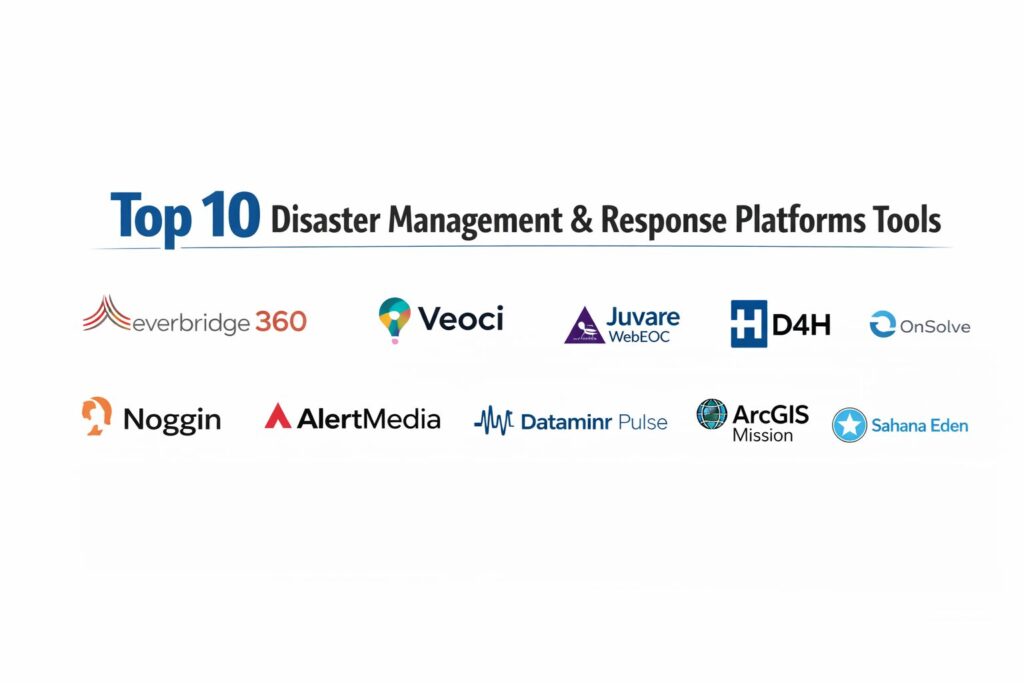
Introduction
Disaster management and response platforms have become the technical cornerstone for modern emergency operations, transforming how organizations prepare for and mitigate large-scale crises. These digital ecosystems integrate real-time data ingestion, multi-channel communication, and automated workflows to provide a “single pane of glass” for decision-makers. In an era where climate volatility and geopolitical risks are escalating, these platforms move beyond simple alerting to offer sophisticated situational awareness. They allow Emergency Operations Centers (EOCs) to digitize their standard operating procedures, ensuring that when a high-pressure event occurs, response teams are not relying on paper plans but on dynamic, data-driven playbooks.
The strategic value of these platforms lies in their ability to orchestrate complex human and material resources across siloed departments and external agencies. By centralizing incident logging, resource tracking, and geospatial mapping, these tools eliminate the “fog of war” that often characterizes the first hour of a disaster. Whether managing a localized chemical spill or a multi-state hurricane response, these systems provide the audit trails and transparency necessary for post-incident reporting and regulatory compliance. Selecting the right platform requires a deep understanding of an organization’s specific threat profile, its existing technical stack, and the critical need for 100% uptime during environmental extremes.
Best for: Municipal emergency managers, corporate security officers, healthcare system coordinators, and government agencies responsible for public safety and business continuity.
Not ideal for: Small businesses with static risk profiles or organizations that only require basic internal messaging without the need for complex incident command structures or external agency interoperability.
Key Trends in Disaster Management Platforms
The most significant trend is the transition from reactive alerting to AI-powered predictive intelligence. Modern platforms now ingest “dark data” from social media, satellite imagery, and IoT sensors to identify potential threats—such as flood risks or civil unrest—minutes or even hours before they escalate. This predictive capability allows responders to pre-position assets and issue preventative warnings, significantly reducing the impact on life and property. Furthermore, there is a massive shift toward “cloud-first, offline-ready” architectures, ensuring that field teams can continue to sync critical data even when primary cellular networks are compromised.
Interoperability is also reaching a new level of maturity through standardized data formats like the Common Alerting Protocol (CAP). This allows disparate systems used by police, fire, and private security to “talk” to one another seamlessly. Additionally, there is a growing emphasis on the “Human-in-the-Loop” AI model, where machine learning filters out the noise of thousands of data points, but human experts verify the most critical alerts to prevent false positives. Finally, we see the rise of digital twins in disaster management, where platforms simulate disasters in a virtual model of a city or facility to test the effectiveness of response plans before a real event occurs.
How We Selected These Tools
The selection process for these platforms focused on “mission-critical” reliability and the depth of their incident management frameworks. We prioritized tools that adhere strictly to the National Incident Management System (NIMS) and Incident Command System (ICS) standards, as these are the global benchmarks for emergency coordination. Market leadership was a primary factor, but we also included innovative niche players that excel in specific areas like open-source humanitarian aid or AI-driven threat intelligence.
Technical robustness was evaluated based on the platform’s ability to handle massive spikes in traffic during a crisis without latency. Security was a top priority; we only selected platforms that demonstrate high levels of compliance, such as SOC 2 Type II, ISO 27001, or FedRAMP certification. Finally, we looked for user-centric design—interfaces that remain intuitive even under the extreme stress of a live disaster—and platforms that offer strong mobile capabilities for “boots on the ground” responders.
1. Everbridge 360
Everbridge 360 is the global benchmark for Critical Event Management (CEM). It is an enterprise-grade platform that combines global threat intelligence with a massive multi-channel notification engine capable of reaching millions of people in seconds. It is designed for large-scale operations where speed and global reach are the primary requirements.
Key Features
The platform features a “Risk Intelligence Monitoring” center that scans thousands of data sources for potential disruptions. It offers automated incident response playbooks that trigger specific communication flows based on the type and location of a threat. Its “Visual Command Center” provides a global map view of all assets, people, and threats in real-time. The system supports two-way communication, allowing recipients to confirm their safety or request assistance. Additionally, it provides robust analytics for after-action reporting and compliance audits.
Pros
Unrivaled scalability and a proven track record in the world’s largest disasters. Its vast integration ecosystem allows it to pull data from almost any corporate or public system.
Cons
The platform is highly complex and requires significant training and setup time. It is also one of the most expensive options on the market, making it less accessible for smaller organizations.
Platforms and Deployment
Web-based command center with native iOS and Android apps for both admins and end-users.
Security and Compliance
FedRAMP authorized, SOC 2 Type II, ISO 27001, and HIPAA compliant.
Integrations and Ecosystem
Integrates with over 300 systems, including HR databases, IT service management (ITSM) tools, and building security systems.
Support and Community
Offers 24/7 premium support, a dedicated account management team, and an extensive user community and knowledge base.
2. Veoci
Veoci is a highly flexible, cloud-native platform that functions as a virtual Emergency Operations Center (EOC). It is unique because it uses a “no-code” architecture, allowing organizations to build custom forms, dashboards, and workflows without needing software developers.
Key Features
The platform is built around “Rooms”—digital spaces where specific teams can collaborate on an incident using chat, shared documents, and task lists. It features a powerful GIS engine for mapping incidents and tracking assets in the field. Its automated workflow engine can digitize complex standard operating procedures (SOPs), ensuring every step of a response is followed. Veoci also includes a robust resource management module for tracking equipment and personnel costs. It supports multi-agency collaboration by allowing external partners to be invited into specific incident rooms with granular permissions.
Pros
Exceptional customization options allow the platform to mirror an organization’s existing paper processes perfectly. The “Slack-like” interface is very intuitive for teams who are already used to modern collaboration tools.
Cons
The extreme flexibility can lead to “configuration sprawl” if not managed properly by a dedicated administrator. Some of the more advanced GIS features have a steeper learning curve.
Platforms and Deployment
Cloud-based web platform with fully functional mobile apps for field data collection and communication.
Security and Compliance
SOC 2 Type II compliant and hosted on secure, redundant AWS infrastructure.
Integrations and Ecosystem
Strong API support for connecting to GIS databases, weather feeds, and internal identity management systems.
Support and Community
Provides high-touch implementation support and a library of pre-built templates for various industries.
3. Juvare WebEOC
Juvare WebEOC is the industry standard for government and public safety agencies. It is specifically designed to facilitate multi-agency coordination during large-scale regional or national emergencies. It focuses on “Status Boards” that provide a structured way to share information across different jurisdictions.
Key Features
The core of the platform is its customizable status boards, which allow agencies to track everything from shelter availability to road closures. It features a “Mapper” tool that overlays incident data onto professional-grade GIS layers. The system includes a “Board Builder” that allows administrators to create data entry forms tailored to their specific needs. It supports the “Juvare Exchange,” a network that allows different organizations using Juvare products to share data with each other in real-time. It also provides comprehensive tools for managing Mission Requests and Resource Requests according to ICS standards.
Pros
It is the most widely used tool by state and local governments, making it the best choice for interoperability with public sector partners. Its focus on structured data makes it excellent for high-level situational awareness.
Cons
The user interface can feel dated compared to newer SaaS platforms. It often requires professional services for deep customization and initial setup.
Platforms and Deployment
Web-based with mobile-responsive views and a dedicated mobile application.
Security and Compliance
ISO 27001 and SOC 2 compliant, with options for secure on-premise or private cloud deployment.
Integrations and Ecosystem
Deeply integrated with Esri ArcGIS and other Juvare products like EMResource and eICS.
Support and Community
Extensive training programs, regional user groups, and 24/7 technical support for active incidents.
4. D4H
D4H is a specialized platform designed for the highly technical needs of Search and Rescue (SAR), HAZMAT, and industrial response teams. It focuses on personnel readiness, equipment maintenance, and live incident management for “boots on the ground” teams.
Key Features
The platform is divided into modules: Personnel & Training, Equipment Management, and Incident Management. It features a real-time “Incident Stack” that allows field teams to log events, track personnel on a map, and share photos instantly. The equipment module tracks the expiration dates and maintenance history of critical gear like oxygen tanks or vehicles. It provides automated “Readiness Reports” that show exactly which team members are qualified and available for a specific type of mission. The mobile app is designed to work in low-bandwidth environments, ensuring data is captured even in remote locations.
Pros
Outstanding focus on the operational “readiness” of a team before an incident even occurs. The mobile interface is clean and specifically designed for use in high-stress field environments.
Cons
It is less focused on mass public notification and more on the management of the response teams themselves. It may require other tools for large-scale community alerting.
Platforms and Deployment
Cloud-based web dashboard with dedicated mobile apps for field responders.
Security and Compliance
GDPR and SOC 2 compliant, with high-level data encryption at rest and in transit.
Integrations and Ecosystem
Integrates with various GIS platforms and professional weather services.
Support and Community
Strong community of first responders and a very responsive technical support team.
5. OnSolve (formerly CodeRED)
OnSolve is a powerhouse in AI-driven risk intelligence and mass notification. It is particularly well-known for its “CodeRED” engine, which is used by thousands of municipalities to send high-speed emergency alerts to residents.
Key Features
The platform features an AI-powered “Risk Intelligence” engine that filters through millions of data points to identify only the threats relevant to an organization’s specific assets. It offers a “Dynamic Proximity” feature that automatically triggers alerts to employees who enter a high-risk zone. The mass notification system supports voice, text, email, and social media with extreme delivery speeds. It also includes “Incident Management” playbooks that guide teams through the necessary response steps. The system provides real-time “Safe Check-in” features to track employee status during a crisis.
Pros
The AI filtering significantly reduces “alert fatigue” by only showing actionable threats. The CodeRED system is legendary for its speed and reliability in public safety.
Cons
The pricing can be steep for small to mid-sized organizations. Some users find the backend administration interface a bit complex.
Platforms and Deployment
SaaS-based web platform with a focus on mobile-first notification and response.
Security and Compliance
FedRAMP authorized, SOC 2 Type II, and ISO 27001 certified.
Integrations and Ecosystem
Integrates with a wide range of HR, IT, and security systems through a robust API.
Support and Community
Offers 24/7/365 emergency support and professional implementation services.
6. Noggin
Noggin is a comprehensive resilience and crisis management platform that focuses on the full lifecycle of a disaster, from initial risk assessment to long-term recovery. It is designed for large organizations that want to standardize their resilience workflows globally.
Key Features
The platform offers an “All-Hazards” approach, with dedicated modules for crisis management, worker safety, and operational resilience. It features an integrated “Library” of world-standard incident management templates. The system provides a unified dashboard that links risk assessments directly to incident response plans. It includes a mobile-first “Check-in” tool for lone workers and staff in the field. Noggin also features powerful reporting tools that can generate compliance-ready reports for regulators or boards of directors. Its architecture is highly modular, allowing organizations to start with one module and expand as their needs grow.
Pros
Excellent for organizations that need to prove “compliance-based” resilience to regulators. The link between risk management and incident response is very well-integrated.
Cons
The modularity can lead to a fragmented experience if the implementation is not planned holistically. It is a premium product with a price tag to match.
Platforms and Deployment
Web-based platform with a highly capable native mobile app.
Security and Compliance
ISO 27001, SOC 2 Type II, and GDPR compliant.
Integrations and Ecosystem
Strong API for integrating with corporate GRC (Governance, Risk, and Compliance) systems.
Support and Community
Global support footprint with dedicated implementation consultants.
7. AlertMedia
AlertMedia has rapidly become a favorite for corporate security and business continuity teams due to its focus on ease of use and high-quality “in-house” threat intelligence. It prioritizes the user experience to ensure that the platform is accessible to non-technical users.
Key Features
The platform features an “Integrated Threat Intelligence” feed that is curated by a 24/7 team of analysts, not just an algorithm. It provides a simple “two-click” mass notification interface that works across SMS, voice, email, and app push notifications. Its “Monitoring” module allows security teams to track the real-time location of traveling employees against emerging threats. It includes “Event Pages”—dynamic web pages that act as a single source of truth for employees during a crisis. The system also offers a “Panic Button” for mobile employees that instantly alerts the security team.
Pros
The user interface is arguably the best in the industry—it is clean, modern, and requires almost no training. The analyst-verified threat intelligence is highly accurate.
Cons
It is less focused on the “Incident Command” (ICS/NIMS) structured response needed by government agencies. It is primarily a corporate tool.
Platforms and Deployment
SaaS web platform with a top-rated mobile app for both iOS and Android.
Security and Compliance
SOC 2 Type II and GDPR compliant.
Integrations and Ecosystem
Excellent integrations with HRIS (Workday, BambooHR) to keep employee contact data synchronized.
Support and Community
Known for exceptional customer success teams and 24/7 technical support.
8. Dataminr Pulse
Dataminr Pulse is the premier “Intelligence” tool for disaster response. It leverages advanced AI to analyze billions of public data signals—from social media to sensor data—to provide the earliest possible warning of breaking events.
Key Features
The platform’s standout feature is its AI-driven “First Alert” system, which often beats traditional news sources by minutes or even hours. It allows users to set up highly specific “Watchlists” for their company assets, supply chains, or regions of interest. It provides real-time “Visuals”—images and videos from the scene of an incident—providing immediate situational awareness. The “Pulse for Corporate Security” module links these alerts directly to employee locations. It also includes “Impact Analysis” tools that show exactly which assets are in the path of a developing disaster.
Pros
Unbeatable speed in threat detection. It is often the very first tool that alerts a security team that something is going wrong.
Cons
It is primarily an “intelligence” tool; it does not have the deep “incident management” or “mass notification” capabilities of an Everbridge or Veoci.
Platforms and Deployment
Cloud-based web platform and mobile app for real-time alerting.
Security and Compliance
ISO 27001, SOC 2, and rigorous data anonymization protocols.
Integrations and Ecosystem
Integrates with major CEM and SIEM platforms to trigger response workflows automatically.
Support and Community
Offers high-touch analyst support and strategic intelligence reviews.
9. ArcGIS Mission
ArcGIS Mission is a specialized tactical situational awareness tool from Esri. It is designed for field-centric response teams who need a map-centric way to coordinate their activities in real-time.
Key Features
The platform is built on the world-leading Esri GIS engine, providing unmatched mapping capabilities. It allows mission leads to define an “Area of Interest” and share it with field teams instantly. Responders in the field can use the mobile app to share their real-time location, send geo-tagged photos, and chat with the command center. It features “Mission Timelines” that record every action and communication for a complete historical record. The system also supports “Peer-to-Peer” communication in environments where a central server might be unreachable.
Pros
The gold standard for organizations that are already using Esri ArcGIS. It provides a level of geospatial precision that other platforms cannot match.
Cons
It requires an existing investment in the ArcGIS ecosystem. It is more of a tactical tool than a general-purpose mass communication or resilience platform.
Platforms and Deployment
Integrated with ArcGIS Enterprise, with dedicated mobile applications for field use.
Security and Compliance
Follows high-level GIS data security standards and is typically deployed within a secure enterprise environment.
Integrations and Ecosystem
Fully integrated with the entire ArcGIS suite of mapping and analysis tools.
Support and Community
Backed by the massive Esri global support network and professional services.
10. Sahana Eden
Sahana Eden is a unique, open-source platform designed for humanitarian aid and large-scale disaster coordination. It is particularly valuable for NGOs and governments in developing regions who need a customizable, low-cost solution.
Key Features
The platform is highly modular, with features for tracking organization and office locations, managing human resources and volunteers, and tracking inventory and warehouse supplies. It features a “Project Tracking” module for long-term recovery efforts. The system is designed to be “offline-first,” allowing it to run on a local server in areas where the internet is down. It includes a “Messaging” module that can connect to various SMS gateways for local alerting. Because it is open-source, organizations can modify the code to meet very specific local or linguistic requirements.
Pros
Completely free to use from a licensing perspective. It is extremely flexible and can be customized for everything from earthquake response to refugee management.
Cons
It requires significant technical expertise to set up, host, and maintain. It lacks the polished user interface and 24/7 commercial support of the other tools on this list.
Platforms and Deployment
Web-based platform that can be hosted on a local server or in the cloud.
Security and Compliance
Security depends on the implementation and hosting environment chosen by the organization.
Integrations and Ecosystem
Supports standard data formats for GIS and communication but requires custom coding for deep integrations.
Support and Community
Supported by a global community of volunteer developers and humanitarian practitioners.
Comparison Table
| Tool Name | Best For | Platform(s) Supported | Deployment | Standout Feature | Public Rating |
| 1. Everbridge 360 | Global Enterprises | Web, iOS, Android | Cloud | Global Mass Notification | 4.6/5 |
| 2. Veoci | Virtual EOC | Web, iOS, Android | Cloud | No-Code Flexibility | 4.8/5 |
| 3. Juvare WebEOC | Gov/Public Safety | Web, Mobile App | Hybrid | Multi-Agency Interop | 4.3/5 |
| 4. D4H | Field Teams (SAR/HAZ) | Web, iOS, Android | Cloud | Personnel/Gear Readiness | 4.7/5 |
| 5. OnSolve | Municipal Alerting | Web, Mobile | Cloud | AI Risk Filtering | 4.5/5 |
| 6. Noggin | Enterprise Resilience | Web, iOS, Android | Cloud | Full Lifecycle Resilience | 4.4/5 |
| 7. AlertMedia | Corporate Security | Web, iOS, Android | Cloud | Analyst-Verified Intel | 4.9/5 |
| 8. Dataminr Pulse | Early Warning | Web, iOS, Android | Cloud | AI “First Alert” Speed | 4.6/5 |
| 9. ArcGIS Mission | Tactical Field Ops | Web, iOS, Android | Enterprise | Real-time GIS Mapping | 4.5/5 |
| 10. Sahana Eden | Humanitarian/NGOs | Web | Self-hosted | Open-Source Modularity | 4.0/5 |
Evaluation & Scoring of Disaster Management & Response Platforms
The scoring below is a comparative model intended to help shortlisting. Each criterion is scored from 1–10, then a weighted total from 0–10 is calculated using the weights listed. These are analyst estimates based on typical fit and common workflow requirements, not public ratings.
Weights:
- Core features – 25%
- Ease of use – 15%
- Integrations & ecosystem – 15%
- Security & compliance – 10%
- Performance & reliability – 10%
- Support & community – 10%
- Price / value – 15%
| Tool Name | Core (25%) | Ease (15%) | Integrations (15%) | Security (10%) | Performance (10%) | Support (10%) | Value (15%) | Weighted Total |
| 1. Everbridge 360 | 10 | 6 | 10 | 10 | 10 | 9 | 6 | 8.65 |
| 2. Veoci | 9 | 9 | 9 | 9 | 9 | 9 | 8 | 8.85 |
| 3. Juvare WebEOC | 9 | 5 | 8 | 9 | 8 | 8 | 7 | 7.70 |
| 4. D4H | 9 | 8 | 7 | 8 | 9 | 9 | 9 | 8.50 |
| 5. OnSolve | 9 | 7 | 9 | 10 | 10 | 8 | 7 | 8.50 |
| 6. Noggin | 9 | 7 | 8 | 9 | 9 | 8 | 7 | 8.10 |
| 7. AlertMedia | 8 | 10 | 9 | 9 | 9 | 10 | 8 | 9.05 |
| 8. Dataminr Pulse | 8 | 8 | 9 | 9 | 10 | 8 | 6 | 8.20 |
| 9. ArcGIS Mission | 8 | 6 | 10 | 9 | 9 | 8 | 7 | 8.05 |
| 10. Sahana Eden | 7 | 5 | 5 | 6 | 7 | 6 | 10 | 6.85 |
How to interpret the scores:
- Use the weighted total to shortlist candidates, then validate with a pilot.
- A lower score can mean specialization, not weakness.
- Security and compliance scores reflect controllability and governance fit, because certifications are often not publicly stated.
- Actual outcomes vary with assembly size, team skills, templates, and process maturity.
Which Disaster Management & Response Platform Tool Is Right for You?
Solo / Freelancer
For consultants working with smaller clients, AlertMedia is often the best choice. Its ease of use means you can set it up quickly for a client and they will be able to manage it with minimal ongoing training.
SMB
Medium-sized cities or counties should look at OnSolve or D4H. These platforms provide professional-grade alerting and team management without the extreme complexity and cost of the global enterprise suites.
Enterprises
For organizations with offices in multiple countries, Everbridge 360 is the gold standard. Its ability to monitor global threats and communicate in dozens of languages is essential for protecting a distributed workforce.
First Responders & Tactical Teams
Search and Rescue or specialized industrial teams should prioritize D4H or ArcGIS Mission. These tools are built specifically for the field, focusing on gear, personnel qualifications, and real-time tactical mapping.
High-Resilience Environments (Healthcare/Utilities)
Organizations that cannot afford even a minute of downtime, such as hospitals or power grids, should look at Veoci or Noggin. These platforms excel at digitizing strict regulatory workflows and ensuring business continuity.
NGOs and International Aid
Sahana Eden remains the primary choice for large-scale humanitarian coordination where budget is limited but the need for customization and offline capability is high.
Intelligence-Focused Security Teams
If your team’s primary role is identifying threats before they happen, Dataminr Pulse is an essential “first layer” of your technology stack, even if you use another tool for the actual response management.
Government EOCs (Multi-Agency)
For state or regional EOCs where multiple independent agencies must share data, Juvare WebEOC remains the standard for creating a common operational picture across jurisdictions.
Frequently Asked Questions (FAQs)
1. What is the difference between CEM and a simple notification system?
A notification system only sends messages. Critical Event Management (CEM) platforms like Everbridge or OnSolve integrate threat intelligence, response workflows, asset tracking, and after-action reporting into one unified system.
2. Can these platforms work when the internet is down?
Many platforms, such as D4H and Sahana Eden, have “offline-first” capabilities that allow data to be captured locally and synced once connectivity is restored. Some also support satellite or radio-based data transmission.
3. Do these tools follow the Incident Command System (ICS)?
Yes, professional-grade platforms like Juvare WebEOC and Veoci are built specifically to support ICS and NIMS standards, ensuring that terminology and organizational structures are consistent with global best practices.
4. How do these platforms protect sensitive personal data?
Leading platforms use high-level encryption and comply with regulations like GDPR and SOC 2. They allow for granular permissions so that only authorized personnel can see private contact information or location data.
5. Can I use AI to automate my emergency response?
AI is best used for “filtering” threat data and “recommending” actions. While platforms like OnSolve can automate the triggering of certain notifications, a human should always be the final authority for critical life-safety decisions.
6. How long does it take to implement a disaster management platform?
A simple notification tool can be up in days, but a full EOC platform like WebEOC or Veoci typically takes 3 to 6 months to fully configure, integrate, and train staff on.
7. Are there free versions of these platforms available?
Most professional platforms are paid SaaS models. Sahana Eden is free open-source software, and some commercial providers offer limited-feature “community” editions for small volunteer organizations.
8. Do I need a GIS expert to use these tools?
While tools like ArcGIS Mission benefit from GIS expertise, most modern platforms have “user-friendly” mapping interfaces that can be operated by anyone with basic computer skills.
9. Can these systems integrate with my building’s fire alarm?
Yes, many enterprise platforms can integrate with physical security systems, fire panels, and IoT sensors to automatically trigger a “crisis room” when an alarm is activated.
10. What is an “After-Action Report” (AAR)?
An AAR is a formal document generated after an incident that outlines what happened, what went well, and what needs improvement. Professional platforms automate the data collection for these reports.
Conclusion
Navigating the complexities of modern emergency management requires a strategic shift from static, paper-based plans to dynamic, data-driven platforms. The primary differentiator between a successful response and an operational failure is the ability to achieve immediate situational awareness through integrated intelligence. The platforms discussed here represent the absolute pinnacle of reliability and technical innovation in the field of resilience. Choosing a partner is not merely about a software license; it is about establishing a secure, scalable infrastructure that can withstand the most extreme pressures of a live crisis. By investing in the right digital EOC or critical event management suite, organizations do not just protect their assets—they ensure the continuity of their mission and the safety of the people they serve. Success in disaster management is earned in the months of preparation, not the minutes of response.