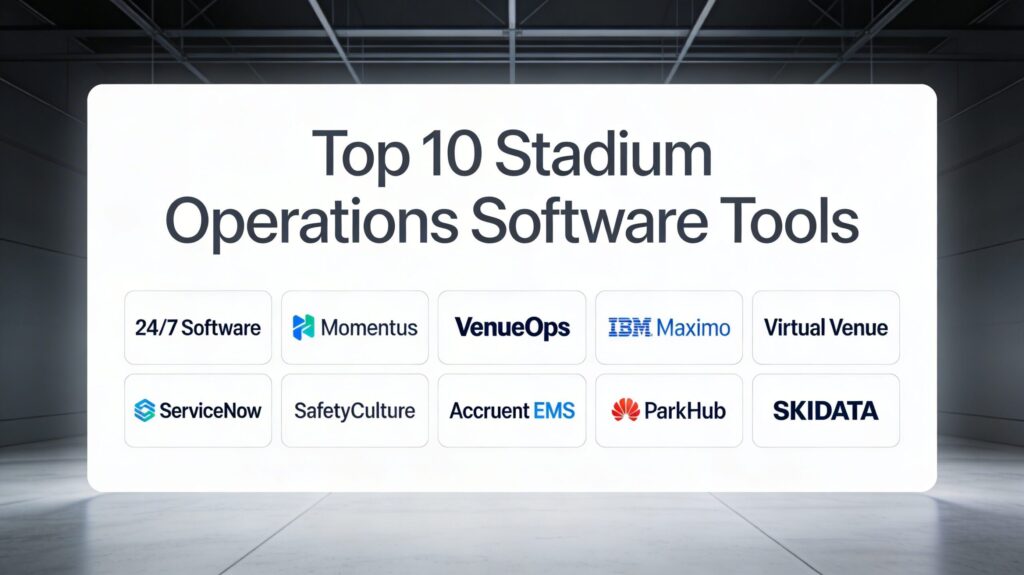
Introduction
Stadium operations software has transitioned from a back-office luxury to a critical mission-control requirement for modern sports and entertainment venues. As facilities evolve into complex, multi-use ecosystems hosting everything from international football matches to high-capacity concerts, the need for a centralized “operational brain” has become paramount. This software category encompasses a broad spectrum of technical needs, including incident management, asset maintenance, crowd safety, and real-time staff coordination. By digitizing these traditionally fragmented workflows, stadium operators can ensure that every stakeholder—from the janitorial crew to the head of security—shares a common operational intelligence.
The strategic deployment of these platforms is essential for mitigating the high-stakes risks associated with mass gatherings. In an era where fan experience is inextricably linked to safety and efficiency, the ability to respond to a broken seat or a security breach in seconds is what separates elite venues from the rest. Modern solutions leverage digital twins, mobile-first tasking, and automated reporting to replace the “paper and radio” methods of the past. When selecting a platform, it is vital to look for enterprise-grade reliability that can handle the extreme load of game-day traffic and the nuanced data privacy requirements of global sporting federations.
Best for: Stadium managers, venue owners, security directors, and facility maintenance teams at professional sports arenas, convention centers, and large-scale entertainment venues.
Not ideal for: Small community sports clubs or local recreational centers that lack the complex infrastructure or high-frequency event schedule to justify the cost of enterprise-level software.
Key Trends in Stadium Operations Software
The most significant trend is the rise of the “Digital Twin” for operational planning, allowing teams to simulate crowd flows and emergency scenarios in a virtual 3D model before doors ever open. We are also seeing a heavy push toward “Agentic AI” and predictive analytics, where the software identifies potential equipment failures or crowd bottlenecks before they occur. This shift from reactive to proactive management is drastically reducing downtime and improving the overall safety rating of venues globally.
Sustainability and energy management are also being woven directly into operational dashboards. Modern platforms now track real-time utility consumption and waste management metrics to help stadiums meet strict ESG goals. Furthermore, mobile-first workforce management has become the standard, enabling a largely seasonal and part-time staff to receive instant training, location-based tasks, and real-time safety alerts directly on their personal devices, ensuring a unified front during high-pressure events.
How We Selected These Tools
Our selection process focused on tools that demonstrate a “stadium-first” architecture, prioritizing those capable of handling the unique surges in data and activity that occur on match days. We evaluated platforms based on their ability to integrate with physical hardware, such as turnstiles, CCTV, and BMS (Building Management Systems). Market reputation within major leagues—including the NFL, Premier League, and FIFA—was a significant factor, as these environments demand the highest levels of performance and security.
We also looked for technical depth in asset management and incident response. A top-tier tool must go beyond simple ticketing and provide a robust framework for long-term facility health and audit-ready compliance. Ease of use for seasonal workers was another critical criterion; if a system is too complex for a part-time steward to learn in five minutes, it fails the “game-day test.” Finally, we prioritized platforms that offer flexible deployment models, acknowledging that many stadiums still require a hybrid of cloud and on-premise hardware connectivity.
1. 24/7 Software
24/7 Software is the industry standard for incident management and real-time communication in the sports world. It is specifically built to manage the chaos of game-day operations by providing a unified platform for reporting incidents, tracking tasks, and communicating across large teams. It is used by a vast majority of professional sports venues in North America and a growing number internationally.
Key Features
The platform features a world-class incident management system that allows for rapid reporting via mobile apps or text-to-stadium services. It includes a comprehensive computerized maintenance management system (CMMS) for tracking facility assets and preventive maintenance. The software offers a “CheckPoint” feature for tracking guard tours and safety inspections in real-time. It also provides advanced analytics dashboards that visualize historical incident data to help with future event planning. A unique feature is the “speed-of-type” two-way communication channel that keeps staff and fans connected during emergencies.
Pros
Extremely high adoption rate in professional sports ensures a large community of users and proven reliability. The interface is specifically designed for quick learning by seasonal staff.
Cons
The platform is a premium solution and may be cost-prohibitive for smaller venues. Its broad feature set can be overwhelming for teams only needing simple task management.
Platforms and Deployment
Cloud-based web dashboard with native mobile applications for iOS and Android.
Security and Compliance
SOC 2 Type II compliant with enterprise-grade data encryption and secure role-based access controls.
Integrations and Ecosystem
Integrates with major security hardware, CCTV systems, and fan engagement platforms like VenueNext.
Support and Community
Offers 24/7 live technical support and an extensive library of stadium-specific best practice guides.
2. Momentus Technologies
Momentus Technologies (formerly EventBooking and Ungerboeck) provides an end-to-end venue management solution that covers the entire lifecycle of an event. It is particularly strong in high-level venue scheduling and financial coordination for complex, multi-day bookings.
Key Features
The platform offers a powerful centralized calendar that prevents double bookings across complex venue spaces. It includes detailed inventory management for tracking equipment, furniture, and catering supplies. The system features a robust CRM for managing relationships with promoters, teams, and vendors. It provides integrated financial tools for invoicing, deposits, and settlement after an event. Additionally, it offers mobile-friendly work order management to ensure that facility setups match the digital floor plans exactly.
Pros
Excellent for managing the commercial and logistical aspects of a venue alongside daily operations. The reporting engine is highly customizable for executive-level financial overviews.
Cons
The system is complex and typically requires a longer implementation and training period. Some users find the interface less modern compared to mobile-first competitors.
Platforms and Deployment
Web-based cloud platform with mobile browser accessibility.
Security and Compliance
Adheres to global data privacy standards and provides secure, encrypted payment processing.
Integrations and Ecosystem
Strong connections with ERP and accounting software, as well as digital signage and ticketing systems.
Support and Community
Provides dedicated account managers and a large global user conference for networking and learning.
3. VenueOps
VenueOps is a modern, intuitive venue management platform designed to streamline the planning and execution of events. It is favored by mid-to-large stadiums for its clean user interface and its focus on making complex data easy to digest for all staff levels.
Key Features
The platform features a drag-and-drop event calendar that is both powerful and easy to use. It includes a dedicated “Event Readiness” module that provides checklists and status trackers for game-day preparations. The system allows for easy creation of professional proposals and contracts for venue rentals. It features a robust task management system that can be assigned to specific departments or individuals. The mobile interface is highly responsive, ensuring that on-ground staff can update task statuses in real-time as they walk the concourses.
Pros
One of the most user-friendly interfaces in the market, leading to high staff adoption. The setup process is generally faster than more traditional enterprise platforms.
Cons
May lack some of the deep “heavy industry” asset management features found in specialized CMMS tools. The integration library, while growing, is not as vast as some older competitors.
Platforms and Deployment
Cloud-native web application optimized for mobile and tablet use.
Security and Compliance
Uses modern security protocols and regular third-party audits to ensure data integrity.
Integrations and Ecosystem
Integrates with popular calendars, accounting tools, and various stadium-specific ticketing platforms.
Support and Community
Known for highly responsive customer success teams and a simplified onboarding process.
4. IBM Maximo
IBM Maximo is an enterprise asset management (EAM) powerhouse used by the world’s most asset-heavy stadiums. It focuses on the technical side of operations, ensuring that the physical infrastructure—from HVAC systems to retractable roofs—is maintained to a professional standard.
Key Features
The platform provides a comprehensive lifecycle management tool for every physical asset in the stadium. it uses AI and IoT data to perform “predictive maintenance,” identifying when a critical system is likely to fail before it actually does. The system includes advanced inventory and procurement modules to manage the supply chain for facility repairs. It features a robust mobile app for technicians to access manuals and log work orders in the field. It also provides deep environmental and sustainability tracking to help stadiums monitor their carbon footprint.
Pros
Unmatched depth in asset management and long-term facility planning. The AI-driven insights can lead to significant cost savings on major infrastructure repairs.
Cons
Extremely high complexity requires a dedicated IT team to manage and customize. The cost of implementation and licensing is at the top of the market range.
Platforms and Deployment
Available as a cloud service (SaaS), on-premise, or hybrid deployment.
Security and Compliance
Meets the highest global security standards (ISO 27001, FedRAMP) required by government and international bodies.
Integrations and Ecosystem
Vast integration capabilities with nearly any enterprise system, including BIM (Building Information Modeling) and ERPs.
Support and Community
Backed by IBM’s global support network and a massive ecosystem of certified third-party consultants.
5. Virtual Venue
Virtual Venue is a next-generation platform that focuses on the “digital twin” aspect of stadium operations. It allows stakeholders to collaborate in a shared virtual space to plan events, manage overlays, and coordinate site visits remotely.
Key Features
The core of the platform is a high-fidelity 3D digital twin of the stadium that serves as the single source of truth for planning. It includes a “Site Visit” module that allows remote teams to walk through the venue virtually, reducing the need for travel. The software features a “Venue Overlay” tool for planning temporary structures like stages or fan zones. It provides real-time dashboards for monitoring event-day readiness and incident reports. The system also supports “Handover and Handback” workflows to ensure that vendors leave the space in the required condition.
Pros
Revolutionizes event planning by allowing for precise, visual coordination between teams. Greatly reduces the time and cost associated with physical site inspections.
Cons
Requires a high-quality 3D model of the venue to be created initially. It is more of a planning and coordination tool than a full-scale asset management system.
Platforms and Deployment
Cloud-based web platform with high-performance 3D rendering capabilities.
Security and Compliance
Ensures data security through encrypted transfers and strict user permissioning for sensitive venue data.
Integrations and Ecosystem
Designed to connect with existing venue management and incident reporting systems to provide a visual layer.
Support and Community
Offers specialized support for major sports events and international stadium federations.
6. ServiceNow (Facilities Management)
ServiceNow is a global leader in enterprise workflow automation. Their facilities management module is used by large stadium groups to standardize service requests and operational processes across multiple venues.
Key Features
The platform uses a powerful “Service Catalog” where staff can request anything from a lightbulb change to a security escort. It features a robust workflow engine that automates the routing of tasks based on location and priority. The system includes an interactive “Space Management” tool for visualizing occupancy and utilization. It provides a centralized dashboard for tracking the performance of third-party vendors and contractors. Additionally, it offers advanced AI-powered analytics to identify trends in service requests and operational bottlenecks.
Pros
Provides a highly professional and standardized way to manage internal operations. The scalability is world-class, making it ideal for groups managing multiple venues.
Cons
The platform is an enterprise-wide tool and can feel “corporate” rather than “stadium-specific.” Setup requires significant expertise in the ServiceNow ecosystem.
Platforms and Deployment
Pure cloud-based platform with powerful native mobile apps for all users.
Security and Compliance
Industry-leading security certifications including HIPAA, SOC 1 & 2, and various international standards.
Integrations and Ecosystem
One of the most connected platforms in the world, with thousands of pre-built integrations for IT and HR.
Support and Community
Massive global community of developers and a 24/7 enterprise support structure.
7. SafetyCulture
SafetyCulture (formerly iAuditor) is a mobile-first inspection and safety platform that is widely used for stadium “readiness checks” and compliance auditing. It excels at getting field-level data into the hands of decision-makers quickly.
Key Features
The platform is famous for its easy-to-use checklist and inspection builder. It allows staff to capture photos, notes, and evidence of issues directly within an audit. The software features a “Heads Up” module for sending instant safety alerts to all staff members simultaneously. It includes automated scheduling for recurring safety checks, such as fire extinguisher inspections or concourse clean-ups. The “Issues” feature allows any staff member to quickly flag a problem and assign it to the correct department for resolution.
Pros
Extremely easy to deploy and use, even for non-technical staff. The template library has thousands of pre-made stadium and event safety checklists.
Cons
While excellent for inspections and safety, it lacks the deep financial and scheduling tools of a full venue management system. Advanced analytics require a higher-tier subscription.
Platforms and Deployment
Mobile-first platform (iOS/Android) with a comprehensive web-based management portal.
Security and Compliance
Strong focus on data privacy with ISO 27001 certification and secure cloud storage.
Integrations and Ecosystem
Integrates well with business tools like Slack, Microsoft Teams, and various BI platforms for data analysis.
Support and Community
Offers extensive online training and a highly responsive global support team.
8. Accruent EMS
Accruent EMS focuses on the complex scheduling and space utilization needs of large-scale venues. It is the go-to choice for stadiums that host a high volume of meetings, tours, and secondary events alongside their main sports schedule.
Key Features
The platform provides a highly detailed scheduling engine that can manage everything from a 50,000-seat bowl to a small executive boardroom. It features a robust “Service Provider” module that alerts catering and AV teams as soon as a booking is made. The system includes an “Academic Integration” feature for stadiums linked to universities. It provides detailed reporting on space utilization to help management maximize revenue from every square foot. Additionally, it offers self-service booking portals for internal staff and external clients.
Pros
Unrivaled in its ability to manage complex, overlapping schedules in a multi-use facility. It helps turn a stadium into a year-round revenue generator.
Cons
The interface can feel complex and “data-heavy” compared to more modern SaaS tools. It requires a well-trained administrator to unlock its full potential.
Platforms and Deployment
Available as a cloud-hosted solution or as an on-premise installation.
Security and Compliance
Provides robust security features and is compliant with standard enterprise data protection requirements.
Integrations and Ecosystem
Integrates with Microsoft Outlook, Google Calendar, and various digital signage and HVAC systems.
Support and Community
Offers a deep knowledge base and a professional services team for complex implementations.
9. ParkHub
Stadium operations don’t stop at the gates; the parking lot is the first and last impression for fans. ParkHub is a specialized platform that manages event-day parking operations with a focus on speed and financial accountability.
Key Features
The platform features a handheld “Prime” device that allows attendants to validate pre-paid passes and take credit card payments in seconds. it provides real-time data on lot occupancy to help management redirect traffic before bottlenecks occur. The system integrates directly with major ticketing platforms to allow for seamless scanning of parking permits. It features a robust “Settle” dashboard for real-time revenue tracking and reconciliation. Additionally, it uses location-based data to provide insights into fan arrival patterns.
Pros
Significantly reduces the time it takes to get fans into the parking lot. Provides a high level of transparency and prevents “cash leakage” in parking operations.
Cons
It is a specialized tool and must be used alongside a broader venue management system. Hardware maintenance for handheld devices is an added operational task.
Platforms and Deployment
Cloud-based management portal with specialized mobile hardware for field use.
Security and Compliance
Fully PCI compliant for payment processing with secure, encrypted data transmission.
Integrations and Ecosystem
Deep integrations with Ticketmaster, SeatGeek, and other major stadium ticketing ecosystems.
Support and Community
Offers on-site training and 24/7 support during major events.
10. SKIDATA
SKIDATA is a global leader in access control and parking management systems. It provides the “physical-to-digital” bridge for stadium entry, managing the hardware and software that controls the flow of thousands of people.
Key Features
The platform manages high-speed turnstiles and gates with support for various ticket types, including NFC, QR codes, and RFID. It includes a comprehensive parking management suite that features license plate recognition and automated payment kiosks. The software provides real-time “Zone Management” to monitor crowd density at different entry points. It features an integrated marketing tool that allows venues to send personalized offers to fans as they enter the stadium. The system is designed for “peak load” reliability, ensuring gates stay open even if the main network is slow.
Pros
Provides the most robust and reliable entry-management hardware and software in the world. Excellent for high-security environments requiring strict access control.
Cons
Requires a significant investment in physical hardware and professional installation. The software interface for administration is highly technical.
Platforms and Deployment
Hybrid deployment with on-site servers for gate control and cloud-based management for reporting.
Security and Compliance
Top-tier security for both physical and digital access, complying with international safety standards.
Integrations and Ecosystem
Integrates with all major global ticketing providers and stadium loyalty programs.
Support and Community
Offers 24/7 technical support and a global network of service technicians for hardware maintenance.
Comparison Table
| Tool Name | Best For | Platform(s) Supported | Deployment | Standout Feature | Public Rating |
| 1. 24/7 Software | Game-day Incident Management | Web, iOS, Android | Cloud | Real-time “Speed-of-Type” Comms | 4.8/5 |
| 2. Momentus Technologies | End-to-End Venue Lifecycle | Web | Cloud | Complex Event Scheduling | 4.4/5 |
| 3. VenueOps | Modern Event Readiness | Web, Mobile | Cloud | Intuitive Task Workflows | 4.6/5 |
| 4. IBM Maximo | Deep Asset Management | Web, Mobile | Hybrid | AI Predictive Maintenance | 4.5/5 |
| 5. Virtual Venue | Digital Twin Planning | Web | Cloud | 3D Collaborative Space | 4.7/5 |
| 6. ServiceNow | Enterprise Workflow Ops | Web, iOS, Android | Cloud | Automated Service Catalog | 4.6/5 |
| 7. SafetyCulture | Safety Compliance / Audits | Web, iOS, Android | Cloud | Mobile Checklist Simplicity | 4.7/5 |
| 8. Accruent EMS | Space & Meeting Scheduling | Web, Desktop | Hybrid | Granular Room Utilization | 4.3/5 |
| 9. ParkHub | Parking & Revenue Control | Web, Mobile | Cloud | Real-time Lot Occupancy | 4.5/5 |
| 10. SKIDATA | Access Control & Gates | Web, Hardware | Hybrid | High-Speed Entry Tech | 4.4/5 |
Evaluation & Scoring of Stadium Operations Software
The scoring below is a comparative model intended to help shortlisting. Each criterion is scored from 1–10, then a weighted total from 0–10 is calculated using the weights listed. These are analyst estimates based on typical fit and common workflow requirements, not public ratings.
Weights:
- Core features – 25%
- Ease of use – 15%
- Integrations & ecosystem – 15%
- Security & compliance – 10%
- Performance & reliability – 10%
- Support & community – 10%
- Price / value – 15%
| Tool Name | Core (25%) | Ease (15%) | Integrations (15%) | Security (10%) | Performance (10%) | Support (10%) | Value (15%) | Weighted Total |
| 1. 24/7 Software | 10 | 9 | 9 | 10 | 10 | 9 | 8 | 9.35 |
| 2. Momentus | 9 | 7 | 8 | 9 | 8 | 8 | 7 | 8.15 |
| 3. VenueOps | 8 | 10 | 8 | 9 | 9 | 9 | 9 | 8.70 |
| 4. IBM Maximo | 10 | 5 | 10 | 10 | 9 | 8 | 6 | 8.25 |
| 5. Virtual Venue | 8 | 8 | 7 | 9 | 9 | 8 | 8 | 8.05 |
| 6. ServiceNow | 9 | 6 | 10 | 10 | 9 | 8 | 7 | 8.35 |
| 7. SafetyCulture | 7 | 10 | 8 | 9 | 9 | 9 | 10 | 8.55 |
| 8. Accruent EMS | 9 | 6 | 8 | 8 | 8 | 7 | 7 | 7.65 |
| 9. ParkHub | 8 | 9 | 9 | 9 | 9 | 8 | 8 | 8.50 |
| 10. SKIDATA | 10 | 6 | 8 | 10 | 10 | 8 | 6 | 8.30 |
How to interpret the scores:
- Use the weighted total to shortlist candidates, then validate with a pilot.
- A lower score can mean specialization, not weakness.
- Security and compliance scores reflect controllability and governance fit, because certifications are often not publicly stated.
- Actual outcomes vary with assembly size, team skills, templates, and process maturity.
Which Stadium Operations Software Tool Is Right for You?
Solo / Freelancer
For facilities that prioritize ease of use and rapid deployment, SafetyCulture and VenueOps offer the best entry point. These tools provide immediate visibility into readiness and safety without the need for a massive IT infrastructure or a year-long training cycle.
Professional Sports Stadiums
If your primary concern is managing the high-pressure environment of a live match day, 24/7 Software is the non-negotiable leader. Its focus on incident management and real-time communication ensures that small issues don’t escalate into stadium-wide crises.
Asset-Heavy / Modern Mega-Venues
For the world’s most advanced arenas that feature complex automation, retractable roofs, and massive IoT networks, IBM Maximo provides the technical depth required to protect these multi-billion-dollar investments. It is the gold standard for long-term asset health.
Multi-Purpose Centers
Stadiums that function as convention centers or hosts for corporate meetings will benefit most from Accruent EMS or Momentus Technologies. These platforms excel at the high-volume scheduling and commercial logistics required for non-match-day revenue.
Security and Entry Specialists
If the goal is to modernize the fan arrival experience, the combination of ParkHub for the lots and SKIDATA for the gates provides a seamless, high-speed entry experience that also secures the venue’s revenue streams.
Planning and Collaboration
For venues in the construction or renovation phase, or those hosting international tournaments like the World Cup, Virtual Venue’s digital twin technology is essential for coordinating with global partners and simulating operational flows before the event begins.
Enterprise Group Management
Groups that manage a portfolio of different venues should look toward ServiceNow. Its ability to standardize workflows and automate service requests across a large organization provides a level of operational governance that smaller, specialized tools cannot match.
Frequently Asked Questions (FAQs)
1. What is the difference between CMMS and Venue Management software?
A CMMS (Computerized Maintenance Management System) like IBM Maximo focuses on the technical maintenance of physical assets. Venue Management software like VenueOps focuses on the event lifecycle, including scheduling, staffing, and customer coordination.
2. Can these tools work if the stadium Wi-Fi goes down?
Top-tier platforms like 24/7 Software and SKIDATA are designed with “offline-first” capabilities or local server backups to ensure that gate access and incident reporting continue to function even during a network outage.
3. How long does it take to implement stadium operations software?
For mobile-first tools like SafetyCulture, it can take just a few days. For enterprise solutions like IBM Maximo or Momentus, implementation can take several months and often involves a dedicated project team.
4. Do these platforms help with crowd control?
Yes, tools like 24/7 Software and SKIDATA provide real-time density maps and flow data, allowing security teams to see where bottlenecks are forming and redirect staff to manage the surge.
5. Are these tools compliant with safety regulations like the Green Guide?
Most leading platforms are designed with international safety standards in mind and provide the audit-ready reporting necessary to prove compliance with local and international sports facility regulations.
6. Can fans interact with the operations software?
Through integrations, fans can often send “text-to-stadium” alerts for issues like seat problems or unruly behavior, which then creates a task directly in the operations dashboard for the staff to address.
7. Is training difficult for seasonal staff?
Modern platforms focus heavily on “low-barrier” interfaces. Most seasonal staff can be trained on a mobile app in under 15 minutes, provided the platform uses intuitive design and clear checklists.
8. Do these systems manage payroll for staff?
While some have basic shift-tracking, most integrate with specialized workforce management or HR tools to handle the complexities of payroll, taxes, and labor law compliance for thousands of part-time workers.
9. How does AI help in stadium operations?
AI is used to predict when equipment might break (predictive maintenance), to analyze crowd movement patterns from video feeds, and to automate the routing of incident reports to the nearest available staff member.
10. What is the cost model for these tools?
Most use a SaaS (Software as a Service) model with annual subscription fees based on the number of users or the size/capacity of the venue. Specialized hardware for parking or access control usually requires an additional upfront purchase.
Conclusion
The evolution of stadium operations software reflects the broader digital transformation of the sports and entertainment industry. The success of a venue is measured not just by the quality of the competition on the field, but by the seamless, secure, and efficient experience provided to every attendee. Choosing the right software requires a deep understanding of your venue’s unique operational challenges—whether they be technical asset maintenance, high-speed fan entry, or enterprise-level scheduling. By centralizing these functions into a robust digital platform, stadium operators can ensure peak performance during every event while building a sustainable, data-driven foundation for the future. The ultimate goal is a “silent” operational excellence where the fans never notice the complexity of the systems keeping them safe and comfortable.