Introduction
Customer Consent and Preference Management Platforms (CPMPs) have transitioned from simple “cookie banner” tools into critical data orchestration engines. In a world defined by the death of third-party cookies and the rise of stringent global regulations like GDPR, CCPA, and India’s DPDP, these platforms serve as the single source of truth for a brand’s permission to interact with its customers. A modern preference center is more than a compliance checkbox; it is a strategic portal where users can dictate the frequency of emails, the topics they care about, and the channels they prefer. This “zero-party data” collection allows brands to build deeper trust while simultaneously improving marketing ROI by ensuring that every communication is wanted and relevant.
The current landscape of consent management is characterized by a shift toward “Privacy UX”—the idea that privacy controls should be as intuitive and frictionless as the rest of the customer journey. Organizations are moving away from siloed consent records toward unified, real-time synchronization across their entire tech stack, from CRMs and Email Service Providers to Data Lakes and AI models. For enterprises, the challenge is managing these preferences across multiple brands and jurisdictions while maintaining a consistent user identity. When evaluating these platforms, the focus must be on the robustness of their API ecosystems, the accuracy of their geo-fencing capabilities, and their ability to automate the downstream enforcement of user choices.
Best for: Legal and compliance teams, growth marketers, and data engineers who need to centralize user permissions and automate data privacy workflows.
Not ideal for: Small personal blogs with no tracking or data collection needs, or companies that only require a basic, non-customizable “OK” button without the need for audit logs.
Key Trends in Consent & Preference Management
The integration of Artificial Intelligence into consent management is a dominant trend, with platforms now using predictive analytics to optimize banner designs for higher opt-in rates while remaining compliant. We are also seeing the rise of “Universal Consent,” where a user’s choice on a mobile app is instantly reflected on their smart TV and desktop browser through advanced cross-device identity mapping. Furthermore, Google Consent Mode v2 has become a standard requirement for digital advertisers, forcing platforms to provide deeper technical integrations that signal consent states directly to advertising algorithms.
Another significant shift is the “Democratization of Privacy,” where mid-market companies are now demanding the same level of sophisticated preference management once reserved for Fortune 500 enterprises. This has led to the development of more lightweight, API-first solutions that can be deployed in days rather than months. Additionally, there is a growing focus on “Dark Pattern” prevention, as regulators increasingly penalize designs that manipulate users into consenting. Modern platforms are now building in “Compliance Guardrails” that prevent marketing teams from accidentally deploying non-compliant or deceptive preference centers.
How We Selected These Tools
Our selection process focused on platforms that provide a balance between rigorous compliance and a high-quality user experience. We prioritized “Google Certified CMPs” to ensure compatibility with modern advertising ecosystems and looked for tools that offer robust audit trails for regulatory defense. A key factor was the “multi-regulation” capability—the platform’s ability to automatically detect a user’s location and serve the appropriate legal notice, whether it’s an “opt-in” requirement for the EU or an “opt-out” notice for California.
We also evaluated the depth of “Preference Management” features beyond just cookie consent. We favored platforms that allow for granular choice—such as opting into “Weekly Newsletters” while opting out of “Third-party Sharing.” Scalability was another major criterion; we selected tools that can manage millions of consent strings per second with 99.9% uptime. Finally, we looked at the ease of integration, specifically how well these tools communicate with major platforms like Salesforce, HubSpot, and Braze to ensure that a “do not track” request is honored immediately across all systems.
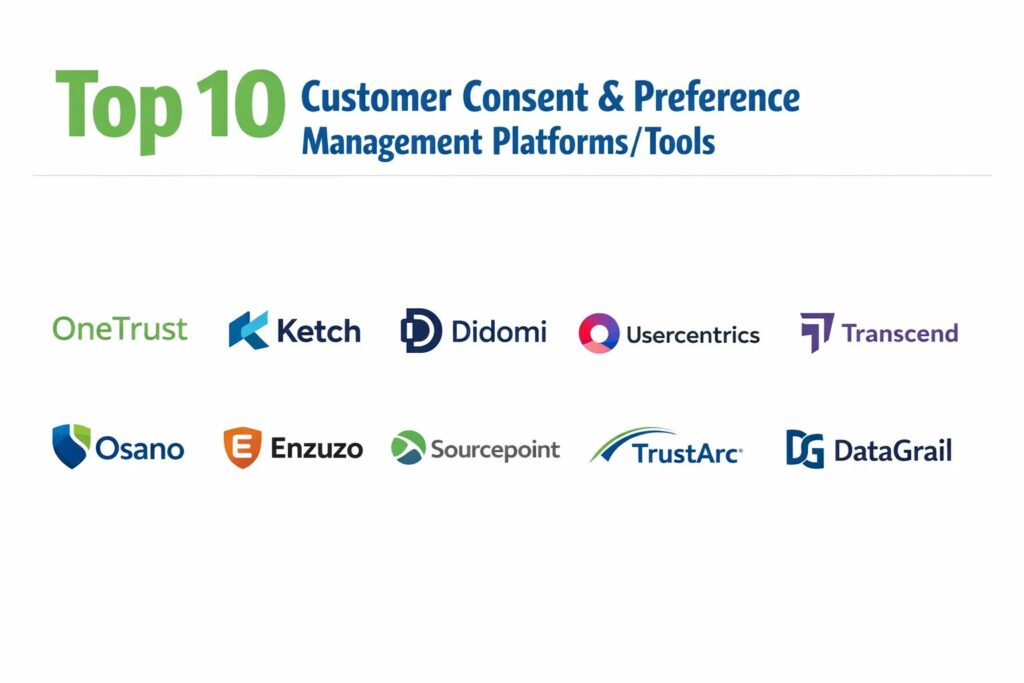
1. OneTrust Consent & Preferences
OneTrust is the undisputed market leader in the GRC (Governance, Risk, and Compliance) space, offering a massive suite of privacy tools. Its Consent and Preference Management module is designed for large-scale enterprises that need to manage complex, multi-brand consent lifecycles across every digital touchpoint.
Key Features
The platform features a “Universal Consent” engine that synchronizes user choices across web, mobile, OTT, and offline channels. It includes a highly customizable “Self-Service Preference Center” that allows users to manage their communication frequencies and topics. The system offers automated “Cookie Scanning and Auto-blocking” to ensure no tracking occurs before consent is given. It features a “Centralized Consent Registry” that provides a tamper-proof audit trail for regulatory inquiries. Additionally, its “Mobile App Consent” SDK is one of the most mature in the industry, supporting complex native app environments.
Pros
It offers the most comprehensive set of regulatory templates and legal guidance built directly into the software. The platform is highly scalable and can handle the data volumes of the world’s largest companies.
Cons
The setup process is notoriously complex and often requires professional services or external consultants. Pricing is high and can be opaque, often starting at tens of thousands of dollars.
Platforms and Deployment
Cloud-based SaaS, with options for private cloud or on-premises deployment for high-security needs.
Security and Compliance
Industry-leading certifications including ISO 27001, SOC 2 Type II, and FedRAMP.
Integrations and Ecosystem
Extensive marketplace with pre-built connectors for thousands of SaaS applications and internal databases.
Support and Community
Provides a massive “Knowledge Academy,” a dedicated community forum, and 24/7 global support.
2. Ketch
Ketch is a modern, API-first privacy orchestration platform that focuses on making compliance a “background task” for developers. It is built for the high-tech enterprise that views privacy as a data infrastructure challenge rather than just a legal one.
Key Features
The platform features “Privacy Orchestration,” which automatically propagates consent signals across all internal data systems and cloud warehouses. It includes a “Dynamic Preference Center” that can be embedded directly into existing user profiles. The system offers “Smart Policy Engine” that automatically applies the correct legal framework based on the user’s jurisdiction. It features “Identity Discovery” to link consent to a single user identity across multiple devices. Additionally, it provides a “Developer Portal” with robust APIs and SDKs for custom implementations.
Pros
The “set-it-and-forget-it” approach to data propagation saves hundreds of engineering hours. It provides a very clean, modern UI that is easier to navigate than older enterprise GRC tools.
Cons
It is a premium solution that might be overkill for businesses that only need a simple cookie banner. Some legacy system integrations may require custom API work.
Platforms and Deployment
Cloud-native SaaS platform.
Security and Compliance
Full GDPR, CCPA, and HIPAA compliance with SOC 2 certification.
Integrations and Ecosystem
Strongest in the modern data stack, integrating deeply with Snowflake, Databricks, and Segment.
Support and Community
Offers high-touch technical support and a library of developer-focused documentation.
3. Didomi
Didomi is an enterprise-first CMP based in Europe, making it a specialist in the strictest “opt-in” regulatory environments. It is known for its high uptime and its ability to handle billions of consent signals for global publishers and brands.
Key Features
The platform features “Consent Signature,” a proprietary technology that ensures the integrity of every consent record. It includes “Multi-Regulation Logic” that supports over 25 countries with localized legal rules. The system offers a “Preference Management Platform” (PMP) that allows for highly granular data collection beyond cookies. It features “Cross-Device Consent” through a unique “Didomi ID” or by integrating with existing customer IDs. Additionally, it provides advanced “Analytics and A/B Testing” to optimize consent rates without sacrificing compliance.
Pros
Exceptional performance and reliability, with 99.999% uptime for its consent API. The platform is very strong in the European market and understands the nuances of local DPA requirements.
Cons
The pricing is enterprise-grade and may not be accessible for smaller businesses. The interface can be technical, requiring a bit of a learning curve for marketing teams.
Platforms and Deployment
Web-based SaaS with robust SDKs for iOS, Android, and CTV.
Security and Compliance
IAB TCF v2.3 certified and fully GDPR compliant with European data residency.
Integrations and Ecosystem
Excellent integrations with ad tech and publishing stacks, as well as major CDPs and CRMs.
Support and Community
Provides dedicated account managers and a “Privacy Barometer” for staying updated on global laws.
4. Usercentrics (including Cookiebot)
Usercentrics is one of the world’s most widely used CMPs, especially after its merger with Cookiebot. It provides a scalable solution that serves everyone from individual website owners to global enterprises through its two distinct product lines.
Key Features
The platform features “Cookiebot’s Patented Scanning Technology,” which is widely regarded as the most accurate in detecting hidden trackers. It includes “Usercentrics Enterprise,” which offers deep customization of banners and preference centers. The system offers “Google Consent Mode v2” certification, ensuring seamless ad performance. It features “CTV and Gaming Support,” allowing consent collection on smart TVs and game consoles. Additionally, it provides “Smart Data Shielding” to prevent third-party scripts from loading before a user accepts.
Pros
Offers a wide range of pricing tiers, from a free version for small sites to enterprise-level plans. Its scanning technology is highly automated and requires very little manual categorization.
Cons
The interface for the “Cookiebot” version can feel a bit dated compared to modern SaaS tools. Enterprise features are strictly gated behind higher-tier plans.
Platforms and Deployment
Web-based SaaS with wide platform support including WordPress, Shopify, and mobile SDKs.
Security and Compliance
SOC 2 Type II, ISO 27001, and fully compliant with GDPR, CCPA, and LGPD.
Integrations and Ecosystem
Integrates with almost every major CMS, Tag Manager, and marketing automation platform.
Support and Community
Extensive self-service help center and a responsive ticketing system for paid users.
5. Transcend
Transcend is a “privacy-infrastructure-as-code” platform that focuses on automating the hardest parts of data privacy, such as data mapping and preference enforcement at the system level. It is a favorite among high-growth tech companies and Fortune 500s.
Key Features
The platform features “Airgap.js,” a client-side technology that regulates data flow at the network level rather than just the UI level. It includes “System Discovery,” which automatically identifies personal data across thousands of SaaS tools and databases. The system offers a “Unified Preference Center” that propagates choices in real-time to the actual backend systems. It features “Global Privacy Control (GPC)” support, automatically honoring browser-level opt-out signals. Additionally, it provides “Deep Deletion” capabilities to ensure a user’s right to be forgotten is actually executed.
Pros
Provides the most technical and secure way to enforce consent, moving beyond “cosmetic” compliance. It significantly reduces the engineering burden of managing Data Subject Access Requests (DSARs).
Cons
It is a highly technical platform that requires engineering involvement for initial setup. It may be “too much tool” for companies that only need a basic cookie banner.
Platforms and Deployment
Cloud-based platform with a focus on API and JavaScript-based enforcement.
Security and Compliance
Maintains the highest security standards, including Zero-Knowledge architecture and SOC 2 Type II.
Integrations and Ecosystem
Deep integrations with modern infrastructure like AWS, Google Cloud, and enterprise SaaS like Workday.
Support and Community
Provides high-level engineering support and a comprehensive “Privacy Operations” library.
6. Osano
Osano is known for its “Privacy Monitor,” which rates the privacy practices of thousands of vendors. Its CMP is designed to be simple, reliable, and compliant, making it a popular choice for mid-market companies that want a “no-headache” solution.
Key Features
The platform features a “No-Code Banner Builder” that allows non-technical users to deploy a compliant banner in minutes. It includes “Vendor Risk Management,” which alerts you if a third-party script on your site changes its privacy policy. The system offers “Automatic Geofencing” to serve different rules to users in different states or countries. It features “Consent Records Export,” providing a clean audit trail for legal teams. Additionally, it provides a “DSAR Portal” to manage user data requests in one centralized location.
Pros
It is one of the easiest platforms to set up and maintain. The “Vendor Discovery” feature is unique and helps companies keep track of what third-party tools are actually doing on their site.
Cons
The preference center customization is not as granular as high-end enterprise tools. Some advanced reporting features are only available on the most expensive plans.
Platforms and Deployment
Cloud-based SaaS with simple JavaScript installation.
Security and Compliance
GDPR and CCPA compliant, with a unique “Compliance Guarantee” for its enterprise customers.
Integrations and Ecosystem
Integrates with major tag managers and a wide range of marketing tools.
Support and Community
Offers a robust library of privacy laws and a very helpful “customer success” team.
7. Enzuzo
Enzuzo is a lightweight, modern compliance platform designed for the e-commerce and mid-market sectors. It stands out for its deep integration with platforms like Shopify and its focus on being “agency-friendly.”
Key Features
The platform features a “Google Gold Certified CMP,” ensuring the highest level of compatibility with Google Ad products. It includes a “Privacy Policy and Legal Page Generator” that stays updated as laws change. The system offers “Consent Analytics” that help marketers understand how users are interacting with the banner. It features a “Unified Dashboard” for managing multiple domains and storefronts. Additionally, it provides “Shopify-Specific Features,” such as automated banner theme matching and app-blocker compatibility.
Pros
The pricing is very affordable for small to mid-sized businesses. The UX is incredibly clean and designed for users who don’t want to deal with complex legal jargon.
Cons
It lacks some of the deep “data mapping” and “enterprise orchestration” features found in tools like Ketch or Transcend. It is primarily focused on web-based consent rather than OTT or complex native apps.
Platforms and Deployment
Cloud-based SaaS with a dedicated Shopify App and Webflow plugin.
Security and Compliance
Fully GDPR and CCPA compliant with secure data hosting.
Integrations and Ecosystem
Strongest in the e-commerce ecosystem (Shopify, Wix, Squarespace) and Google Tag Manager.
Support and Community
Provides fast email support and a library of practical “how-to” guides for merchants.
8. Sourcepoint
Sourcepoint is a “Privacy Experience” platform that focuses on the intersection of compliance and monetization. It is the preferred choice for large publishers and media companies that need to balance user privacy with advertising revenue.
Key Features
The platform features “Dialogue,” a highly customizable messaging system for consent and preference management. It includes “Yield Optimization” tools that help publishers understand the revenue impact of different consent strategies. The system offers “CTV and OTT Support,” making it a leader in the streaming media space. It features “A/B Testing for Consent,” allowing teams to test different message tones and designs. Additionally, its “Global Identity Mapping” ensures that a user’s choices are remembered across multiple media properties.
Pros
It is the best platform for organizations that are heavily reliant on ad revenue. Its support for “non-standard” devices like Samsung TV and Roku is industry-leading.
Cons
The focus is very much on the publishing and advertising world, making it less of a fit for a B2B SaaS company. It can be quite expensive for smaller media outlets.
Platforms and Deployment
Cloud-based SaaS with specialized SDKs for web, mobile, and connected TV.
Security and Compliance
IAB TCF v2.3 compliant and adheres to all major global privacy regulations.
Integrations and Ecosystem
Deeply integrated with the ad-tech ecosystem (Prebid, Google Ad Manager, various SSPs).
Support and Community
Provides expert consulting on privacy-centric monetization strategies.
9. TrustArc
TrustArc is one of the “original” privacy companies, formerly known as TRUSTe. It provides a massive, modular platform that covers everything from data mapping to privacy certifications, making it a “one-stop-shop” for corporate legal departments.
Key Features
The platform features “Risk and Vendor Assessments,” allowing you to vet the privacy health of your partners. It includes a “Global Compliance Manager” that tracks your adherence to over 1000 global privacy laws. The system offers “Cookie Consent with Regional Logic,” serving different banners based on the user’s IP. It features “DSAR Automation” with a secure portal for data verification. Additionally, it provides “Trust Seals and Certifications” that can be displayed on your site to build consumer confidence.
Pros
It is a highly trusted name in the industry, and its certifications carry significant weight with consumers and regulators. The platform is incredibly broad, covering nearly every aspect of privacy operations.
Cons
The interface can feel “legacy” and clunky compared to newer, API-first competitors. Like OneTrust, it can be very expensive and complex to implement.
Platforms and Deployment
Cloud-based SaaS with a focus on enterprise governance.
Security and Compliance
One of the most certified platforms in the world, with a long history of regulatory leadership.
Integrations and Ecosystem
Integrates well with enterprise systems like SAP, Oracle, and Salesforce.
Support and Community
Provides extensive analyst support and a “Privacy Index” for benchmarking your program.
10. DataGrail
DataGrail is a “Privacy Control Center” that focuses on simplicity and automation. It is designed to help companies manage the “privacy side of the house” without needing a dedicated team of lawyers or engineers.
Key Features
The platform features “Live Data Map,” which automatically scans your systems to find where personal data lives. It includes “Request Manager,” a highly automated way to handle “Do Not Sell” and “Right to Know” requests. The system offers “Consent Management” that integrates directly into your existing marketing stack. It features “Risk Assessments” that identify potential compliance gaps in your vendor list. Additionally, it provides a “Privacy Portal” that gives users a transparent look at what data you have and how they can control it.
Pros
It is one of the most user-friendly platforms for teams that want a “clean” and “modern” experience. The automated data mapping is a huge time-saver for growing companies.
Cons
It is more of a “privacy operations” platform than a pure “preference management” tool, so it may lack some of the granular marketing preference features.
Platforms and Deployment
Cloud-native SaaS platform.
Security and Compliance
SOC 2 Type II certified and fully compliant with all major US and EU laws.
Integrations and Ecosystem
Features an impressive “Integration Network” with over 1,500 pre-built connectors.
Support and Community
Offers great customer success support and a helpful “Privacy Guide” for businesses.
Comparison Table
| Tool Name | Best For | Platform(s) Supported | Deployment | Standout Feature | Public Rating |
| 1. OneTrust | Global Enterprise | Web, iOS, Android, OTT | Cloud / Hybrid | Centralized Registry | 4.1/5 |
| 2. Ketch | API-First Privacy | Web, API, SDK | Cloud SaaS | Privacy Orchestration | 4.7/5 |
| 3. Didomi | EU-Focused Brands | Web, Mobile, CTV | Cloud SaaS | Consent Signature | 4.6/5 |
| 4. Usercentrics | SMB to Enterprise | Web, Mobile, CTV | Cloud SaaS | Deep Cookie Scanning | 4.6/5 |
| 5. Transcend | Privacy Engineering | Web, API, SDK | Cloud SaaS | Airgap.js Enforcement | 4.8/5 |
| 6. Osano | No-Code Compliance | Web-Based | Cloud SaaS | Vendor Risk Rating | 4.7/5 |
| 7. Enzuzo | E-commerce / Mid-Market | Shopify, Web, Mobile | Cloud SaaS | Google Gold Certified | 4.9/5 |
| 8. Sourcepoint | Media & Publishers | Web, Mobile, OTT | Cloud SaaS | Yield Optimization | 4.7/5 |
| 9. TrustArc | GRC & Certifications | Web-Based | Cloud SaaS | Privacy Certifications | 4.1/5 |
| 10. DataGrail | Privacy Operations | Web, API | Cloud SaaS | Live Data Mapping | 4.8/5 |
Evaluation & Scoring of Consent & Preference Centers
The scoring below is a comparative model intended to help shortlisting. Each criterion is scored from 1–10, then a weighted total from 0–10 is calculated using the weights listed. These are analyst estimates based on typical fit and common workflow requirements, not public ratings.
Weights:
- Core features – 25%
- Ease of use – 15%
- Integrations & ecosystem – 15%
- Security & compliance – 10%
- Performance & reliability – 10%
- Support & community – 10%
- Price / value – 15%
| Tool Name | Core (25%) | Ease (15%) | Integrations (15%) | Security (10%) | Performance (10%) | Support (10%) | Value (15%) | Weighted Total |
| 1. OneTrust | 10 | 4 | 10 | 10 | 9 | 9 | 5 | 8.20 |
| 2. Ketch | 9 | 9 | 10 | 9 | 9 | 8 | 8 | 8.95 |
| 3. Didomi | 9 | 8 | 9 | 9 | 10 | 9 | 7 | 8.70 |
| 4. Usercentrics | 8 | 9 | 9 | 9 | 9 | 8 | 9 | 8.65 |
| 5. Transcend | 10 | 6 | 10 | 10 | 10 | 9 | 7 | 8.85 |
| 6. Osano | 7 | 10 | 8 | 9 | 9 | 9 | 9 | 8.50 |
| 7. Enzuzo | 7 | 10 | 9 | 8 | 9 | 9 | 10 | 8.65 |
| 8. Sourcepoint | 8 | 8 | 8 | 9 | 10 | 8 | 7 | 8.05 |
| 9. TrustArc | 9 | 5 | 8 | 10 | 8 | 9 | 6 | 7.80 |
| 10. DataGrail | 8 | 9 | 9 | 9 | 9 | 10 | 8 | 8.75 |
How to interpret the scores:
- Use the weighted total to shortlist candidates, then validate with a pilot.
- A lower score can mean specialization, not weakness.
- Security and compliance scores reflect controllability and governance fit, because certifications are often not publicly stated.
- Actual outcomes vary with assembly size, team skills, templates, and process maturity.
Which Consent & Preference Center Tool Is Right for You?
Solo / Founder-Led
If you are running a single website or blog, your primary goal is to “set it and forget it” with minimal cost. You need a platform that provides a free tier or a very low monthly cost and handles the legal wording for you. Look for tools that offer simple WordPress or Shopify plugins, as these will allow you to stay compliant without ever looking at a single line of code.
Small Nonprofit
Nonprofits often deal with sensitive donor data and need to build high levels of trust on a limited budget. A tool that provides “transparency seals” and easy-to-use privacy policy generators is ideal. Focus on platforms that offer discounted pricing for 501(c)(3) organizations and prioritize “ease of use” so that your staff can focus on the mission rather than technical compliance.
Mid-Market
For growing companies, the focus shifts to marketing automation and lead generation. You need a platform that doesn’t just block cookies but also feeds user preferences into your CRM and Email Service Providers. This ensures that you aren’t emailing people who have opted out, which protects your sender reputation and keeps you on the right side of anti-spam laws like CAN-SPAM and CASL.
Enterprise
Large-scale organizations require “Privacy Orchestration.” This means you need a platform that can handle multiple languages, jurisdictions, and brands from a single pane of glass. Your choice must be able to synchronize consent signals across thousands of internal and external systems in real-time, providing a “bulletproof” audit trail for the world’s most aggressive regulators.
Budget vs Premium
Budget solutions are perfect for basic website compliance and simple “opt-out” management. However, they often lack the deep system-level enforcement and “Zero-Knowledge” security of premium platforms. Premium solutions are an investment in “Risk Mitigation”—they are more expensive up front but can save millions in potential fines and engineering costs associated with manual data deletion and audit responses.
Feature Depth vs Ease of Use
If your primary concern is the “Right to be Forgotten” and complex data mapping, you need a high-depth tool that can reach deep into your databases. If your primary concern is simply having a compliant and beautiful cookie banner that doesn’t hurt your site’s conversion rate, an “ease-of-use” focused tool with advanced A/B testing features is the better choice.
Integrations & Scalability
A preference center is useless if it doesn’t talk to your other tools. Before choosing, map out every system that stores user data (CRM, ESP, CDP, Help Desk). Ensure your chosen platform has “pre-built” connectors for your most critical systems, as custom API development can quickly derail your compliance timeline and budget.
Security & Compliance Needs
Evaluate the “Data Residency” of the platform itself. If you are a European company, you may prefer a platform that hosts its data in the EU to simplify your own compliance. Similarly, if you handle healthcare or financial data, look for platforms with specialized HIPAA or SOC 2 Type II certifications to ensure your users’ choices are handled as securely as their data.
Frequently Asked Questions (FAQs)
1. What is the difference between a CMP and a Preference Center?
A Consent Management Platform (CMP) primarily focuses on the technical side of “cookie consent”—blocking trackers until a user agrees. A Preference Center is a user-facing portal where individuals can make more granular choices, such as opting in to specific newsletter topics or setting the frequency of text messages.
2. Does a cookie banner make me 100% GDPR compliant?
No. A cookie banner is only one part of the GDPR requirements. You also need a comprehensive privacy policy, a legal basis for processing all data, a system for responding to data subject requests (DSARs), and records of how you are protecting user information.
3. What is “Google Consent Mode v2” and why do I need it?
Google Consent Mode v2 is a technical framework that allows your website to communicate a user’s consent status directly to Google’s tags (like Google Ads and Analytics). As of 2024, it is required for any business that wants to use personalized advertising and measurement features in Europe.
4. What are “Dark Patterns” in consent design?
Dark patterns are design choices that trick or manipulate users into giving consent they didn’t intend to give. Examples include making the “Accept All” button much larger and brighter than the “Reject All” button, or using confusing double negatives in the legal text.
5. How does geofencing work in a consent platform?
The platform uses the user’s IP address to determine their approximate location. It then serves the specific legal notice required for that region—for example, showing a strict “Opt-In” banner to a user in Berlin and a less intrusive “Opt-Out” notice to a user in San Francisco.
6. Can I host my preference center on my own domain?
Yes, most enterprise-level platforms allow you to use a “CNAME” or custom domain (e.g., https://www.google.com/search?q=privacy.yourbrand.com). This is highly recommended as it builds trust and provides a more seamless experience for the user.
7. How do I handle consent for users on mobile apps?
Consent management for mobile apps requires a specialized “Mobile SDK” (Software Development Kit). This SDK integrates directly into your app’s code to manage permissions for IDFA (iOS) and AAID (Android) tracking, as well as in-app analytics.
8. What is “Zero-Party Data”?
Zero-party data is information that a customer intentionally and proactively shares with a brand. This includes communication preferences, purchase intentions, and personal interests collected through your preference center. It is considered the most valuable and accurate form of customer data.
9. Why is a “tamper-proof” audit log important?
If a regulator investigates your company, you must be able to prove that a specific user gave consent at a specific time and on a specific version of your privacy policy. A tamper-proof log ensures that these records cannot be altered, making them legally defensible.
10. Do I need a lawyer to set up my preference center?
While these platforms provide many templates and “best practice” guides, it is always recommended to have your legal counsel review your final implementation. Every business has unique data practices, and a lawyer can ensure your specific notices are accurate and compliant with the latest case law.
Conclusion
Navigating the intersection of user privacy and data-driven marketing requires more than just a legal policy; it requires a sophisticated technical infrastructure. The platforms highlighted in this guide represent the pinnacle of modern consent and preference management, offering a bridge between complex global regulations and the need for a seamless customer experience. By centralizing user choices, organizations can move beyond the “compliance as a burden” mindset and instead treat privacy as a core brand value that drives long-term loyalty. In an increasingly transparent digital world, the ability to demonstrate that you respect and honor your customers’ choices is the ultimate competitive advantage.