Introduction
Subscription creator platforms represent the evolution of the digital economy, shifting the focus from volatile ad revenue to stable, recurring community support. These ecosystems provide the infrastructure for individuals and organizations to gate premium content, manage memberships, and foster direct relationships with their audience without the interference of third-party algorithms. By leveraging integrated payment processing and automated delivery systems, these platforms allow creators to treat their intellectual property as a scalable business asset. In a landscape where platform stability and data ownership are paramount, selecting the right environment is the most critical strategic decision a digital entrepreneur can make.
The necessity of these tools is driven by the demand for “sovereign” audiences. Modern creators require environments where they own their subscriber lists and can communicate without filtered reach. Organizations utilize these platforms for specialized training, exclusive research distribution, and community-led product development. When evaluating these services, a professional must look beyond simple aesthetics. Critical evaluation criteria include the platform’s fee structure, the robustness of its data export capabilities, its compliance with global financial regulations, and the depth of its built-in marketing automation. A platform that offers a seamless transition between free engagement and paid conversion is essential for long-term growth and high member retention rates.
Best for: Independent journalists, digital educators, community leaders, and creative professionals seeking to replace unpredictable social media earnings with consistent, recurring revenue streams.
Not ideal for: One-time product sales without an ongoing content strategy or users looking for a traditional e-commerce storefront for physical goods. If your goal is strictly bulk shipping and inventory management, dedicated e-commerce engines are more appropriate.
Key Trends in Subscription Creator Platforms
The current market is moving rapidly toward “all-in-one” functionality, where a single subscription covers newsletters, video hosting, and community forums. There is a significant rise in AI-driven tools that assist creators in generating engagement prompts, summarizing long-form discussions, and predicting subscriber churn before it happens. Portability has also become a non-negotiable standard; the industry is shifting toward open protocols that allow creators to move their entire business—including payment history and member profiles—between different providers without friction.
Monetization models are diversifying beyond simple monthly tiers. We are seeing the integration of “pay-what-you-want” mechanics, tiered “founder” memberships, and integrated tipping systems that complement the base subscription model. Additionally, there is a heavy focus on “white-label” mobile experiences, where high-tier creators can offer their community a dedicated, branded app on major mobile stores. Security and privacy have also taken center stage, with platforms implementing advanced encryption and localized data compliance to meet the growing demands of a global, privacy-conscious user base.
How We Selected These Tools
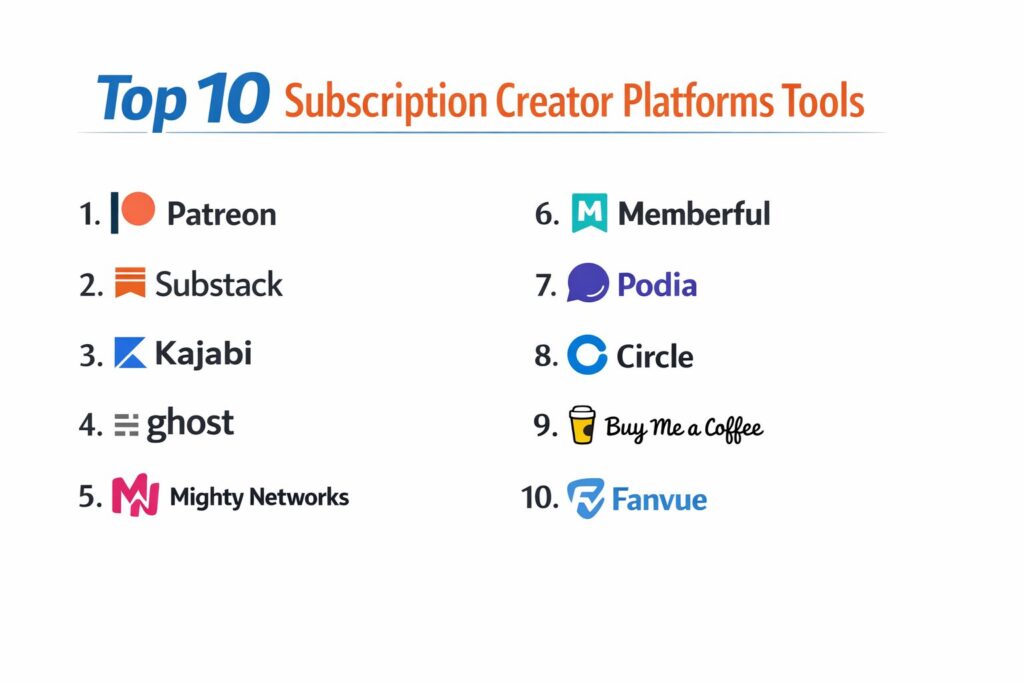
The selection of these ten platforms followed a rigorous assessment of their operational reliability and market impact. We prioritized established players with a proven history of timely payouts and high uptime, ensuring that a creator’s livelihood is never compromised by technical instability. The fee structures were scrutinized for transparency, with a preference for platforms that offer a fair balance between features provided and the percentage of revenue taken. We also analyzed the “network effect” of each tool—its ability to help creators discover new fans within the platform’s own ecosystem.
Technical flexibility was another key factor, particularly the ease of integration with external marketing stacks and CRM tools. We looked for platforms that provide deep analytics, giving creators the data they need to understand member behavior and optimize their content strategy. Accessibility for the end-user was also a primary concern, as a frictionless checkout and login process are the biggest drivers of conversion. Finally, we assessed the level of community and professional support provided by the developers, ensuring that users have access to the resources needed to scale their operations effectively.
1. Patreon
Patreon is the most recognized name in the membership space, functioning as a hub where fans support creators across nearly every medium. It excels at providing a structured tier system that allows creators to offer varying levels of access and rewards to their most dedicated followers.
Key Features
The platform features a robust tiered membership system with automated benefit delivery for different levels of support. It includes integrated tools for hosting private podcasts and distributing exclusive RSS feeds. Creators can utilize a native messaging system to communicate directly with their patrons. The platform also offers a “Free” tier that acts as a lead magnet for potential paying members. It provides detailed insights into member growth and churn rates, along with a specialized mobile app for on-the-go community management and content posting.
Pros
It has the highest brand recognition in the industry, which builds immediate trust with potential subscribers. The integration with Discord for automated community role management is a major advantage for community-led brands.
Cons
The platform fees can be high on the premium tiers, and the “Discover” algorithm is not as powerful for growth as some of its newsletter-based competitors.
Platforms and Deployment
Web-based with dedicated iOS and Android apps for both creators and patrons.
Security and Compliance
It is PCI DSS compliant and adheres to GDPR and CCPA regulations. It uses industry-standard encryption for all financial transactions and personal data.
Integrations and Ecosystem
Strong integrations with Discord, WordPress, and various podcasting platforms. It has a mature API that allows for custom connections with external marketing tools.
Support and Community
Offers an extensive creator blog, a dedicated help center, and specialized workshops for high-growth creators.
2. Substack
Substack has redefined the newsletter industry by making it incredibly simple for writers and journalists to build a paid audience. It focuses on a clean, distraction-free reading experience while providing powerful organic growth tools through its internal recommendation engine.
Key Features
The platform is built around a high-performance email delivery system that ensures newsletters reach the inbox. It features a sophisticated recommendation network that helps creators find new subscribers through other writers. Users can host both public and private podcasts directly on the platform. It includes community “Threads” for real-time discussion and a “Notes” feature for short-form social engagement. The system allows for easy import and export of subscriber lists, ensuring creators maintain total ownership of their audience data.
Pros
The ease of use is unmatched; a professional paid newsletter can be launched in minutes without any technical knowledge. The internal network effect is a massive driver for organic growth.
Cons
The platform takes a flat 10% cut of revenue, which can become expensive for high-earning creators. Customization options for the website’s design are relatively limited.
Platforms and Deployment
Web-based with a highly-rated mobile app for readers.
Security and Compliance
Utilizes Stripe for secure payment processing and is fully compliant with standard data protection laws.
Integrations and Ecosystem
Minimal third-party integrations by design, though it allows for the embedding of various media types and supports standard tracking pixels.
Support and Community
Provides a comprehensive support library and regular “Office Hours” where creators can learn from the platform’s successful writers.
3. Kajabi
Kajabi is a high-end, all-in-one platform designed for creators who want to build a full digital business around courses, coaching, and memberships. It provides a comprehensive suite of tools that replaces the need for separate website builders and email marketing software.
Key Features
The software includes a powerful website builder with professional templates tailored for digital products. It features a sophisticated automation engine that triggers emails and access based on user behavior. It provides a native mobile app where members can access courses and community spaces. The system includes integrated funnels—known as “Pipelines”—that guide potential customers from discovery to purchase. It also offers advanced assessment tools, such as quizzes and surveys, to track student progress and engagement.
Pros
It eliminates “plugin bloat” by providing every tool needed to run a business in one place. The marketing automation capabilities are far more advanced than those of simpler subscription tools.
Cons
The starting price point is significantly higher than other platforms, making it less accessible for beginners. The learning curve is steeper due to the sheer volume of features available.
Platforms and Deployment
Cloud-hosted web platform with a branded mobile app for members.
Security and Compliance
Maintains PCI Level 1 compliance and uses secure AWS hosting. It provides robust GDPR tools for managing global student data.
Integrations and Ecosystem
Features built-in integrations with major providers like Stripe, PayPal, and Google Analytics. It also supports Zapier for thousands of additional connections.
Support and Community
Offers 24/7 customer support and an elite community of “Kajabi Heroes” who share business growth strategies.
4. Ghost
Ghost is a professional, open-source alternative to Substack, favored by independent publishers and tech-savvy creators who want total control over their brand. It offers a powerful publishing engine with built-in membership tools and a focus on site speed and SEO.
Key Features
The platform features a world-class editor optimized for a distraction-free writing experience. It includes native membership management with customizable tiers and automated sign-up flows. Its “Ghost Pro” managed service handles all technical maintenance, while developers can choose to self-host the software for complete customization. The system offers deep SEO tools built directly into the core, ensuring content ranks well in search engines. It also provides advanced analytics that show exactly which posts are driving the most conversions.
Pros
The platform takes 0% transaction fees, meaning creators only pay a flat monthly hosting fee and keep all their revenue. It offers unparalleled design freedom for those who want a unique website.
Cons
The setup can be more technical than “plug-and-play” platforms. While it has some community features, it is primarily a publishing tool and lacks deep interactive forum capabilities.
Platforms and Deployment
Web-based; can be self-hosted on any server or managed via Ghost Pro.
Security and Compliance
Ghost Pro includes enterprise-grade security with 24/7 DDoS mitigation and automated rate limiting. It is fully GDPR compliant.
Integrations and Ecosystem
Includes a built-in integration library with over 1,000 tools. It has a powerful API and a flexible theme engine for custom development.
Support and Community
Managed users get priority professional support, and there is a large developer community for those customizing the platform.
5. Mighty Networks
Mighty Networks focuses on “Cultural Software,” allowing creators to bring community, courses, and content together under their own brand. It is designed to foster deep engagement and move audiences away from the noise of traditional social media.
Key Features
The platform utilizes a unique “Spaces” architecture that lets creators organize different groups, courses, and feeds within one network. It features integrated livestreaming and real-time chat for immediate community interaction. The system includes an AI “Cohost” that helps generate course outlines and member icebreakers. For enterprise clients, it offers “Mighty Pro,” which provides a completely custom-branded mobile app in the Apple and Google stores. It also features a dynamic activity feed that prioritizes high-value conversations over algorithmic noise.
Pros
It offers the strongest community-building features in the market, making it ideal for movements and brand-led ecosystems. The ability to have a fully branded mobile app is a major prestige factor.
Cons
The interface can be complex for members if the creator doesn’t organize the “Spaces” effectively. Some of the most powerful features are locked behind the higher-priced tiers.
Platforms and Deployment
Web-based with native iOS and Android apps.
Security and Compliance
SOC 2 Type II compliant and GDPR ready. It provides robust data privacy controls and secure payment processing via Stripe.
Integrations and Ecosystem
Integrates with Zapier and offers deep links for Google Analytics and Facebook pixel tracking. It is designed to be the central “home” for a brand’s audience.
Support and Community
Hosts a dedicated community for “Mighty Hosts” and provides extensive webinars and success managers for professional clients.
6. Memberful
Memberful is a streamlined membership plugin that allows creators to add subscription features to their existing websites. It is widely used by established publishers and podcasters who want to maintain their own site architecture while offloading the complexity of billing.
Key Features
The software provides a clean, minimal checkout overlay that keeps users on the creator’s site during purchase. It features automated recurring billing and renewal management through Stripe. The system includes tools for creating private RSS feeds for podcasters and restricted content areas on WordPress sites. It offers a “Member Dashboard” where subscribers can manage their own plans and update payment details. It also provides a robust analytics suite that tracks member lifetime value and conversion rates across different marketing channels.
Pros
It is incredibly reliable and stays “out of the way,” letting the creator’s brand remain front and center. It integrates more seamlessly with WordPress than almost any other membership tool.
Cons
It does not host your content; you must have your own website or platform to put the content on. It lacks built-in community features like forums or chat.
Platforms and Deployment
Cloud-based service that integrates with existing websites (primarily WordPress).
Security and Compliance
Uses Stripe-based security and is fully GDPR and CCPA compliant. It provides detailed audit logs for all administrative actions.
Integrations and Ecosystem
One of the strongest integration ecosystems, with dedicated links for Discord, Mailchimp, and Discourse. It is designed to plug into a pre-existing technical stack.
Support and Community
Known for excellent customer service and clear documentation for both creators and developers.
7. Podia
Podia positions itself as a user-friendly, all-in-one alternative for creators who find platforms like Kajabi too complex. It provides a unified storefront for selling memberships, online courses, and digital downloads without any technical friction.
Key Features
The platform features a simple website builder that allows for rapid storefront setup. It includes a native community tool where members can interact and participate in discussions. The system allows for “Instant Payouts,” meaning creators don’t have to wait for a monthly billing cycle to receive their earnings. It provides built-in email marketing with automated sequences and broadcast capabilities. It also features a “Live Session” tool for hosting webinars and workshops directly for subscribers.
Pros
The interface is exceptionally clean and intuitive for both the creator and the customer. It offers a very high value-to-price ratio for those moving off free platforms.
Cons
The customization options for the website and email templates are more limited than specialized tools. It lacks advanced marketing features like complex branching logic in automations.
Platforms and Deployment
Web-based platform with mobile-responsive design for all member areas.
Security and Compliance
Features PCI-compliant transactions and secure hosting on AWS. It provides standard GDPR support and secure file delivery for downloads.
Integrations and Ecosystem
Supports major payment gateways and integrates with tools like Zapier, Mailchimp, and various analytics providers.
Support and Community
Offers highly responsive live chat support and a rich repository of creator resources and guides.
8. Circle
Circle is a modern community platform that has quickly become the preferred choice for creators who want to build a “private social network.” It is designed to be embedded into existing websites or run as a standalone destination for discussion and learning.
Key Features
The platform features organized discussion “Spaces” that can be set to public or private based on membership tiers. It includes a built-in course player that allows creators to host lessons directly alongside their community. The system supports “Live Rooms” for real-time video workshops and Q&A sessions. It features a member directory with custom profiles and private messaging capabilities. It also offers a “Weekly Digest” email that automatically summarizes the most popular community activity for members.
Pros
It offers a “premium” feel that mimics the best parts of modern social media without the ads or distractions. The ability to embed the community into a separate website is a unique technical advantage.
Cons
The costs can scale quickly as the community grows and more features are added. It is less focused on long-form publishing than platforms like Ghost or Substack.
Platforms and Deployment
Web-based with a dedicated mobile app for members.
Security and Compliance
SOC 2 Type II compliant and utilizes SSL encryption for all data. It follows strict GDPR protocols for user data management.
Integrations and Ecosystem
Deeply integrated with tools like Memberstack and Teachable. It is famous for its “Single Sign-On” (SSO) capabilities, allowing it to sync with other login systems.
Support and Community
Maintains an active “Circle Experts” community and provides detailed documentation and email support.
9. Buy Me a Coffee
Buy Me a Coffee is a simplified, “low-friction” platform that allows creators to accept one-time donations and recurring memberships. It is ideal for creators who want a friendly, approachable way for their audience to show financial support without the pressure of a formal subscription site.
Key Features
The platform features a “one-tap” payment system that doesn’t require supporters to create an account. It includes a “Shop” feature for selling digital products or physical commissions. Creators can offer recurring memberships with exclusive “locked” content for supporters. The system provides a simple email tool for sending updates to the entire audience. It also features a unique “Goal” tracker that allows fans to see how their contributions are helping the creator reach specific milestones.
Pros
It has one of the most delightful and easy-to-use interfaces for fans, leading to high conversion for small donations. There are no monthly subscription fees for the creator; the platform only takes a small percentage of transactions.
Cons
It lacks the advanced community and course-building tools found in more robust platforms. The branding options are minimal, as the page always maintains the “Buy Me a Coffee” look.
Platforms and Deployment
Web-based with a focus on mobile optimization.
Security and Compliance
Does not store credit card data on its own servers, utilizing Stripe for PCI Level 1 compliance. It uses Cloudflare for DDoS protection and data security.
Integrations and Ecosystem
Integrates with Zapier and Discord, and allows for the use of custom “widgets” on external websites.
Support and Community
Offers a helpful FAQ section and is known for being highly responsive to feature requests from its user base.
10. Fanvue
Fanvue is an emerging challenger that distinguishes itself through its embrace of AI-driven tools and its focus on discoverability. It is designed for creators across all genres, providing advanced technological features to automate engagement and maximize revenue.
Key Features
The platform features a native AI suite that can help creators generate automated messages and analyze fan preferences. It offers a “Discover” feed that actively promotes creators to potential new subscribers, reducing the reliance on external social media. The system provides exceptionally fast payout options, sometimes processing earnings in less than 30 minutes. It includes advanced media theft protection to safeguard a creator’s content. It also features virtual avatar support for creators who want to build a brand around AI-generated or virtual influencers.
Pros
The integration of AI tools for interaction can save creators a massive amount of administrative time. The internal promotion algorithms offer better growth potential for new accounts than legacy platforms.
Cons
The platform is newer, meaning it has less long-term historical data on stability compared to giants like Patreon. Its focus on AI and virtual creators might not appeal to all traditional content types.
Platforms and Deployment
Web-based with a highly optimized mobile dashboard for creators.
Security and Compliance
Adheres to strict UK safety and data regulations. It uses rigorous identity verification (KYC) to maintain a secure environment for all users.
Integrations and Ecosystem
Focused on being a self-contained ecosystem, but supports standard financial and data export tools for professional business management.
Support and Community
Offers high-quality customer support that frequently outperforms larger industry competitors in response time.
Comparison Table
| Tool Name | Best For | Platform(s) Supported | Deployment | Standout Feature | Public Rating |
|---|---|---|---|---|---|
| Patreon | Memberships, fan support, and creator communities | Web, iOS, Android | Cloud | Tiered memberships with strong brand trust | 4.7/5 |
| Substack | Paid newsletters, journalism, and podcast subscriptions | Web, Mobile App | Cloud | Built-in recommendation network for growth | 4.8/5 |
| Kajabi | Courses, coaching, memberships, and full creator businesses | Web, Mobile App | Cloud | All-in-one funnels, automations, and course delivery | 4.6/5 |
| Ghost | Independent publishing and owned-media memberships | Web | Cloud / Self-hosted | 0% transaction fees with strong SEO control | 4.7/5 |
| Mighty Networks | Community-led brands, memberships, and branded apps | Web, iOS, Android | Cloud | Deep community architecture with Spaces and branded app options | 4.6/5 |
| Memberful | Memberships on existing websites and WordPress-based businesses | Web | Cloud | Seamless integration with existing websites and private podcasting | 4.5/5 |
| Podia | Simple all-in-one selling for memberships, courses, and downloads | Web | Cloud | Beginner-friendly storefront with built-in email and community | 4.5/5 |
| Circle | Premium private communities, cohorts, and learning spaces | Web, Mobile App | Cloud | Premium private social network with Live Rooms and SSO | 4.7/5 |
| Buy Me a Coffee | Low-friction donations and lightweight memberships | Web | Cloud | One-tap supporter payments with simple recurring memberships | 4.4/5 |
| Fanvue | AI-enabled creator monetization and discoverability | Web, Mobile Optimized | Cloud | AI-driven creator tools and growth-oriented discovery | 4.3/5 |
Evaluation & Scoring of Subscription Creator Platforms
The scoring below is a comparative model intended to help shortlisting. Each criterion is scored from 1–10, then a weighted total from 0–10 is calculated using the weights listed. These are analyst estimates based on typical fit and common workflow requirements, not public ratings.
Weights:
- Core features – 25%
- Ease of use – 15%
- Integrations & ecosystem – 15%
- Security & compliance – 10%
- Performance & reliability – 10%
- Support & community – 10%
- Price / value – 15%
| Tool Name | Core (25%) | Ease (15%) | Integrations (15%) | Security (10%) | Performance (10%) | Support (10%) | Value (15%) | Weighted Total |
|---|---|---|---|---|---|---|---|---|
| Patreon | 9 | 8 | 8 | 9 | 8 | 8 | 7 | 8.15 |
| Substack | 8 | 10 | 6 | 8 | 9 | 8 | 8 | 8.15 |
| Kajabi | 10 | 7 | 9 | 9 | 9 | 9 | 6 | 8.45 |
| Ghost | 9 | 7 | 9 | 9 | 9 | 8 | 9 | 8.55 |
| Mighty Networks | 9 | 7 | 8 | 9 | 8 | 8 | 7 | 8.00 |
| Memberful | 8 | 9 | 9 | 9 | 8 | 9 | 8 | 8.50 |
| Podia | 8 | 9 | 7 | 8 | 8 | 8 | 9 | 8.15 |
| Circle | 9 | 8 | 8 | 9 | 8 | 8 | 7 | 8.10 |
| Buy Me a Coffee | 6 | 10 | 6 | 8 | 8 | 7 | 9 | 7.65 |
| Fanvue | 7 | 8 | 6 | 8 | 8 | 7 | 8 | 7.35 |
How to interpret the scores:
- Use the weighted total to shortlist candidates, then validate with a pilot.
- A lower score can mean specialization, not weakness.
- Security and compliance scores reflect controllability and governance fit, because certifications are often not publicly stated.
- Actual outcomes vary with assembly size, team skills, templates, and process maturity.
Which Subscription Creator Platform Tool Is Right for You?
Solo / Freelancer
For individuals starting out, platforms like Substack or Patreon offer the lowest barriers to entry. They provide built-in audiences and require zero technical knowledge to operate, allowing the creator to focus entirely on content production and initial community growth.
SMB
Small businesses that require more control over their branding and customer data should look toward Ghost or Podia. These tools allow for a more professional presentation and better integration with existing marketing workflows without the extreme complexity of enterprise systems.
Mid-Market
Organizations with a growing audience and a need for deep engagement will find the most value in Circle or Mighty Networks. These platforms excel at turning a passive audience into an active community, which is essential for scaling a brand’s influence.
Enterprise
For high-revenue operations, Kajabi or a self-hosted Ghost installation provide the necessary depth. These options offer advanced automation, team management features, and the level of data security required for large-scale commercial operations.
Budget vs Premium
Ghost and Buy Me a Coffee are the clear winners for the budget-conscious, as they either take no transaction fees or only charge for successful sales. Premium options like Kajabi and Mighty Pro are significant investments that pay off through saved time and advanced business capabilities.
Feature Depth vs Ease of Use
If you need deep technical control and custom designs, Ghost is the industry standard. If you prioritize a “turnkey” solution where you never have to think about a server or a plugin, Substack and Patreon are the most efficient choices.
Integrations & Scalability
Memberful and Circle are the champions of integration, designed to live alongside other software. As a business scales, the ability to connect your subscription platform to your CRM and analytics tools becomes the primary driver of efficiency.
Security & Compliance Needs
All listed platforms provide professional-grade security, but enterprise-focused tools like Kajabi and Mighty Networks offer more granular controls for user permissions and data handling, which is critical for organizations operating in regulated industries.
Frequently Asked Questions (FAQs)
1. Do I own my subscriber list on these platforms?
Most professional platforms on this list, such as Ghost, Substack, and Memberful, allow you to export your subscriber data at any time. It is vital to choose a platform that gives you full ownership of your email list and payment data.
2. How much of my revenue do these platforms take?
Fees vary significantly, ranging from 0% on Ghost (plus hosting) to 12% on Patreon and 10% on Substack. Always account for payment processing fees, which are typically an additional 2.9% plus a small per-transaction fee.
3. Can I use these platforms for video content?
Yes, several platforms like Patreon, Fanvue, and Kajabi have native video hosting. Others, like Circle and Mighty Networks, allow you to embed video from professional hosts while providing the community layer around it.
4. Is it possible to migrate from one platform to another?
Most platforms allow you to import email lists, but migrating your “active” paid subscriptions and their credit card data is technically difficult and often requires specialized help from the platform’s support team.
5. Do I need a website to use a creator platform?
No, most of these tools provide a hosted “landing page” or storefront. However, tools like Memberful are specifically designed for creators who already have a website and want to add subscription functionality to it.
6. How do I handle taxes for global subscribers?
Many modern platforms integrate with tax management services or handle the basic collection of VAT and sales tax. However, as your business grows, you should use a platform that connects to specialized tax compliance software.
7. Can I offer different levels of access?
Yes, tiered memberships are a core feature of almost all these tools. This allows you to provide a basic “free” experience while locking your most valuable content, community spaces, or direct access behind a paywall.
8. What is the best way to grow my paid subscriber count?
Internal discovery features, like Substack’s recommendation engine, are powerful. However, the most successful creators use social media for broad reach and then funnel that audience into their private subscription platform for deeper engagement.
9. Are these platforms safe for sensitive content?
Different platforms have different “Acceptable Use” policies. While some are very open, others have strict rules against adult or highly controversial content. Always review the terms of service to ensure your content aligns with the platform’s brand.
10. How often do these platforms pay out?
Most platforms offer “Instant Payouts” via Stripe or PayPal, meaning the money moves to your account as soon as the fan pays. Some legacy systems may have a delay or a minimum threshold before a payout can be initiated.
Conclusion
Navigating the landscape of subscription creator platforms requires a strategic focus on long-term sustainability and audience sovereignty. The transition from public social media to private, member-supported ecosystems is not just a trend but a fundamental shift in how digital value is created and captured. By choosing a platform that aligns with your technical capabilities and business goals, you ensure that your creative work remains protected and profitable regardless of external market changes. The ultimate goal is to build an infrastructure where you own the relationship with your audience, ensuring that your community remains a resilient asset for years to come.
From a corporate strategy and business development viewpoint, this analysis of subscription creator platforms is a critical guide for building a sustainable Direct-to-Consumer (D2C) model. I’ve learned that the true value of these platforms isn’t just the payment gateway; it’s the Just-in-Time (JIT) delivery of value that keeps members retained and reduces churn. In my professional world, I see the shift toward “sovereign audiences” as a mandatory risk-mitigation strategy—if you don’t own your subscriber list, you don’t truly own your business. For others, this blog highlights how choosing a platform like Ghost for its 0% transaction fees or Kajabi for its automation engine can drastically change your long-term ROI (Return on Investment). My advice for those evaluating these tools is to prioritize platforms that offer robust data export and API access; your infrastructure must be flexible enough to evolve as your community grows.