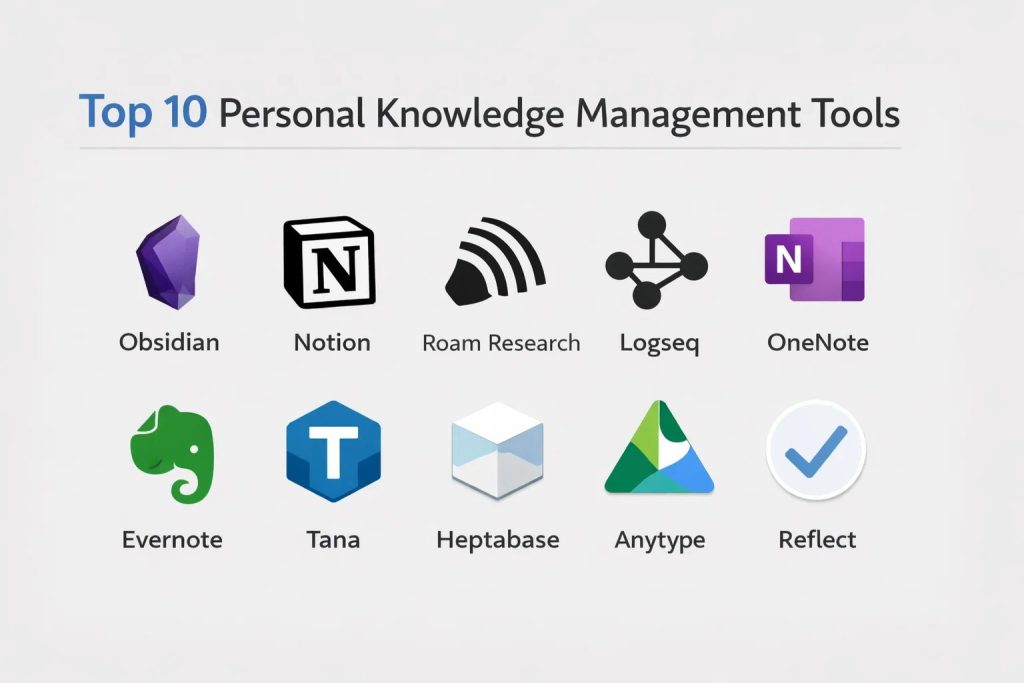
Introduction
Personal Knowledge Management (PKM) tools have evolved from simple digital notebooks into sophisticated “Second Brains” that facilitate the capture, organization, and retrieval of vast amounts of information. In an era of data saturation, the ability to synthesize disparate ideas into actionable insights is a critical professional competency. These platforms leverage various methodologies—such as the Zettelkasten method, the PARA system, and bi-directional linking—to mimic the non-linear way the human brain processes information. By creating a networked repository of thoughts, users can move beyond mere archiving toward true knowledge synthesis.
The professional necessity for these tools is driven by the rise of complex, interdisciplinary projects that require long-term context retention. Whether you are managing technical documentation, researching market trends, or developing a creative portfolio, a robust PKM system ensures that valuable insights are not lost to the “forgetting curve.” When evaluating a platform, it is essential to consider the underlying data structure, the friction involved in capturing new information, and the long-term portability of your data. The following tools represent the current gold standard for individuals and teams looking to optimize their cognitive workflows.
Best for: Academic researchers, software developers, strategic consultants, and creative professionals who need to manage large volumes of interconnected information.
Not ideal for: Users seeking a basic “to-do” list or simple grocery shopping app. If your primary goal is temporary task tracking rather than long-term knowledge building, lighter utility apps are more efficient.
Key Trends in Personal Knowledge Management Tools
The most significant trend is the shift from hierarchical folder structures to “networked thought.” This approach uses bi-directional linking to create a web of information where every note is connected to several others, allowing for organic discovery of patterns. Another major movement is “local-first” development, which prioritizes user privacy and offline speed by storing data directly on the device rather than exclusively in the cloud. This trend is particularly popular among users concerned with data sovereignty and long-term access.
Artificial Intelligence is also being integrated into PKM tools, but not just for text generation. Modern AI features focus on “proactive recall,” where the software automatically surfaces relevant past notes based on what you are currently writing. This reduces the time spent manually searching for related context. Additionally, the rise of open standards like Markdown ensures that knowledge remains future-proof, allowing users to switch between different applications without losing their formatting or connections.
How We Selected These Tools
Our selection process focused on technical flexibility and the long-term reliability of the platform. We prioritized tools that offer high “data stickiness,” meaning they provide powerful ways to link and retrieve information that grows more valuable as the database expands. Market longevity and developer activity were also key factors; a PKM tool is a long-term investment, so we selected platforms with proven track records of consistent updates and security patches.
We also looked for diversity in workflows, including block-based outliners, visual canvases, and document-centric editors. The capability for extensibility through plugins or a robust API was weighted heavily, as professional users often need to customize their environment. Finally, we assessed the community ecosystem surrounding each tool. A vibrant community often means a wealth of shared templates, tutorials, and third-party extensions that significantly lower the barrier to advanced knowledge management.
1. Obsidian
Obsidian is a powerful, local-first knowledge base that works on top of a local folder of plain text Markdown files. It is highly prized by technical users for its extreme customizability and the fact that you own your data entirely. Its “Graph View” provides a visual representation of how your notes are connected, making it easy to spot clusters of related ideas.
Key Features
The core strength of the platform lies in its bi-directional linking, which allows for the creation of a dense web of information. It features a massive plugin library that can transform the app into anything from a task manager to a scientific research hub. The “Canvas” feature offers an infinite visual board for mind mapping and spatial organization. Because it uses Markdown, files are easily searchable by external system tools. It also supports “backlinks” and “unlinked mentions,” helping users find connections they might have forgotten.
Pros
It is incredibly fast and works completely offline, ensuring privacy and reliability. The massive community provides thousands of free themes and plugins to tailor the experience to any workflow.
Cons
Syncing across multiple devices requires a paid subscription or technical knowledge to set up a third-party solution. The interface can be overwhelming for beginners who are not familiar with Markdown.
Platforms and Deployment
Windows, macOS, Linux, Android, and iOS. It is deployed as a local-first application.
Security and Compliance
Since data is stored locally, the user has full control over security. It is inherently compliant with strict privacy standards like GDPR and HIPAA if the local environment is secured.
Integrations and Ecosystem
It integrates with almost any tool that can export Markdown. Its community-led ecosystem is one of the most active in the productivity space, offering specialized integrations for Zotero, Readwise, and more.
Support and Community
Excellent community-driven support through a dedicated forum and Discord server, supplemented by comprehensive official documentation.
2. Notion
Notion is an all-in-one workspace that combines notes, databases, and project management into a single, highly visual canvas. It is the most popular choice for users who want to combine their personal knowledge with collaborative team wikis.
Key Features
Its block-based editor allows users to create complex pages with embedded videos, images, and interactive databases. The database functionality is world-class, offering multiple views such as boards, calendars, and galleries for the same set of data. It includes an integrated AI assistant that can summarize long notes or suggest brainstorm ideas. The platform supports sophisticated “relations” and “rollups” between different databases. Additionally, its template gallery is the largest in the industry, offering pre-built systems for almost every use case.
Pros
The flexibility to build your own custom tools without any coding knowledge is unmatched. It is excellent for sharing specific pages or entire workspaces with collaborators.
Cons
Being a cloud-only tool, it can feel sluggish compared to local apps, and it does not have a true offline mode. The “all-in-one” nature can lead to organizational sprawl if not managed carefully.
Platforms and Deployment
Windows, macOS, Web, iOS, and Android. It is a cloud-native platform.
Security and Compliance
It offers SOC 2 Type 2 compliance and uses TLS encryption for data in transit and AES-256 for data at rest.
Integrations and Ecosystem
It boasts a massive integration library, connecting seamlessly with Slack, Google Drive, GitHub, and thousands of other apps via Zapier or Make.
Support and Community
Offers professional customer support and a vast ecosystem of certified consultants and template creators.
3. Roam Research
Roam Research pioneered the “networked thought” movement with its focus on daily journaling and block-level bi-directional linking. It is designed for researchers who want an effortless way to connect disparate snippets of information.
Key Features
Every paragraph in Roam is a “block” that can be referenced or mirrored in any other part of the database. It utilizes a “Daily Notes” page as the primary entry point, encouraging a chronological flow of information. The sidebar allows for multiple notes to be open at once, facilitating deep synthesis and comparison. Its “Graph Overview” maps the relationships between every page in the system. The platform also supports advanced queries that allow users to pull specific information based on complex tagging logic.
Pros
The lack of a rigid folder structure removes the “where do I put this?” friction during capture. It is arguably the most powerful tool for discovering non-obvious connections between ideas.
Cons
It carries a high monthly subscription cost compared to other tools. The user interface is minimalist and can feel dated to some users.
Platforms and Deployment
Web-based with a mobile app wrapper. It is primarily a cloud-resident tool.
Security and Compliance
Offers standard cloud encryption and regular backups, though it lacks the local-first privacy of tools like Obsidian.
Integrations and Ecosystem
While it has fewer native integrations than Notion, it has a dedicated group of power users who build custom scripts through the “Roam42” extension suite.
Support and Community
Has a cult-like following (the “RoamCult”) that provides extensive unofficial training and advanced workflow sharing.
4. Logseq
Logseq is a privacy-first, open-source outliner that serves as a powerful alternative to Roam Research for those who prefer local storage. It excels at structured thinking and managing complex technical journals.
Key Features
Like Roam, it is based on blocks and bi-directional links but stores everything as plain text files on your computer. It features a built-in PDF annotator that allows you to link specific highlights directly to your notes. It supports both Markdown and Org-mode formats. The tool includes a native flashcard system for spaced repetition, making it excellent for students and lifelong learners. Its “Whiteboard” feature allows users to organize their blocks spatially for visual brainstorming.
Pros
It is completely free and open-source, ensuring that you will never lose access to your data. It provides the power of a networked outliner with the speed of a local app.
Cons
The mobile experience is still maturing and can be less stable than the desktop version. Advanced features often require a basic understanding of query languages.
Platforms and Deployment
Windows, macOS, Linux, Android, and iOS. Local-first deployment.
Security and Compliance
Offers maximum privacy through local data ownership. Users can choose their own encrypted sync methods.
Integrations and Ecosystem
Supports a growing library of community plugins and integrates well with research tools like Zotero.
Support and Community
Active open-source community on GitHub and Discord, with a strong focus on developer-friendly documentation.
5. Microsoft OneNote
OneNote is the digital equivalent of a physical multi-subject binder, making it one of the most intuitive tools for users transitioning from paper to digital. It is a staple in corporate and educational environments.
Key Features
The “infinite canvas” allows you to place text, images, and drawings anywhere on the page, rather than being restricted to a linear top-to-bottom flow. It features excellent handwriting recognition and ink-to-text capabilities for tablet users. The search engine is powerful enough to find text within images (OCR) and handwritten notes. It integrates deeply with the entire Microsoft 365 suite, allowing for easy meeting note capture from Outlook. It also supports password-protected sections for sensitive data.
Pros
It is free for most users and offers a familiar, easy-to-understand organizational structure. The cross-platform syncing is robust and highly reliable.
Cons
It lacks the advanced bi-directional linking and “graph” capabilities of modern PKM tools. The page-based structure can feel restrictive for those who prefer networked thinking.
Platforms and Deployment
Windows, macOS, iOS, Android, and Web. Cloud-synced via OneDrive.
Security and Compliance
Benefits from enterprise-grade security within the Microsoft ecosystem, including multi-factor authentication and data residency options.
Integrations and Ecosystem
Deeply integrated with the Microsoft 365 ecosystem. Supports various web clippers and third-party automation tools.
Support and Community
Comprehensive professional support from Microsoft and a vast global user base with endless tutorial resources.
6. Evernote
Evernote is the classic “digital filing cabinet,” designed for high-volume clipping and archiving of web articles, documents, and images. It has recently been modernized with AI features to help users manage their massive archives.
Key Features
Its web clipper is widely considered the best in the industry, allowing for the clean capture of any webpage. The “Home” dashboard provides a central view of your most important notes, tasks, and calendar events. It features an AI-powered search that understands natural language and can find information across thousands of notes instantly. The platform also includes a tasks system with reminders and a “Schedules” feature that links notes directly to your calendar appointments.
Pros
The search capability is unmatched for finding text inside scanned PDFs and images. It remains the most reliable tool for “capturing everything” without worrying about organization.
Cons
The free version has become very restrictive, essentially requiring a paid subscription for any serious use. It can feel heavy and cluttered compared to newer, more focused apps.
Platforms and Deployment
Windows, macOS, iOS, Android, and Web. Cloud-native storage.
Security and Compliance
Provides industry-standard encryption and has established data protection policies as a long-standing market leader.
Integrations and Ecosystem
Integrates with almost every major productivity tool, including Google Drive, Outlook, and Slack.
Support and Community
Offers a professional support team and a large library of “Evernote Certified Expert” resources.
7. Tana
Tana is a next-generation “everything” tool that combines an outliner with a powerful database engine. It is designed for “knowledge engineers” who want to build highly structured systems without the friction of traditional databases.
Key Features
Its “Supertags” allow you to define what a piece of information is (e.g., #meeting, #project, #person) and automatically apply a set of fields and templates. This turns a simple bullet point into a rich data object. It features a “Live Search” capability that pulls in information from across the entire graph based on specific criteria. The platform is built for speed, with a keyboard-centric interface that allows for rapid data entry. It also includes an advanced AI integration that can populate fields or transcribe audio directly into structured notes.
Pros
The Supertag system is a revolutionary way to organize data that provides more structure than Roam but more flexibility than Notion. It is incredibly powerful for managing complex, recurring workflows.
Cons
It is currently in an early stage and can be complex to set up initially. It is a cloud-only platform, which may be a concern for those prioritizing local privacy.
Platforms and Deployment
Web-based with a companion mobile app. Cloud-native.
Security and Compliance
Adheres to modern cloud security standards; however, as a newer platform, it lacks the deep compliance history of enterprise giants.
Integrations and Ecosystem
Growing rapidly with a focus on “Tana Paste,” a unique way to move structured data between Tana and other applications.
Support and Community
A very high-quality community of “Tana Navigators” who share advanced workflows and technical setups.
8. Heptabase
Heptabase is a visual-first PKM tool that focuses on “spatial thinking.” It is designed for people who need to visualize their research and see the “big picture” of how ideas interact.
Key Features
The core of the app is a “Whiteboard” where you can drag and drop your notes as cards, connecting them with lines and grouping them into sections. Every card is a full-featured note that can contain images, videos, and complex formatting. It includes a “Map” view that shows you how your various whiteboards are related to each other. The platform also features a powerful PDF reader that allows you to extract highlights directly onto your visual boards. It perfectly balances a linear “journal” view with a spatial “brainstorming” view.
Pros
The visual nature of the app makes it much easier to learn and synthesize complex topics compared to text-only outliners. It is exceptionally polished and offers a very smooth user experience.
Cons
The focus on visual boards may not suit users who prefer a more traditional, document-focused approach. It is a premium product with no permanent free version.
Platforms and Deployment
Windows, macOS, Linux, iOS, and Android. Hybrid cloud/local deployment.
Security and Compliance
Provides secure cloud syncing with end-to-end encryption options, ensuring that your research remains private.
Integrations and Ecosystem
Focuses on a cohesive internal experience but supports standard imports/exports for interoperability.
Support and Community
Direct support from a very responsive development team and a growing community of visual thinkers.
9. Anytype
Anytype is a privacy-focused, decentralized “everything” app that aims to replace Notion while giving users total control over their data. It is built on a peer-to-peer architecture, ensuring your notes exist only where you want them.
Key Features
It uses an “Object-based” system where everything—a person, a task, an idea—is a distinct entity with its own properties. It offers a visual layout similar to Notion but runs at the speed of a local-first application. The software features an “On-device Graph” that maps your objects without them ever leaving your machine. It includes pre-built “Experiences” which are essentially templates for specific workflows like traveling, health tracking, or academic research. It is completely open-source and designed to work even if the company’s servers disappear.
Pros
It offers the best of both worlds: the power and beauty of Notion with the privacy and speed of Obsidian. The decentralized nature makes it uniquely resilient to data loss or platform shutdown.
Cons
The peer-to-peer syncing can be more complex to troubleshoot than traditional cloud sync. The “object” logic has a slight learning curve for users used to simple folders.
Platforms and Deployment
Windows, macOS, Linux, iOS, and Android. Local-first, peer-to-peer deployment.
Security and Compliance
Industry-leading privacy due to its “local-first, E2E encrypted” architecture. It is the gold standard for data sovereignty.
Integrations and Ecosystem
Growing its own ecosystem of “Experiences” and focuses on being a self-contained, secure environment.
Support and Community
Strong community on Discord and GitHub, supported by a mission-driven development team.
10. Reflect
Reflect is a minimalist, high-speed note-taking app that focuses on the core essentials of networked thought: daily notes, bi-directional links, and a calendar-centric workflow.
Key Features
The app is built around a “Daily Notes” stream that automatically integrates with your Google or Outlook calendar, making it easy to see which notes were taken during which meeting. It features an incredibly fast search and a seamless AI integration that can summarize meetings or rewrite notes. It includes an “End-to-end encryption” feature, ensuring that only you can read your notes. The mobile app is exceptionally polished, providing a desktop-level experience on the go. It also features a “Map View” to visualize your network of ideas.
Pros
It is one of the most beautiful and friction-free apps available, making it a joy to use for daily capture. The focus on calendar integration is perfect for busy professionals.
Cons
It lacks the deep database capabilities of Notion or the extreme plugin extensibility of Obsidian. It is a premium-only product.
Platforms and Deployment
macOS, Web, and iOS. Cloud-synced with end-to-end encryption.
Security and Compliance
Prioritizes security with native end-to-end encryption and transparent data policies.
Integrations and Ecosystem
Deeply integrated with Google and Apple calendars, and offers a robust web clipper for capturing articles and Kindle highlights.
Support and Community
Offers direct, high-quality support and maintains a curated set of resources for its professional user base.
Comparison Table
| Tool Name | Best For | Platform(s) Supported | Deployment | Standout Feature | Public Rating |
| 1. Obsidian | Privacy Power Users | Win, Mac, Linux, Mobile | Local-First | Graph View & Plugins | 4.9/5 |
| 2. Notion | Team Collaboration | Win, Mac, Web, Mobile | Cloud | Relational Databases | 4.7/5 |
| 3. Roam Research | Networked Research | Web, Mobile | Cloud | Block-level Referencing | 4.5/5 |
| 4. Logseq | Open-source Outlining | Win, Mac, Linux, Mobile | Local-First | Built-in PDF Annotator | 4.6/5 |
| 5. OneNote | Free-form Notetaking | Win, Mac, Web, Mobile | Cloud | Infinite Canvas | 4.3/5 |
| 6. Evernote | Document Archiving | Win, Mac, Web, Mobile | Cloud | Industry-best Web Clipper | 4.2/5 |
| 7. Tana | Knowledge Engineering | Web, Mobile | Cloud | Supertags & Data Fields | 4.8/5 |
| 8. Heptabase | Visual Synthesis | Win, Mac, Linux, Mobile | Hybrid | Visual Whiteboards | 4.7/5 |
| 9. Anytype | Secure Everything App | Win, Mac, Linux, Mobile | P2P / Local | Decentralized Objects | 4.6/5 |
| 10. Reflect | Fast Daily Notes | Mac, Web, iOS | Cloud (E2E) | Calendar Integration | 4.5/5 |
Evaluation & Scoring of Personal Knowledge Management Tools
The scoring below is a comparative model intended to help shortlisting. Each criterion is scored from 1–10, then a weighted total from 0–10 is calculated using the weights listed. These are analyst estimates based on typical fit and common workflow requirements, not public ratings.
Weights:
- Core features – 25%
- Ease of use – 15%
- Integrations & ecosystem – 15%
- Security & compliance – 10%
- Performance & reliability – 10%
- Support & community – 10%
- Price / value – 15%
| Tool Name | Core (25%) | Ease (15%) | Integrations (15%) | Security (10%) | Performance (10%) | Support (10%) | Value (15%) | Weighted Total |
| 1. Obsidian | 10 | 4 | 9 | 10 | 10 | 8 | 10 | 8.80 |
| 2. Notion | 9 | 8 | 10 | 8 | 6 | 9 | 9 | 8.45 |
| 3. Roam Research | 9 | 5 | 6 | 7 | 8 | 7 | 5 | 7.00 |
| 4. Logseq | 9 | 4 | 7 | 10 | 9 | 8 | 10 | 8.05 |
| 5. OneNote | 6 | 9 | 8 | 9 | 7 | 10 | 10 | 8.05 |
| 6. Evernote | 7 | 8 | 9 | 8 | 6 | 9 | 6 | 7.45 |
| 7. Tana | 10 | 3 | 7 | 7 | 9 | 8 | 7 | 7.40 |
| 8. Heptabase | 9 | 8 | 6 | 8 | 9 | 9 | 7 | 8.10 |
| 9. Anytype | 9 | 6 | 5 | 10 | 9 | 7 | 9 | 7.85 |
| 10. Reflect | 8 | 9 | 8 | 9 | 10 | 8 | 6 | 8.30 |
How to interpret the scores:
- Use the weighted total to shortlist candidates, then validate with a pilot.
- A lower score can mean specialization, not weakness.
- Security and compliance scores reflect controllability and governance fit, because certifications are often not publicly stated.
- Actual outcomes vary with assembly size, team skills, templates, and process maturity.
Which Personal Knowledge Management Tool Is Right for You?
Solo / Freelancer
For independent professionals, Obsidian or Reflect are often the best choices. Obsidian offers the ultimate flexibility to build a custom system that grows with your career, while Reflect provides a high-speed, friction-free way to manage notes and meetings without any technical setup.
SMB
Small businesses thrive on Notion. Its ability to combine a personal knowledge base with a team wiki and task manager in one place reduces the “tool fatigue” that often plagues growing teams. It serves as the single source of truth for procedures, projects, and goals.
Mid-Market
Mid-market companies often lean toward Tana or Notion. Tana is particularly useful for organizations that need to manage highly structured data across different departments, while Notion offers the broad appeal and ease of use needed for larger groups.
Enterprise
Microsoft OneNote and Evernote remain the standard for enterprise deployments due to their established security protocols, IT management tools, and deep integration with standard corporate software suites.
Budget vs Premium
If budget is the primary concern, Logseq and Obsidian provide professional-grade power for free. For those willing to pay a premium for a more polished or AI-driven experience, tools like Reflect, Heptabase, and Tana offer cutting-edge features that can significantly boost productivity.
Feature Depth vs Ease of Use
If you want something intuitive you can start using in five minutes, OneNote or Reflect are ideal. If you are a “power user” who wants to build a complex, custom data engine and doesn’t mind a learning curve, Obsidian and Tana are the standout options.
Integrations & Scalability
Notion and Evernote lead the way in integrations, allowing you to connect your knowledge to almost any other app. For scalability of raw data, Obsidian’s local Markdown approach ensures your system stays fast and accessible regardless of how many thousands of notes you create.
Security & Compliance Needs
For users with high-security requirements, Anytype and Obsidian are the clear winners. By keeping data local and/or end-to-end encrypted, these tools ensure that sensitive intellectual property is never exposed to third-party cloud vulnerabilities.
Frequently Asked Questions (FAQs)
1. What is bi-directional linking and why does it matter?
Bi-directional linking means that if Note A links to Note B, Note B automatically shows a “backlink” to Note A. This creates a two-way street that allows you to discover relationships between ideas effortlessly, forming a network of thought rather than a rigid list.
2. Should I choose a local-first or cloud-based PKM tool?
Local-first tools like Obsidian offer better privacy, speed, and offline access, but they require more effort to sync. Cloud-based tools like Notion are easier to use across devices and better for collaboration but require a constant internet connection and carry more privacy risks.
3. What is the Zettelkasten method?
It is a system of taking “atomic” notes—short, single-idea notes—and linking them together to build a conversation with your future self. It is a highly effective way to use PKM tools for long-term research and writing projects.
4. Can I move my data if I decide to switch tools later?
Yes, provided you choose a tool that supports standard formats like Markdown or CSV. Tools that use proprietary formats can be harder to “exit,” so it is always wise to check the export options before committing to a platform.
5. How do I avoid “over-organizing” my notes?
The key is to focus on “capture” first. Use tools with a strong search or daily notes feature so you don’t have to worry about where a note belongs immediately. Over time, the connections and structure will emerge naturally.
6. Do PKM tools replace task managers?
Some can, but most experts suggest using them alongside a dedicated task manager. PKM tools are for “thinking,” while task managers are for “doing.” Keeping them separate helps prevent your knowledge base from becoming cluttered with temporary to-dos.
7. Is AI in PKM tools safe for sensitive information?
It depends on the tool. Some use local AI models that never send your data to the cloud, while others use cloud-based APIs like OpenAI. Always check the tool’s privacy policy if you are handling sensitive intellectual property.
8. What is a “Second Brain”?
It is a term popularized by Tiago Forte, referring to a digital system that helps you capture, organize, and retrieve information so you can free up your physical brain for creativity and problem-solving.
9. How many notes do I need before a PKM tool becomes useful?
The value usually starts to become apparent after 50 to 100 linked notes. At this point, the “graph” of your knowledge begins to show patterns and connections that you wouldn’t be able to track in a simple list.
10. Can I use a PKM tool for team collaboration?
Yes, but some are better than others. Notion is the industry leader for teams, while others like Obsidian are primarily designed for individual use, though they are slowly adding collaborative features.
Conclusion
Developing a Personal Knowledge Management system is a transformative investment in your long-term cognitive assets. In a professional landscape where information is the primary currency, the ability to rapidly capture, connect, and retrieve insights provides a significant competitive advantage. Whether you choose a local-first environment for maximum privacy or a cloud-based workspace for seamless collaboration, the objective remains the same: to transition from a passive consumer of information to an active architect of knowledge. The tools highlighted in this guide represent the current pinnacle of digital organization, but the true power lies in the habits you build around them. By selecting a platform that aligns with your specific cognitive style, you ensure that your “Second Brain” becomes a dynamic partner in your professional and creative growth.
I find that this analysis of the top 10 Personal Knowledge Management (PKM) tools is a definitive guide for anyone looking to build a “Second Brain” from my perspective as a Solutions Architect. I learned that modern PKM has moved far beyond simple note-taking; it’s now a sophisticated field of “networked thought” where tools like Obsidian and Roam Research use bi-directional linking to mimic the non-linear way our brains actually work.
In my professional life, these tools are indispensable for managing complex technical documentation and long-term project contexts that would otherwise be lost to the “forgetting curve.” For others in knowledge-intensive roles, this blog highlights how a well-chosen tool—whether a local-first option for maximum privacy or a cloud-native workspace like Notion for collaboration—can turn a chaotic flow of data into a structured, high-value asset. My advice for anyone starting their PKM journey is to focus on capture first; don’t worry about perfect organization immediately, as the most powerful insights often emerge naturally once you’ve linked your first 50 to 100 “atomic” notes. Do you think the integration of Proactive AI Recall will eventually make manual tagging and folder structures completely obsolete, or will there always be a need for human-led organization?
Gemini said
I find that this analysis of the Top 10 Personal Knowledge Management (PKM) Tools perfectly captures the shift from simple digital note-taking to building a true “Second Brain” from my perspective as a Knowledge Engineer.