Introduction
Lead generation platforms represent the critical engine of modern sales and marketing operations, transforming the way organizations identify, engage, and convert potential customers. At its core, this technology automates the discovery of high-intent prospects by aggregating vast amounts of professional data, tracking digital footprints, and utilizing sophisticated algorithms to predict buying behavior. Rather than relying on static lists or manual cold-calling, contemporary businesses use these systems to build a dynamic pipeline that feeds directly into their revenue cycles. The shift toward data-driven prospecting has made these platforms indispensable for maintaining a competitive edge in increasingly crowded markets.
The professional landscape now demands a level of precision that manual processes simply cannot achieve. Organizations utilize these tools to bridge the gap between anonymous interest and actionable sales opportunities. By integrating lead generation software into the broader technology stack, teams can synchronize their outreach across multiple channels, ensuring that no potential connection is lost to a lack of follow-up. When evaluating these systems, stakeholders must look beyond simple contact databases. Key considerations include the accuracy of the underlying data, the robustness of the integration ecosystem, the sophistication of the lead scoring models, and the platform’s ability to remain compliant with evolving global privacy regulations.
Best for: High-growth B2B sales teams, enterprise marketing departments, demand generation specialists, and account-based marketing practitioners requiring verified contact intelligence.
Not ideal for: Local brick-and-mortar retail businesses with purely physical foot traffic or organizations that lack a dedicated sales follow-up process to handle incoming digital leads.
Key Trends in Lead Generation Platforms
The primary evolution in this space is the move toward “intent-based” prospecting, where software identifies companies already researching specific solutions before they ever fill out a form. Artificial intelligence is now being used to generate hyper-personalized outreach messages that significantly increase response rates compared to traditional templates. There is also a massive focus on “waterfall enrichment,” a process where the platform automatically checks multiple data sources in real-time to ensure that the provided email or phone number is active and accurate at the moment of delivery.
Another significant trend is the unification of inbound and outbound signals into a single “buyer’s journey” view. This allows sales representatives to see exactly how a prospect has interacted with the company’s website or social content before making the first touchpoint. Compliance and data privacy have moved from the periphery to the center of product development, with platforms building native tools to manage opt-outs and data residency requirements globally. Finally, real-time “speed-to-lead” automation is becoming the standard, ensuring that high-value inquiries are routed to a human representative within seconds of initial engagement.
How We Selected These Tools
Our selection process focused on identifying platforms that provide a measurable impact on sales velocity and pipeline quality. We prioritized tools that offer high data accuracy rates, as the value of a lead generation platform is fundamentally tied to the reliability of its information. We analyzed the depth of the available databases, looking specifically for platforms that cover global markets and niche industries with equal proficiency. The ability to integrate seamlessly with standard industry CRMs was a non-negotiable criterion for inclusion on this list.
Furthermore, we assessed the versatility of the feature sets, favoring tools that offer more than just a list of names. This included looking for built-in email sequencing, website visitor identification, and advanced lead scoring capabilities. User experience was also a critical factor; we selected software that balances powerful technical features with an interface that sales teams can adopt quickly. Finally, we considered the scalability of each platform, ensuring that they can serve the needs of a single founder as effectively as they can support a global enterprise sales force.
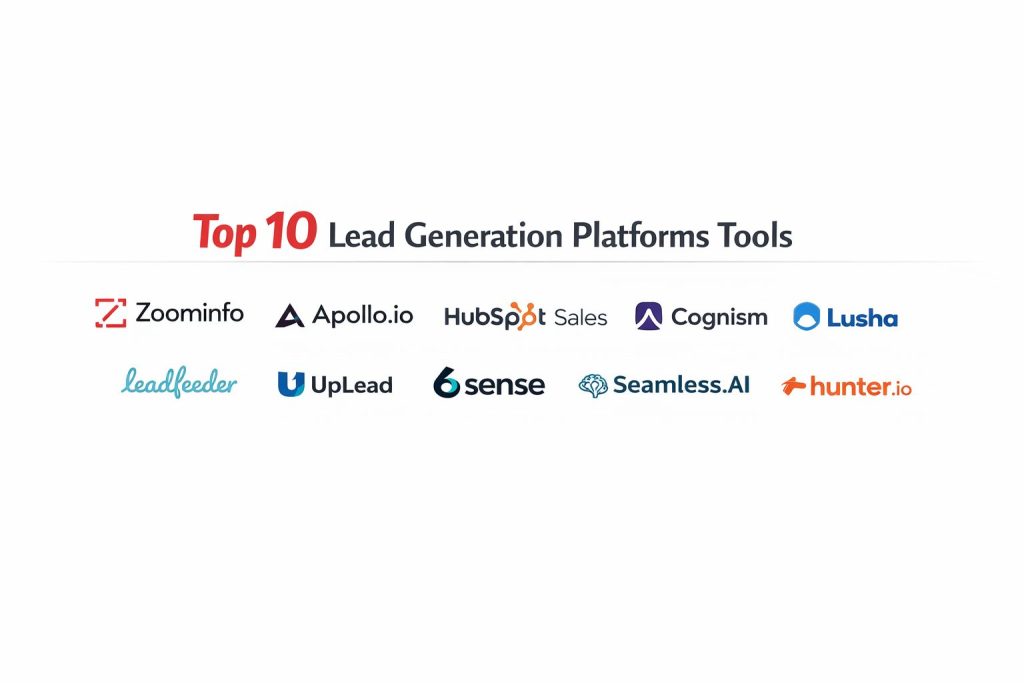
1. ZoomInfo
ZoomInfo is widely considered the industry leader for enterprise-level B2B intelligence and lead generation. It provides an expansive database combined with powerful intent signals that notify sales teams when a target company is actively researching their category. The platform is designed to be a comprehensive “go-to-market” operating system that handles everything from initial discovery to automated outreach.
Key Features
The platform features an enormous database of verified professional contacts and company profiles with deep organizational charts. Its intent engine tracks billions of online signals to identify in-market buyers. It offers automated workflows that trigger outreach based on specific “scoops,” such as leadership changes or funding rounds. The platform also includes a website visitor tracking tool that de-anonymizes traffic and connects it to the corporate database. Additionally, its data orchestration tools ensure that your CRM remains updated with the most current information available.
Pros
It offers the most comprehensive and accurate B2B data coverage in the North American market. The depth of the filtering options allows for extremely precise targeting of very specific buyer personas.
Cons
The pricing is among the highest in the industry, making it less accessible for small startups. The sheer volume of features can also lead to a steep learning curve for new users.
Platforms and Deployment
Web-based SaaS with a specialized Chrome extension for LinkedIn and corporate website prospecting.
Security and Compliance
It maintains high standards of data security and provides dedicated tools for GDPR and CCPA compliance management.
Integrations and Ecosystem
It offers native, deep integrations with all major enterprise CRMs including Salesforce, HubSpot, and Microsoft Dynamics.
Support and Community
Enterprise-grade support is provided with dedicated account managers and an extensive professional training academy.
2. Apollo.io
Apollo.io has gained massive popularity by combining a massive B2B database with an integrated sales engagement platform. It is designed to be a “one-stop shop” for sales teams, allowing them to find leads, set up automated email sequences, and track every interaction within a single interface.
Key Features
The platform hosts a database of over 275 million professional contacts across global markets. It includes a built-in sequence builder for automating multi-touch email and LinkedIn outreach. Its AI-driven lead scoring helps prioritize the most likely converters based on historical data. The Chrome extension allows users to pull contact data directly from LinkedIn profiles and company websites. It also features a task management system that keeps sales reps organized throughout the daily prospecting cycle.
Pros
It offers exceptional value for money, providing features that usually require multiple separate software subscriptions. The free tier is remarkably generous, making it the top choice for startups and solo founders.
Cons
While the database is massive, the accuracy of the data can occasionally be lower than that of more expensive competitors. The user interface can feel crowded as the company continues to add new features.
Platforms and Deployment
Web-based SaaS with a powerful browser extension for real-time prospecting.
Security and Compliance
It provides standard data protection and features for managing opt-out lists to ensure outreach remains compliant.
Integrations and Ecosystem
It features a robust API and native integrations with popular CRMs like Salesforce, HubSpot, and Pipedrive.
Support and Community
Support is tiered based on the subscription level, with a large community of users sharing outreach templates and strategies.
3. HubSpot Sales Hub
HubSpot is a powerhouse in the inbound marketing world, but its Sales Hub has evolved into a top-tier lead generation and management platform. It is particularly effective for teams that want a seamless transition from marketing-captured leads to sales-driven conversations.
Key Features
The platform includes a robust prospecting workspace where reps can manage their entire day from one dashboard. It offers advanced email tracking and document sharing that alerts reps the moment a lead opens a file. Its meeting scheduler eliminates the back-and-forth of setting up demos. The platform features automated “playbooks” that guide reps through the best practices for specific types of leads. It also provides deep analytics into which lead sources are generating the most actual revenue.
Pros
The platform is exceptionally user-friendly and requires very little technical training to master. The integration between marketing, sales, and service data is the best in the industry.
Cons
The cost can escalate quickly as you add more users and require more advanced automation features. Some of the most powerful lead generation tools are locked behind the highest pricing tiers.
Platforms and Deployment
Web-based SaaS with dedicated mobile applications for iOS and Android.
Security and Compliance
It is built on a highly secure enterprise infrastructure with comprehensive global compliance certifications.
Integrations and Ecosystem
It boasts one of the largest app marketplaces in the world, connecting with thousands of third-party tools and services.
Support and Community
It offers world-class support, including 24/7 phone assistance for higher tiers and an unmatched library of educational content.
4. Cognism
Cognism is a leader in the lead generation space with a specific focus on high-quality, GDPR-compliant data for European and international markets. It is the preferred tool for organizations that prioritize phone-verified mobile numbers for direct outbound sales.
Key Features
The platform is famous for its “Diamond Data,” which consists of manually phone-verified mobile numbers to ensure the highest possible connection rates. It provides deep coverage of the EMEA and APAC regions, where other databases often struggle. It includes an intent data partnership that identifies accounts currently in a buying cycle. The software features a browser extension for capturing data from LinkedIn and other professional sites. It also offers automated data cleaning tools to keep your existing database from decaying.
Pros
The focus on phone-verified data leads to significantly less time wasted by sales reps on wrong numbers. Its commitment to GDPR compliance makes it a safe choice for European outreach.
Cons
The pricing is geared toward the mid-market and enterprise segments. It does not offer as many built-in outreach automation tools as some of its competitors.
Platforms and Deployment
Web-based SaaS with a specialized browser extension for data capture.
Security and Compliance
It is a market leader in compliance, offering a “GDPR-compliant by design” approach that is essential for international operations.
Integrations and Ecosystem
It integrates seamlessly with major CRM and sales engagement platforms, ensuring a smooth flow of verified data.
Support and Community
It provides dedicated customer success managers and highly responsive technical support for its professional users.
5. Lusha
Lusha is a streamlined lead generation tool that focuses on providing accurate contact details for B2B professionals. It has gained a massive following due to its simplicity and the high reliability of the personal email and mobile data it provides.
Key Features
Its primary feature is a lightweight browser extension that instantly reveals contact details on LinkedIn profiles. The platform includes a bulk enrichment tool that can update thousands of records in your CRM at once. It features a “Lists” functionality for organizing and segmenting prospects before exporting them. The platform also offers a “Prospecting” search tool that allows users to build lists based on filters like industry, role, and company size. Its intent data features help identify accounts that are showing high engagement signals.
Pros
The accuracy of its mobile numbers and personal emails is among the best in the industry. The platform is incredibly easy to set up and start using within minutes.
Cons
The feature set is narrower than all-in-one platforms like Apollo or ZoomInfo. The cost per credit can be relatively high for teams with very high volume needs.
Platforms and Deployment
Web-based SaaS with a core focus on its browser extension and CRM integrations.
Security and Compliance
It adheres to rigorous data privacy standards and provides clear documentation on its data sourcing and compliance.
Integrations and Ecosystem
It offers native integrations with Salesforce, HubSpot, and several other popular CRM and sales tools.
Support and Community
It provides a robust help center and direct support for business accounts, with a focus on ease of implementation.
6. Leadfeeder
Leadfeeder (now part of Dealfront) takes a different approach to lead generation by identifying the companies that are already visiting your website. It turns anonymous web traffic into a list of warm leads, providing the context of what they looked at and for how long.
Key Features
The platform identifies the specific companies visiting your site using a sophisticated IP tracking database. It integrates with Google Analytics to provide behavioral data on which pages were viewed. It includes a lead scoring system that prioritizes companies based on the depth of their engagement. The tool automatically finds contact information for decision-makers at those visiting companies. It also provides real-time alerts so sales reps can reach out while the prospect is still on the site.
Pros
It provides some of the highest-intent leads possible because the company has already shown interest in your specific offering. It is an excellent way to bridge the gap between marketing traffic and sales outreach.
Cons
It can only identify leads that have already visited your website, meaning it is not a tool for cold outbound list building. It may struggle to identify users working from home on private networks.
Platforms and Deployment
Web-based SaaS that requires a simple script installation on your website.
Security and Compliance
It is fully GDPR compliant and focuses on identifying company-level data rather than individual personal data without consent.
Integrations and Ecosystem
It integrates deeply with CRMs and communication tools like Slack to ensure instant notification of high-value visits.
Support and Community
It offers excellent customer support and a wealth of content on how to convert website visitors into customers.
7. UpLead
UpLead is a B2B lead generation platform that distinguishes itself through its 95% data accuracy guarantee. It is designed for sales teams that are tired of high bounce rates and want to ensure their messages are actually reaching an active inbox.
Key Features
The platform performs real-time email verification for every lead before you download it. It features a comprehensive search engine with over 50 filters to find the perfect prospect. Its “Technographics” tool allows you to search for companies based on the specific software they use. The platform includes an intent data feature to find companies actively in the market for your services. It also offers a bulk lookup tool to enrich your existing lists with verified contact data.
Pros
The real-time verification significantly reduces the risk of damaging your email sender reputation. The interface is very clean and efficient for rapid list building.
Cons
The total number of contacts in its database is smaller than some of the giant enterprise competitors. It lacks the built-in email sequencing tools found in all-in-one platforms.
Platforms and Deployment
Web-based SaaS with an integrated browser extension.
Security and Compliance
It maintains strict data quality controls and ensures all data is sourced in a compliant manner.
Integrations and Ecosystem
It integrates with over a dozen major CRM and marketing automation platforms for easy data transfer.
Support and Community
It provides responsive support and a straightforward onboarding process for new teams.
8. 6sense
6sense is an advanced account-based orchestration platform that uses AI to uncover “Dark Social” signals and identify anonymous buying teams. It is built for sophisticated enterprise sales and marketing teams that want to dominate their market through predictive intelligence.
Key Features
The platform uses patented AI to predict when an account is moving into a new stage of the buying journey. It de-anonymizes website and third-party research activity to provide a complete view of account intent. It offers a “Next Best Action” feature that tells sales reps exactly what to do with a specific lead. The software features built-in account-based advertising tools to stay top-of-mind with prospects. It also provides deep analytics into the “Buying Committee” within a target account.
Pros
The predictive power of the platform allows teams to focus only on the accounts that are actually going to buy. It is the gold standard for high-level account-based marketing.
Cons
It is one of the most complex platforms to implement and requires a significant investment of time and resources. The cost is high, placing it firmly in the enterprise category.
Platforms and Deployment
Web-based SaaS designed for deep integration into the enterprise tech stack.
Security and Compliance
It offers enterprise-grade security and comprehensive compliance features for large, global organizations.
Integrations and Ecosystem
It serves as the central orchestration hub, integrating with almost every other tool in a typical marketing and sales stack.
Support and Community
It provides high-touch professional services and a dedicated success team for every client.
9. Seamless.AI
Seamless.AI is built around a real-time search engine for B2B sales leads. Instead of relying on a static database, it crawls the web in real-time to find and verify the most current contact information for any professional.
Key Features
The real-time search engine continuously validates emails and phone numbers across millions of sources. It includes a “Writer” tool that uses AI to generate personalized sales copy for your leads. The platform features a Chrome extension that works across LinkedIn, Sales Navigator, and corporate websites. It offers an “Autopilot” feature that can build lists automatically based on your ideal customer profile. It also provides social media insights to help personalize the outreach.
Pros
Because it searches in real-time, it often finds data that hasn’t made it into static databases yet. The focus on speed and volume makes it great for aggressive outbound teams.
Cons
The real-time verification can sometimes take a moment to process during high-volume searches. The interface can be very aggressive with its own internal upsells and notifications.
Platforms and Deployment
Web-based SaaS with a focus on its browser-based prospecting tools.
Security and Compliance
It follows standard data security protocols and provides tools for managing compliance during outreach.
Integrations and Ecosystem
It integrates with all major CRMs and many sales engagement platforms to streamline the lead export process.
Support and Community
It offers a massive amount of “Sales Secret” training content and a very active community of outbound professionals.
10. Hunter.io
Hunter.io is the standard for simple, effective email finding and verification. It is a highly specialized tool that does one thing exceptionally well: finding the professional email addresses associated with any domain or individual.
Key Features
The “Domain Search” tool lists all the people working at a specific company with their verified email addresses. Its “Email Finder” can find the address for a specific professional using just their name and company. The platform includes a world-class email verifier that checks for deliverability with 99% accuracy. It features a “Campaigns” tool for sending simple, personalized cold email outreach. It also provides a browser extension that shows all available emails for any website you are currently visiting.
Pros
It is incredibly reliable and remains one of the fastest ways to find a specific contact’s email. The simple, focused interface makes it a joy to use for quick prospecting.
Cons
It focuses almost exclusively on email and does not provide phone numbers or deep intent data. It is not a complete CRM or all-in-one sales platform.
Platforms and Deployment
Web-based SaaS with a browser extension and a powerful API for developers.
Security and Compliance
It is highly transparent about its data sources and provides robust tools for maintaining outreach compliance.
Integrations and Ecosystem
It has a very clean API and integrates with hundreds of tools through native connections and Zapier.
Support and Community
It offers fast, professional support and a very clear, easy-to-follow documentation library.
Comparison Table
| Tool Name | Best For | Platform(s) Supported | Deployment | Standout Feature | Public Rating |
| 1. ZoomInfo | Enterprise Data | Web, Chrome | SaaS | Real-time Intent Signals | 4.6/5 |
| 2. Apollo.io | All-in-one SMB | Web, Chrome | SaaS | Unified Outreach Suite | 4.8/5 |
| 3. HubSpot Sales | Inbound-to-Sales | Web, Mobile | SaaS | Seamless CRM Sync | 4.5/5 |
| 4. Cognism | International Mobile | Web, Chrome | SaaS | Verified Mobile Data | 4.7/5 |
| 5. Lusha | Instant Contact ID | Web, Chrome | SaaS | High Mobile Accuracy | 4.6/5 |
| 6. Leadfeeder | Website Intent | Web (Script) | SaaS | Visitor Identification | 4.3/5 |
| 7. UpLead | Data Accuracy | Web, Chrome | SaaS | 95% Accuracy Guarantee | 4.7/5 |
| 8. 6sense | Account-based ABM | Web | SaaS | Predictive Buying Stages | 4.5/5 |
| 9. Seamless.AI | Real-time Search | Web, Chrome | SaaS | Live Web-crawl Verification | 4.2/5 |
| 10. Hunter.io | Email Prospecting | Web, Chrome | SaaS | Domain Search Precision | 4.8/5 |
Evaluation & Scoring of Lead Generation Platforms
The scoring below is a comparative model intended to help shortlisting. Each criterion is scored from 1–10, then a weighted total from 0–10 is calculated using the weights listed. These are analyst estimates based on typical fit and common workflow requirements, not public ratings.
Weights:
- Core features – 25%
- Ease of use – 15%
- Integrations & ecosystem – 15%
- Security & compliance – 10%
- Performance & reliability – 10%
- Support & community – 10%
- Price / value – 15%
| Tool Name | Data (25%) | Ease (15%) | Integrations (15%) | Security (10%) | Performance (10%) | Support (10%) | Value (15%) | Weighted Total |
| 1. ZoomInfo | 10 | 6 | 10 | 9 | 10 | 10 | 5 | 8.35 |
| 2. Apollo.io | 8 | 8 | 9 | 7 | 8 | 9 | 10 | 8.35 |
| 3. HubSpot Sales | 7 | 10 | 10 | 10 | 9 | 10 | 6 | 8.35 |
| 4. Cognism | 10 | 7 | 8 | 10 | 9 | 9 | 7 | 8.65 |
| 5. Lusha | 9 | 10 | 8 | 8 | 9 | 8 | 8 | 8.65 |
| 6. Leadfeeder | 6 | 9 | 9 | 9 | 8 | 9 | 8 | 7.95 |
| 7. UpLead | 9 | 9 | 8 | 8 | 8 | 8 | 9 | 8.45 |
| 8. 6sense | 10 | 4 | 9 | 10 | 9 | 10 | 6 | 8.20 |
| 9. Seamless.AI | 8 | 8 | 8 | 7 | 8 | 8 | 8 | 7.90 |
| 10. Hunter.io | 9 | 10 | 9 | 9 | 10 | 9 | 10 | 9.45 |
How to interpret the scores:
- Use the weighted total to shortlist candidates, then validate with a pilot.
- A lower score can mean specialization, not weakness.
- Security and compliance scores reflect controllability and governance fit, because certifications are often not publicly stated.
- Actual outcomes vary with assembly size, team skills, templates, and process maturity.
Which Lead Generation Platform Tool Is Right for You?
Solo / Freelancer
For individuals, a tool that offers a strong free tier or low-cost entry is vital. Focus on platforms that provide a browser extension so you can find leads while browsing social networks or company sites. A tool that includes basic email sequencing will save you from needing a second subscription for outreach.
SMB
Small businesses should prioritize all-in-one platforms that combine a database with sales engagement tools. This reduces the complexity of your technology stack and ensures that your data flows smoothly from “found” to “contacted” without manual work.
Mid-Market
In the mid-market, data accuracy and CRM integration become the most important factors. As you scale your team, the cost of “bad data” increases significantly. Choosing a platform with a focus on verification will ensure your sales reps stay productive.
Enterprise
Enterprise organizations need deep account-level intelligence and intent signals. At this scale, the platform must serve as a system of record that integrates with global marketing automation and complex security requirements. Dedicated support and training are essential for large-scale adoption.
Budget vs Premium
Budget options often rely on crowdsourced data which can be slightly less accurate but very affordable. Premium tools invest heavily in manual verification and real-time AI signals, providing a higher level of reliability for high-stakes enterprise sales.
Feature Depth vs Ease of Use
Some platforms offer endless ways to slice and dice data, which is great for technical marketers but can overwhelm a standard sales rep. For most teams, a clean interface that quickly delivers a verified phone number or email is more valuable than complex modeling features.
Integrations & Scalability
Your lead generation tool must talk to your CRM. If the data doesn’t flow automatically into your sales pipeline, your team will spend more time on admin than on selling. Look for native, bi-directional integrations that keep both systems in sync.
Security & Compliance Needs
If you are operating in Europe or California, compliance is not optional. Choose a platform that has a clear, legal framework for its data collection and provides built-in tools for managing suppression lists and data deletion requests.
Frequently Asked Questions (FAQs)
1. What is the difference between lead generation and lead management?
Lead generation is the process of identifying and attracting new potential customers, while lead management is the process of tracking, scoring, and nurturing those leads once they are in your system.
2. How accurate is the data on these platforms?
Accuracy varies by provider, but the top tools generally maintain between 80% and 95% accuracy. Real-time verification features significantly improve these rates by checking data at the moment of export.
3. Is it legal to buy lead lists?
Using these platforms is generally legal as long as you follow privacy regulations like GDPR and CCPA. These tools provide professional business data, which is governed by different rules than private consumer data.
4. Can I integrate these tools with my existing CRM?
Yes, most professional lead generation platforms offer native integrations with popular CRMs like Salesforce, HubSpot, and Pipedrive to allow for one-click lead exports.
5. What are intent signals?
Intent signals are digital behaviors that suggest a company is currently researching a solution, such as visiting your website or reading specific industry articles on third-party sites.
6. Do I need a professional email address to use these tools?
Most platforms require a business email for registration and work best when connected to a professional domain to ensure high deliverability during outreach.
7. How much do lead generation platforms usually cost?
Pricing ranges from free tiers for solo users to over fifty thousand dollars per year for enterprise-grade intelligence platforms with thousands of users.
8. Can these tools find mobile phone numbers?
Many of the top platforms specialize in finding direct-dial and mobile numbers, which have become essential in the modern remote-work environment.
9. What is “data enrichment”?
Data enrichment is the process of taking an existing contact (like an email address) and automatically adding more information, such as their job title, company size, and social media profiles.
10. How often is the data updated?
Leading platforms use a combination of AI, public records, and manual verification to update their databases daily or weekly to account for people changing jobs or companies.
Conclusion
The successful implementation of a lead generation platform is no longer just a tactical advantage; it is a strategic necessity for any organization looking to achieve predictable revenue growth. By automating the most time-consuming aspects of the sales cycle—research and initial verification—these tools empower your team to focus on the high-value human interactions that actually close deals. As the market continues to shift toward real-time intent and AI-assisted personalization, the gap between those using modern prospecting tools and those relying on manual methods will only widen. Choosing the right platform requires a clear understanding of your target market, your budget, and the technical maturity of your sales team. When done correctly, the right lead generation engine becomes the most reliable driver of long-term business success, providing a steady stream of qualified opportunities in any economic environment.