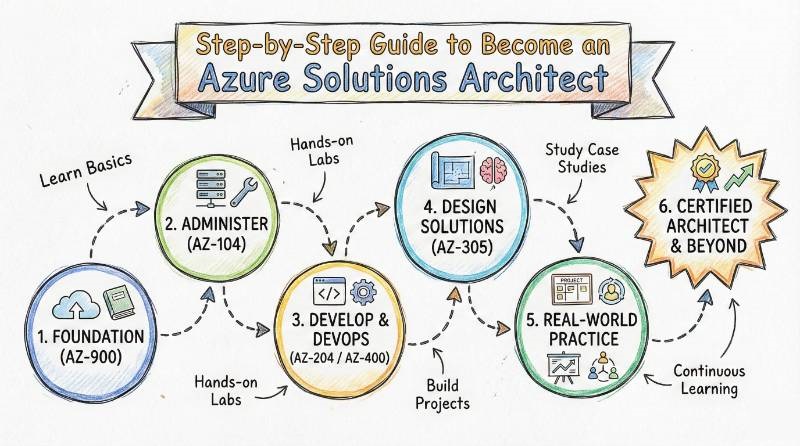
In the tech world, there is a clear line between those who follow a plan and those who create it. For many years, the industry focused on specialized roles—someone for the network, someone for the database, and someone for the code. Today, the cloud has removed those walls. Companies now need a “Big Picture” expert. This expert is the Azure Solutions Architect.
If you are an engineer or a manager, you have seen how complex cloud setups can become. Designing a system that stays safe, works fast globally, and doesn’t waste money is a massive challenge. This guide is built for those who want to move from “doing the work” to “designing the future.” Whether you are based in India or working for a global team, these skills are the gold standard for senior career growth.
Master Certification Guide: Azure Solutions Architect
Below is the high-level view of the certification path for those aiming for the expert level.
| Track | Level | Certification Name | Who it’s for | Prerequisites | Skills Covered | Recommended Order |
| Cloud Design | Expert | Azure Solutions Architect | Seniors, Tech Leads, Managers | Strong Azure Admin/Dev knowledge | Design for Identity, Security, Business Continuity, and Infrastructure | After Associate (AZ-104) |
Deep Dive: The Azure Solutions Architect Certification
What it is
The Azure Solutions Architect certification is an expert-level badge that proves you can design a complete cloud environment from scratch. It is not about knowing every single button in the portal; it is about knowing how to solve business problems. You learn to turn a company’s goals—like high speed or low cost—into a technical blueprint that actually works.
Who should take it
This path is meant for the seasoned professional. If you have been a Senior Software Engineer, a Cloud Administrator, or an Engineering Manager, this is your next step. It is for those who want to move away from daily “firefighting” and move into high-level strategy and design.
Skills you’ll gain
Studying for this role changes your mindset. You stop looking at small tasks and start looking at the entire system as one unit.
- Architectural Logic: You will learn to pick the right compute and storage tools so your apps are always reliable.
- Security & Governance: Master how to protect data and make sure your team follows the rules automatically through policy.
- Resiliency Planning: Learn how to build systems that stay online even if a whole cloud region has an outage.
- Cost Engineering: Gain the ability to choose only the services you need, ensuring the company gets the most value for its spend.
Real-world projects you should be able to do after it
Once you are certified, you will have the confidence to lead major projects with a steady hand.
- Enterprise Cloud Migration: Taking an old office application and redesigning it to run perfectly on the cloud using microservices.
- Global Delivery Networks: Designing a system so that users in India and the US both have a fast experience on the same app.
- Hybrid Connectivity: Securely linking a company’s private data center to Azure so they work together as one safe network.
- Automated Guardrails: Building a system that blocks any team member from making expensive or unsafe mistakes.
Preparation plan
Your plan should match your current experience. Don’t rush; the goal is deep understanding.
- 7–14 days (The Sprint): This is for those who live in Azure every day. Focus on practice exams and reading the latest whitepapers on cloud design patterns.
- 30 days (The Standard): Spend two hours every night. Spend the first two weeks on networking and security, and the last two weeks on data and apps.
- 60 days (The Deep Dive): This is best for busy managers. Go through one main topic per week and spend your weekends doing hands-on practice in the Azure portal.
Common mistakes candidates make
Many smart people fail the first time because they treat this like a simple memory test.
- Thinking like an Admin only: Architects must think about the budget and the business goals, not just how to turn a service on.
- Over-Designing: Sometimes the simplest solution is the best. Don’t add complex tools if they are not truly required for the goal.
- Rushing the Case Studies: The exam has long stories. Read them twice. Often, a tiny sentence in the story tells you exactly why one answer is better than another.
Choose Your Path: 6 Specialized Career Tracks
As a cloud leader, you can choose to specialize in different areas of cloud operations.
1. DevOps
Focus on speed and automation. You will design systems that can be built and updated automatically using code. This path is for those who want to make software delivery fast and error-free.
2. DevSecOps
Focus on safety. You will learn to put security checks into every part of the building process. You become the guard who keeps the cloud safe from the very first day.
3. SRE (Site Reliability Engineering)
Focus on uptime and stability. You will design systems that can “heal” themselves when something goes wrong. This is for people who want to make sure the app never fails the customer.
4. AIOps / MLOps
Focus on the future of AI. You will design the massive computer systems needed to run Artificial Intelligence models, handling huge amounts of data and fast compute power.
5. DataOps
Focus on the flow of data. You will design the “pipes” that move information around a company so that leaders can make smart decisions quickly.
6. FinOps
Focus on the money. You will become the expert in cloud economics, making sure every dollar spent on Azure brings back the most value to the company.
Role → Recommended Certifications Mapping
| If your role is… | You should focus on… |
| DevOps Engineer | Azure Administrator → Azure DevOps → Azure Architect |
| SRE | Azure Administrator → Azure Architect → Networking |
| Platform Engineer | Azure Architect → Kubernetes → Azure DevOps |
| Cloud Engineer | Azure Administrator → Azure Architect → Azure Security |
| Security Engineer | Azure Security → Azure Architect → Cybersecurity |
| Data Engineer | Azure Data → Azure Architect → Data Admin |
| FinOps Practitioner | Azure Fundamentals → Azure Architect → Cost Management |
| Engineering Manager | Azure Fundamentals → Azure Architect → Leadership |
Next Certifications to Take
Based on current industry data, here are three ways to move forward after your expert cert:
- Same Track: Azure Advanced Networking (AZ-700) – For mastering global connectivity.
- Cross-Track: Azure Security Engineer (AZ-500) – To become the ultimate security expert.
- Leadership: PMP or ITIL – To move into high-level management and lead large departments.
Top Institutions for Azure Solutions Architect Training
- DevOpsSchool: A premier choice for hands-on learning. They have teachers who have worked in the industry for years, helping you learn how to solve real problems.
- Cotocus: They provide professional training for people who are already working. Their courses are built to get you ready for a better job quickly.
- Scmgalaxy: A great community for engineers with a huge library of resources and study materials that make learning much easier.
- BestDevOps: They focus on modern ways of working, helping you understand how cloud design and automation fit together.
- devsecopsschool: The school for you if you care most about security and building “locked-tight” cloud systems.
- sreschool: They focus on reliability and uptime. You will learn the secrets of how to keep massive systems running without any downtime.
- aiopsschool: Helps you learn the skills needed for the infrastructure of the future, focusing on AI and Machine Learning.
- dataopsschool: Experts in the data lifecycle. They teach you how to build data systems that are fast and safe.
- finopsschool: Teaches you the financial side of the cloud, a rare and valuable skill that helps you save money for your company.
FAQs : Difficulty, Time, and Value
1. How difficult is the Azure Solutions Architect exam?
It is one of the hardest because it asks for design logic, not just memory. You must pick the best tool for the job under specific constraints.
2. How much time do I need to prepare?
Most people spend 1 to 2 months. If you are a manager, plan for a bit longer to practice the hands-on parts in the portal.
3. Are there prerequisites for this certification?
You should know Azure basics and administration first. It is very hard to design what you don’t know how to run daily.
4. What is the best sequence for these exams?
Start with Fundamentals, move to Administrator, and finish with the Architect exam. This builds your knowledge step-by-step.
5. Is this certification valuable for my career?
Yes. It is one of the highest-paying certifications globally. It shows you can lead large projects and solve complex business problems.
6. What are the career outcomes after getting certified?
You can become a Lead Architect, a Cloud Consultant, or a Technical Manager. It moves you from “doing tasks” to “making decisions.”
7. Do I need to know how to code to be an architect?
You don’t need to be a professional coder, but you should understand scripts like PowerShell or CLI to automate your designs.
8. Can I get a job in India with this?
Yes. Every major tech company in India, from startups to MNCs, is looking for certified Azure architects right now.
9. How long does the badge stay valid?
It stays good for one year. You can renew it for free every year with a simple online test on the Microsoft website.
10. Is it good for beginners in the tech field?
No. It is an expert level. It is much better to start with the Administrator level first and work your way up.
11. Is the exam all multiple choice?
Mostly, but it also has case studies where you have to read a long story and solve a complex design puzzle.
12. Does it help with remote work?
Yes. Architecture is a great job for working from home since everything is managed in the cloud and requires strategic planning.
FAQs : General Azure Solutions Architect Questions
13. What is the difference between an Administrator and an Architect?
Admins handle the day-to-day work, like fixing a broken server. Architects decide if the server is needed at all or if a better tool exists.
14. Does the exam have live labs?
Microsoft changes the exam format often. You should always be ready to build things in the portal just in case they are included.
15. Is Azure better than AWS?
Both are great. However, many large companies use Azure because it works so well with their existing Microsoft software.
16. What happens if I fail the exam?
Don’t worry, many people do. You can take it again after a short wait. Use the first try to see what you need to study more.
17. Does the certification cover cost management?
Yes. A huge part of the architect role is making sure the company does not waste money on the cloud.
18. Can I use a free Azure account to study?
Yes. Microsoft offers a free account with some credit, which is perfect for practicing what you learn.
19. Why is networking so important for architects?
Networking is the foundation of the cloud. If the connections are bad, the rest of the system won’t work properly or safely.
20. How do I start my journey today?
The best way is to pick a good training school like DevOpsSchool and start your first lesson. Having a guide makes it much faster.
Conclusion
Stepping into the role of an Azure Solutions Architect is a major milestone in your professional life. It marks the transition from someone who follows instructions to someone who creates the vision. In a world where every business is moving to the cloud, the ability to design a system that is secure, fast, and cost-effective is a rare and powerful skill. While the journey to certification is challenging and requires a lot of hard work, the rewards are immense. You will gain the technical authority to lead large teams, the strategic mindset to help your business grow, and a career path that remains in high demand globally. Whether you are an engineer looking for a promotion or a manager wanting to lead better, mastering Azure architecture is the single best investment you can make in your future today.