The DevOps tools market continues to expand as organizations across industries accelerate their software delivery pipelines and adopt cloud-native practices. Understanding the structure of this market — its key players, adoption segments, and regional dynamics — helps engineering and procurement teams make informed toolchain decisions.
What DevOps Tools Market Research Typically Covers
Industry research reports on the DevOps tools market generally analyze the following dimensions:
- Market size and growth trajectory — historical revenue figures and forward-looking forecasts expressed in both value and volume terms.
- Competitive landscape — market share, strategic positioning, and product differentiation among leading vendors.
- Segment-level analysis — breakdown by organizational maturity, application domain, and geographic region.
- Demand and supply dynamics — adoption drivers, barriers to entry, and emerging opportunities.
- Impact of macroeconomic events — such as the COVID-19 pandemic, which accelerated remote-first delivery models and increased urgency around automation tooling.
Market Segmentation by DevOps Maturity
One common framework for segmenting DevOps tool adoption is organizational maturity. Buyers and analysts often classify organizations into three tiers:
- DevOps Ready — Organizations that have the cultural and process foundation in place but are still evaluating or piloting tooling.
- DevOps Enabled — Teams actively using a defined toolchain, with CI/CD pipelines and infrastructure automation in production.
- DevOps Capable — Mature organizations running fully automated pipelines, measuring DORA metrics, and integrating security (DevSecOps) and operations (SRE practices) into their workflows.
Production volume, average selling price, and revenue trends differ significantly across these three tiers, and vendors frequently tailor their go-to-market strategies accordingly.
Key Industry Verticals Driving Adoption
DevOps tooling adoption is not uniform across sectors. The verticals that consistently represent the largest share of consumption include:
- IT and Technology — The primary early adopter segment; software companies and managed service providers have the highest tool density per developer.
- Banking, Financial Services, and Insurance (BFSI) — Regulatory complexity and the need for audit trails drive investment in pipeline automation, configuration management, and compliance-as-code tooling.
- Retail and E-Commerce — High release frequency requirements around seasonal peaks make CI/CD and feature-flag tooling critical.
- Telecom — Network function virtualization and 5G rollouts are accelerating infrastructure-as-code adoption.
- Education — Growing adoption of cloud-hosted learning platforms is pushing EdTech teams toward containerization and orchestration tools.
- Other Sectors — Healthcare, manufacturing, and government are emerging segments with increasing DevOps investment.
Major Vendors in the DevOps Tools Market
The DevOps tools landscape is broad, spanning configuration management, containerization, CI/CD orchestration, release automation, and collaboration. Vendors that appear consistently in market analyses include:
- Puppet Labs — Infrastructure automation and configuration management at scale.
- Chef (now part of Progress) — Policy-based infrastructure automation with strong compliance features.
- Docker Inc. — Container runtime and image registry tooling that underpins most modern CI/CD pipelines.
- Red Hat (Ansible) — Agentless configuration management and automation, widely adopted in enterprise Linux environments.
- Atlassian — Collaboration and issue-tracking (Jira, Confluence) plus CI/CD (Bitbucket Pipelines).
- SaltStack (acquired by VMware) — Event-driven automation and remote execution.
- Broadcom — Enterprise release automation and mainframe DevOps tooling.
- Rackspace — Managed cloud services with DevOps advisory and toolchain integration.
- XebiaLabs (now Digital.ai) — Release orchestration and value stream management.
- VersionOne (now part of Digital.ai) — Agile planning and DevOps value stream tooling.
- Cisco — Network automation and AppDynamics observability.
- CollabNet (now part of Digital.ai) — Agile and DevOps platform solutions.
- IBM — UrbanCode deploy and release tooling, integrated with hybrid cloud offerings.
- Microsoft — Azure DevOps and GitHub Actions represent one of the largest integrated DevOps ecosystems.
- VMware — Tanzu platform for Kubernetes and application modernization.
- DBmaestro — Database DevOps and release automation tooling.
- Spirent Communications — Test automation for networking and cloud environments.
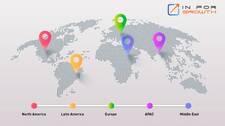
Regional Market Distribution
DevOps tool adoption and revenue are distributed unevenly across global regions. The key markets typically analyzed in industry reports include:
- North America — Historically the largest revenue-generating region, driven by a dense concentration of technology companies and early enterprise adoption.
- Europe — Strong growth, with GDPR compliance requirements adding demand for audit and policy-as-code tooling.
- China — Rapid growth in domestic cloud platforms and local DevOps toolchain alternatives.
- Japan — Mature IT market with increasing digital transformation investment from traditional enterprises.
- Middle East & Africa — Emerging market with government-led digital transformation programs driving adoption.
- India — A significant contributor as both a consumption market and a services delivery hub for global DevOps engagements.
- South America — Growing adoption in fintech and retail sectors, with Brazil as the primary market.
Key Factors Shaping the DevOps Tools Market
Several structural forces are influencing the direction of the DevOps tools market:
- Platform consolidation — Vendors are acquiring point solutions to offer integrated platforms, reducing the number of discrete tools teams need to manage.
- Shift-left security — Growing demand for security tooling embedded directly into CI/CD pipelines (SAST, DAST, SCA, secrets scanning).
- Cloud-native architecture — Kubernetes adoption is reshaping infrastructure tooling requirements, favoring operators, Helm charts, and GitOps workflows.
- AI-assisted development — Emerging integration of AI code assistants and intelligent test generation into DevOps pipelines.
- Regulatory pressure — Compliance requirements in BFSI, healthcare, and government are increasing demand for tooling with built-in audit trails and policy enforcement.
- Remote-first delivery — The COVID-19 pandemic accelerated distributed team practices, increasing reliance on cloud-hosted CI/CD and collaboration tooling.
Evaluating DevOps Toolchain Investments
For engineering leaders assessing toolchain decisions, market research provides useful context but should be supplemented with hands-on evaluation. Consider the following when reviewing vendor options:
- Alignment with your current cloud provider and existing toolchain to minimize integration overhead.
- Total cost of ownership, including licensing, training, and operational overhead — not just seat price.
- Community activity and ecosystem health (plugins, integrations, open-source contribution cadence).
- Vendor stability: acquisition activity in this market is high, and roadmaps can shift after M&A events.
- Support for your target deployment model — on-premises, SaaS, or hybrid.
Market share data provides a useful starting point, but the right toolchain for your organization depends on team size, maturity, regulatory environment, and existing infrastructure investments.