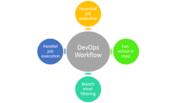
DevOps is a set of practices and a cultural philosophy that grew out of the Agile and Lean movements. It brings software development teams (Dev) and IT operations teams (Ops) together to automate infrastructure, streamline workflows, and continuously monitor application performance — all with the goal of delivering software more frequently and more reliably.
Researchers Len Bass, Dr. Ingo Weber, and Dr. Liming Zhu have offered a widely cited academic definition: DevOps is “a set of practices intended to reduce the time between committing a change to a system and the change being placed into normal production while ensuring high quality.”
The Problem DevOps Solves
To understand what DevOps changes, it helps to understand the friction it replaces. In a traditional software organisation, developers and operations engineers work in separate silos with different priorities, tools, and mental models of the system.
The Developer’s Experience Without DevOps
Developers write code in a local or shared development environment. Once a batch of changes is ready, it gets handed off to operations for deployment — a process that might happen only once or twice a month. The developer moves on to the next feature while that batch sits in a queue.
When the code finally reaches production, it can behave differently than it did in development. Subtle environment differences — configuration, library versions, network rules — cause errors. The developer must now context-switch back to code they wrote weeks ago to diagnose and fix a problem they can barely remember writing.
The Operations Team’s Experience Without DevOps
The operations team owns the production environment. They manage servers, maintain uptime, and are ultimately accountable when something breaks in front of customers. Periodically, they receive a large bundle of new code from developers and must integrate it into a live system with as little disruption as possible.
Because deployments are infrequent and each one is large, they carry significant risk. Operations engineers often spend considerable time coaxing new code to behave correctly in an environment they maintain but did not design the code for. If errors follow a deployment, it is the operations team that must respond — even when root cause lies in code they did not write.
This structural tension — developers optimising for speed, operations optimising for stability — is the core problem DevOps addresses.
How a DevOps Team Works Differently
DevOps removes the handoff wall. Developers and operations engineers collaborate throughout the entire development lifecycle: design, coding, testing, deployment, and post-release monitoring. The key shifts are:
- Smaller, more frequent releases. Instead of batching weeks of work into a single deployment, teams ship small increments of code continuously. Smaller changes are easier to test, easier to debug, and easier to roll back.
- Automation first. Manual steps — building, testing, provisioning infrastructure, deploying code — are automated wherever possible. This reduces human error and makes the pipeline repeatable and auditable.
- Infrastructure as Code (IaC). Infrastructure is defined in version-controlled configuration files rather than configured manually. Tools like Terraform, Ansible, and Puppet make environments reproducible, closing the gap between development and production.
- Continuous monitoring. Application performance, error rates, and user experience are measured in near real-time. Both developers and operations engineers are responsible for acting on that data.
- Shared ownership. The team shares responsibility for the full lifecycle of a service, reducing the blame culture that arises from siloed work.
Core DevOps Principles
Several principles underpin the DevOps way of working:
- Continuous Integration (CI): Developers merge code changes into a shared repository frequently. Each merge triggers an automated build and test run, surfacing integration problems early.
- Continuous Delivery (CD): Every change that passes automated tests is automatically prepared for release to production. The decision to deploy can be made at any time.
- Continuous Deployment: An extension of CD where every passing change is automatically deployed to production without manual approval gates.
- Feedback loops: Short, fast feedback loops between production behaviour and developer action are central. Monitoring and alerting tools provide this signal.
- Blameless culture: Post-incident reviews focus on systemic improvements rather than individual blame, encouraging transparency and learning.
A Brief History of DevOps
DevOps did not emerge from a single moment. It evolved from the Agile System Administration and Enterprise Systems Management (ESM) movements that gained momentum in the mid-2000s, as practitioners began questioning why Agile principles applied inside development teams were not extending to operations.
Key milestones include:
- 2008 — Velocity Conference: O’Reilly’s Velocity conference, focused on web performance and operations, became a gathering point for engineers interested in developer-operations collaboration. Talks at the 2008 and 2009 editions helped crystallise the ideas that would become DevOps.
- 2009 — DevOpsDays, Ghent: Agile practitioner and project manager Patrick Debois organised the first DevOpsDays conference in Belgium, giving the movement its name and a dedicated community.
- 2012 — First State of DevOps Report: Alanna Brown at Puppet launched what became an annual industry survey tracking DevOps adoption, practices, and outcomes. Subsequent editions, produced in partnership with DORA (DevOps Research and Assessment), provided data on the business impact of DevOps practices.
Essential DevOps Toolchains
DevOps practices depend on integrated toolchains — sets of tools that automate and connect different stages of the delivery pipeline. The major categories are:
| Category | Purpose | Example Tools |
|---|---|---|
| Source Control | Version control and collaboration on code | Git, GitHub, GitLab, Bitbucket |
| Continuous Integration | Automated build and test on every commit | Jenkins, GitHub Actions, GitLab CI, CircleCI |
| Artifact Management | Store and version build artifacts and container images | Nexus, Artifactory, Docker Hub |
| Infrastructure as Code | Define and provision infrastructure declaratively | Terraform, AWS CloudFormation, Pulumi |
| Configuration Management | Enforce consistent server and application configuration | Ansible, Puppet, Chef |
| Continuous Delivery / Deployment | Automate releases to staging and production | Spinnaker, Argo CD, Harness |
| Monitoring & Observability | Track performance, errors, and user experience in production | Prometheus, Grafana, Datadog, New Relic |
What DevOps Is Not
DevOps is frequently misunderstood. It is not a job title, a specific product, or a team you stand up and declare done. Hiring a “DevOps engineer” or deploying a CI/CD tool does not make an organisation DevOps. The tools support the practices, and the practices require a genuine cultural shift: shared ownership, trust between teams, tolerance for experimentation, and a commitment to learning from failure.
Why DevOps Matters
Organisations that successfully adopt DevOps practices can deploy code more frequently, recover from failures faster, and maintain higher levels of service stability. The underlying reason is structural: by removing handoff delays, automating repetitive work, and closing feedback loops between production behaviour and engineering decisions, teams spend more time on valuable work and less time on rework, incident response, and coordination overhead.
DevOps is not a destination. It is an ongoing discipline — one that rewards teams willing to continuously examine their own processes and improve them.