Introduction
A Customer Data Platform (CDP) is a specialized software system that creates a persistent, unified customer database accessible to other systems. Unlike traditional databases, a CDP is designed primarily for marketers and customer success teams to collect data from multiple sources, clean it, and link it to a single customer profile. This process, often called “Identity Resolution,” ensures that a customer interacting with your mobile app and your physical store is recognized as the same individual.
In the current landscape, data is often trapped in silos—email systems, CRMs, and web analytics tools—which prevents a cohesive customer experience. A CDP acts as the central “brain” that synchronizes this information in real-time. The shift toward first-party data has made CDPs indispensable for any organization looking to maintain privacy compliance while delivering high-end personalization.
Real-world use cases include:
- Omnichannel Personalization: Ensuring a customer sees the same discounted product on your website that they just abandoned in their mobile cart.
- Predictive Churn Analysis: Identifying customers whose engagement has dropped across all channels and triggering an automated “win-back” email.
- Online-to-Offline Attribution: Tracking when a customer who saw a digital ad eventually makes a purchase at a physical retail location.
- Lookalike Modeling: Using the profiles of your highest-value customers to find similar audiences on advertising platforms.
What buyers should evaluate:
- Identity Resolution: How accurately does it “stitch” different identifiers (email, cookies, device IDs) together?
- Real-Time Activation: Can it trigger an action (like a push notification) within milliseconds of a user event?
- Data Governance: Does it have built-in tools to manage GDPR/CCPA consent and data privacy?
- Integration Library: How many pre-built connectors does it have for your existing MarTech stack?
- Ease of Use: Can marketing teams build audiences without writing SQL or needing a developer?
- Scalability: Can it handle billions of events without significant latency?
- Reverse ETL: Can it push resolved data back into your operational tools (like a CRM)?
- Cost Model: Is it priced by profile count, data volume, or user seats?
Best for: B2C enterprises with high-volume customer interactions, e-commerce brands, and data-driven marketing teams.
Not ideal for: B2B startups with very small customer lists or companies that only collect data from a single source (e.g., just a website).
Key Trends in Customer Data Platforms (CDP)
- Composable CDPs: A shift toward “warehouse-native” architectures where data stays in your Snowflake or BigQuery instead of being moved to a separate vendor silo.
- AI-Generated Segments: Using natural language prompts to create complex customer audiences (e.g., “Find me users likely to buy a jacket in the next 48 hours”).
- Zero-Copy Architecture: Technologies that allow CDPs to read data directly from the cloud warehouse without duplicating it, reducing storage costs and security risks.
- Privacy-First Identity: Moving away from third-party cookies toward durable identifiers based on encrypted first-party data.
- Predictive Customer Scoring: Built-in machine learning that assigns “propensity scores” for purchase, churn, or lifetime value.
- Edge Activation: Processing customer data at the “edge” to personalize web experiences in under 100 milliseconds.
- B2B Identity Graphs: Advanced CDPs are now better at linking individual users to their respective accounts/companies in B2B environments.
- Data Clean Rooms: Integrated environments where brands can safely collaborate on data with partners without exposing individual PII (Personally Identifiable Information).
How We Selected These Tools (Methodology)
To select the top 10 CDP tools, we analyzed the market using a multi-dimensional framework:
- Market Adoption: We prioritized tools used by Fortune 500 companies and leading digital brands.
- Integration Ecosystem: We evaluated the number and quality of “out-of-the-box” connectors for popular apps.
- Real-Time Capability: We tested the platform’s ability to ingest and act on data in under a second.
- Security & Compliance: We looked for standard-setting certifications like SOC 2, ISO 27001, and HIPAA.
- Identity Stitching Logic: We analyzed the sophistication of their deterministic and probabilistic matching algorithms.
- User Experience: We focused on tools that empower non-technical users to manage data pipelines.
- Analyst Recognition: We cross-referenced findings with top industry reports and customer reviews.
- Innovation Pace: We prioritized vendors that have successfully integrated generative AI and composable architectures.
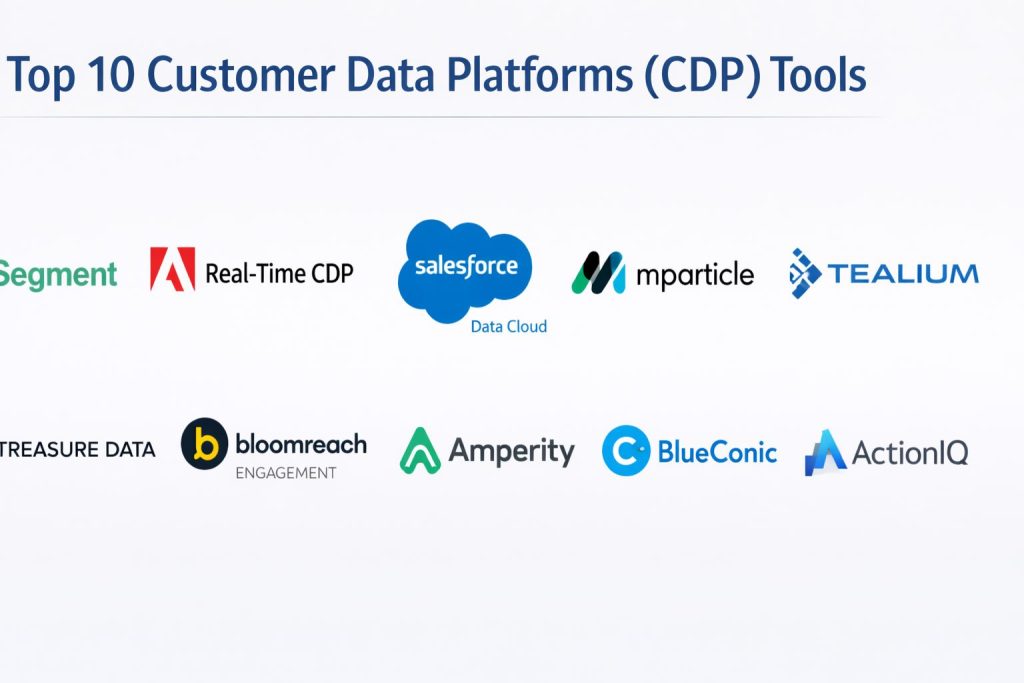
Top 10 Customer Data Platforms (CDP) Tools
#1 — Twilio Segment
A developer-friendly CDP known for its “API-first” approach. It acts as a single pipe to collect and route data to hundreds of tools.
Key Features
- Segment Connections: A massive library of 400+ pre-built integrations for easy data routing.
- Protocols: A data governance tool that enforces a tracking plan to keep data clean and consistent.
- Personas: Real-time identity resolution that builds comprehensive 360-degree customer profiles.
- Reverse ETL: Send warehouse data back into your marketing tools like Salesforce or Braze.
- Functions: Allows developers to write custom code to transform data in transit.
Pros
- Extremely easy to set up for technical teams.
- Industry-leading documentation and developer community support.
Cons
- Can become very expensive as your data volume or profile count grows.
- Some advanced features require manual configuration.
Platforms / Deployment
- Web / Windows / macOS / Linux / iOS / Android
- Cloud (SaaS)
Security & Compliance
- SSO/SAML, MFA, RBAC
- SOC 2 Type II, ISO 27001, GDPR, HIPAA (Enterprise)
Integrations & Ecosystem
Segment has the largest marketplace in the industry.
- Google Analytics
- Salesforce
- Mixpanel
- Facebook Ads
- Snowflake
Support & Community
Twilio provides excellent technical support and a vast library of “Segment University” courses. Its developer community is one of the most active in the MarTech space.
#2 — Adobe Real-Time CDP
An enterprise-grade platform that unifies B2B and B2C data for massive global brands.
Key Features
- Unified Profile: Stitching together online, offline, and third-party data into one view.
- Adobe Sensei AI: Built-in machine learning for predictive modeling and audience discovery.
- Data Governance: Sophisticated tools for managing consent and privacy labels.
- Edge Network: Distributes profiles globally for sub-second personalization.
- B2B & B2C Support: Unique ability to handle both individual and account-level data.
Pros
- Deeply integrated with the Adobe Experience Cloud (Analytics, Target, Campaign).
- Unmatched scalability for massive, global data sets.
Cons
- Extremely high cost and complex implementation.
- Primarily designed for large enterprises with established Adobe stacks.
Platforms / Deployment
- Web / Windows / macOS
- Cloud (Adobe Experience Platform)
Security & Compliance
- SSO, MFA, Encryption at rest/transit
- HIPAA, SOC 2, ISO 27001, GDPR
Integrations & Ecosystem
Part of the broader Adobe ecosystem, but also connects to external data warehouses.
- Adobe Creative Cloud
- Microsoft Dynamics
- Amazon S3
- Google Ads
Support & Community
Professional-grade support with dedicated account managers for enterprise tiers. The community is highly professional and corporate-focused.
#3 — Salesforce Data Cloud
A CRM-native CDP that turns Salesforce into a real-time data engine for sales, service, and marketing.
Key Features
- Einstein AI: Generative and predictive AI to suggest the “next best action” for a customer.
- Customer 360: A unified view that connects every touchpoint across the Salesforce suite.
- Flow Builder: Automate business processes directly based on CDP data triggers.
- MuleSoft Integration: Connects to legacy backends and ERP systems effortlessly.
- Data Spaces: Allows brands to separate data by region or department within one org.
Pros
- The most seamless experience for existing Salesforce users.
- High-speed data ingestion specifically tuned for CRM workflows.
Cons
- Can feel restrictive if you want to use “best-of-breed” tools outside Salesforce.
- Pricing is tied to “credits,” which can be hard to predict.
Platforms / Deployment
- Web / iOS / Android
- Cloud (Hyperforce)
Security & Compliance
- SSO, MFA, Audit Logs
- SOC 2, ISO 27001, HIPAA, FedRAMP
Integrations & Ecosystem
Native to the world’s largest CRM ecosystem.
- Sales Cloud
- Service Cloud
- Tableau
- Slack
Support & Community
Massive “Trailblazer” community with millions of members and endless free training through Trailhead.
#4 — mParticle
A mobile-first CDP that excels at handling high-velocity data from apps and digital devices.
Key Features
- Data Master: A suite of tools to validate and protect data quality at the source.
- Identity Mapping: Advanced logic to resolve identities across mobile, web, and OTT devices.
- Audience Builder: No-code tool for marketers to create cross-channel segments.
- Real-Time Feeds: Ingest data from external sources like Zendesk or Shopify instantly.
- Security Controls: Granular PII masking and data localization features.
Pros
- Best-in-class support for mobile app developers.
- Strong focus on data privacy and security (HIPAA compliant).
Cons
- Less focus on “traditional” offline data compared to enterprise competitors.
- Learning curve can be steep for non-technical marketers.
Platforms / Deployment
- iOS / Android / Web / Smart TV
- Cloud (SaaS)
Security & Compliance
- SSO, RBAC, Encryption
- HIPAA, SOC 2 Type II, ISO 27001, GDPR
Integrations & Ecosystem
- Braze
- Airship
- AppsFlyer
- Amazon Redshift
Support & Community
Offers white-glove onboarding and highly responsive technical support. The community is focused on high-growth mobile apps.
#5 — Tealium EventStream
A high-speed, event-driven CDP that emphasizes data orchestration and real-time triggers.
Key Features
- AudienceStream: Turns event data into unified customer profiles and segments in real-time.
- Predict: A built-in machine learning tool that predicts customer behavior without code.
- Identity Resolution: Patented tech for resolving identities across browsers and devices.
- Consent Manager: Integrated tools to manage user preferences across the globe.
- Functions: Server-side logic for transforming data before it hits your destination.
Pros
- Exceptional speed; it is one of the fastest CDPs for real-time action.
- Strong heritage in tag management, making data collection very robust.
Cons
- Interface can feel complex and dated to some users.
- Pricing is premium, targeted toward large mid-market and enterprise firms.
Platforms / Deployment
- Web / Windows / macOS / Linux / Mobile
- Cloud / Hybrid
Security & Compliance
- SSO, MFA, IP Whitelisting
- HIPAA, SOC 2, ISO 27001, GDPR
Integrations & Ecosystem
- Google Marketing Platform
- Facebook Conversions API
- Oracle Marketing Cloud
Support & Community
Tealium Education provides comprehensive certification programs. The community is veteran-heavy and very technical.
#6 — Treasure Data
A big-data CDP capable of handling massive, complex datasets with “schema-on-read” flexibility.
Key Features
- Data Workbench: Advanced SQL-based data modeling for power users.
- Predictive Lead Scoring: AI that identifies high-value leads for B2B teams.
- Treasure Boxes: Pre-built code and templates to speed up deployment.
- Profile API: Allows external apps to query unified profiles in real-time.
- Consent Management: Global compliance tools built into the data core.
Pros
- Can ingest petabytes of data without breaking a sweat.
- High degree of flexibility for custom data science workloads.
Cons
- Requires more technical expertise (SQL/Data Science) than “plug-and-play” CDPs.
- Not as focused on simple marketing automation.
Platforms / Deployment
- Web / Linux
- Cloud-native (AWS/GCP/Azure)
Security & Compliance
- SSO, Encryption, Audit Trails
- SOC 2, ISO 27001, HIPAA, FISMA
Integrations & Ecosystem
- Arm (Parent ecosystem)
- Snowflake
- Tableau
- Marketo
Support & Community
Strong enterprise support. Known for high-touch consulting services to help with complex data strategies.
#7 — Bloomreach Engagement
An all-in-one CDP and marketing automation platform designed specifically for e-commerce.
Key Features
- Single Customer View: Unifies online and offline data for retail brands.
- Loomi AI: A specialized AI for e-commerce that automates product recommendations.
- Campaign Orchestration: Email, SMS, and Web Push built directly into the CDP.
- Experiments: Built-in A/B testing and personalization tools.
- Zero-Copy Support: Connects directly to data warehouses without duplication.
Pros
- No need for a separate “Email Service Provider” (ESP); it’s all in one box.
- The best CDP for retail and e-commerce-specific needs.
Cons
- Less flexible for non-retail use cases (like financial services or B2B).
- Can feel like “vendor lock-in” since it handles both data and execution.
Platforms / Deployment
- Web / iOS / Android
- Cloud (SaaS)
Security & Compliance
- SSO, MFA, RBAC
- ISO 27001, SOC 2, GDPR
Integrations & Ecosystem
- Shopify
- BigCommerce
- Google Ads
Support & Community
Excellent customer success model. The community is filled with retail marketers and e-commerce experts.
#8 — Amperity
An enterprise-grade CDP that focuses heavily on “AI-driven” identity resolution for messy data.
Key Features
- Stitch: Uses patented AI to resolve identities even when data is missing or inconsistent.
- AmpIQ: A visual dashboard for marketers to analyze segments and ROI.
- Amp360: Provides a clean, mastered record of every customer for the whole company.
- Predictive Insights: Forecasts customer lifetime value (LTV) and discount sensitivity.
- Data Governance: Automated tools for PII management and deletion requests.
Pros
- Best-in-class identity resolution; it handles messy data better than anyone.
- Very fast time-to-value for complex enterprise projects.
Cons
- Not a “real-time” orchestrator; it focuses more on deep, accurate data mastering.
- Premium pricing model.
Platforms / Deployment
- Web / Windows / macOS / Linux
- Cloud (AWS/Azure)
Security & Compliance
- SSO, MFA, Audit logs
- SOC 2, ISO 27001, HIPAA, CCPA
Integrations & Ecosystem
- Snowflake
- Microsoft Azure
- Salesforce
- Adobe
Support & Community
Known for high-end strategic consulting. Its community is smaller but consists of elite data engineers and marketing leaders.
#9 — BlueConic
A user-friendly, real-time CDP focused on empowering marketing teams without IT help.
Key Features
- Persistent Profiles: Profiles that update the moment a user takes an action.
- Lifecycle Orchestration: Visual builder for moving customers through their journey.
- Privacy Management: Consent and preference management is built into every profile.
- AI Workbench: A Python-friendly environment for data scientists to build custom models.
- Direct Plugs: 100+ native connectors for standard marketing tools.
Pros
- One of the most intuitive user interfaces in the category.
- Excellent for publishing and retail companies that need fast personalization.
Cons
- Less focus on “big data” engineering than Treasure Data or Amperity.
- Scalability can be an issue for the very largest global datasets.
Platforms / Deployment
- Web / Windows / macOS
- Cloud (SaaS)
Security & Compliance
- SSO, MFA, Encryption
- ISO 27001, GDPR, CCPA
Integrations & Ecosystem
- Google Ad Manager
- HubSpot
- Mailchimp
- Shopify
Support & Community
Highly rated for its onboarding process and “BlueConic Academy” training materials.
#10 — ActionIQ
A “composable” CDP that allows organizations to bridge the gap between their data warehouse and marketing.
Key Features
- InfiniteCompute: A powerful engine that queries data without moving it out of the warehouse.
- Audience Builder: A drag-and-drop interface for complex multi-channel segments.
- Journey Orchestration: Plan and execute multi-step cross-channel campaigns.
- Reverse ETL: Syncs resolved audience data back into any operational tool.
- Self-Service Analytics: Marketers can explore data without writing a single line of SQL.
Pros
- Perfect for companies following a “Modern Data Stack” (Snowflake, Databricks).
- No data duplication means better security and lower costs.
Cons
- Still a relatively young company compared to Salesforce or Adobe.
- Implementation requires a solid existing data warehouse.
Platforms / Deployment
- Web / Linux
- Cloud-native (Warehouse-first)
Security & Compliance
- SSO, MFA, Data masking
- SOC 2, GDPR, CCPA
Integrations & Ecosystem
- Snowflake
- Databricks
- Google BigQuery
- Amazon Redshift
Support & Community
Highly specialized support team. The community is focused on the “composable” data movement and modern analytics.
Comparison Table (Top 10)
| Tool Name | Best For | Platform(s) Supported | Deployment | Standout Feature | Public Rating |
| Twilio Segment | Developers/Agile | Web, Mobile, Win | Cloud | 400+ Connectors | 4.6/5 |
| Adobe RT-CDP | Global Enterprises | Web, Win, Mac | Cloud | Experience Edge | 4.3/5 |
| Salesforce Data Cloud | Salesforce Users | Web, iOS, Android | Cloud | CRM-Native AI | 4.4/5 |
| mParticle | Mobile-First Apps | iOS, Android, TV | Cloud | Mobile Identity | 4.5/5 |
| Tealium | Real-Time Speed | Web, Mobile, Win | Hybrid | Event Stream | 4.4/5 |
| Treasure Data | Big Data Engineering | Web, Linux | Cloud | Schema-on-Read | 4.5/5 |
| Bloomreach | E-commerce/Retail | Web, Mobile | Cloud | Built-in ESP | 4.7/5 |
| Amperity | Messy/Large Data | Web, Win, Linux | Cloud | AI Stitching | 4.6/5 |
| BlueConic | Marketing Teams | Web, Win, Mac | Cloud | UI Intuitiveness | 4.2/5 |
| ActionIQ | Composable Stack | Web, Linux | Cloud | Warehouse-Native | 4.5/5 |
Evaluation & Scoring of Customer Data Platforms (CDP)
| Tool Name | Core (25%) | Ease (15%) | Integrations (15%) | Security (10%) | Performance (10%) | Support (10%) | Value (15%) | Weighted Total |
| Segment | 9 | 8 | 10 | 9 | 9 | 9 | 7 | 8.8 |
| Salesforce | 9 | 7 | 8 | 10 | 9 | 9 | 7 | 8.5 |
| Adobe | 10 | 5 | 8 | 10 | 10 | 8 | 5 | 8.1 |
| Bloomreach | 8 | 9 | 8 | 9 | 8 | 9 | 8 | 8.3 |
| Tealium | 9 | 6 | 9 | 10 | 10 | 8 | 6 | 8.1 |
| Amperity | 10 | 6 | 7 | 9 | 8 | 8 | 7 | 7.8 |
| mParticle | 8 | 7 | 8 | 10 | 9 | 8 | 7 | 8.0 |
| ActionIQ | 9 | 6 | 8 | 9 | 9 | 7 | 8 | 8.0 |
| BlueConic | 7 | 10 | 8 | 9 | 7 | 8 | 7 | 7.7 |
| Treasure Data | 9 | 4 | 7 | 10 | 10 | 8 | 6 | 7.6 |
How to interpret these scores:
- 8.5 – 10.0: Industry leaders with massive integration libraries and high performance.
- 7.5 – 8.4: Strong specialized platforms for specific industries (Retail, Mobile, etc.).
- Below 7.5: Niche or engineering-heavy tools that require significant technical resources.
Which Customer Data Platform (CDP) Tool Is Right for You?
Solo / Startup
Startups usually don’t need a heavy enterprise CDP. Twilio Segment (Free tier) or a “light” CDP like BlueConic is best. Focus on getting your data tracking right before worrying about complex identity resolution.
SMB
For small-to-medium businesses, Bloomreach (if in retail) or BlueConic (if in media) offer the best ease of use. You don’t want to hire three data engineers just to run your CDP.
Mid-Market
Companies at this level are often looking for mParticle or Tealium. These tools offer enterprise features like high security and real-time triggers without the massive complexity of Adobe or Salesforce.
Enterprise
If you are a global brand, your choice is likely Adobe Real-Time CDP or Salesforce Data Cloud. These platforms offer the security, compliance, and international support that large corporations require.
Budget vs Premium
- Budget-Friendly: Segment (Free to start), ActionIQ (Composable/No duplication costs).
- Premium: Adobe, Salesforce, Amperity.
Feature Depth vs Ease of Use
If you want deep, AI-driven identity resolution, Amperity is the winner. If you want a platform your marketing manager can use without calling IT, BlueConic is the better fit.
Integrations & Scalability
Twilio Segment wins on integrations. Treasure Data and Adobe win on the sheer scale of data volume they can manage.
Security & Compliance Needs
Industries like healthcare and finance should prioritize mParticle or Salesforce, which have specialized HIPAA and FedRAMP certifications.
Frequently Asked Questions (FAQs)
1. Is a CDP the same as a CRM?
No. A CRM (like Salesforce) tracks manual interactions between your sales team and a customer. A CDP (like Segment) tracks all digital behavioral data from websites, apps, and servers automatically.
2. Does a CDP replace my data warehouse?
Usually no. Most modern CDPs complement your warehouse (Snowflake/BigQuery). The warehouse is the long-term storage, while the CDP is the “activation layer” that makes that data usable for marketing.
3. How long does it take to implement a CDP?
A simple setup can take 2–4 weeks. A full enterprise implementation involving multiple data sources and identity resolution usually takes 3–6 months.
4. What is “Identity Resolution”?
It is the process of linking different data points—like an email from a newsletter sign-up and a cookie from a web visit—to the same person so you can see their full journey.
5. Do I need a developer to use a CDP?
You need a developer for the initial setup (installing tracking codes). Once set up, most CDPs are designed for marketers to build audiences and launch campaigns without code.
6. Are CDPs expensive?
They can be. Enterprise CDPs often start at $100k+ per year. However, “composable” CDPs and mid-market tools offer much more affordable pricing for smaller companies.
7. Is a CDP compliant with GDPR?
Yes, most top-tier CDPs have built-in tools to handle “Right to be Forgotten” requests and consent management, making compliance much easier.
8. Can I use a CDP for B2B?
Yes. Platforms like Salesforce and Adobe have specialized features to link individuals to “Accounts,” which is essential for B2B marketing.
9. What is “Reverse ETL”?
It’s a feature that takes data out of your CDP or warehouse and pushes it into other apps (like sending a “High Value” tag back into your helpdesk tool).
10. Can a CDP work without cookies?
Yes. Modern CDPs use “First-Party Identifiers” (like hashed emails or logged-in IDs) to track users, which works even if third-party cookies are blocked.
Conclusion
A Customer Data Platform is the foundation of a modern, data-driven business. Whether you are aiming to fix “messy” data with Amperity, or launch real-time e-commerce campaigns with Bloomreach, the right tool depends on your technical maturity and your industry.
Don’t buy a CDP just for the sake of having one. Start by identifying the specific “data gaps” in your current customer journey. Your next step should be to run a “Data Audit” to see which of these 10 tools best connects your existing systems.