Introduction
An API Gateway is a management tool that sits between a client and a collection of backend services. Think of it as a traffic cop or a single entry point for all incoming requests. Instead of a mobile app or web browser calling dozens of individual microservices, it sends a request to the gateway, which then routes the traffic, handles security, and gathers the results.
Technical landscape, where microservices and serverless architectures are the standard, managing these connections manually is impossible. API Gateways have evolved from simple proxies into intelligent layers that handle high-speed traffic, identity management, and real-time data monitoring. They are the frontline of defense and the primary engine for scaling modern digital products.
Real-world use cases include:
- E-commerce: Consolidating requests for pricing, inventory, and shipping services into a single response for the user.
- Mobile Applications: Reducing “chattiness” by aggregating data so the phone doesn’t have to make multiple slow network calls.
- Security Layers: Centrally managing API keys and blocking malicious bot traffic before it hits the database.
- Legacy Modernization: Wrapping an old backend system in a modern REST or GraphQL interface without changing the original code.
What buyers should evaluate:
- Latency: Does the gateway add significant delay to the request processing?
- Ease of Configuration: Is it managed via a simple UI, or does it require complex manual scripting?
- Security Features: Does it include built-in Rate Limiting, WAF, and OAuth2 support?
- Deployment Models: Can it run on-premises, in the cloud, or as a fully managed SaaS?
- Observability: How well does it integrate with monitoring tools like Prometheus or Grafana?
- Extensibility: Can you write custom plugins to handle unique business logic?
- Protocol Support: Does it support REST, gRPC, WebSocket, and GraphQL?
- Scalability: Can it handle millions of requests per second during peak traffic?
Best for: DevOps engineers, SREs, and backend architects building scalable microservices or exposing public APIs.
Not ideal for: Simple monolithic applications with only one or two internal endpoints where a basic load balancer would suffice.
Key Trends in API Gateways
- AI-Powered Traffic Shaping: Modern gateways use machine learning to detect anomalous traffic patterns and automatically block potential DDoS attacks.
- Wasm (WebAssembly) Plugins: Developers are increasingly using Wasm to write high-performance gateway extensions in languages like Rust or Go.
- Service Mesh Integration: Gateways are now more tightly integrated with service meshes (like Istio), creating a unified “North-South” and “East-West” traffic management layer.
- Zero Trust Security: Moving beyond simple keys toward short-lived tokens and identity-based access for every single request.
- GraphQL Federation: Gateways now act as a central hub to merge multiple GraphQL schemas into one unified graph.
- Serverless Native: Many gateways are becoming “request-aware,” scaling down to zero when no traffic is present to save on cloud costs.
- Edge Computing: Shifting gateway logic (like authentication and caching) to the “edge” to be closer to the user, reducing latency significantly.
- GitOps Integration: Managing gateway configurations entirely through code repositories to ensure fast and safe deployments.
How We Selected These Tools (Methodology)
To identify the leading API Gateways, we analyzed the market based on several high-performance benchmarks:
- Production Reliability: We focused on tools used by Fortune 500 companies and high-growth startups.
- Feature Maturity: The tool must go beyond simple routing to include security, caching, and transformation.
- Cloud Compatibility: We evaluated how easily these tools deploy across AWS, Azure, Google Cloud, and Kubernetes.
- Developer Experience: We looked for tools with excellent CLI support, clear documentation, and easy-to-use dashboards.
- Security Posture: Preference was given to tools with robust encryption, authentication, and compliance features.
- Performance Signals: We reviewed benchmark data regarding request-per-second capabilities and overhead latency.
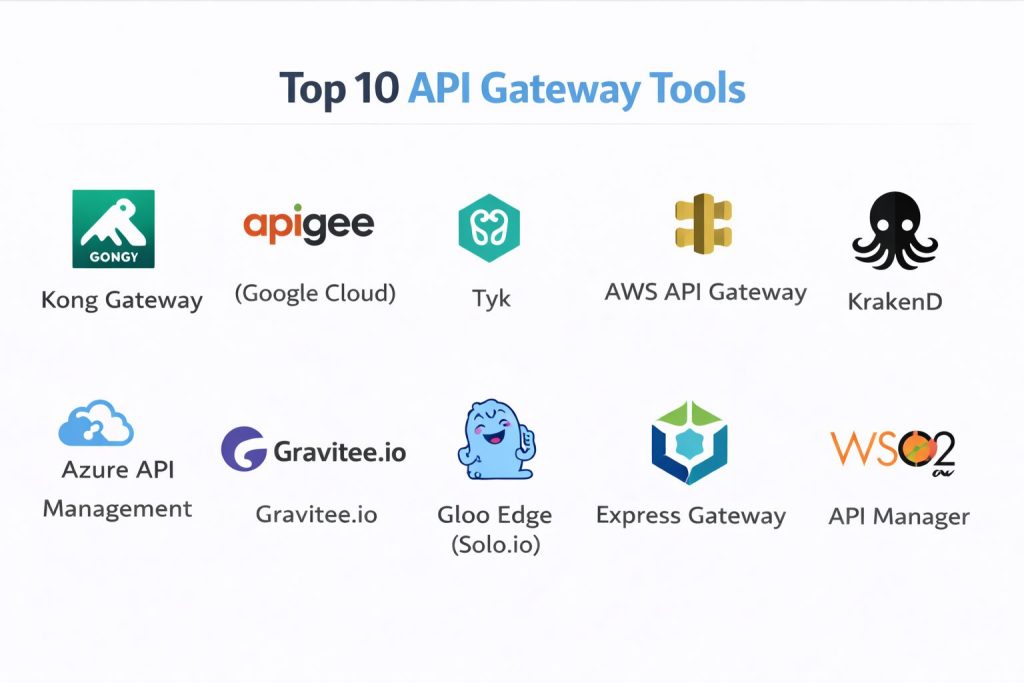
Top 10 API Gateway Tools
#1 — Kong Gateway
An open-source, cloud-native API gateway built on top of Nginx. It is widely considered the fastest and most extensible gateway in the industry.
Key Features
- Plugin Architecture: Over 100+ ready-to-use plugins for authentication, logging, and traffic control.
- High Performance: Extremely low latency, making it ideal for high-traffic environments.
- Kong Konnect: A unified control plane for managing multiple gateway instances across different clouds.
- Native Kubernetes Support: Deep integration with K8s using the Kong Ingress Controller.
- Service Mesh Support: Works seamlessly with Kong Mesh for end-to-end traffic management.
Pros
- Unrivaled performance and scalability.
- Extremely flexible thanks to the massive plugin library.
Cons
- The Enterprise version is quite expensive.
- Configuration can be complex for those unfamiliar with Nginx/Lua.
Platforms / Deployment
- Windows / macOS / Linux / Docker / Kubernetes
- Cloud / Self-hosted / Hybrid
Security & Compliance
- RBAC, OAuth2, OpenID Connect, Key Auth
- SOC 2, HIPAA (Enterprise)
Integrations & Ecosystem
Kong has a massive ecosystem of integrations for monitoring and security.
- Datadog
- Prometheus
- Okta
- AWS Lambda
Support & Community
One of the largest communities in the API space. Kong offers extensive documentation and a dedicated forum for open-source users.
#2 — Apigee (Google Cloud)
A full-lifecycle API management platform that focuses on enterprise-level security, analytics, and monetization.
Key Features
- Advanced Analytics: Detailed dashboards that track API performance and developer usage.
- API Monetization: Built-in tools to create rate plans and charge developers for API usage.
- AI-Powered Threat Protection: Uses Google’s security intelligence to detect and block threats.
- Multi-Cloud Support: Can manage APIs across various cloud providers and on-premises.
- Developer Portal: A ready-made portal to help external developers discover and test your APIs.
Pros
- Exceptional analytics and business-level reporting.
- Deeply integrated into the Google Cloud ecosystem.
Cons
- Can be very expensive for small startups.
- Heavy UI-centric approach may feel slower to developers who prefer CLI/Code.
Platforms / Deployment
- Cloud (GCP) / Hybrid
- Managed Service
Security & Compliance
- SAML, OAuth2, JWT, TLS
- PCI-DSS, HIPAA, SOC 2
Integrations & Ecosystem
- Google Cloud Functions
- Firebase
- BigQuery
- Stackdriver
Support & Community
Professional enterprise support from Google. The documentation is exhaustive and tailored for corporate environments.
#3 — Tyk
An open-source API gateway written in Go. It is known for its modern architecture and powerful, easy-to-use dashboard.
Key Features
- Built-in Dashboard: A high-quality UI for managing APIs, keys, and documentation.
- Go-Based Performance: High throughput with minimal memory footprint.
- GraphQL Out-of-the-Box: Includes a powerful GraphQL engine to transform REST into GraphQL.
- Developer Portal: Built-in CMS to publish your API documentation instantly.
- Zero-Downtime Reloads: Changes can be applied without interrupting active traffic.
Pros
- The dashboard is highly intuitive and user-friendly.
- Very developer-friendly with a focus on ease of use.
Cons
- Smaller community compared to Kong.
- Some advanced features require the paid license.
Platforms / Deployment
- Windows / macOS / Linux / Docker
- Cloud / Self-hosted / Hybrid
Security & Compliance
- Mutual TLS, OpenID Connect, HMAC
- GDPR Compliant
Integrations & Ecosystem
- Splunk
- ElasticSearch
- Jaeger
- GitHub
Support & Community
Excellent direct support for paid tiers. The open-source community is active, and the documentation is very clear and easy to follow.
#4 — AWS API Gateway
A fully managed service that makes it easy for developers to create, publish, and secure APIs at any scale within the AWS ecosystem.
Key Features
- Serverless Integration: Perfect integration with AWS Lambda.
- WebSocket Support: Handles real-time, two-way communication effortlessly.
- Canary Deployments: Safely roll out new API versions to a small percentage of users.
- Usage Plans: Set different rate limits and quotas for different groups of users.
- CloudWatch Monitoring: Automatic logging and metrics for every request.
Pros
- No servers to manage; it scales automatically.
- Very cost-effective for small-to-medium traffic.
Cons
- Harder to move to another cloud provider (vendor lock-in).
- Some advanced configurations can be tricky in the AWS Console.
Platforms / Deployment
- Cloud (AWS)
- Managed Service
Security & Compliance
- IAM, Amazon Cognito, WAF
- HIPAA, PCI-DSS, SOC 1/2/3
Integrations & Ecosystem
- AWS Lambda
- DynamoDB
- AWS X-Ray
- SQS
Support & Community
Massive community and professional support from AWS. Thousands of tutorials are available online.
#5 — KrakenD
An ultra-high-performance open-source API gateway that focuses on statelessness and extreme speed.
Key Features
- Stateless Architecture: Does not require a database, making it incredibly fast and easy to scale.
- Aggregation: Combine responses from multiple backends into a single JSON object.
- Transformation: Rename fields, filter data, and change structures on the fly.
- Declarative Configuration: Managed entirely via a single JSON or YAML file.
- Security Middleware: Built-in rate limiting, circuit breakers, and CORS handling.
Pros
- One of the fastest gateways ever benchmarked.
- Simple to deploy as it’s a single binary.
Cons
- No built-in dashboard for the open-source version.
- Not as feature-rich as Kong or Apigee for “management” tasks.
Platforms / Deployment
- Windows / macOS / Linux / Docker
- Self-hosted
Security & Compliance
- JWT, OAuth2, SSL/TLS
- Not publicly stated
Integrations & Ecosystem
- Prometheus
- InfluxDB
- New Relic
- Graylog
Support & Community
Strong documentation and a growing community. Excellent for engineering teams that prioritize performance over a fancy UI.
#6 — Azure API Management
A hybrid, multi-cloud management platform for APIs across all environments, deeply integrated into the Microsoft ecosystem.
Key Features
- Self-Hosted Gateway: Run the Azure gateway locally on-premises while managing it from the cloud.
- Policy Engine: A powerful XML-based engine to change API behavior without code.
- Developer Portal: Customizable website for developers to sign up and read docs.
- VNet Integration: High security for internal-only APIs.
- Revision History: Track and roll back changes to your API definitions.
Pros
- Seamless integration with Azure Active Directory and Microsoft services.
- Excellent hybrid cloud capabilities.
Cons
- The policy engine (XML) can be frustrating to work with.
- Higher cost tiers are quite steep.
Platforms / Deployment
- Cloud (Azure) / Hybrid
- Managed Service
Security & Compliance
- Azure AD, Managed Identity, OAuth2
- HIPAA, GDPR, SOC 2
Integrations & Ecosystem
- Azure Functions
- Logic Apps
- Application Insights
- Power BI
Support & Community
Standard enterprise support from Microsoft. Very popular in corporate and Windows-heavy environments.
#7 — Gravitee.io
A modern, flexible open-source API management platform that handles both synchronous and asynchronous (event-driven) APIs.
Key Features
- Event-Native: First-class support for Kafka, MQTT, and RabbitMQ.
- Policy Studio: A visual drag-and-drop editor to create security and traffic rules.
- Alert Engine: Real-time notifications for performance drops or security breaches.
- Cockpit: A central tool to manage multiple environments (Dev, QA, Prod).
- Multi-Protocol: Handles REST, SOAP, and WebSocket in one place.
Pros
- Best-in-class support for event-driven architectures.
- Highly modern and visually appealing UI.
Cons
- Documentation can be slightly behind new releases.
- Smaller market share compared to the “Big 3” (Kong, Google, AWS).
Platforms / Deployment
- Windows / macOS / Linux / Docker / Kubernetes
- Cloud / Self-hosted / Hybrid
Security & Compliance
- MFA, Biometrics (via AM), OAuth2, OpenID Connect
- SOC 2 compliant
Integrations & Ecosystem
- Kafka
- ElasticSearch
- Slack
- Microsoft Teams
Support & Community
Very active community and a responsive development team. Great for companies moving toward real-time data.
#8 — Gloo Edge (Solo.io)
A next-generation API gateway built on Envoy Proxy, designed specifically for Kubernetes and microservices.
Key Features
- Envoy Based: Built on the same high-performance proxy used by Istio and Lyft.
- Function Routing: Can route directly to AWS Lambda or Google Cloud Functions.
- Deep Discovery: Automatically finds services running in Kubernetes.
- WebAssembly (Wasm): Allows for custom business logic at the edge.
- Multi-Cluster: Manage APIs across multiple Kubernetes clusters globally.
Pros
- Specifically built for the modern cloud-native stack.
- Very powerful for advanced traffic routing and security.
Cons
- Can be overwhelming for teams not using Kubernetes.
- High learning curve for those unfamiliar with Envoy.
Platforms / Deployment
- Linux / Docker / Kubernetes
- Cloud / Self-hosted / Hybrid
Security & Compliance
- OPA (Open Policy Agent), JWT, OAuth
- FIPS 140-2 (Enterprise)
Integrations & Ecosystem
- Istio
- Prometheus
- Grafana
- HashiCorp Vault
Support & Community
Strong focus on the cloud-native community. Solo.io provides excellent technical support for enterprise customers.
#9 — Express Gateway
A microservices API gateway built entirely on Express.js. Perfect for JavaScript/Node.js developers.
Key Features
- Fully Javascript: Written in Node.js, making it easy for web developers to extend.
- Middleware Focused: Uses the familiar Express middleware pattern.
- Hot Reload: Apply configuration changes without restarting the service.
- CLI Driven: Simple command-line interface for managing users and credentials.
- Plug-and-Play: Very fast to set up for simple projects.
Pros
- Zero learning curve for Node.js developers.
- Completely free and open-source.
Cons
- Not as performant as Go or Nginx-based gateways under massive load.
- Limited enterprise management features.
Platforms / Deployment
- Windows / macOS / Linux / Docker
- Self-hosted
Security & Compliance
- Key Auth, OAuth2, Basic Auth
- Not publicly stated
Integrations & Ecosystem
- Redis (for storage)
- Any Node.js library can be imported.
Support & Community
Strong community among JavaScript developers. Great for startups already using a Node.js stack.
#10 — WSO2 API Manager
A comprehensive, veteran open-source platform that covers the entire API lifecycle, from design to monetization.
Key Features
- Full Lifecycle: Tools for designing, documenting, testing, and deploying APIs.
- Advanced Rate Limiting: Complex policies for protecting backend systems.
- Microgateway: A lightweight version specifically for microservices.
- Business Analytics: Deep insights into how APIs are being used by different clients.
- Multi-Tenancy: Host multiple independent organizations on one platform.
Pros
- One of the most mature and feature-complete platforms available.
- Truly open-source (no “community” vs “enterprise” feature gaps).
Cons
- The UI can feel heavy and dated.
- Requires more system resources (RAM/CPU) than lightweight gateways.
Platforms / Deployment
- Windows / macOS / Linux / Docker / Kubernetes
- Cloud / Self-hosted / Hybrid
Security & Compliance
- OAuth2, OIDC, JWT, SAML
- GDPR, HIPAA, FIPS
Integrations & Ecosystem
- Active Directory
- LDAP
- SAP
- Salesforce
Support & Community
One of the most established communities in the industry. WSO2 offers professional support that is highly regarded by enterprise clients.
Comparison Table (Top 10)
| Tool Name | Best For | Platform(s) Supported | Deployment | Standout Feature | Public Rating |
| Kong Gateway | High-Performance | Win, Mac, Linux, K8s | Hybrid | 100+ Plugins | 4.7/5 |
| Apigee | Enterprise/GCP | Cloud, Linux | Managed | Analytics & Monetization | 4.6/5 |
| Tyk | Developer UX | Win, Mac, Linux | Hybrid | Built-in GraphQL Engine | 4.8/5 |
| AWS API Gateway | Serverless/AWS | Cloud | Managed | Lambda Integration | 4.5/5 |
| KrakenD | Extreme Speed | Win, Mac, Linux | Self-hosted | Stateless (No DB) | 4.6/5 |
| Azure API Mgmt | Microsoft Ecosystem | Cloud | Hybrid | Self-hosted Gateway | 4.4/5 |
| Gravitee.io | Event-Driven/Kafka | Win, Mac, Linux, K8s | Hybrid | Policy Studio (Visual) | 4.5/5 |
| Gloo Edge | Kubernetes/Envoy | Linux, K8s | Hybrid | Wasm Plugin Support | 4.7/5 |
| Express Gateway | Node.js Teams | Win, Mac, Linux | Self-hosted | Pure JavaScript/Express | 4.2/5 |
| WSO2 API Manager | Full Lifecycle | Win, Mac, Linux, K8s | Hybrid | Open Source Maturity | 4.5/5 |
Evaluation & Scoring of API Gateways
We have scored these tools based on technical performance and business utility for 2026.
| Tool Name | Core (25%) | Ease (15%) | Integrations (15%) | Security (10%) | Performance (10%) | Support (10%) | Value (15%) | Weighted Total |
| Kong Gateway | 10 | 6 | 10 | 9 | 10 | 8 | 7 | 8.5 |
| Tyk | 9 | 9 | 8 | 8 | 8 | 9 | 9 | 8.6 |
| Apigee | 9 | 7 | 9 | 10 | 8 | 10 | 5 | 8.2 |
| AWS Gateway | 8 | 8 | 10 | 9 | 8 | 9 | 8 | 8.3 |
| KrakenD | 7 | 8 | 6 | 7 | 10 | 7 | 9 | 7.5 |
| Gloo Edge | 9 | 5 | 9 | 9 | 9 | 8 | 7 | 7.8 |
| Gravitee.io | 8 | 9 | 8 | 8 | 8 | 8 | 8 | 8.1 |
| Azure API Mgmt | 8 | 7 | 9 | 9 | 8 | 9 | 7 | 8.0 |
| WSO2 Manager | 9 | 5 | 9 | 9 | 7 | 8 | 8 | 7.7 |
| Express Gateway | 6 | 9 | 6 | 6 | 7 | 6 | 10 | 7.0 |
How to interpret these scores:
- 8.0 – 10.0: Industry leaders. Suitable for mission-critical, global-scale production.
- 7.0 – 7.9: Excellent specialized tools. Perfect for specific stacks (Kubernetes, Node.js) or high-performance niches.
- Below 7.0: Entry-level or older tools that are still useful for small projects or specific legacy integrations.
Why Choose DevOpsSchool?
When it’s about mastering API Gateways and the broader DevOps landscape, DevOpsSchool stands out as a premier institution. We don’t just teach tools; we build careers by focusing on the “SRE mindset.” Our programs are led by industry veterans like Rajesh Kumar, who brings decades of real-world experience in scaling global infrastructures.
At DevOpsSchool, we emphasize practical, hands-on learning. You won’t just watch videos; you’ll build production-ready gateways, configure security policies, and manage traffic in live Kubernetes environments. With our dedicated job support and a community of thousands of successful alumni, choosing us means choosing a path to expertise.
Which API Gateway Tool Is Right for You?
Solo / Freelancer
If you are building your own apps, AWS API Gateway or Tyk (Open Source) are great. AWS offers a generous free tier for small traffic, and Tyk’s dashboard makes management easy without needing a full DevOps team.
SMB
For growing startups, Tyk or Kong (Open Source) are excellent. They provide professional-grade features without the massive enterprise price tag of Google or Microsoft.
Mid-Market
Companies with multiple teams often benefit from Gravitee.io. Its visual policy editor and event-native support make it perfect for companies moving toward real-time features.
Enterprise
For large corporations, Apigee (Google) or Azure API Management are the safest bets. They offer the deep security, compliance, and multi-cloud management that big businesses require.
Budget vs Premium
- Budget: Express Gateway (Free), Blender (Free), KrakenD (Free Open Source).
- Premium: Apigee, Kong Enterprise, WSO2 (Support costs).
Feature Depth vs Ease of Use
If you want every feature imaginable, go with WSO2 or Kong. If you want to be up and running in 10 minutes, go with Express Gateway or Tyk.
Integrations & Scalability
Kong and Gloo Edge are the winners for high-performance scalability, especially in Kubernetes environments.
Security & Compliance Needs
Apigee and Azure API Management are world-leaders in security, offering deep integration with enterprise identity providers and global compliance certifications.
Frequently Asked Questions (FAQs)
1. What is the difference between a Load Balancer and an API Gateway?
A Load Balancer just moves traffic between servers. An API Gateway is “intelligent”—it looks at the request, checks security, transforms data, and can route to different services based on the URL path.
2. Is an API Gateway mandatory for microservices?
Not mandatory, but highly recommended. Without it, your clients have to track dozens of endpoints, and you have to implement security and rate limiting in every single service manually.
3. Does an API Gateway slow down my application?
It adds a very small amount of latency (usually 1–10ms). However, by aggregating requests and caching data, it often makes the total user experience much faster.
4. Can I run an API Gateway on my own servers?
Yes! Tools like Kong, Tyk, and KrakenD are designed to be self-hosted on your own hardware or in your own private cloud.
5. What is the best gateway for Kubernetes?
Kong and Gloo Edge are specifically optimized for Kubernetes. They can automatically discover your services and manage traffic using standard Kubernetes commands.
6. Can an API Gateway handle GraphQL?
Yes, modern gateways like Tyk and Apollo (not listed but relevant) have built-in support for GraphQL, allowing you to merge multiple backends into one graph.
7. How do I secure my API Gateway?
Most gateways support OAuth2, API Keys, and JWT. You should also enable Rate Limiting to prevent a single user from crashing your system with too many requests.
8. What is a “Service Mesh” and how is it different?
An API Gateway manages “North-South” traffic (from the user to your servers). A Service Mesh manages “East-West” traffic (between your internal servers).
9. Which tool is best for Node.js developers?
Express Gateway is the clear winner here, as it is built on the same Express framework that most Node.js developers already know.
10. Do I need to learn to code to use these?
Some (like Gravitee.io and Tyk) have great UIs, but most professional DevOps roles require some knowledge of YAML, JSON, or basic scripting to automate the setup.
Conclusion
The API Gateway is the heart of a modern software architecture. Whether you choose the raw speed of Kong, the enterprise intelligence of Apigee, or the simplicity of Tyk, the “best” tool is the one that solves your specific bottlenecks without adding unnecessary complexity.
As you move forward, remember that the gateway is only as good as the DevOps culture surrounding it. Your next step should be to choose two tools—one cloud-managed and one open-source—and run a small pilot project to see which fits your team’s workflow and security requirements.