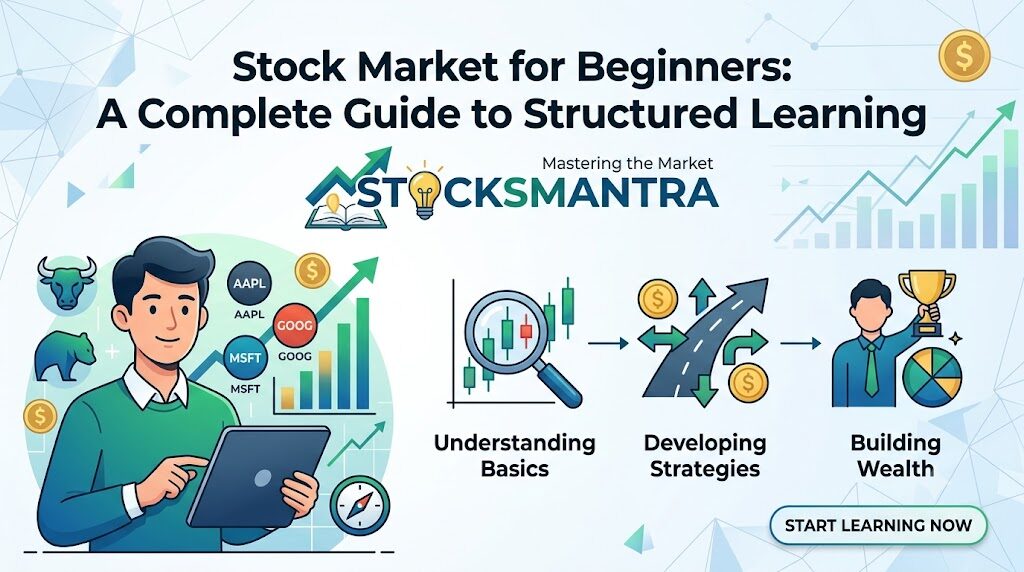
The journey toward financial independence often begins with a single step: understanding how money works. In an era where financial markets are more accessible than ever, the interest in equity participation has reached new heights. However, for many, the stock market remains a complex puzzle characterized by volatility and technical jargon. This is where the importance of financial literacy becomes paramount. Navigating these markets without a map is akin to sailing in a storm without a compass, which is why beginners often face significant hurdles when attempting to enter the space. To bridge this gap, structured learning resources have become essential. Platforms like stocksmantra serve as a dedicated financial education and stock market learning platform, designed to help individuals learn stock market basics, investing concepts, and research strategies in a simple and practical way. By prioritizing education over speculation, new participants can build the confidence needed for successful stock market investing for beginners.
What is Stock Market Education?
Stock market education is the process of acquiring the necessary knowledge, skills, and discipline to navigate financial markets effectively. It is not merely about learning how to buy or sell a stock; it is about understanding the mechanics of the economy, the nature of corporate ownership, and the psychology behind market movements.
True education moves beyond surface-level information. It provides a comprehensive framework for interpreting financial data, evaluating business models, and managing risk. Investing blindly—relying on tips, rumors, or emotional impulses—is a recipe for instability. In contrast, an educated approach involves analyzing data objectively and forming a thesis based on logic. Financial literacy acts as the foundation upon which all informed decisions are built, ensuring that individuals understand not just the potential rewards, but the underlying risks involved in every transaction.
Why Beginners Should Learn Stock Market Before Investing
Entering the market without prior knowledge is one of the most common reasons retail investors experience frustration. Learning the fundamentals before deploying capital provides several distinct advantages.
First, it fosters a realistic understanding of risk. Every investment carries a degree of uncertainty, and understanding how to quantify and mitigate that risk is a critical survival skill. Second, education improves decision-making. When a beginner understands the difference between a high-quality business and a failing one, they are less likely to fall for market hype. Third, it builds long-term discipline. The stock market is rarely a shortcut to wealth; it is a tool for long-term growth. Structured learning teaches the patience required to weather market cycles, helping individuals maintain their course toward financial independence despite short-term noise.
Basics of Stock Market for Beginners
At its core, the stock market is a platform where buyers and sellers meet to trade shares of publicly listed companies. A share represents a fractional ownership interest in a business. When a company performs well, the value of that ownership generally increases; conversely, when a company struggles, the value may decrease.
Market participants include individual retail investors, institutional investors, and traders. These participants interact on exchanges, such as the NSE or BSE, which provide the infrastructure for transparent and fair trading. Price movement is primarily a function of supply and demand. If more people want to buy a stock than sell it, the price typically rises. Understanding these basic supply and demand dynamics is the first step in decoding how the market functions on a day-to-day basis.
Introduction to Stock Market Investing for Beginners
There is a fundamental distinction between investing and trading. Investing is generally a long-term endeavor focused on holding assets that appreciate over time or provide dividends. Trading, by contrast, is often short-term and relies on capitalizing on price fluctuations.
For those starting out, focusing on long-term portfolio building is often the most sustainable path. This involves selecting assets based on their long-term potential rather than short-term price swings. Risk diversification—spreading investments across different sectors and asset classes—is a core tenet of this approach. By not putting all one’s capital into a single basket, an investor protects themselves against sector-specific downturns, creating a more resilient financial profile.
Understanding Fundamental Analysis of Stocks
Fundamental analysis is the process of evaluating a company’s intrinsic value. Instead of looking at charts or price trends, an analyst looks at the business itself. Key components include examining company financials, such as earnings, revenue growth, profit margins, and debt levels.
Beyond the numbers, fundamental analysis involves understanding the industry in which the company operates and the competitive advantages the business possesses. An investor performing this type of research asks: Is this business profitable? Is the management team capable? Does the company have a clear path to future growth? This method of analysis is the cornerstone of value investing and is essential for anyone looking to build wealth over several years or decades.
Technical Analysis for Beginners
While fundamental analysis looks at the health of a business, technical analysis for beginners focuses on the price action itself. It relies on the premise that historical price patterns and volume trends can provide insights into future market behavior.
Key tools include charts, which map out price movements over time, and indicators that help identify trends. Concepts such as support and resistance levels are crucial; support is a price level where a stock has historically had difficulty falling below, while resistance is a level where it has had difficulty breaking above. Understanding these patterns helps traders identify potential entry and exit points. However, it is important to remember that technical analysis is a study of market psychology and supply-demand imbalances, and it works best when combined with a sound understanding of trading psychology.
Stock Market Analysis and Research Methods
The most effective market participants often combine fundamental and technical analysis. This dual approach allows for a more holistic view of the market. For instance, an investor might use fundamental analysis to identify a high-quality company, while using technical analysis to determine an optimal time to enter the position.
Research sources for this analysis include annual reports, financial news, market sentiment reports, and sector analysis. By staying informed about macroeconomic factors—such as interest rates or inflation—and comparing them with microeconomic data specific to a company, an investor can make more nuanced decisions. Continuous research is not just a habit; it is a necessity for anyone looking to remain competitive and informed.
IPO Analysis for Beginners
An Initial Public Offering (IPO) occurs when a private company decides to go public by offering shares to the public for the first time. Companies go public to raise capital for expansion, pay off debt, or provide an exit for early investors.
For beginners, analyzing an IPO can be challenging because there is often limited historical data available for the company as a public entity. Evaluating an IPO requires reading the prospectus, understanding the company’s business model, and assessing whether the valuation offered by the company is reasonable compared to its peers. It is vital to distinguish between the hype surrounding an IPO and the actual business potential, as not every newly listed company is a sound investment.
Common Mistakes Beginners Make in Stock Market
The path to success is often marked by avoiding the errors that trap others. One of the most common mistakes is emotional trading—making decisions based on fear or greed rather than data. Another significant error is a lack of research; buying a stock simply because someone else recommended it or because it has been rising is a high-risk behavior.
Overtrading is another pitfall, where investors buy and sell too frequently, leading to higher transaction costs and diminished returns. Furthermore, the absence of risk management—such as failing to set stop-loss levels or failing to diversify—can lead to catastrophic losses during market corrections. Learning to recognize these patterns is a vital part of one’s development as a market participant.
How Structured Learning Helps in Stock Market Success
Structured learning provides a pathway to success that is both efficient and reliable. By following a step-by-step curriculum, learners gain concept clarity, ensuring they understand the “why” behind every market move. This reduces the likelihood of impulsive mistakes and helps in developing a disciplined approach to capital allocation.
Structured education also builds confidence. When an investor understands the mechanics of the market, they are less likely to panic when prices drop. Instead of reacting emotionally, they are able to assess whether the drop is a temporary market fluctuation or a fundamental shift in the company’s prospects. This analytical framework is the hallmark of a successful long-term investor.
Role of Online Platforms in Stock Market Education
The digital age has democratized access to financial information. Online platforms have made it possible for anyone with an internet connection to learn stock market dynamics at their own pace. These platforms offer a wealth of resources, ranging from simplified explanations of complex concepts to interactive research tools.
Community learning is another major benefit, allowing individuals to discuss strategies and share experiences in a controlled environment. The goal of these platforms is to lower the barrier to entry and ensure that retail investors have the same access to quality educational content as professional market participants. By centralizing resources, these platforms help beginners avoid the fragmented and often misleading information found across the web.
Skills Required for Stock Market Success
Succeeding in the financial markets requires a specific set of soft and hard skills. Analytical thinking is at the top of the list; the ability to process data, identify patterns, and draw logical conclusions is essential. Patience is equally critical, as the best investments often take time to materialize.
Discipline is the glue that holds these skills together—the ability to stick to one’s strategy even when the market is chaotic. Risk management is the final pillar, involving the constant assessment of potential downsides. Finally, a commitment to continuous learning is non-negotiable. Markets evolve, economic cycles change, and the most successful investors are those who never stop refining their knowledge.
Future of Stock Market Education
The future of financial education is increasingly data-driven and technology-integrated. We are seeing the rise of AI-powered tools that can help learners analyze vast amounts of financial data in seconds. Simulation-based learning, which allows beginners to “practice” trading and investing with virtual money, is becoming a standard way to gain experience without risking actual capital.
As retail participation continues to grow globally, the demand for high-quality, accessible financial awareness will only increase. We are moving toward a future where financial literacy is considered a fundamental life skill, and education platforms will be the primary drivers of this transition.
Learning Insight: Why Stock Market Education Matters for Modern Investors
In the modern financial landscape, the traditional reliance on simple savings accounts is no longer sufficient to build long-term wealth. With inflation eroding the purchasing power of idle cash, the shift toward investing has become a necessity for achieving financial independence.
Growing retail participation is a positive trend, but it carries a significant responsibility: the need for education. Informed investors are better for the economy, better for the markets, and ultimately, better for themselves. Structured platforms continue to play a pivotal role in this journey, providing the resources and guidance necessary for individuals to transition from passive savers to active, informed participants in the global economy.
Frequently Asked Questions
What is stock market education? Stock market education is the systematic process of learning the concepts, strategies, and psychological aspects of investing and trading to make informed financial decisions.
How can beginners learn stock market easily? Beginners can start by using structured online platforms that break down complex topics into simple, digestible modules, focusing on basics before moving to advanced strategies.
Is stock market investing safe for beginners? While no investment is entirely risk-free, investing becomes significantly safer when a beginner understands risk management, performs thorough research, and maintains a long-term perspective.
What is the difference between investing and trading? Investing is a long-term approach focused on capital appreciation and wealth building, while trading is typically short-term, focusing on capitalizing on price fluctuations.
What is fundamental analysis of stocks? It is the method of evaluating a company’s financial health, including its revenue, earnings, assets, and liabilities, to determine its intrinsic value.
What is technical analysis for beginners? Technical analysis is the study of market price trends and volume patterns, using charts and indicators to predict future price movements based on historical data.
How do IPOs work? An IPO is the process where a private company offers shares to the public to raise capital. Investors can apply for these shares during the subscription period.
How can I start learning stock market? Start by mastering the basic terminology, understanding how exchanges work, and studying the difference between fundamental and technical analysis through reputable educational platforms.
What mistakes should beginners avoid? Beginners should avoid trading based on rumors, emotional decision-making, overtrading, and failing to perform independent research.
How long does it take to learn stock market? Learning is a continuous process. While basic concepts can be understood in a few weeks, becoming proficient takes consistent study and practice over time.
Can I learn stock market online? Yes, online platforms provide comprehensive courses, articles, and research resources that make it convenient to learn at your own pace from anywhere.
Is stock market research important before investing? Yes, research is the most critical step. It ensures that your investment decisions are based on data and logic rather than guesswork or external tips.
Final Thoughts
The journey into the world of finance is an ongoing process of growth and discovery. As we have explored, the stock market offers immense opportunities, but it requires a commitment to learning and a disciplined approach to risk. By focusing on structured financial education, beginners can navigate the complexities of the market with confidence. The importance of financial literacy cannot be overstated; it is the primary tool for achieving long-term financial goals and independence. Whether you are interested in fundamental analysis, technical charts, or simply understanding how the broader economy impacts your savings, consistency is key. Utilizing professional educational resources ensures that your learning path remains clear, practical, and effective. As you continue your journey, remember that the most successful investors are those who prioritize knowledge over impulse, consistently refining their research methods and staying grounded in the core principles of sound financial management.